- Basedment
- Posts
- 2026: The Battle for Zaporizhzhia?
2026: The Battle for Zaporizhzhia?
Today we take a look at the situation on Ukraine's southern front and how Russian units are progressing and what 2026 will have in store.

Editor-in-Chief
January 13, 2026
THE BRIEFING
Here’s what’s happening in geopolitics today.
From the Caribbean to the Black Sea, today’s headlines trace how geopolitics keeps spilling into energy markets, airspace and shipping lanes.
Trump sharpens pressure on Cuba via Venezuela’s oil, Sweden moves to harden its skies, Oslo briefly halts flights over a rogue drone, Moldova reopens a sensitive debate about its future, and Russian drones strike foreign vessels near a Ukrainian port.
In today’s Deep Dive, we take a look at the situation on Ukraine's southern front and how Russian units are progressing and what 2026 will have in store.
THE LAST 24 HOURS IN GEOPOLITICS
1. Trump says no more Venezuelan oil or money to go to Cuba, demands ‘deal’.
Trump declared on Sunday that Cuba will no longer receive Venezuelan oil or financial support, asserting on his Truth Social platform that Havana had long depended on Caracas for energy and funds in exchange for “security services” but that arrangement is now over. Trump urged Cuban leaders to “make a deal … before it is too late,” framing the cutoff as part of broader U.S. efforts to reshape regional alignments after the capture of Venezuelan President Nicolás Maduro and the enforcement of a strict oil blockade. Cuban President Miguel Díaz-Canel responded defiantly, rejecting U.S. interference and insisting Cuba will defend its sovereignty even as the loss of subsidised Venezuelan oil risks worsening the island’s deepening economic crisis.
read more
2. Sweden to pledge $1.6B for short-range air defence systems
The Swedish government has announced it will invest 15 billion Swedish crowns (about $1.6 billion) to strengthen its air defence capabilities, focusing on acquiring short-range systems to protect cities, critical infrastructure and civilian populations from aerial threats. Defence Minister Pål Jonson said the decision reflects lessons learned from Russia’s invasion of Ukraine, highlighting the need for a more robust and resilient layered air defence network. The funding will support purchases of mobile short-range systems, advanced radars and associated command-and-control infrastructure as part of Sweden’s broader effort to deter and respond to evolving threats in Europe.
read more
3. Oslo Airport shuts one runway due to drone observation, police say
Oslo’s main airport, Oslo Gardermoen, briefly closed one of its two runways on Sunday after airport staff and authorities detected a drone in the vicinity of active flight operations, operator Avinor said, disrupting aircraft movements for about 20 minutes before normal service resumed. The closure was triggered by the observation of a “small hobby drone” near the runway, and no injuries or collisions were reported; the incident highlights ongoing concerns about unauthorised drones near critical aviation infrastructure. Norwegian police and airport officials have emphasised the danger such drones pose to aircraft during landing and takeoff.
read more
4. Moldova’s President Sandu says she would vote for reunification with Romania
Moldovan President Maia Sandu said she would personally vote in favour of unification with Romania if a referendum on the issue were held, arguing that it is becoming increasingly difficult for a small, sovereign state like Moldova to maintain its democracy and resist Russian pressure on its own. Sandu made the remarks in an interview on the British podcast The Rest Is Politics, but acknowledged that most Moldovans currently do not support reunification, and that joining the European Union remains a more realistic and widely backed objective for ensuring Moldova’s security and future.
read more
5. Russian drones hit two foreign vessels near Ukrainian port
Russian forces struck two foreign-flagged civilian vessels with attack drones near the Ukrainian port of Chornomorsk in the Black Sea, Ukrainian Deputy Prime Minister Oleksiy Kuleba said, marking another escalation in maritime targeting linked to the ongoing war. One ship was Panama-flagged and en route to load vegetable oil, where one crew member was injured, while the other vessel flying a San Marino flag had just departed with a corn cargo and continued its voyage despite damage, Ukrainian officials reported.
read more
DAILY DEEP DIVE
The Battle For Ukraine’s Southern Front in 2026
What I doubt was on Putin’s list of achievable goals for 2026 was a major battle for Zaporizhzhia. For Ukraine, however, a siege or land blockade would be just as deadly as an outright takeover—but we’ll get to that shortly. There is also the question of how Russia would get there. At present, Russian forces sit roughly 20 km from the outer suburbs: far, but not an impossible stretch. That said, the south is not where Ukraine should be most concerned. The real danger lies to the east.
Let’s dive in. Many months ago, I argued that Ukraine’s first major defensive line for Zaporizhzhia would be the Haichur River. The main road linking Pokrovske and Huliaipole runs adjacent to the river for much of its length, creating a natural defensive line. In theory, this should have worked. In practice, it hasn’t. Poor organisation, a ragtag mix of units, and unstable cohesion were just the first of many issues for Ukrainian forces east of the Haichur. Even with increased attention on this sector following several rapid Russian advances, the same problems continue to persist.
According to milblogger Thorskill, the situation in the Varvarivka–Pryluky–Dobropillia sector north of Huliaipole has deteriorated sharply for Ukrainian forces. Russian troops from the 394th Regiment of the 127th Motorized Rifle Division reportedly exploited a gap in Ukrainian fortifications along the Haichur River, establishing a small bridgehead on the western bank that currently functions as a grey zone. Russian DRG units are probing toward the Zaliznyczne–Termuwate railway line and infiltrating Olenokostiantynivka.
This sector should have been held by a company from the 184th Territorial Defense Battalion (122nd TDF Brigade), which has reportedly vanished from its positions. While Ukrainian defences around Dobropillia are still holding—repelling assaults by Russia’s 37th Motorized Rifle Brigade with elements of the 110th Mechanized Brigade and the 33rd Assault Regiment—Ukrainian unit channels describe severe command-and-control breakdowns. Drone operators from the 131st Reconnaissance Battalion report grey zones extending 10–15 km deep, infantry shortages, and drone teams increasingly forced into direct firefights due to chaotic coordination.
If Russian forces can consolidate a bridgehead here, they would not only outflank the entire Haichur River line, but potentially enable another “flower” to blossom. By this, I mean the capture of strategic heights that then “blossom” outward, allowing Russian units to fan out in multiple directions. We’ve seen this before with the “Pospana flower” and the “Orchertyne flower.” Such a development would also directly impact logistics along the Pokrovske–Zaporizhzhia axis.
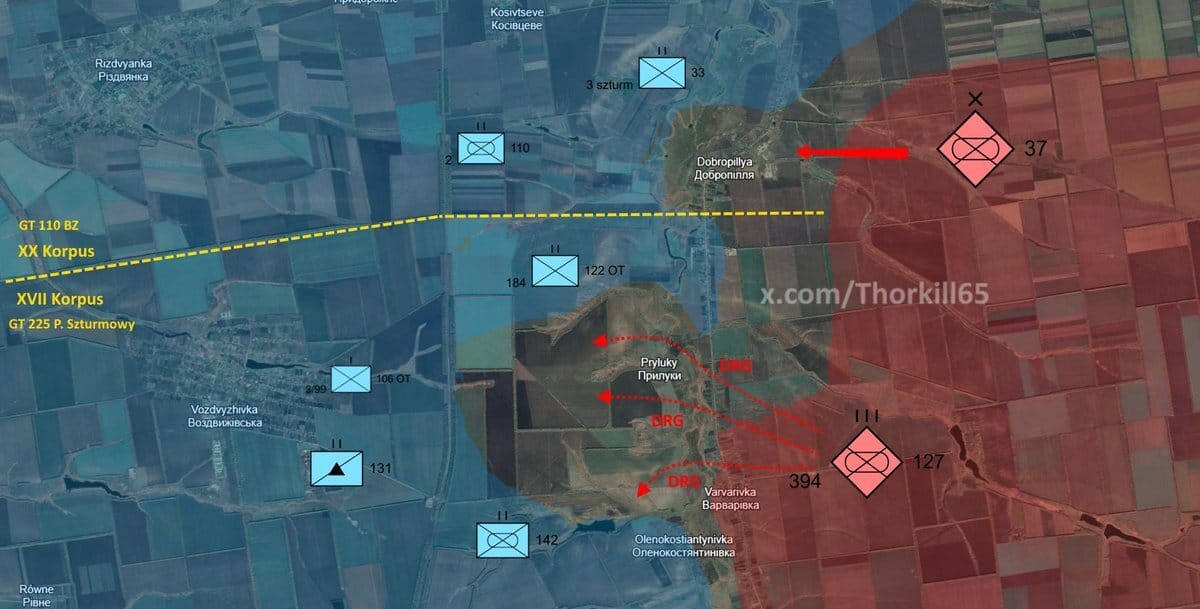
Thorkill source.
Further south, near the recently taken city of Huliaipole, fierce fighting continues around the village of Zaliznychne. As I’ve said before, capturing this village opens the gate to a chain of tactical heights stretching for kilometres, aligned with fortifications originally constructed facing south—toward Russian positions.
This highlights the core problem for Ukraine. The defensive structures here are neither as extensive nor as robust as those in Donetsk. This is difficult to justify given that this front was largely dormant for years and should have allowed ample time for preparation. It also doesn’t excuse the lack of foresight, particularly when milbloggers repeatedly urged Ukrainian high command to construct layered fortifications facing east—warnings that were largely ignored.
The image below shows defensive fortifications mapped by Playfra in October, meaning the data is now two to three months out of date. Even so, the underlying issue remains. If Ukrainian drone operators are being forced to fight 10–15 km behind the frontline in some areas, it’s difficult to believe that strong, layered defences can be constructed under such constant surveillance and pressure. Notably, even at that time, little had been built behind the Haichur fortifications facing east.
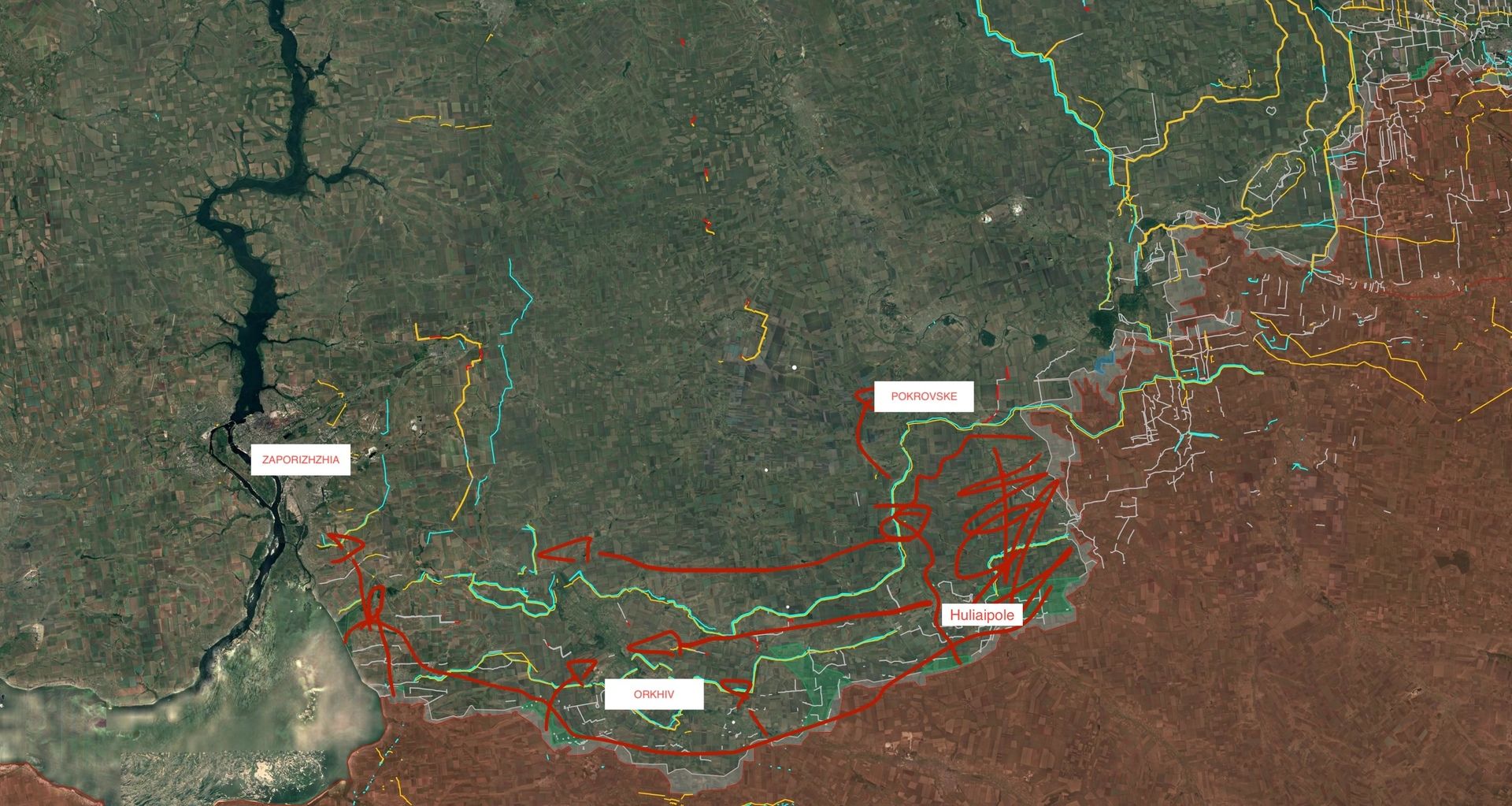
Excuse the non-professional arrows and updates. Given this map was done in October, some adjustments had to be made. Arrows will show likely Russian advances.
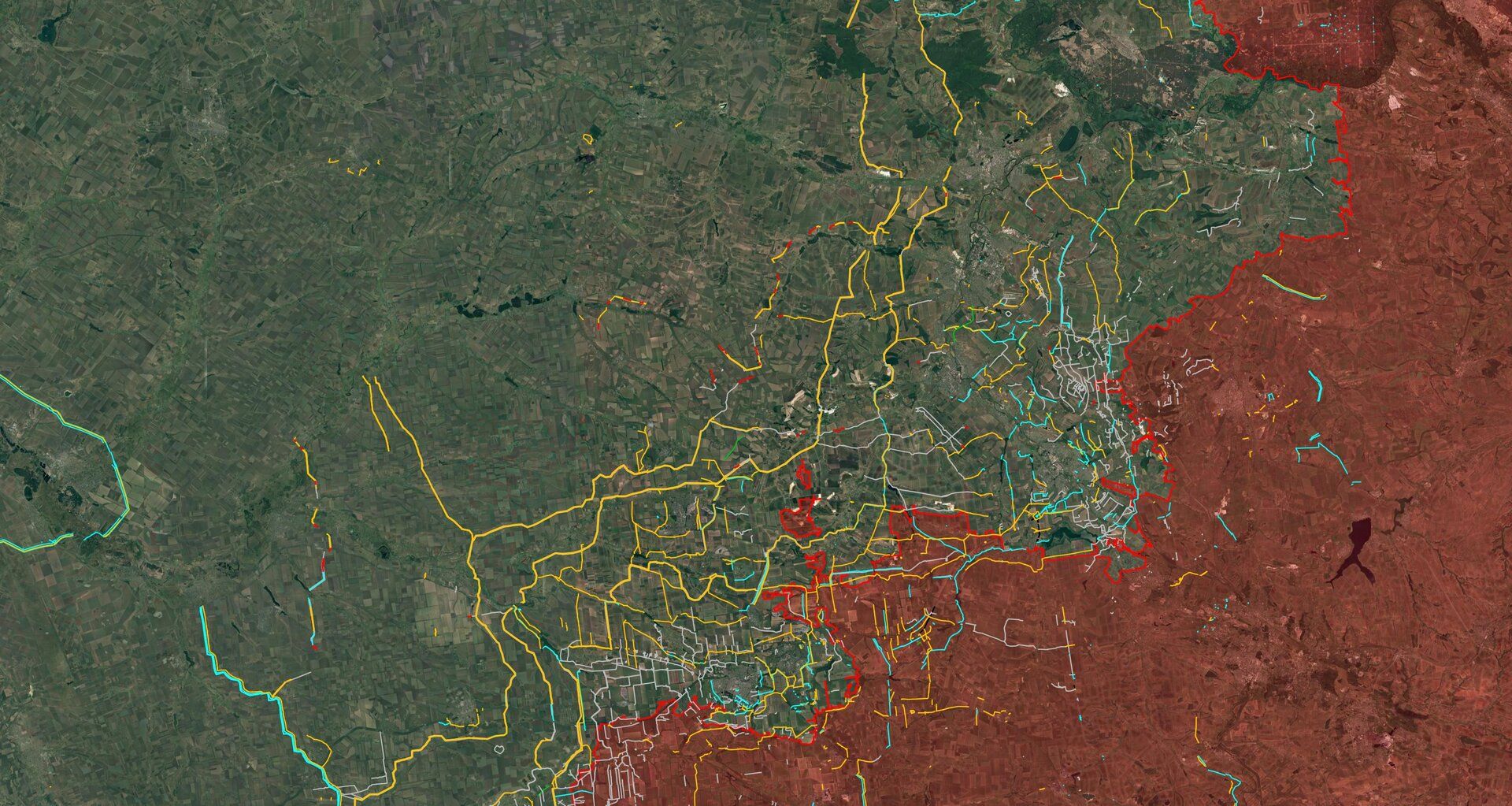
To give you an example of how sparc fortifications are
The major test this year will come quickly if Russian forces move on Orikhiv. Russian troops have demonstrated increasing speed in urban combat, aided by manpower advantages, improved tactics, and more precise FAB bomb employment. If Orikhiv is attacked from three directions, a rapid collapse is possible. If not, Russia may become bogged down just long enough for Ukraine to reinforce Zaporizhzhia.
As Russian forces move closer to the industrial city of Zaporizhzhia, the effects will be felt long before any assault. Increased artillery fire, FPV drone strikes, and sustained pressure will begin to strangle industry and commerce, compounded by population flight. The closer Russia gets, the worse these effects become. This is why the danger is not only in Zaporizhzhia being captured, but in it being slowly encircled. Whether under siege or occupation, factories cannot function, and the wider national economy suffers.
2026 will be interesting. I believe that main focal point will be the battle of Orikhiv, Russian units will not take Zaporizhizha in 2026 - but it will set up the battle for it.
Sources
News/Journal sources available upon request, not shown to maintain visual integrity of page.
TODAY IN HISTORY
(January 12, 1959): The music label that changed American music
Berry Gordy took a major step toward transforming American music on this day in 1959, when he launched Tamla Records. With Smokey Robinson and the Miracles signed as its first act, Tamla soon merged with Gordy's other label, Motown Records, to form one of the most influential music companies in American history.