- Basedment
- Posts
- A Disaster For Syrian Kurds In Deir Hafer
A Disaster For Syrian Kurds In Deir Hafer
What was meant to be a planned withdrawal has escalated in full conflict, as Kurdish troops fail to secure the main frontline on Deir Hafer and Tabqa.

Editor-in-Chief
January 18, 2026
THE BRIEFING
Here’s what’s happening in geopolitics today.
From NATO boots touching down in Greenland to a rare thaw in China–Canada trade ties, today’s headlines stretch from the Arctic to the Pacific.
We’re also tracking a new UN push to protect the world’s oceans, Washington’s latest attempt to reshape Gaza’s future, and a historic shift in Syria with long-denied rights granted to Kurds.
In today’s deep dive, we examine what was meant to be a planned withdrawal escalating in full conflict, as Kurdish troops fail to secure the main frontline on Deir Hafer and Tabqa.
THE LAST 24 HOURS IN GEOPOLITICS
1. European troops arrive in Greenland amid ongoing Trump threats
European troops from several NATO countries have begun arriving in Greenland, including contingents from France, Denmark, Germany, the U.K., Norway and Sweden, as part of a coordinated effort to bolster the Arctic island’s security at Denmark’s request. The deployments come amid ongoing tensions with the United States, where Trump has publicly pressed for greater U.S. influence over Greenland and repeatedly stressed its strategic importance, a stance that Danish and European officials have pushed back against.
read more
2. China and Canada announce tariffs relief after meeting between Carney and Xi
Canada and China announced a preliminary trade agreement following meetings in Beijing between Carney and Xi Jinping, aimed at repairing bilateral economic ties after years of tariff disputes and diplomatic strain. Under the deal, Canada will lower its 100 % tariff on Chinese electric vehicles to a reduced 6.1 % rate for up to 49,000 units annually, while China has agreed to slash tariffs on key Canadian agricultural exports including canola seed from about 84 % to around 15 % by March 1, 2026, and remove other punitive duties on products such as canola meal, lobsters, crabs and peas through at least the end of the year. The agreement marks a notable thaw in trade tensions.
read more
3. UN biodiversity treaty enters into force, aims to protect 30% of oceans by 2030
The UN’s landmark Biodiversity Beyond National Jurisdiction (BBNJ) treaty officially entered into force on Saturday, creating the first legally binding global framework to conserve and sustainably use marine life on the high seas, which comprise areas beyond national jurisdiction. The agreement, which followed 15 years of negotiations and surpassed the required ratification threshold with over 80 countries, aims to enable the creation of marine protected areas and environmental assessments for activities affecting ocean ecosystems and supports the broader international “30×30” goal of protecting 30 % of the world’s oceans by 2030.
read more
4. White House names leaders who will oversee Trump’s plan for Gaza
The US announced the formation of a new “Board of Peace” to oversee the transitional governance and reconstruction of Gaza under President Donald Trump’s peace plan, naming key figures including U.S. Secretary of State Marco Rubio, former U.K. Prime Minister Tony Blair, and Trump’s son-in-law Jared Kushner as executive members. The board, which Trump will chair, also includes U.S. special envoy Steve Witkoff, World Bank President Ajay Banga and private equity executive Marc Rowan, and is intended to supervise a technocratic Palestinian authority during a transitional period following a fragile ceasefire.
read more
5. Syria’s al-Sharaa grants Kurdish Syrians citizenship, language rights for first time
Al-Sharaa issued a landmark decree granting Kurdish Syrians full citizenship and formally recognising the Kurdish language as a national language for the first time in the country’s history, a move aimed at addressing long-standing ethnic grievances under previous regimes. The decree also abolishes discriminatory measures from a 1962 census that left many Kurds stateless, allows Kurdish to be taught in schools, designates the Kurdish New Year Nowruz as a paid national holiday, and bans ethnic or linguistic discrimination in state institutions.
read more
DAILY DEEP DIVE
The Complicated Situation For The Kurds
Context:
President Ahmed al-Sharaa has issued Decree 16 recognising Kurdish Syrians as an integral part of the nation, permitting Kurdish-language education, restoring citizenship to previously unregistered Kurds, and declaring Nowruz a national holiday for the first time. State institutions are mandated to enforce an inclusive, anti-discrimination discourse.
However, the measures appear largely symbolic and fall short of addressing core SDF political and security demands—explaining why the SDF remains intact. The decree may also serve as political cover for Kurdish withdrawals from Dayr Hafir, allowing Damascus to claim progress while consolidating control on the ground — and allowing SDF leadership to save face.
The Last 24 Hours
The situation in northern Syria over the past 24 hours marks a decisive deterioration for the Syrian Democratic Forces (SDF) and a clear failure of US mediation to stabilise the front west of the Euphrates.
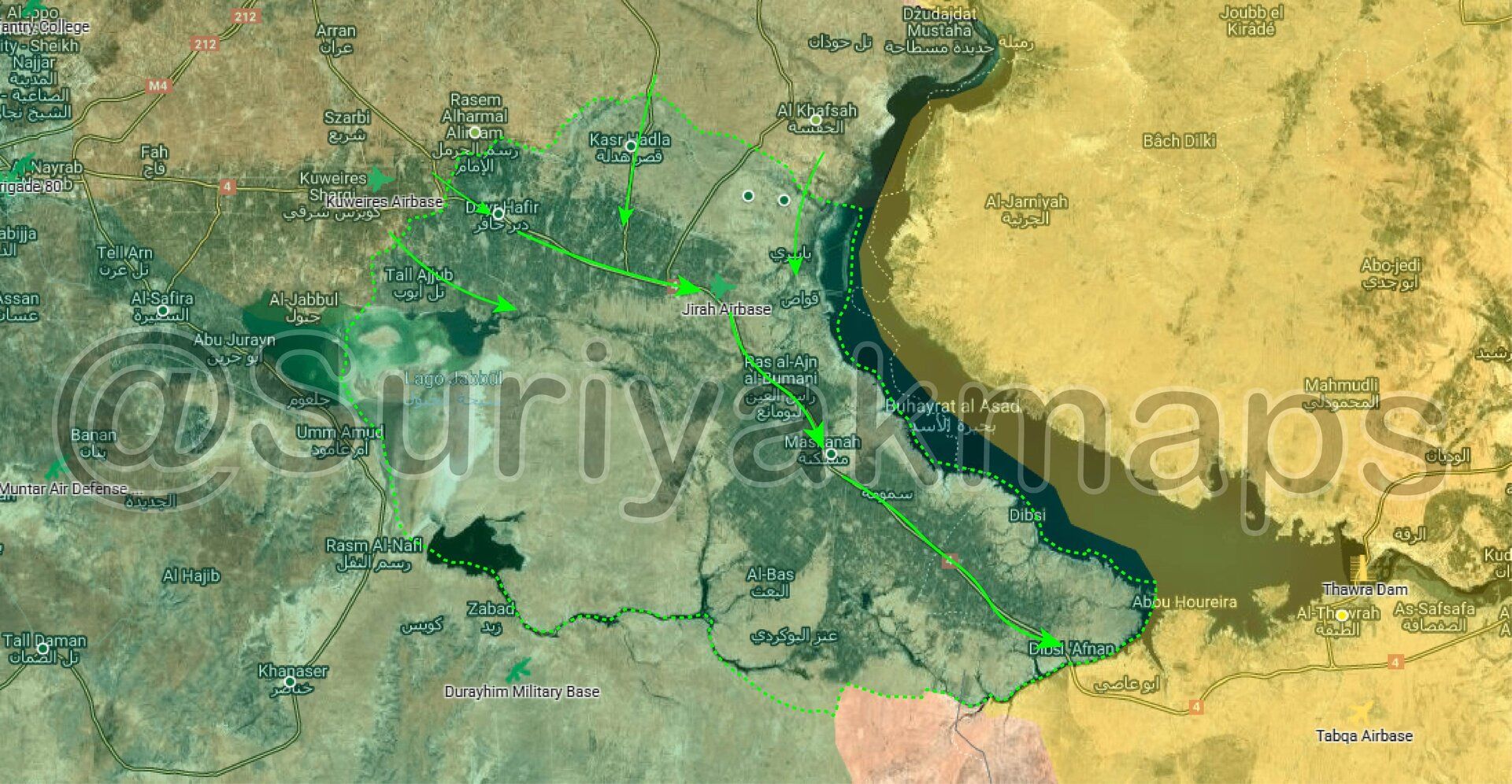
Syrian government forces have now seized Tabqa Military Airport, a symbolic and operational gain that places pressure directly on the remaining SDF-controlled positions around the Tabqa canton. This comes as US forces were observed withdrawing from Dayr Hafir shortly before the SDF formally announced its pullback from most positions west of the Euphrates in Aleppo governorate, including Dayr Hafir and Maskanah. The agreed withdrawal corridor reportedly terminates at the Dibsi ‘Afnan (Shu’ayb al-Dhikr) bridge, forming a logical new boundary line.
On paper, the deal was meant to prevent escalation. The STG committed to not attacking withdrawing SDF units, and reinforcements were promised to secure the retreat. In practice, the outcome has been far messier. Multiple reports indicate SDF units were ambushed during withdrawals, with localized surrenders and breakdowns in command and control. There was no coherent, phased extraction plan, and US leverage proved insufficient to enforce discipline on the ground or deter probing attacks.
The tribal dimension is now emerging as the most destabilising factor. A statement attributed to the Al-Shuwayt tribe calls on Jazira tribes to pull their fighters from the SDF/PKK structure, align with Damascus, and demands the US-led coalition end its support for the SDF. This is not isolated rhetoric. Multiple tribal networks have reportedly urged defections, signalling that the STG is attempting to replicate its earlier success against regime-aligned forces by engineering an internal collapse rather than relying solely on direct military pressure.
This approach carries risks. Elements of the US government have warned that any large-scale offensive into SDF territory could trigger the reinstatement of Caesar sanctions. However, Ahmad Al-Sharaa appears increasingly impatient with negotiations. If Damascus believes tribal defections could fracture the SDF, the economic cost may be viewed as acceptable.
Meanwhile, fighting continues around the Tabqa canton, including clashes in southern Thawra and Dibsi ‘Afnan, alongside sustained artillery and MLRS exchanges near the Tishreen Dam. Kurdish sources also warn of increased ISIS cell activity, exploiting the security vacuum created by withdrawals and fractured lines.
Taken together, this is shaping into a strategic disaster for the SDF: loss of territory, erosion of tribal support, ineffective US protection, and the looming prospect of a full battle for Tabqa. The next phase will determine whether this remains a controlled contraction—or collapses into a broader unraveling east of the Euphrates.
Sources
News/Journal sources available upon request, not shown to maintain visual integrity of page.
TODAY IN HISTORY
(January 17, 2021): Aleksey Navalny returned to Russia after recovering in Germany from an assassination attempt carried out, according to an investigation, by the Russian government. One of Vladmir Putin's most prominent critics, Navalny was immediately arrested and imprisoned. He died in a Russian prison in 2024.