- Basedment
- Posts
- Aleppo: Sheikh Maqsoud Under Full Assault - Fall Expected Soon
Aleppo: Sheikh Maqsoud Under Full Assault - Fall Expected Soon
We take a quick look at the recent fighting in Aleppo and how it will once again be under one flag after 14 years of civil war. What's next for the Kurds?

Editor-in-Chief
January 10, 2026
THE BRIEFING
Here’s what’s happening in geopolitics today.
From oil tankers being seized in the Caribbean to billion-dollar bets on Venezuela’s energy future, today’s headlines show how hard power and hydrocarbons remain tightly intertwined.
Add Greenland pushing back against U.S. pressure, BRICS navies flexing off South Africa, and Iran deploying its army at home as unrest grows, and it’s a reminder that geopolitics rarely stays neatly compartmentalised.
In today’s Deep Dive, we address the current situation in Aleppo as the final chapter for the control of the city comes to a close, and what’s next for the Kurds.
THE LAST 24 HOURS IN GEOPOLITICS
1. US seizes Olina tanker in Caribbean, 5th vessel taken in Venezuela blockade
The United States has seized the oil tanker Olina in the Caribbean Sea, marking the fifth vessel taken by U.S. forces in recent weeks as part of an intensified effort to enforce sanctions and disrupt Venezuelan oil exports, U.S. Southern Command said on Friday. The Olina was boarded “without incident” by Marines and sailors from Joint Task Force Southern Spear launched from the carrier USS Gerald R. Ford, with authorities saying the move targets so-called “ghost fleet” tankers suspected of carrying embargoed oil.
read more
2. Trump says oil companies will spend $100 billion in Venezuela
At a White House meeting with major U.S. oil executives, President Trump said he expects “giant oil companies” to invest at least $100 billion of their own capital to rebuild and modernise Venezuela’s dilapidated oil infrastructure following the capture of Nicolás Maduro, stressing that no U.S. government money would be used for the investments. Trump also noted that Venezuela has agreed to allow the United States to begin refining and selling up to 50 million barrels of Venezuelan crude “indefinitely,” asserting this would help lower energy prices and benefit both countries.
read more
3. Greenland’s parliament will bring forward meeting to discuss US threats
Greenland’s parliament has advanced a scheduled session to discuss its response to renewed U.S. threats over the strategic Arctic island, Greenlandic party leaders said, with the move coming amid heightened tensions after Trump reiterated claims that the United States may seek control of the territory. The leaders of all five political parties issued a joint statement reaffirming their rejection of external pressure and insisting that Greenland’s future must be decided by its own people, rejecting the notion that the island should become American despite its strategic importance. The debate will focus on how to defend Greenland’s sovereignty and autonomy.
read more
4. China, Russia, Iran begin BRICS Plus naval drills in South Africa
China, Russia and Iran have begun a week-long joint naval exercise off the coast of Cape Town, South Africa, under the expanded “BRICS Plus” framework, as the host country described the manoeuvres as focused on maritime safety, interoperability and the protection of shipping lanes. The drills involve warships from the three countries and are intended to improve cooperation among BRICS Plus navies, though the timing has drawn attention amid broader geopolitical tensions with the United States. South African officials say the exercises are apolitical and aimed at bolstering regional maritime security.
read more
5. Iran’s army vows to protect public property as Tehran seeks to quell growing unrest
Iran’s army announced on Saturday that it would protect strategic infrastructure and public property as authorities intensify efforts to quell the largest protests in years, which have spread across major cities in response to a deepening economic crisis. The military statement accused “enemy plots” of trying to undermine security and came as state media reported clashes, fires at municipal buildings and funerals for security personnel killed during the unrest, while security forces including the IRGC continue to be deployed.
read more
DAILY DEEP DIVE
As Sheikh Maqsoud Is Expected To Fall, What’s Next?
“Aleppo Comes To A Close?”
This one is personal for me. The Syrian Civil War was probably the first major conflict I began tracking as an almost obsessive hobby over a decade ago. At the centre of it all was Aleppo — a city of immense history and culture, one of the oldest continuously inhabited cities in the world, and of huge strategic importance. I spent countless nights analysing and scrolling through news, videos, and reports on the many battles that raged across Aleppo’s suburbs. And now, after nearly fourteen years, it feels as though this long, sad, and bloody chapter may finally be drawing to a close. It’s a strange feeling. As this chapter in Syria’s history begins to close, there are memories and layers of history here that many people do not know — but should. Yet with closure comes uncertainty. As one chapter ends, another begins, and it may yet bring further bloodshed. Among many Kurds, the prevailing sentiment following the attack on Sheikh Maqsoud is that they were too accommodating toward the government. If that view hardens, peace may be further away than many had hoped.
The Situation The Last 48 Hours
Fighting around the Aleppo enclave had entered a highly contested and increasingly opaque phase, with claims from all sides now diverging sharply and verification proving extremely difficult.
In the early hours of the morning (9th Jan), Syrian Transitional Government (STG) forces advanced into areas previously evacuated by Asayish units affiliated with the Syrian Democratic Forces. In the north, STG elements secured trench networks west of the Youth Housing Complex and expanded through the Barakah Quarries, capturing additional trench lines and blocks in the Resafa district. Further west, the final blocks of the Al-Layramoun industrial zone were taken.
In the south, STG forces fully seized the New Syriac district and pushed beyond the Assyrian Quarter, entering the cemetery area and capturing the Al-Jalaa Sports Club. Simultaneously, pressure increased from the east as STG units launched their first assault into Sheikh Maqsoud, entering initial blocks of the Awared neighbourhood.All of these advances occurred prior to the implementation of a ceasefire reportedly brokered by the United States and France. Under the ceasefire framework, Damascus issued an ultimatum offering evacuation of civilians and Asayish fighters in exchange for the enclave’s surrender. Although a convoy of buses arrived, Asayish leadership rejected evacuation, citing fears of reprisals and referencing previous massacres along the Syrian coast and in Suwayda.
Meanwhile, east of the Euphrates River, Kurdish authorities initiated a general mobilisation in solidarity with besieged forces, anticipating a possible widening of hostilities across SDF-controlled territory. Conflicting claims now dominate the information space. Syrian government sources assert control over up to 90 percent—if not all—of the neighbourhood, claiming remaining fighters are conducting hit-and-run attacks from within civilian areas. Kurdish sources, by contrast, insist the battle remains ongoing and that significant portions of the enclave are still under Asayish control. At present, the reality likely sits somewhere between these narratives. The frontlines appear fluid, the information environment heavily contested, and the situation on the ground remains unresolved despite claims of decisive control from multiple sides.
Please note: all the information for the above has come from Suriyak - while pro-Assad government, he has often been the most rational in reporting. From what I have read current pro-government and Kurdish sources are simply filled with too much anger to report anything reliable.
BREAKING: Current Update
The Syrian Arab Army has announced an immediate halt to military operations in Sheikh Maqsoud, Aleppo, effective from 3:00 p.m. local time, according to the Army Operations Command.
Under the announcement, Syrian Democratic Forces fighters entrenched inside Yassin Hospital will be transferred to Tabqa, with their weapons confiscated as part of the process. The army also stated it will begin handing over health and government facilities to state institutions, followed by a gradual withdrawal of troops from the streets of Sheikh Maqsoud.
I suspect we could be seeing the end of formal rule by the SDF in Aleppo.
Civilians Evacuation
The Autonomous Administration of North and East Syria (AANES) stated that the protection of civilians in Sheikh Maqsoud and Ashrafieh remains one of its highest priorities. In a public statement, AANES said it is open to an internationally mediated proposal to reposition forces currently stationed in Sheikh Maqsoud to areas east of the Euphrates River, provided the move is conducted safely and guarantees the continued presence of local Kurdish protection forces and a local civilian council for residents. The administration emphasised that any such arrangement must adhere to the April 1 agreement, framing the proposal as a conditional acceptance rather than a full withdrawal.
Both sides have accused eachother of indiscriminate bombings and shootings. As well as torture and executions.
What’s Next For The Kurds?
Like I have said before the single biggest issue for the Kurds is that the Arab population will not be friendly to them politically. Especially after they had not allowed celebrations for the anniversary of the fall of Assad. Naturally the tribes will support the Arab majority government.
This presents a number of issues through legitimacy and security concerns in the region - especially where most of the fighting would be taking place if full scale war breaks out - on the Euphrates river.
The U.S. being friendly with both parties simply complicates matters more than it does to solve them. I suspect that diplomatically the Kurds might get the short end of the stick as al-Sharaa has been on a worldwide PR tour to promote the new Syrian government.
Sources
News/Journal sources available upon request, not shown to maintain visual integrity of page.
TODAY IN HISTORY
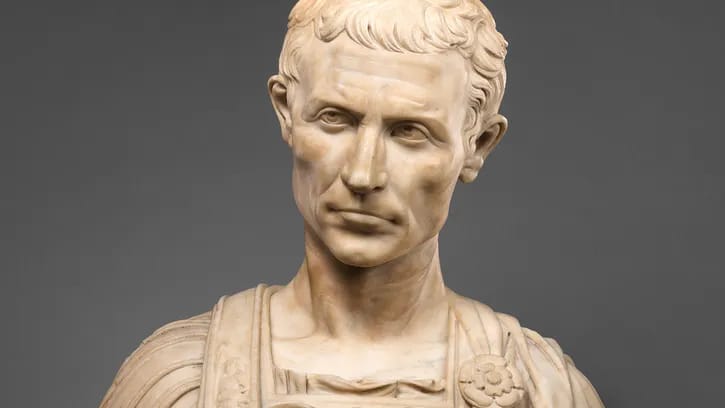
(January 10, 49): Crossing the Rubicon
Julius Caesar and his army crossed the Rubicon on this day in 49 bce to take control of the Roman Republic. Caesar was breaking a law that forbade generals from leading armies out of their assigned territories, and he provoked a four-year civil war that irreversibly transformed ancient Rome.