- Basedment
- Posts
- Are Cracks Appearing In The Gaza Peace Plan?
Are Cracks Appearing In The Gaza Peace Plan?
Your daily dose of geopolitical updates and strategic analysis. Unbiased, but not unbased.

Editor-in-Chief
October 15, 2025
THE BRIEFING
Here’s what’s happening in geopolitics today.
A mix of diplomatic tensions, political manoeuvring, and unexpected alliances shaped the global headlines overnight. From new clashes on the Pakistan–Afghanistan border to Hamas returning hostages’ remains under Israeli pressure, regional flashpoints continued to test fragile peace deals.
Meanwhile in Europe, France hit pause on Macron’s pension reform, and Donald Trump threw his weight behind Argentina’s Javier Milei for re-election.
Public executions, aid delivery cuts, fresh airstrikes; are cracks beginning to appear in the Gaza Peace Plan?
THE LAST 24 HOURS IN GEOPOLITICS
1. Pakistan reports a new clash with Afghan forces along border
Clashes erupted Tuesday between Pakistani and Afghan forces in a remote northwestern region, with Pakistan’s media accusing Afghan troops and Tehrik-e-Taliban Pakistan militants of opening “unprovoked fire” on Pakistani positions. Pakistani forces responded by destroying Afghan tanks, damaging military posts, and reportedly taking out a Taliban training facility. Afghan officials confirmed the skirmishes but offered few details, while this confrontation marks the second exchange of fire along the border in just a few days.
read more
2. Hamas hands over hostage bodies after Israel threatens aid cut
Hamas has handed over eight coffins of deceased Israeli hostages, four of which were delivered via the Red Cross from northern Gaza shortly before midnight, according to the Israeli military. The move came after Israel threatened to reduce humanitarian aid and block the opening of a southern border crossing, accusing Hamas of violating the ceasefire by failing to return all promised bodies. While the transfer represents limited progress under the peace plan brokered last month, officials say 19 deceased remain in Gaza and one body remains unaccounted for.
read more
3. US strikes another boat accused of carrying drugs off Venezuela, killing six
The U.S. military struck a vessel off the coast of Venezuela on Tuesday, killing six people whom President Trump labeled “narcoterrorists” in a Truth Social post. He claimed intelligence confirmed the boat was trafficking narcotics and tied to illicit networks, though he did not provide detailed evidence. The attack is part of an escalating U.S. campaign in the Caribbean against drug syndicates, and it has raised serious questions about the legality and oversight of such strikes.
read more
4. French PM to freeze Emmanuel Macron’s pension reform until 2027
French Prime Minister Sébastien Lecornu has announced he will suspend President Macron’s controversial 2023 pension reform until after the 2027 presidential election, in a bid to stabilise his fragile government. The move is widely seen as a strategic concession to win support from Socialist deputies and avert two looming no-confidence votes. he suspension is expected to cost roughly €400 million in 2026 and €1.8 billion in 2027, though Lecornu says it will be offset with additional fiscal measures.
read more
5. Trump says he is endorsing Argentina’s Milei for reelection
Trump announced during a White House meeting that he is endorsing Argentinian President Javier Milei for re-election, calling him his “complete and total endorsement.” He reiterated this support amid a backdrop of U.S. financial assistance which he said would continue only if Milei’s party succeeds in upcoming legislative elections. The endorsement underscores the growing alignment between Trump and Milei, but it also raises questions about foreign influence and U.S. involvement in Argentina's internal politics.
read more
DAILY DEEP DIVE
CRACKS IN THE GAZA PEACE PLAN?
In the last 24 hours we have seen Israeli threats to cut aid delivery due to slow handovers of deceased hostages, Hamas fighters executing rival clan members and just forty minutes ago an Israeli airstrike hit two alleged Hamas members who were crossing into the “yellow line” towards an Israeli-backed Gaza clan. Are these early signs of trouble with the agreed upon peace deal? Let’s dive in.
Cracks On The Streets Of Gaza
Firstly, Hamas at this point does not show any willingness to relinquish control of the Gaza Strip. What we’re seeing is a public show of authority, with uniformed fighters directing traffic, assisting with hostage handovers and overseeing aid. According to the BBC, Hamas has recalled thousands of soldiers to re-establish control in the city. We’re now also seeing the retribution campaign against historical enemies such as the Doghmosh family or clan based in Sabra – who have long clashed with Hamas and have ties to the Islamic State. Hamas’ public executions were justified for alleged looting of aid and collaboration with Israel, another move to strengthen and restore its authority.
Hamas has also claimed it has arrested and killed members of the anti-Hamas militia, the “Popular Army – Northern Forces.” The militia issued a statement rejecting the claims, suggesting these were fake reports intended to sow division. The spokesperson also stated that the group maintains control of some northern suburbs and warned Hamas fighters not to enter, saying they will be treated as traitors just as they treat their own militiamen as traitors.
And now, just forty minutes ago, an Israeli airstrike hit two alleged Hamas members crossing past the red line in the Shuja’iyya area as they were heading toward a Gazan clan under Israeli protection.
The actions we’re seeing here are not those you would expect from a group planning to disarm and relinquish power. The signed deal envisions a complete disarmament of all Hamas and allied groups, and the transfer of security to an Arab state-backed Palestinian Authority (PA). Theoretically, this would lead to gradual political reintegration, but only once Hamas gives up control. Yet, at this stage, it seems Hamas is consolidating power and removing its enemies.
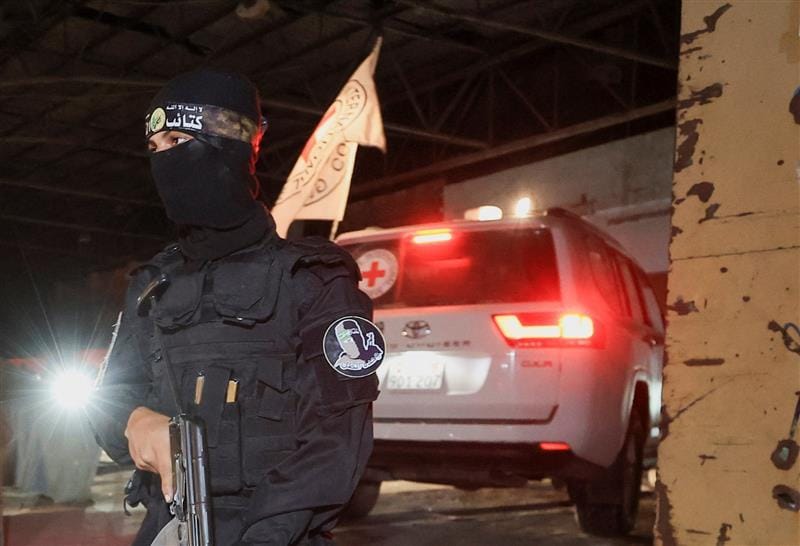
Hamas media footage: Shows uniformed soldier ‘guarding’ Red Cross vehicle.
Hamas And Israeli Issues
One major problem that will continue to grow is the question of weapons. Hamas has publicly refused to surrender its arsenal, though experts say its leaders have privately signalled openness to handing over parts of it. According to Hugh Lovatt of the European Council on Foreign Relations, Hamas officials have told interlocutors they might accept a limited decommissioning of offensive systems — items such as missile launchers, mortars and missiles. However, many of these weapons are domestically produced and could easily be manufactured again. Tight border control will be Israel’s main objective, but President Netanyahu recently said in an interview that ensuring there are no weapons factories in Gaza will also be part of the plan. One has to wonder about the logistics and security implications involved in enforcing this.
President Trump has stated "If they don't disarm, we will disarm them, and it will happen quickly and perhaps violently," Mr Trump said. How much truth is there in this statement? A breakdown of the peace after such media attention could draw Trump to further military aid for Israel. And many in Netanyahu’s party would actually prefer for Hamas to resist disarmament for this very reason.
Now going back to tight border control, Aid agencies and the Red Cross say there has been no major increase in humanitarian deliveries to Gaza, with Israel slowing aid flows and keeping the Rafah crossing closed due to Hamas’s delayed handover of hostage bodies. UNICEF and the World Food Programme reported that only limited trucks have entered, far below the expected 600 daily under the ceasefire agreement. Most aid is entering through the Kissufim crossing, leaving northern Gaza (where much of the famine crisis is taking place) largely cut off. Around 50 international NGOs, including Oxfam and CARE, remain unable to bring in supplies due to registration barriers and clearance delays. Israeli officials say strict border control is necessary, while aid groups warn the situation remains in “limbo,” with a few trucks unable to meet the immense humanitarian need.
In reporting by journalist Jeremy Scahill, it’s noted that during the Gaza negotiations, Israel had accepted that the recovery of deceased captives would be a gradual process, with a formal mechanism established to manage it. Yet, Scahill argues, Israel is now acting as if no such understanding existed — leveraging the delays as justification to renege on the agreement and effectively cut humanitarian aid deliveries to Gaza by half. In reporting by journalist Jeremy Scahill, it’s noted that during the Gaza negotiations, Israel had accepted that the recovery of deceased captives would be a gradual process, with a formal mechanism established to manage it. Yet, Scahill argues, Israel is now acting as if no such understanding existed — leveraging the delays as justification to renege on the agreement and effectively cut humanitarian aid deliveries to Gaza by half. The ceasefire document clearly establishes that recovering deceased hostages would be a gradual process managed through a formal information-sharing mechanism. Israel’s decision to cut aid over perceived delays undermines that agreed framework. Scahill’s assessment, while critical in tone, is consistent with the terms outlined in the official agreement. However, We reiterate that the peace plan’s open-ended nature leaves much room for interpretation — it stipulates that work will continue through an information-sharing mechanism, contingent on Hamas’s full commitment to the process. And based on Israel’s actions they believe Hamas’ commitment is lacking.
And to further complicate matters, Hamas has handed over the bodies of four more Israelis to the Red Cross in the last few hours, bringing the number of released deceased captives to eight. But, three bodies have been identified by family, while the Israeli army says the fourth does not match any recorded captive.
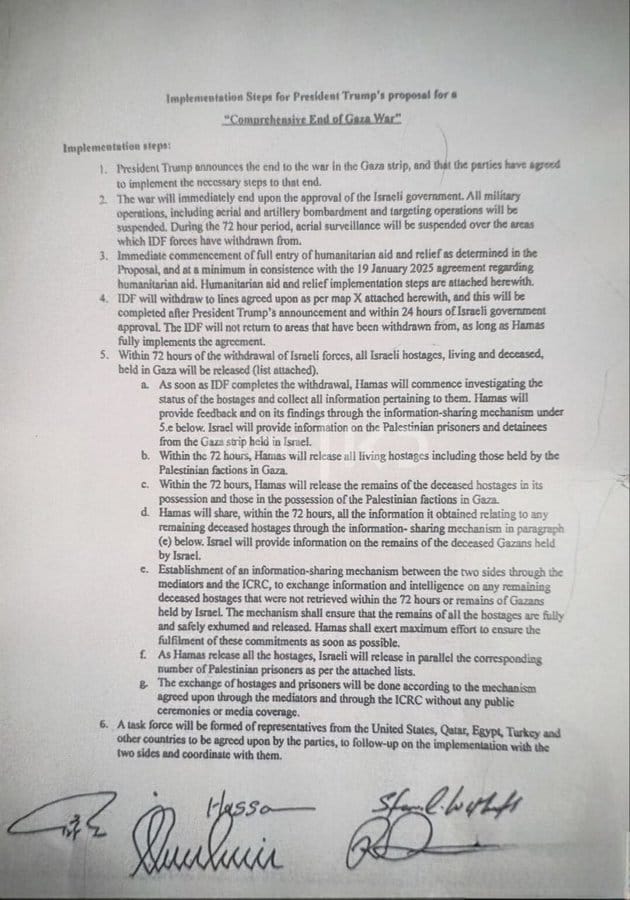
Document discussed above.
Our Assessment
We were cautiously optimistic about this peace plan for many of the reasons we’ve discussed here. The killings of innocents must stop, that much is clear, but the original deal was riddled with ambiguities that left far too much open to interpretation. There was no mention of Palestinian statehood, no defined enforcement mechanism for Hamas’s disarmament, and no real guarantee of political reconciliation beyond a ceasefire on paper. These unresolved questions now appear to be resurfacing on the ground. Still, we can only hope that what we’re witnessing are temporary disruptions rather than fatal fractures, minor road bumps on the long and fragile road toward peace. It’s important to remember that this deal is barely days old, and it involves two sides hardened by decades of mistrust, trauma, and bloodshed. Peace in Gaza, if it is to hold, will depend not just on signatures and speeches, but on whether both parties can resist the gravitational pull back toward vengeance.
Sources:
Sources available upon request, not shown to maintain visual integrity of page.
TWEET OF THE DAY
Honestly, you just can’t hate Italians… 😂
Meloni says she “would kill someone” if she’d have to stop smoking
🇮🇹
— Visegrád 24 (@visegrad24)
8:19 AM • Oct 15, 2025
TODAY IN HISTORY
(October 15, 1959): Final conference on Antarctic Treaty
On this day in 1959 a final conference on the Antarctic Treaty convened in Washington, D.C., and, after six weeks of negotiations, the treaty was signed by 12 countries, preserving the continent for free scientific study.