- Basedment
- Posts
- Are We Seeing A Double Cauldron In Pokrovsk?
Are We Seeing A Double Cauldron In Pokrovsk?
Your daily dose of geopolitical updates and strategic analysis. Unbiased, but not unbased.

Editor-in-Chief
October 28, 2025
THE BRIEFING
Here’s what’s happening in geopolitics today.
It’s been another busy start to the week on the global stage. Trump touched down in Tokyo for a major round of security and trade talks, while the UK looks to deepen economic and defence ties across the Gulf and with Turkey.
In South America, Javier Milei’s party scored a decisive win in Argentina’s midterms, strengthening his reformist mandate, and tensions at sea flared as two U.S. Navy aircraft went down over the South China Sea.
In today’s deep dive, fresh Russian gains have almost cut Ukrainian positions in half at the Pokrovsk sector.
THE LAST 24 HOURS IN GEOPOLITICS
1. Trump arrives in Japan for 3-day visit
Trump arrived in Tokyo on Monday for high-level security and trade talks with Japan, setting the stage for a bilateral summit with Prime Minister Sanae Takaichi and a meeting with Emperor Naruhito. The agenda includes defence spending, investment flows and Tokyo’s share of hosting U.S. troops, while trade issues are also expected to dominate. Analysts say this trip represents how the U.S. is linking security cooperation and economic deals in Asia as it seeks to rebalance alliances and press major partners for greater burden-sharing.
read more
2. UK Chancellor heads for Gulf in bid to boost trade and investment
The UK Chancellor Rachel Reeves is heading to the Gulf this week to push forward trade and investment talks with the Gulf Cooperation Council blocs, including Saudi Arabia and the UAE, amid efforts to bolster Britain’s post-Brexit economic strategy. With trade between the UK and Gulf states already worth about £57 billion annually, Reeves emphasised the mission’s aim to position the UK as a stable, innovative partner for Gulf capital and to secure a major deal that could add billions to the UK economy.
read more
3. Starmer will travel to Turkey on Monday to discuss fighter jets deal
Keir Starmer is set to travel to Ankara on Monday to meet with Recep Tayyip Erdoğan and finalize discussions on the proposed sale of up to 40 Eurofighter Typhoon jets to Turkey. The purchase is part of Turkey’s broader push to modernise its air force and reduce reliance on U.S.-made aircraft, while the UK sees the deal as a boost to its defence-industrial base and NATO cooperation. While the agreement remains subject to final technical and export approvals, the meeting marks an important milestone in UK-Turkey defence ties and signalling deeper strategic alignment.
read more
4. Milei’s party wins Argentina midterms in decisive victory
Javier Milei’s libertarian party, La Libertad Avanza (LLA), claimed a decisive victory in Argentina’s mid-term legislative elections, securing roughly 40.8% of the vote compared with about 31.7% for the main opposition. The win strengthens Milei’s hand in Congress, giving his bloc the ability to block certain opposition moves and push ahead with his free-market reform agenda. Nonetheless, his party still falls short of an absolute majority, meaning alliances will be necessary for major legislative change.
read more
5. US Navy helicopter and fighter jet crash in seperate incidents in the South China Sea
Two United States Navy aircraft crashed in separate incidents over the South China Sea on Sunday while operating from the USS Nimitz. All five crew members (three from the helicopter and two from the jet) were rescued and are reported to be in stable condition, while the cause of both mishaps is under investigation. The twin falls come amid heightened U.S. naval activity in the region and underscore the operational risks facing carriers as strategic competition with China intensifies.
read more
DAILY DEEP DIVE
A DOUBLE CAULDRON IN POKROVSK?
Putin met with General Valery Gerasimov and Russian commanders on October 26, again emphasising Russia’s goal of capturing all of Luhansk, Donetsk, Zaporizhia, and Kherson oblasts. The meeting was notable for Putin wearing a military uniform, only the third time since the invasion began. Gerasimov claimed that Russian forces had surrounded up to 5,500 Ukrainian troops near Pokrovsk and blocked 31 Ukrainian battalions in nearby areas. He said the 2nd and 51st Combined Arms Armies had completed the encirclement, advancing on converging axes. Most analysts, even pro-russian milbloggers, agreed this was largely an over-exaggeration.
Recent Context
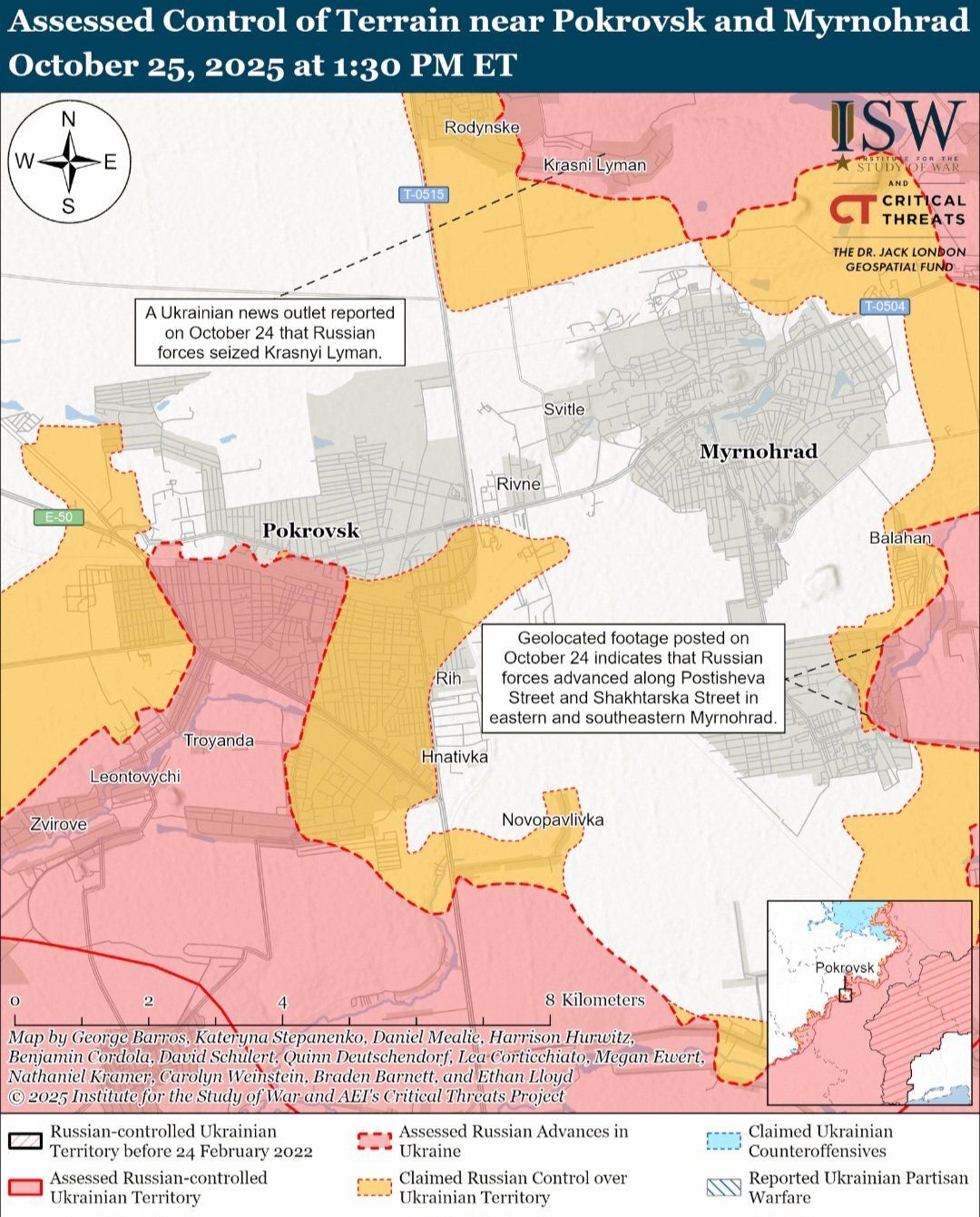
There may, however, be some truth to these reports. The western outskirts of Pokrovsk have become increasingly difficult for Ukrainian forces to access. Last week, soldiers were forced to cover 10–15 kilometres on foot to reach the city—a journey that’s not just exhausting, but perilous, as they move under constant threat from artillery, Russian sabotage groups, and drones. So small groups are being sent across a 15 kilometre stretch of ambushes from the ground and sky. You can see why the situation is being described as beyond critical. The danger has only grown as Russian forces consolidate control over the northern town of Rodyinske, creating a potential launch point for expanding the western pincer around Pokrovsk.
To the east, the past week has seen Ukrainian troops conduct a tactical withdrawal from forward positions near Myrnohrad, particularly in the northern and southern sectors—areas that were swiftly taken over by Russian forces. This kind of repositioning is routine when defences become untenable, but current signs suggest it may mark the start of a larger Ukrainian withdrawal from Myrnohrad altogether.
ISW Map Source
Last 48 Hours
After a reported surrender ultimatum was refused (according to Russian sources) Russian forces in the Pokrovsk direction have reportedly cut off the road to Pavlohrad, threatening Ukraine’s defensive lines on the city’s western approaches. This would effectively put Myrnohrod and Pokrovsk in seperate cauldrons. Ukrainian military analyst Konstantin Mashovets stated that Russian troops advanced into the western industrial zone and secured positions along the railway from Mezheva, closing the flank of advancing units. This development endangers the broader Pokrovsk–Myrnohrad agglomeration, where Russian forces are now less than nine kilometres from Krasnyi Lyman to the northeast. Within Pokrovsk, Ukrainian troops are said to control only the northern sector north of the railway station. Even this area, however, has been heavily mined by Russian aerial drops. Intense street fighting continues in the city centre and Sobachovka district, with the front line remaining unclear.
Most Recent: In the past hour, reports indicate that Russian units have crossed the railway line and entered northern Pokrovsk. If confirmed, this would significantly undermine what remains of Ukraine’s defensive network in the city. The railway line had served as both a natural barrier and a key defensive position, allowing Ukrainian forces to target any Russian movements
attempting to cross it. Its loss would mark a major tactical setback and could accelerate the collapse of organised resistance within the northern districts.
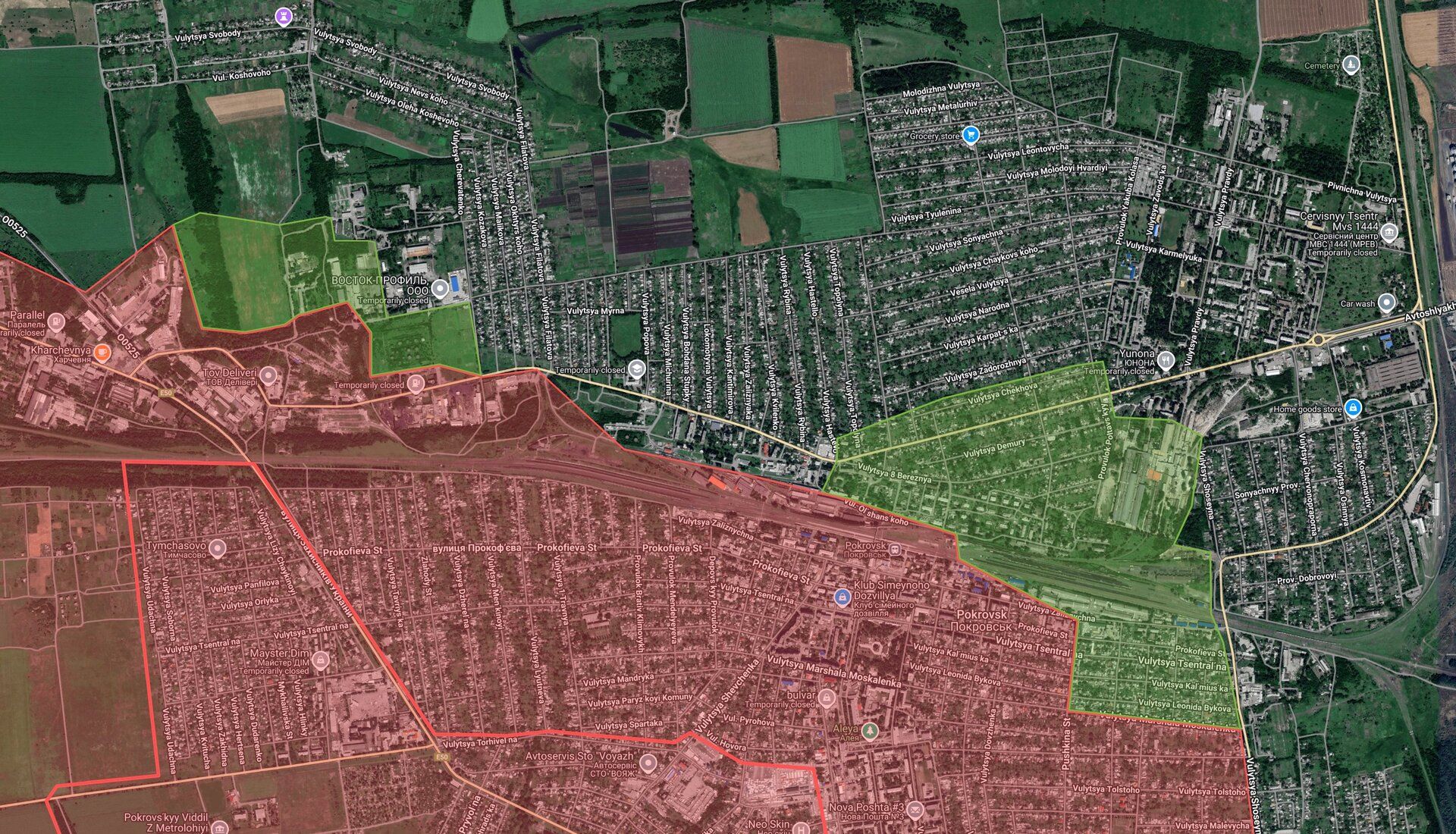
New advances can be seen past the railway line (green). KalibratedMaps Source.
Zelensky Sends In The GUR
The situation is so bad that Ukrainian journalist Tsaplienko is writing that Zelensky has ordered the deployment of Ukrainian GUR special forces. These elite intelligence units, acting under Budanov’s orders, have coordinated with the Armed Forces of Ukraine to reinforce the city’s defence. They have already begun conducting combat operations on the most contested frontlines. Their mission is to counter enemy sabotage efforts and neutralise Russian groups that have infiltrated Pokrovsk.
We see two main takeaways here. First, Ukraine’s decision to deploy its elite GUR special forces suggests that conventional reinforcements are stretched thin—most likely still engaged in the intense fighting within the Dobropillya salient. Second, the political leadership in Kyiv appears determined to prevent Pokrovsk from falling, despite mounting tactical risks. Both Zelensky and Syrskyi are once again facing criticism for delaying what many analysts view as an inevitable withdrawal. If Pokrovsk truly holds little remaining strategic value, as some pro-Ukrainian sources claim, the refusal to retreat raises deeper political motives. We argue that in today’s geopolitical climate, with Trump dominating global headlines, Zelensky cannot afford another symbolic defeat that could shift Trump’s tone or weaken his shaky support.
Sources:
Sources available upon request, not shown to maintain visual integrity of page.
AMK_Mapping, ISW, Deepstate, Mashovets
GUR Claim: https://prm.ua/en/the-situation-is-critical-gur-active-operations-units-were-sent-to-pokrovsk-for-assistance/
TWEET OF THE DAY
This isn’t spoken about enough imo…
This isn’t a joke btw.
This is actually the U.S. economy.
This scam is going to come crashing down. Soon.
— ADAM (@AdameMedia)
1:23 AM • Oct 26, 2025
TODAY IN HISTORY
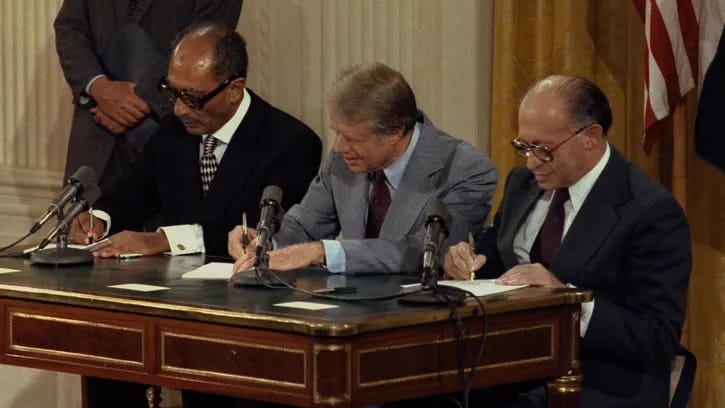
(October 27, 1978): Anwar Sadat and Menachem Begin awarded Nobel Peace Prize
On this day in 1978, Anwar Sadat of Egypt and Menachem Begin of Israel were awarded the Nobel Prize for Peace for negotiations that resulted first in the Camp David Accords, then in a peace treaty between their countries.