- Basedment
- Posts
- "Nuclear Sniffers" Fly To Middle East, As Gulf States Back off Support
"Nuclear Sniffers" Fly To Middle East, As Gulf States Back off Support
Nuclear Sniffers head toward the Middle East, as Trump weighs strike options on Iran all the while the Gulf states pull-back support for strikes.

Editor-in-Chief
January 29, 2026
THE BRIEFING
Here’s what’s happening in geopolitics today.
From a disturbing security incident in New York to fresh diplomatic overtures in Beijing and Hanoi, today’s headlines span faith, force and foreign policy.
We’re also watching tensions sharpen with Iran, Taiwan drilling for worst-case scenarios, and governments recalibrating how they engage in an increasingly uneasy global order.
In Today’s deep dive, we turn to Iran as Nuclear Sniffers head toward the Middle East, as Trump weighs strike options on Iran all the while the Gulf states pull-back support for strikes.
THE LAST 24 HOURS IN GEOPOLITICS
1. Car rams into Brooklyn’s largest synagoge Chabad Lubavitch
A vehicle was driven into the entrance of the Chabad Lubavitch World Headquarters on Wednesday evening, with the driver repeatedly ramming the building’s doors before being taken into custody by the NYPD. No injuries were reported, and the building was evacuated as a precaution while the NYPD’s Bomb Squad and Hate Crimes Task Force investigated the scene. Police arrested the driver at the scene and have yet to confirm a motive, although officials are investigating the incident as a possible hate crime amid heightened security at houses of worship across the city. Authorities also conducted a sweep of the vehicle and found no explosives or other dangerous devices.
read more
2. UK wants ‘sophisticated relationship’ with China, Starmer tells Xi
Starmer told Xi Jinping that Britain wants to build a “more sophisticated relationship” with China, signalling a reset in ties and emphasising the importance of deeper economic and diplomatic engagement. Starmer said that China is a “vital player on the global stage” and that expanding cooperation could benefit both nations’ economies and help tackle shared challenges, even as areas of disagreement remain. His remarks came during a rare bilateral meeting in Beijing attended by business leaders and senior officials, reflecting London’s push to strengthen trade, investment and strategic dialogue.
read more
3. Make nuclear deal or fear ‘far worse’, Trump warns Iran
Trump warned Iran that Tehran must “come to the table” and negotiate a deal to curtail its nuclear programme or face a U.S. military strike “far worse” than previous actions, saying “time is running out” as a U.S. naval “armada” moves toward the region. Trump reiterated in a Truth Social post that he hopes for a “fair and equitable” deal with “no nuclear weapons”, but stressed that failure to agree could trigger severe consequences, referencing last year’s military strikes on Iranian nuclear sites. Iran responded to the warning by stating its armed forces are prepared to respond forcefully to any U.S. aggression, while also asserting that it welcomes dialogue based on mutual respect and interests, though no recent negotiations have been requested by Tehran.
read more
4. Taiwan simulates repelling Chinese assault in military drill
Taiwan’s military conducted a high-profile exercise on Thursday that simulated repelling a Chinese assault from the sea, integrating shore-launched missiles, drones and fast patrol boats to practice defending against an attempted invasion. The drill aimed to demonstrate multi-layered defensive capabilities and coordination across different branches of the armed forces. China views Taiwan as part of its territory and has not renounced the use of force to achieve “unification,” making such exercises a regular part of Taipei’s efforts to prepare for potential conflict and deter aggression.
read more
5. Vietnam, EU elevate diplomatic ties as international order “is under threat”
Vietnam and the European Union have elevated their diplomatic relationship to a Comprehensive Strategic Partnership during a visit by European Council President António Costa to Hanoi. The upgrade, building on decades of cooperation and the 2020 EU-Vietnam Free Trade Agreement, reflects both sides’ resolve to deepen cooperation on trade, sustainable development, security and multilateral engagement amid global disruptions. Costa said the move comes “at a moment when the international rules-based order is under threat from multiple sides,” and emphasised the need for reliable and predictable partnerships to support peace, stability and shared prosperity.
read more
DAILY DEEP DIVE
"Nuclear Sniffers" Head To Middle East, As Gulf States Back off Support
New Update:
The deployment signals are hardening. A U.S. Air Force WC-135R Constant Phoenix — commonly known as a “nuke sniffer” – has departed CONUS for Europe. The main likelihood is onward positioning toward the Middle East. These aircraft are not routine transports; they are used to detect nuclear material in the atmosphere before or after strikes. At the same time, up to seven U.S. Air Force transports are moving east out of CONUS, alongside key aircraft departing Chania. Taken together, this is not posturing. It is preparatory activity consistent with imminent strike contingency planning against Iran. If the aircraft is continuing onward, it can be operationally relevant in-theatre within the next 6–10 hours.
If a strike is happening soon, the weather is looking clear for it. Sunny and cloud free conditions for most of the weekend until Monday.
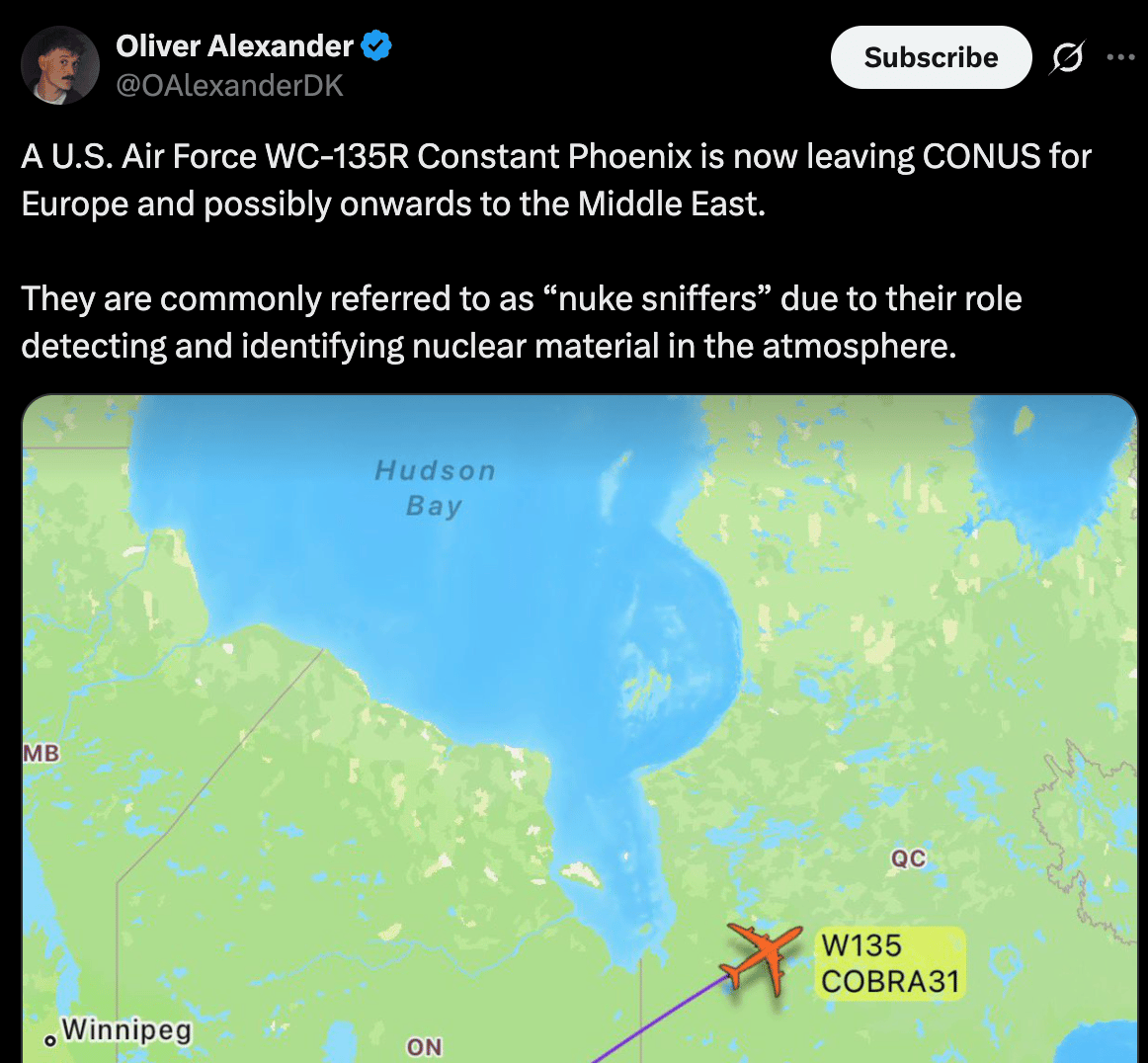
Great source.
Why The Gulf Is Backing Off
Both Saudi Arabia and the UAE have said their airspace will not be allowed to be used by U.S aircraft conducting possible Iran strikes. We’ve had a few questions about this, and the answer comes down to the balance of power. Saudi Arabia has long been a traditional rival of the Iranian regime, so on the surface it might seem logical for Riyadh to want Iran destroyed. In reality, the opposite is often true. The most important factor is that Iran remains Israel’s primary strategic adversary. While Gulf states are quietly building ties with Israel, Iran’s continued existence ensures that Israel must still watch its northern and eastern fronts. A weakened but intact Iran preserves strategic friction without removing a key counterweight. Secondly, the outright destabilisation of Iran would carry severe regional consequences. A collapse could trigger civil war, mass refugee flows, and prolonged instability across the Gulf and beyond — outcomes that would directly threaten Saudi and Gulf security interests. Stability, even in rivalry, is often preferable to chaos.
U.S Strike Options
Every military option available to Washington carries serious trade-offs, and none offer clean escalation control.
A prolonged air campaign is the most visible show of force, but also the least politically viable. It would require sustained sorties, invite regional backlash, and contradict Trump’s preference for short, decisive action. More importantly, it risks hardening Iranian resolve rather than breaking it.
Leadership decapitation, targeting figures such as Ali Khamenei, sits at the opposite extreme. It carries the highest escalation risk and is operationally difficult against a hardened, redundant system. Rather than collapsing the regime, such a strike could unify rival security factions, accelerate repression, and produce an uncontrolled succession crisis.
Cyber and covert operations offer deniability and flexibility, but they are inherently slow. Iran has demonstrated an ability to absorb cyber pressure, operate under sanctions, and adapt its internal security architecture. Exposure also risks retaliation without achieving decisive effects.
This leaves limited punitive strikes as the most plausible option — calibrated attacks designed to deter, signal resolve, and impose costs without triggering all-out war.
Based on the movement of “nuclear sniffers” toward the Middle East, I would wager we are likely to see a strike similar to last year’s operation against Iran — though potentially expanded to include additional military targets.
Iran’s Response
Yet even here, Iran holds leverage. Tehran does not need battlefield dominance. It can respond asymmetrically: activating regional proxies, disrupting maritime traffic, or targeting U.S. partners. In that sense, Iran’s strategy is endurance. The U.S. may control escalation thresholds, but not the consequences that follow.
The key question is how combat-ready Iran actually is. The country has just endured a short but grueling war that damaged or destroyed significant military assets and resulted in the deaths of senior commanders. Another critical factor is whether Iran responds at all. If this is framed as a punitive strike, restraint may be the rational choice. A successful Iranian air defence engagement — downing drones or aircraft — could instead force a far more severe U.S. response.
Some analysts suggest Iran will rely on proxies and other forms of asymmetric warfare. But the reality is that Iran’s power projection has been heavily degraded. Hezbollah is weakened, Assad is gone, and much of Tehran’s regional network is under strain. The Houthis and Iraqi militias remain the main exceptions, yet both are increasingly constrained by their own regional pressures.
Iran’s Damned If You Do, Damned If You Don’t
Iran now finds itself in a classic damned-if-it-does, damned-if-it-doesn’t position. A forceful response risks triggering escalation it is poorly positioned to sustain; restraint, however, invites the perception of weakness that could embolden both external pressure and internal dissent. This dilemma reflects the structural limits of fixed autocracies. Decision-making is narrow, centralized, and reactive, leaving little room for calibrated ambiguity or political off-ramps. Unlike flexible systems that can absorb setbacks through institutional diffusion, Tehran must signal strength at all times — even when doing so accelerates strategic exhaustion. In that sense, Iran’s greatest vulnerability is not military, but structural: a regime trapped by its own rigidity.
Sources
News/Journal sources available upon request, not shown to maintain visual integrity of page.
TODAY IN HISTORY
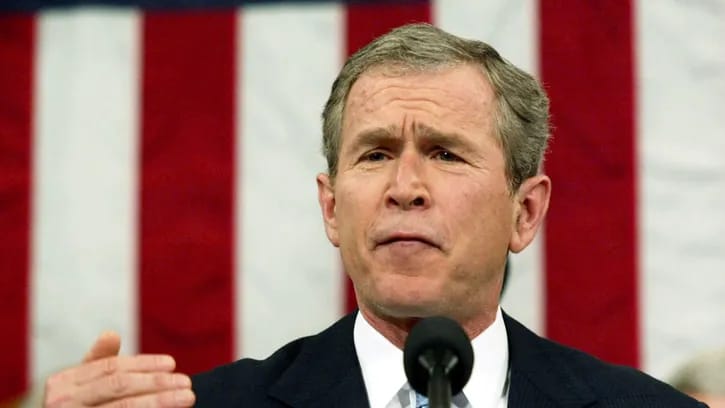
(January 29, 2002): Iraq, Iran, and North Korea called an “axis of evil”
On this day in 2002, U.S. President George W. Bush, delivering a State of the Union address, described Iraq, Iran, and North Korea as an “axis of evil” for their attempts to develop nuclear, chemical, or biological weaponry.