- Basedment
- Posts
- Azerbaijan-Armenia Peace: A weakened Armenia
Azerbaijan-Armenia Peace: A weakened Armenia
Your daily dose of geopolitical updates and strategic analysis. Unbiased, but not unbased.

Editor-in-Chief
August 10, 2025
THE BRIEFING
Here’s what’s happening in geopolitics today.
Today’s briefing covers a fast-moving day in global affairs, with Zelenskyy’s firm rejection of land concessions ahead of high-stakes Trump–Putin talks, to Washington hosting a landmark peace deal between Armenia and Azerbaijan.
In the Middle East, a deadly blast in southern Lebanon has underscored the dangers of post-conflict munitions clearance, while London saw mass arrests at a protest over the banning of Palestine Action. Meanwhile, Trump has confirmed an August 15 meeting with Putin in Alaska, setting the stage for what could be a pivotal diplomatic encounter.
Confused about the big Armenia and Azerbaijan peace deal? We’re providing a historical overview of the entire conflict.
THE LAST 24 HOURS IN GEOPOLITICS
1. Zelenskyy rejects land concessions ahead of Trump-Putin talks
President Volodymyr Zelenskyy rejected the idea of territorial concessions to Russia, responding directly to U.S. President Donald Trump’s suggestion of a “territory swap” in upcoming peace talks with Putin. Zelenskyy firmly stated that Ukraine’s borders are constitutionally protected and cannot be altered without Kyiv’s own agreement. His stance underscores Kyiv’s concern that any deal brokered without Ukraine could undermine its sovereignty and ultimately prove ineffective.
read more
2. Trump embraces role of peacemaker in Azerbaijan and Armenia deal
Azerbaijan and Armenia have signed a landmark peace agreement at the White House under U.S. President Trump, ending nearly four decades of conflict centred on Nagorno-Karabakh. The deal formally establishes diplomatic ties, mutual recognition of territorial integrity, and includes exclusive U.S. development rights over a strategic transit corridor - the so-called “Trump Route for International Peace and Prosperity”. Both leaders praised Trump’s mediation and even signalled plans to nominate him for the Nobel Peace Prize, though human rights advocates warned that issues like political prisoners remain unaddressed.
read more
3. Explosion kills six members of army in Southern Lebanon
An explosion tore through a weapons depot in southern Lebanon near Tyre on Saturday, killing six soldiers and wounding others as they dismantled munitions left behind by Hezbollah. Lebanese authorities described the blast as unusually deadly, occurring during a routine clearance aimed at restoring stability under a U.S.-backed disarmament plan. The incident underscores the dangers Lebanese soldiers face while enforcing national sovereignty in conflict-ravaged border zones.
read more
4. Trump and Putin to meet on August 15 in Alaska
President Trump confirmed on Friday that he will meet Russian President Putin on August 15 in Alaska, marking their first face-to-face encounter since Trump took office in 2025. Moscow confirmed his announcement and called the location to be “quite logical”.
read more
5. Police arrest more than 150 people at protest over Palestine Action in London
London’s Metropolitan Police arrested around 150 people at a protest in Parliament Square, where demonstrators publicly showed support for the newly banned activist group, Palestine Action. Organised by the group Defend Our Juries, the protest drew supporters waving signs stating “I oppose genocide. I support Palestine Action,” prompting police to enforce the law against public endorsement of proscribed groups.
read more
DAILY DEEP DIVE
The Armenia-Azerbaijan peace deal: Everything you need to know.
Like many modern conflicts, its roots lie in the arbitrary borders imposed by imperial powers, disregarding the ethnic and demographic realities on the ground.
Nagorno-Karabakh
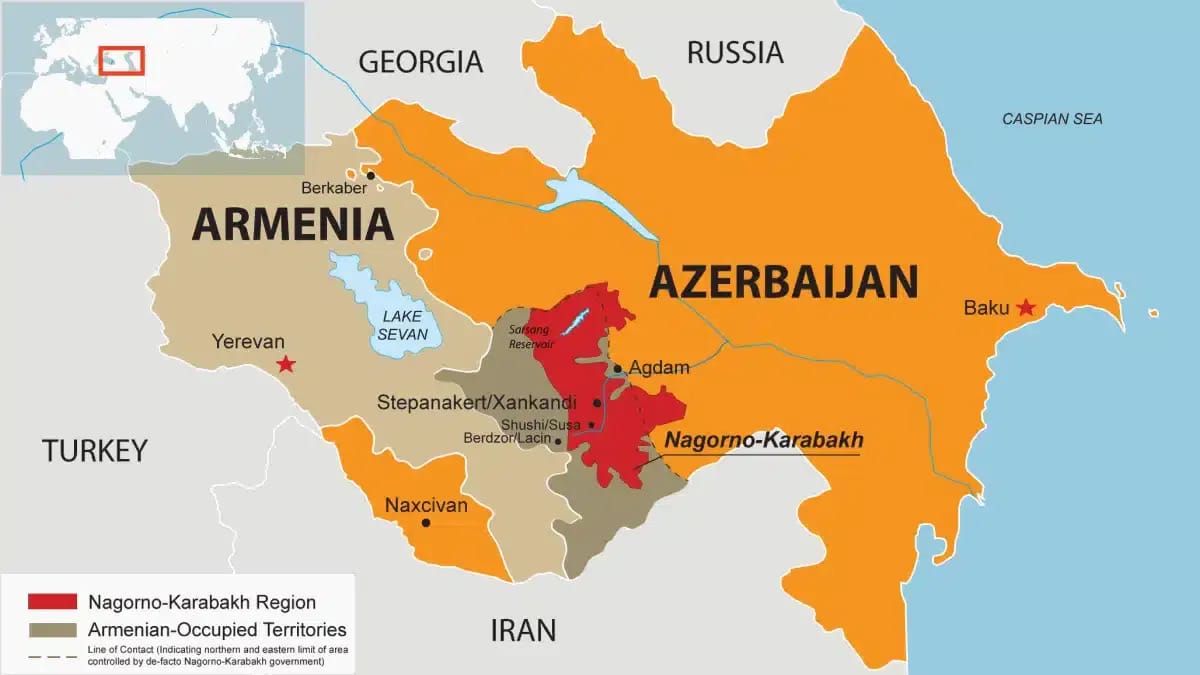
The territorial ownership of Nagorno-Karabakh is one of the most enduring and contentious disputes in the South Caucasus. The conflict’s origins trace back to the collapse of the Russian Empire after World War I, when Armenia and Azerbaijan emerged as short-lived independent republics. Both laid claim to Nagorno-Karabakh, a mountainous, ethnically mixed region with a majority Armenian population but located within Azerbaijan’s internationally recognised borders.
During the Soviet era, Joseph Stalin placed Nagorno-Karabakh within the Azerbaijan Soviet Socialist Republic as an autonomous oblast, despite its Armenian majority. This arrangement sowed the seeds of long-term tension, as Armenians in the region periodically demanded unification with Soviet Armenia.
Tensions escalated in the late 1980s as the Soviet Union weakened. Ethnic violence, mass displacements, and full-scale war followed, leading to the First Nagorno-Karabakh War (1988–1994). Armenia-backed forces gained control not only of most of Nagorno-Karabakh but also surrounding Azerbaijani districts, creating hundreds of thousands of refugees on both sides. The unrecognised Republic of Artsakh was declared in 1991, supported politically, militarily, and economically by Armenia.
First Nagorno-Karabakh War
The First Nagorno-Karabakh War (late 1980s–1994) displaced about 725,000 Azerbaijanis and 300,000–500,000 Armenians. The 1994 Bishkek Protocol ended fighting, leaving Armenian forces in control of most of Nagorno-Karabakh and seven surrounding Azerbaijani districts. UN resolutions in 1993 and 2008 called for Armenian withdrawal, but major powers in the OSCE Minsk Group opposed the latter resolution.
The conflict became a “frozen” one, marked by periodic clashes, notably the 2016 four-day war. Tensions rose in 2020 when Armenia planned to make Shusha the Artsakh capital and moved its parliament there, sparking protests in Azerbaijan and strong Turkish support for Baku. Military exercises by Azerbaijan, including with Turkey, and allegations of Syrian fighters being transferred to Azerbaijan (denied by Baku) preceded the resumption of full-scale hostilities later that year.
The Second Nagorno-Karabakh War and 2023 Offensive
The Second Nagorno-Karabakh War in 2020 was a 44-day conflict between Azerbaijan, Armenia, and the self-declared Republic of Artsakh, ending in an Azerbaijani victory and sparking political unrest in Armenia. Fighting began on 27 September with Azerbaijan’s offensive, heavily supported by Turkish-supplied drones and advanced weaponry, which proved decisive in the outcome. The war concluded after Azerbaijan captured Shusha, leading to a Russian-brokered ceasefire on 10 November that brought significant territorial gains for Baku and the deployment of Russian peacekeepers. Continued tensions and later clashes culminated in Azerbaijan’s 2023 offensive, which brought the entirety of Nagorno-Karabakh under its control.
Russian influence damaged
This development represents a significant setback for Russian regional influence. From a realist perspective, Moscow views the South Caucasus as part of its traditional sphere of influence, where its material power and proximity should ensure political leverage over neighbouring states. However, Russia’s inability to provide substantial security assistance to Armenia during recent conflicts has eroded its credibility as a guarantor of regional stability, contributing to a sharp decline in Armenian public opinion toward Moscow.
Armenia given the bad geopolitical hand:
Armenia had the upper hand in the late 90’s. But the recent decades have not been kind especially in comparison to its rival Azerbaijan. A land locked nation with limited resources, it’s growth was slow. While Baku, grew as a gas export giant. With the necessary funds available and assistance from it’s regional ally, Turkey, it was able to create a modern military. Armenia had relied on a older doctrine of Soviet fire superiority, this did not work too well against the modern concept of drone warfare.
Armenia turned to its CSTO ally, Russia, for support. Its security arrangements with Moscow (under the CSTO and the 1997 bilateral treaty) only cover Armenia’s internationally recognised borders, not Nagorno-Karabakh, which is legally part of Azerbaijan. Moscow used this distinction to avoid direct intervention in the 2020 and 2023 conflicts, acting only as a mediator and peacekeeper, a stance that, coupled with its focus on Ukraine, weakened Armenian trust in Russia as a security partner.
Armenia signed the 2025 peace deal from a position of weakness, having lost all control of Nagorno-Karabakh after the 2020 war and Azerbaijan’s 2023 offensive, with no external power willing to intervene on its behalf. The mass exodus of the region’s Armenian population removed the immediate demographic stake in the territory, while continued confrontation risked further economic hardship and instability. With Russia proving an unreliable security partner, Yerevan saw the accord as a way to pivot toward Western engagement, gain security assurances, and attract infrastructure and trade investment. The deal also offered a path to reduce the risk of future hostilities and begin a process of diplomatic rehabilitation after years of conflict.
Trump’s Goals:
Trump’s goals in brokering the Armenia–Azerbaijan peace deal appear to combine strategic and personal ambitions. Strategically, the agreement helps weaken Russia’s traditional influence in the South Caucasus, a region Moscow has long considered part of its sphere of influence, and strengthens the US position along a key corridor linking the Caspian to Turkey and Europe, effectively tightening the geopolitical ring around Iran. On a personal level, the deal fits into Trump’s broader effort to brand himself as a global peacemaker, adding another high-profile diplomatic achievement to bolster his case for a Nobel Peace Prize.
Sources:
References available upon request. A full citation list has been omitted to preserve the visual integrity of the page.
TWEET OF THE DAY
What’s everyone’s thoughts on the topic?
President Trump has now ended conflicts between:
- Thailand & Cambodia
- Israel & Iran
- Rwanda & the Democratic Republic of the Congo
- India & Pakistan
- Serbia & Kosovo
- Egypt & Ethiopia
- Armenia and AzerbaijanTrump deserves the Nobel Peace Prize.
— Libs of TikTok (@libsoftiktok)
11:43 PM • Aug 8, 2025
TODAY IN HISTORY
(August 9, 48bc): Pompey defeated by Julius Caesar at the Battle of Pharsalus.
During the Roman Civil War, Julius Caesar’s forces decisively defeated Pompey’s army at the Battle of Pharsalus. The loss forced Pompey to flee to Egypt, where he was soon assassinated, marking a major turning point in Caesar’s rise to power.