- Basedment
- Posts
- Bulgaria And The Wider Issue of Corruption
Bulgaria And The Wider Issue of Corruption
Bulgaria’s latest government collapse highlights how deeply entrenched corruption continues to undermine political stability and public trust across the country.

Editor-in-Chief
December 14, 2025
THE BRIEFING
Here’s what’s happening in geopolitics today.
Today’s briefing spans rising tensions on land and sea, from a Russian strike hitting a Turkish cargo ship near Odesa to Thailand openly rejecting ceasefire claims as fighting with Cambodia drags on.
Diplomacy is still in motion elsewhere, with U.S. and Ukrainian advisers heading to Berlin for ceasefire talks, Iran seizing a foreign oil tanker in the Gulf of Oman, and Saudi-Emirati officials arriving in Aden amid deadly power struggles in southern Yemen.
In today’s Deep Dive, we examine how Bulgaria’s protests and government collapse expose a deeper institutional crisis that elections alone have failed to fix.
THE LAST 24 HOURS IN GEOPOLITICS
1. Russia strikes Turkish cargo vessel off Ukraine’s Odesa
Russian forces struck a Turkish-owned cargo vessel, the M/V Cenk T, while it was docked in the port of Chornomorsk near Odesa, Ukraine, causing a fire that firefighters and port crews worked to contain, though there were no reported casualties among the crew or drivers. The vessel, operated by Türkiye-based Cenk Denizcilik and flying a Panama flag on regular Karasu-Odesa runs, was hit by what Ukrainian officials described as a Russian missile attack during broader strikes against civilian port infrastructure.
read more
2. Thailand rejects Trump ceasefire claim, vows to keep fighting Cambodia
Thailand’s Prime Minister Anutin Charnvirakul has vowed to continue military action against Cambodia along their disputed border, rejecting Trump’s claim that both sides had agreed to a ceasefire after his diplomatic intervention. Anutin said Thailand will fight “until there is no more harm or threat to our land and people,” posting his statement on social media even as clashes, including airstrikes and artillery exchanges, continued into a sixth day.
read more
3. US and Ukrainian advisers to attend peace talks in Berlin on Sunday
Germany will host delegations from the United States and Ukraine over the weekend in Berlin for talks on a possible ceasefire, ahead of a high-level summit scheduled for Monday with Zelenskyy and European leaders. U.S. special envoy Steve Witkoff is expected to meet with Ukrainian counterparts and European officials to advance discussions on a U.S.-backed peace proposal aimed at ending the war with Russia.
read more
4. Iran seizes foreign oil tanker with 18 crew members
Iranian authorities have seized a foreign oil tanker in the Gulf of Oman that they say was carrying about 6 million litres of smuggled diesel fuel, detaining all 18 crew members on board. State media reported the vessel was intercepted after turning off its navigation systems and lacking proper documentation for its cargo, and the crew included nationals from India, Sri Lanka and Bangladesh. Iran regularly detains vessels it accuses of illegally transporting fuel in regional waters, part of its broader efforts to curb smuggling driven by domestic fuel subsidies and economic incentives.
read more
5. Joint Saudi-Emirate delegation in Aden for talks as 32 killed in STC takeover
A joint Saudi-Emirati military delegation arrived in Aden, Yemen, this week to hold talks aimed at defusing mounting tensions after the Southern Transitional Council (STC) claimed broad control across southern provinces, including Hadhramaut and Mahra. The visit follows deadly clashes in eastern Yemen in which at least 32 military personnel were killed and 45 wounded in attacks attributed to STC-affiliated forces, according to Yemen’s internationally recognised government. Officials say the delegation’s discussions in Aden will focus on reversing recent unilateral moves in hopes of reducing conflict and restoring stability in the south.
read more
DAILY DEEP DIVE
Bulgaria And The Wider Effects Of Corruption
Context
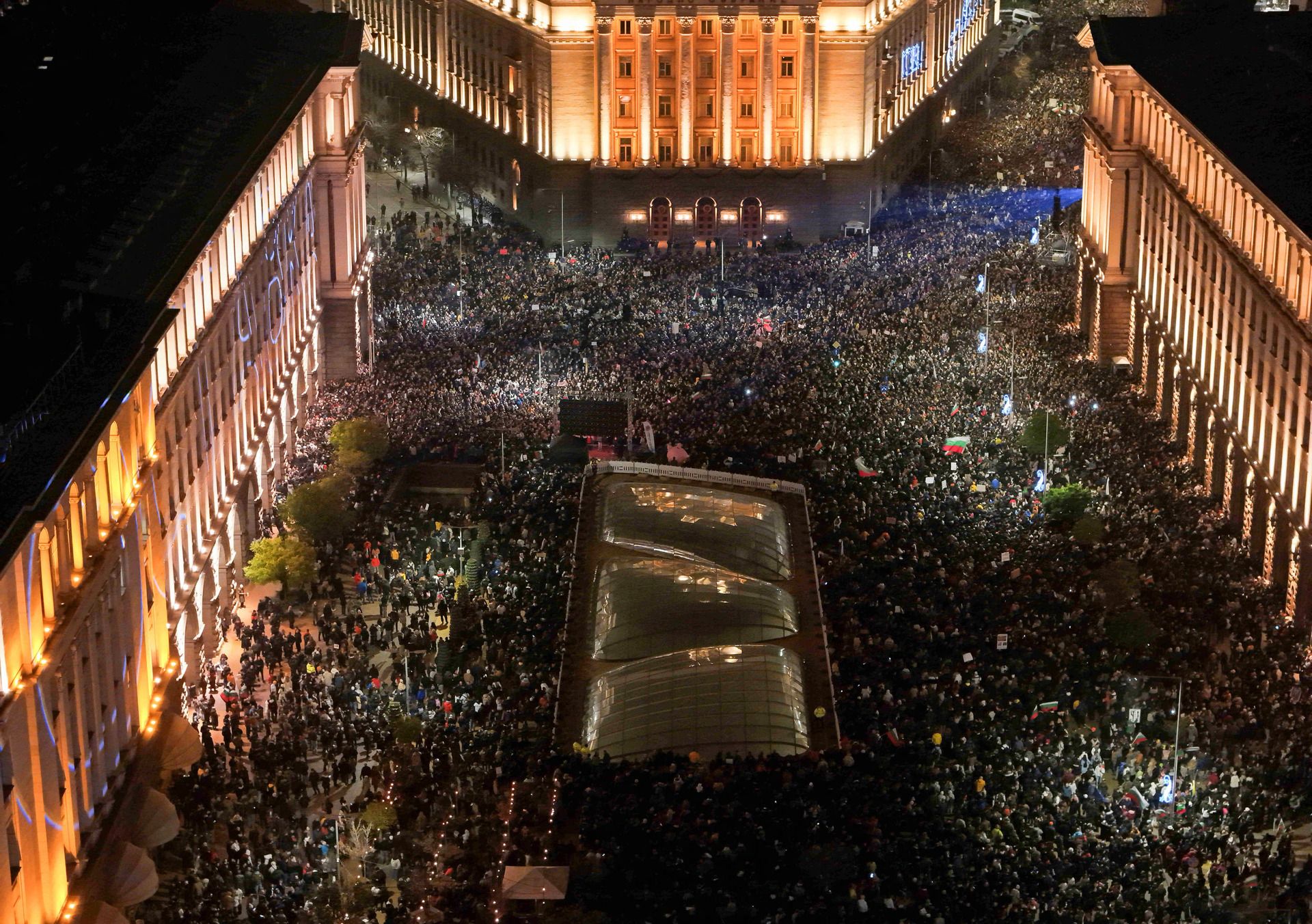
Bulgaria’s government has collapsed after less than a year in power, following weeks of street protests over corruption, economic policy, and governance. Prime Minister Rosen Zhelyazkov announced his resignation live on television just minutes before parliament was due to vote on a no-confidence motion, effectively pre-empting his government’s likely defeat. President Rumen Radev had already publicly called for Zhelyazkov to step down.
The resignation plunges Bulgaria back into political uncertainty at a sensitive moment, just weeks before its planned entry into the euro zone on January 1. It also reinforces a familiar pattern: Bulgaria remains the EU’s poorest and most corruption-plagued member state, with fragile coalitions and recurring public unrest.
The protests, which intensified from late November, were driven by a draft budget proposing higher social security contributions and increased taxes on dividends to fund expanded state spending. Crucially, large portions of that spending were earmarked for police, security services, and the judiciary — institutions widely mistrusted by the public. Although the budget was later withdrawn, anger did not subside.
Demonstrators were largely young, urban, pro-EU professionals who support euro adoption but are deeply frustrated by entrenched graft and what they see as elite arrogance. Tensions had already been building over other government actions, including the arrest and jailing of Varna mayor Blagomir Kotsev on corruption charges he denies — a case many viewed as politically motivated.
Our Comment
What we are seeing, politics aside, is a reminder that the people do have a voice. Bulgaria, like many eastern European countries, is plagued by corruption. Ultimately, corruption is a cancer cell that spreads and ruins the insides of a nation. In Bulgaria, mistrust in the state apparatus runs deep. Police, courts, and security services are widely viewed as politicised, corrupt, or selectively enforced, eroding their legitimacy as neutral institutions. When formal mechanisms fail to deliver accountability, public confidence collapses. In that vacuum, street pressure becomes the only effective corrective force, protests replace courts, and mass mobilisation substitutes for institutional reform, forcing political change from the outside rather than within the system.
The larger issue for nations such as Bulgaria, is that while protests are good, corruption is often institutionalised deep within the core of the government. This means that simply electing a new government often won’t fix the issues. Reform requires insulating the judiciary, prosecuting elite figures, protecting journalists, and sustaining civic pressure. Without breaking party control over institutions, protests alone will reshuffle governments, not dismantle the system.
Sources:
News/Journal sources available upon request, not shown to maintain visual integrity of page.
TODAY IN HISTORY
(December 13, 1294): A pope resigned to save his soul
After five months as pope, Celestine V resigned on this day in 1294. Because he was struggling to fulfill his duties, after many years living as a hermit in a cave, he decided it would be dangerous for the church and for his soul if he continued.