- Basedment
- Posts
- Charlie Kirk in London: From National Politics to Transnational Movements
Charlie Kirk in London: From National Politics to Transnational Movements
Your daily dose of geopolitical updates and strategic analysis. Unbiased, but not unbased.

Editor-in-Chief
September 15, 2025
THE BRIEFING
Here’s what’s happening in geopolitics today.
Welcome back to your daily briefing. Today’s headlines range from Australia’s massive AUKUS investment and fresh South China Sea drills to a huge nationalist rally in London and rising U.S–Israel tensions.
Trump is also pressing NATO allies on Russian oil, underscoring how energy remains central to the wider conflict.
And in today’s deep dive, we take a look at the cross-pollination of political issues that are now longer bound by borders as we saw at today’s London Rally.
THE LAST 24 HOURS IN GEOPOLITICS
1. Australia to invest $8 Billion in AUKUS Defense Hub
Australia is committing A$12 billion (about US$8 billion) over the next decade to upgrade the Henderson shipyard in Western Australia into a major submarine-maintenance and naval shipbuilding facility under the AUKUS pact. The facility will handle maintenance for the future fleet of nuclear-powered submarines, as well as build landing craft and general-purpose frigates, boosting local jobs by around 10,000. The investment underscores Australia’s strategic push to deepen its Indo-Pacific defence posture amid tensions with China, while reaffirming its commitment to long-term trilateral cooperation with the U.S. and U.K. via AUKUS.
read more
2. Philippines, Japan, US hold exercises in South China Sea
Manila teamed up with Japan and the United States this week for joint maritime exercises in the Philippines’ Exclusive Economic Zone, pushing back against growing Chinese activity in the South China Sea. The drills underscored a shared commitment to upholding freedom of navigation and reinforcing regional cooperation in the face of overlapping territorial claims. China responded sharply, warning the Philippines to stop “provocations” and decrying the involvement of external powers.
read more
3. Thousands attend Tommy Robinson protest in London
Over 110,000 people took to central London on Saturday for the “Unite the Kingdom” march organized by far-right activist Tommy Robinson, making it one of the largest nationalist demonstrations in the UK in recent decades. The event, framed by Robinson as a free speech rally, featured strong anti-immigration themes, nationalist flags, and support from figures including Elon Musk. Clashes broke out between protesters and police, leading to dozens of injuries and multiple arrests.
read more
4. US’ Rubio heads to Israel amid tensions with Middle East allies
U.S. Secretary of State Marco Rubio is heading to Israel this weekend against a backdrop of rising tension across the Middle East, particularly over Israel’s strike on Hamas leaders in Doha and fresh settlement expansion in the West Bank. While affirming unwavering U.S. support for Israel, Rubio has expressed concern about how these unilateral actions may damage ongoing hostage negotiations and ceasefire efforts mediated by Qatar.
read more
5. Trump demands NATO action on Russian oil before any U.S. sanctions
Trump said on Saturday that the U.S. is ready to impose new energy-sanctions on Russia, but only if every NATO nation stops buying Russian oil and adopts similar retaliatory measures. He singled out NATO holdouts like Turkey, Hungary and Slovakia for continuing imports, calling their actions “shocking” and warning they weaken the alliance’s ability to pressure Russia.
read more
DAILY DEEP DIVE
LONDON RALLY AND THE CROSS-POLLINATION OF POLITICS
Today we saw one of the largest rally’s in recent memory in the UK. The rally was about ending mass-migration, freedom of speech and as tribute to Charlie Kirk was recently assassinated in the U.S. More than 100,000 people marched through central London on Saturday in an anti-immigration rally organized by activist Tommy Robinson. Demonstrators carried Union Jacks, St George’s Crosses, U.S. and Israeli flags, with some wearing Trump’s MAGA hats and holding up pictures of Charlie Kirk, whose assassination was invoked as part of the rally’s message. Chants targeted Prime Minister Keir Starmer, and placards included slogans such as “send them home.” Robinson branded the march as a defense of free speech, while also framing it as a memorial for Kirk. A counter-protest organized by Stand Up to Racism gathered nearby. Police deployed 1,600 officers, including reinforcements from outside London, but were caught off guard by the sheer size of the rally, calling it “too big to fit into Whitehall.” At least 25 people were arrested after violent clashes, with 26 officers injured, as police promised “many more” arrests to come.
A national rally with its foundations in transnational affairs
The rally marks a significant historical milestone for several reasons. First, it underscores the deepening polarization within the UK, with immigration and free speech emerging as flashpoints capable of drawing unprecedented numbers into the streets. Second, its sheer scale (one of the largest right-wing demonstrations in modern British history) reflects how these issues have moved from the political fringes into the center of public debate. But perhaps most importantly, the rally highlights the increasing internationalization of domestic politics. Symbols from the United States and Israel, tributes to Charlie Kirk, and the presence of MAGA hats in London all point to a trend where political identity and discourse are no longer confined by national borders. Instead, narratives about free speech, culture wars, and identity politics are being shaped, shared, and amplified across countries.
Cross-pollination
This cross-pollination is being accelerated by the rise of populism. As economic pressures, cultural anxieties, and the broader sense of dislocation in modern society deepen, more people are turning away from establishment parties in search of alternatives. Populist leaders and movements thrive in this environment by offering simple answers to complex problems, often framed around identity, sovereignty, and resistance to elites. In doing so, they create narratives that resonate across borders, what starts as a domestic grievance in one country quickly becomes part of a shared populist vocabulary elsewhere.
Rise of populists
Since President Trump’s victory, there has been a growing recognition that politics is no longer the exclusive domain of career politicians. In the United States alone, we’ve seen high-profile figures from outside traditional politics step forward, from Elon Musk (who appeared virtually at the London rally), to Andrew Tate’s campaign for UK prime minister, Conor McGregor’s flirtation with the Irish presidency, and even Kanye West’s presidential bid. On the surface, these names may appear as publicity stunts or jokes. Yet the deeper reality is that all it would take is the right message, paired with a charismatic young leader and a strong online presence, to transform this trend into a serious political force capable of pressuring elites and destabilizing classical party politics.
This is precisely why governments and entrenched interests often seek to foster division among the working class. A fractured public is easier to manage, leaving energy spent on infighting rather than challenging those at the top. But in an era where populism, technology, and disillusionment converge, the possibility of an outsider breaking through can no longer be dismissed.
Sources:
Sources available on request, reduced to maintain visual integrity of page.
TWEET OF THE DAY
Not going to lie, this made me chuckle.
“We want our country back… but let me grab that onion bhaji”
— Sulaiman Ahmed (@ShaykhSulaiman)
2:20 PM • Sep 13, 2025
TODAY IN HISTORY
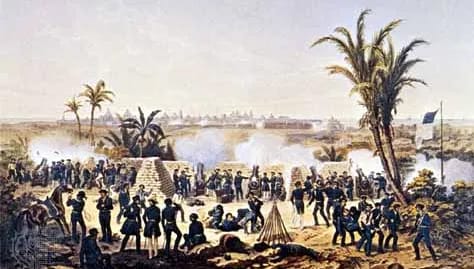
(September 14, 1847): Mexico City captured by U.S. forces
U.S. General Winfield Scott's advance on Mexico City was marked by an unbroken series of victories that culminated this day in 1847, when he entered Mexico City and ended the military phase of the Mexican-American War.