- Basedment
- Posts
- China’s Parade, Trump’s Failure, and the Politics of Image
China’s Parade, Trump’s Failure, and the Politics of Image
Your daily dose of geopolitical updates and strategic analysis. Unbiased, but not unbased.

Editor-in-Chief
September 07, 2025
THE BRIEFING
Here’s what’s happening in geopolitics today.
Today’s briefing brings you a mix of developments from Gaza to Miami, with headlines ranging from Israel’s creation of a new “humanitarian area” to Donald Trump’s plan to host the 2026 G20 summit at his own golf resort.
In Lebanon, the cabinet is backing a contentious army plan to disarm Hezbollah, while China is bristling at Australian and Canadian warships passing through the Taiwan Strait. Meanwhile, House Speaker Mike Johnson made waves by claiming Trump once acted as an FBI informant in the Epstein case.
In today’s deep dive, we examine the power of optics in geopolitics, contrasting how Western and non-Western nations use image and spectacle to project influence.
THE LAST 24 HOURS IN GEOPOLITICS
1. Israeli military tells Gaza City residents to leave and sets up designated “humanitarian area”
Israel has set up a designated “humanitarian area” in the Al-Mawasi region of Khan Younis, Gaza, equipped with critical infrastructure like field hospitals, water pipelines, desalination facilities, and supplies coordinated with the UN, according to the IDF. The military is encouraging civilians to relocate there for safety and access to aid as operations expand across the enclave.
read more
2. Donald Trump was an ‘FBI informant’ on Epstein, Republican Mike Johnson claims
House Speaker Mike Johnson surprised many in Congress and the public by claiming on CNN that President Trump acted as an FBI informant in the Jeffrey Epstein investigation, a remark made while defending Trump’s characterisation of the Epstein Files as a “Democrat Hoax”. Johnson insisted that Trump had long condemned Epstein, saying he even expelled him from Mar-a-Lago—and spoke with a victim’s attorney to support his early cooperation with authorities. The declaration has reignited controversy over transparency in the Epstein case, even as the timing and details of Trump’s alleged role remain unclear.
read more
3. Lebanon’s cabinet welcomes army plan to disarm Hezbollah
Lebanon’s cabinet has publicly welcomed a plan from the army to disarm Hezbollah and establish the state’s monopoly over weapons, though it stopped short of setting a timeline, citing the military's limited capacity. The session revealed deep divisions: all five Shiite ministers, aligned with Hezbollah and its ally Amal, walked out in protest, underscoring the plan’s domestic sensitivity. Hezbollah officials described the move as an “opportunity to return to wisdom and reason”, but only if Israel halts its operations, suggesting implementation hinges on broader regional developments.
read more
4. China condemns sailing of Canadian, Australian warships in Taiwan Strait
China’s People’s Liberation Army strongly condemned the transit of the Canadian frigate Ville de Québec and the Australian destroyer HMAS Brisbane through the Taiwan Strait, calling the manoeuvre a provocative act that increases regional security risks. The PLA’s Eastern Theatre Command said its air and naval forces monitored the vessels and issued warnings during their passage. Taiwan’s defense ministry, which also tracked the ships, echoed international views by affirming the strait is international waters, a stance at odds with Beijing’s claims.
read more
5. Trump says 2026 G20 Summit will be held at his Miami-area golf club
Trump announced today that the 2026 G20 summit will be hosted at his own Trump National Doral golf resort in Miami, calling it the “best location” due to its convenience and facilities, but insisting neither he nor his business will profit from the event. The decision revives criticism over potential conflicts of interest where Trump had previously floated hosting a G7 summit there in 2020 before backing off amid bipartisan backlash. The White House maintains that participants will be billed at cost and that Trump's assets are managed by a third party, though transparency concerns linger.
read more
DAILY DEEP DIVE
THE POWER OF OPTICS…IN GEOPOLITICS
Optics of Power: China’s 80th Anniversary Parade and the Geopolitics of Image
When China marked the 80th anniversary of the end of the Second World War with a massive military parade in September 2025, the event was not just about commemorating history. It was a carefully choreographed spectacle, meant to send messages across multiple audiences - domestic, regional, and global. For Beijing, the parade was an opportunity to present itself as both the military equal of any great power and the diplomatic unifier of an emerging multipolar order. In doing so, China revealed a truth that has long defined international relations: in geopolitics, optics can be as powerful as action.
We believe the parade will be remembered as a defining moment in these turbulent times. The first year of Trump’s presidency has been marked by efforts to redefine America’s role on the world stage, from tariff wars and military posturing to high-profile peace deals and feuds with long-standing allies. Amongst all this, China has staged a meticulously orchestrated spectacle, bringing together states shunned by the West as well as those outside its traditional sphere of influence. The result was an epic display of power and unity, arriving just months after Trump’s own far more modest parade, regardless how much of this actual unity is based on reality.
Of course, tensions remain between many of the states that attended both the SCO Summit and the parade, but that was beside the point. The optics were carefully curated to deliver exactly the image Xi wanted: China as the power capable of convening great powers with conflicting interests and placing smaller states at the same table as equals.
The spectacle in China was so impactful that Trump felt compelled to respond on multiple occasions in as little as 24 hours. He first remarked that he had been watching the parade, then criticised the absence of any mention of U.S. contributions to the war, before later praising the event itself. In a striking admission on Truth Social, he even suggested that Washington had “lost” India and Russia to what he called “dark” China, a rare moment of concession underscoring just how effectively Beijing’s message had landed.
Why Optics Matter in Geopolitics
The Western world seems to have forgotten the importance of optics. Western nations often project themselves through bland, understated political theatre - summits that lack pageantry, speeches without spectacle, and military displays stripped of grandeur. Part of this stems from democratic traditions that prize policy substance over symbolism, and from an ingrained discomfort with what can appear as authoritarian-style “power shows.” In many Western capitals, such displays are seen as relics of a bygone age.
By contrast, states like Russia and China, still steeped in Great Power traditions, place immense value on optics and power projection. For them, parades, summits, and grand rituals are not empty theatre but vital instruments of influence, demonstrations of legitimacy at home and strength abroad. These spectacles are designed to rally domestic audiences, intimidate adversaries, and persuade fence-sitters in the international community.
The issue for the West is that in the age of social media, optics matter more than ever. What circulates globally are the images: Xi Jinping flanked by Putin and Kim Jong-un, hypersonic missiles rolling through Tiananmen Square, dozens of leaders gathered under Beijing’s banner. When done with precision, as China’s 80th anniversary parade was, these power projections create a narrative of unity and ascendancy. In comparison, Western attempts at similar displays (whether military parades or summit gatherings) often appear modest, or even half-hearted. And in geopolitics, perception can be as consequential as reality.
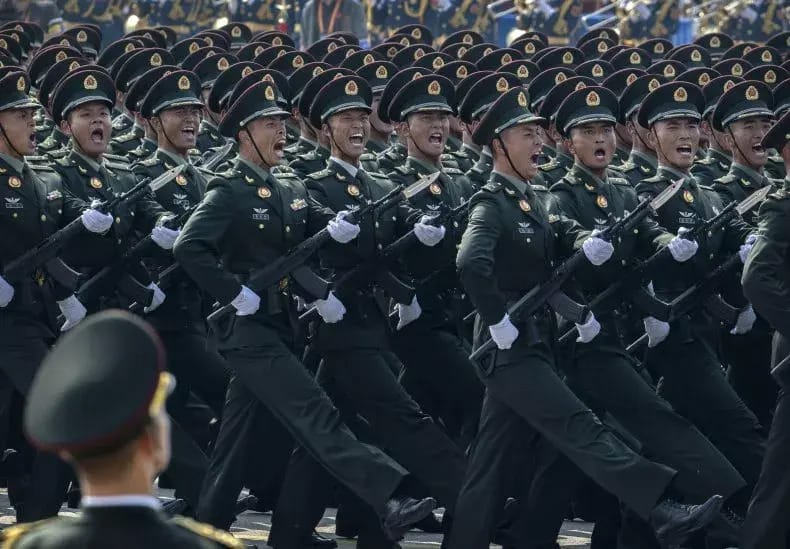
Why The West Can’t Pull This Off
Democratic nations often shy away from grand displays of power because such spectacles are seen as wasteful or authoritarian in nature, clashing with values of transparency and restraint. That said, this isn’t universal across the West, it often depends on national culture. France, for example, maintains one of the largest annual military parades in the world on Bastille Day, while the U.S. and U.K. tend to favour more subdued ceremonies or symbolic flyovers rather than massed displays of firepower.
Large-scale military parades or overt power shows are frequently criticised in Western societies as propaganda rather than legitimate statecraft, leading leaders to emphasise diplomacy and policy substance instead. In democracies, legitimacy is grounded in elections and institutions, not choreographed mass rituals, which helps explain the preference for modest optics over overt power projection. Public opinion in many Western states is skeptical of militarism, making it politically risky for leaders to stage the kind of displays that authoritarian governments can freely organise.
The Trump Parade
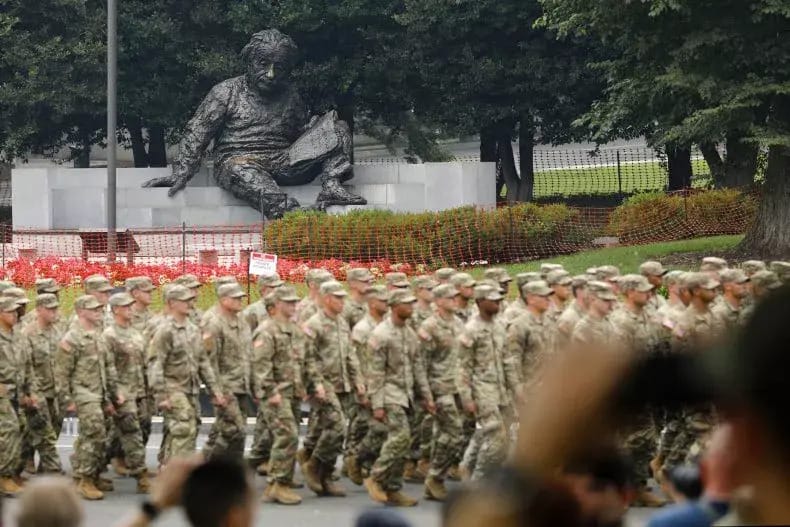
When Trump staged his military parade in June, intended to mark the U.S. Army’s long history of service, it failed by most accounts. On a practical level, it was rushed and poorly planned: soldiers marched in loose formations, boots and uniforms lacked uniformity, and the displays themselves appeared small rather than grandiose. But on a deeper level, the parade clashed with America’s political culture. Unlike France or Russia, the U.S. has never built its national identity on large-scale military spectacles. Its historical narrative is rooted in being anti-authoritarian, and in the Western imagination, parades of tanks and troops evoke the essence of militarism and authoritarianism. This isn’t just an opinion, it was proven by the large scale protests suggesting Trump’s authoritarianism on the day of and leading up to the parade in Washington. There was also backlash of $50 million dollar price tag of the parade during government cuts.
This created an attempt to strike a balance, avoiding the image of an authoritarian-style military showpiece while still projecting American power and honouring the history of the U.S. Army. In the end, it achieved neither, resulting in a failure on both fronts.
Trump’s attempt to import this style of politics into the U.S. felt forced, and rather than projecting strength, it revealed a weakness that rivals like China and Russia could exploit on the world stage. In contrast, Beijing’s Victory Day Parade served as a clear demonstration as a “this is how it’s done” moment.
Overall
We are not suggesting that military parades or spectacles are essential to statecraft. But their impact cannot be dismissed, especially in the age of social media where images travel faster than policy papers. When combined with the growing cultural divide between Western and non-Western values amongst civilians in Western nations, such displays become powerful tools of perception and influence. They matter not because they win wars, but because they frame narratives. And they matter even more when leaders like Trump attempt to borrow from that playbook but fail to execute, exposing the gulf between traditions of Western restraint and the authoritarian mastery of optics.
Sources:
Sources available upon request!
TWEET OF THE DAY
Is this the perfect visual of what’s to come? 😅
this guy watched his job get taken by AI in real time 😭
— FearBuck (@FearedBuck)
5:56 AM • Sep 6, 2025
TODAY IN HISTORY
(September 6, 1997): Funeral of Princess Diana
The world mourned as the funeral of Princess Diana was held in London, a week after her tragic death in a car accident in Paris. The ceremony was watched by an estimated 2.5 billion people worldwide, making it one of the most viewed broadcasts in history. The service featured moving tributes, including Elton John’s performance of Candle in the Wind, reworked in her memory, cementing Diana’s legacy as the “People’s Princess.”