- Basedment
- Posts
- Conflict Breaks Out In Northern Syria (Part 2)
Conflict Breaks Out In Northern Syria (Part 2)
Your daily dose of geopolitical updates and strategic analysis. Unbiased, but not unbased.

Editor-in-Chief
October 23, 2025
THE BRIEFING
Here’s what’s happening in geopolitics today.
It’s been another busy night in global affairs, with both new flashpoints and attempts at de-escalation.
The U.S. and China are set to meet in Malaysia for rare face-to-face trade talks, while Europe tightens the screws on Moscow with fresh sanctions and Russia flexes its nuclear muscle in response. Sweden takes a major step toward re-arming Ukraine, and a fragile peace may be taking shape between Thailand and Cambodia.
In today’s deep dive, we’re continuing to analyse the unfolding situation in northern Syria, which could be the catalyst for new conflict.
THE LAST 24 HOURS IN GEOPOLITICS
1. US and China to hold two-day trade talks in Malaysia on weekend
The U.S. Treasury Department and State Council of the People’s Republic of China are set to hold two-day trade talks in Malaysia this coming weekend, with the face-to-face meeting between Scott Bessent and He Lifeng aimed at resetting relations ahead of a potential summit between Donald Trump and Xi Jinping. The talks come as Beijing’s new export controls on rare-earths and Washington’s threatened 100% tariffs hang over the two largest economies, making this effort a key barometer of whether de-escalation is possible.
read more
2. Russia tests Sineva and Yars missiles in major nuclear drill
Putin oversaw a major exercise of Russia’s strategic nuclear forces that included launches of the RS‑24 Yars intercontinental ballistic missile and the R‑29RMU2 Sineva submarine-launched missile, among other components of the nuclear triad. Moscow said the drills were designed to test command procedures for authorising nuclear use and to display readiness amid heightened tensions with the West. The move signals a clear message that Russia is reinforcing its deterrent posture even as diplomatic efforts falter and geopolitical risks grow.
read more
3. Europe adopts 19th sanctions package against Russia, including LNG import ban
The European Union has adopted its 19th package of sanctions against Russia in response to the war in Ukraine, with one of the most significant measures being a ban on all imports of Russian liquefied natural gas (LNG). The LNG ban will roll out in two phases: contracts of short duration will end within six months, while longer-term agreements must be terminated by January 1 2027. Beyond energy, the package also tightens restrictions on Russian banks, added more vessels from Russia’s “shadow fleet,” and cracked down on entities in third countries facilitating Moscow’s war economy.
read more
4. Sweden agrees to sell 100-150 Gripen fighter jets to Ukraine
Sweden and Ukraine have signed a letter of intent for a major defence deal that could see the delivery of up to 100–150 JAS 39 Gripen fighter jets over the next decade. Swedish Prime Minister Ulf Kristersson emphasised that the agreement marks the start of a long journey with production and delivery expected to unfold over 10–15 years, with first aircraft possibly reaching Ukraine around 2026.
read more
5. Thailand, Cambodia expected to seal border deal at ASEAN Summit
Thailand and Cambodia are expected to sign a long-awaited border-ceasefire agreement at the upcoming Association of Southeast Asian Nations (ASEAN) summit in Kuala Lumpur, with both countries backed by facilitators such as Donald Trump and the summit host, Anwar Ibrahim. The pact is aimed at ending months of deadly border clashes that killed dozens and displaced hundreds of thousands, while also committing to land-mine removal, troop withdrawals and joint monitoring along the disputed 817 km frontier.
read more
DAILY DEEP DIVE
SYRIA’S ‘NIGHT OF THE LONG KNIVES’?
PART 2
Negotiations Ongoing?
Government and allied forces attacked Omar’s base with heavy weaponry throughout the entirety of yesterday, with at least ten members killed during the assault. However, the base still holds. According to Cedric, negotiations are underway to merge the French fighters from the camp into the 84th Army Division, which is primarily composed of Central Asian fighters. This proposal stems from the fact that the French and Central Asians were once combined before a peaceful split in 2018. The main issue is that Firkat al-Ghuraba carries too much bad blood with the former Hayat Tahrir al-Sham (now the current government), and it may be too late to integrate them into the central system without risking further violence in the future. As for Omar, no one seems to know his current situation or whether he is alive or dead. No official statements have been released from either side.
Fighting Spreading?
A recent video was shared showing a group of Uzbek jihadists pledging their support to Omar and the Firkat al-Ghuraba group. The size and capability of the group remain unclear, but what is more important is their decision to align with Omar. Their confidence possibly conveys that Jolani’s grip on foreign fighters may not be as firm as previously believed, at least in the north.
We have also seen a rise in IED bombings, first in Idlib, then Deir ez-Zor, and now Aleppo. A vehicle explosion struck the village of Al-Aziziya in the Al-Safira district of eastern Aleppo, killing two people after an explosive device planted in a vehicle belonging to Damascus government forces detonated. The incident underscores how instability is spreading beyond the traditional frontlines, showing that even regime-held areas are not immune to renewed unrest. However, we should be cautious about directly linking these incidents to the current fighting with Omar. The new Syrian government still faces numerous enemies, both internal and external. ISIS remains active in the Deir ez-Zor desert, while in Aleppo, tensions persist between government forces and the historically Kurdish neighbourhood of Sheikh Maqsoud.
Pain in the South
What certainly does not help the situation is further Israeli aggression in the south — and that is precisely what has just occurred. Israeli tanks deployed on the Syrian side of the border fired several shells tonight at the outskirts of Kuwiya, located in the Yarmuk Basin area of north-western Daraa. The strikes reportedly targeted positions near the village perimeter, though no casualties have been confirmed so far. This unchecked Israeli aggression is a major sore point for Al-Sharaa’s jihadists, who do not view events through a geopolitical lens but a religious one and for them, that means fighting Israel directly.
Conclusion
The same way we are watching events unfold in the north, rest assured that the various integrated foreign fighters within the Syrian army are watching closely too. As we’ve said, the outcome of this clash between Omar and Jolani will determine how much leverage al-Sharaa ultimately holds over his fighters. A failed negotiation or attempted takeover would amount to a major PR victory for Firkat al-Ghuraba, who would almost certainly call others to join their new jihad. Conversely, a successful deal or subjugation of the group would likely see those same integrated units continue to fall in line — as, ultimately, the central government controls the flow of both weaponry and financial support. It is, after all, a government backed by the U.S., Gulf States, and Turkey (to varying degrees).
Sources:
Sources available upon request, not shown to maintain visual integrity of page.
TWEET OF THE DAY
The new designs for the White House East Wing are out… 😂
Build Back Better ...
— Wall Street Mav (@WallStreetMav)
2:55 PM • Oct 22, 2025
TODAY IN HISTORY
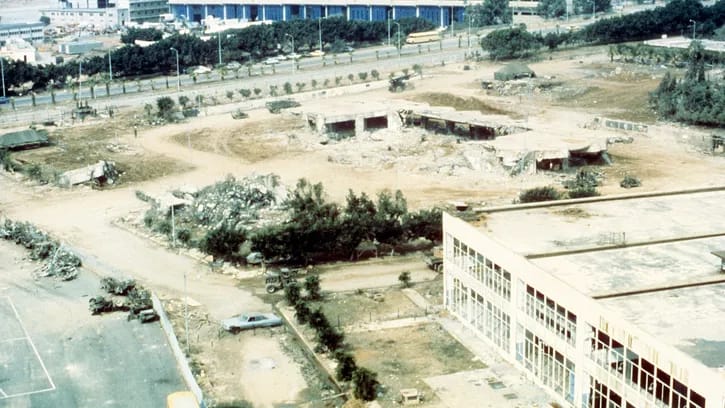
(October 23, 1983): U.S. and French troops attacked in Beirut
On this day in 1983, suicide bombers drove truckloads of high explosives into the barracks of U.S. Marines and French paratroopers in Beirut, killing 241 U.S. servicemen and 58 French troops.