- Basedment
- Posts
- EU Budget Blowup, UK-Germany Pact & Southern Syria’s Chaos
EU Budget Blowup, UK-Germany Pact & Southern Syria’s Chaos
Your daily dose of geopolitical updates and strategic analysis. Unbiased, but not unbased.

Editor-in-Chief
July 17, 2025
THE BRIEFING
Here’s what’s happening in geopolitics today.
Today's top developments span Europe, Asia, and the Middle East, as leaders navigate deepening alliances, political flashpoints, and billion-dollar deals.
Germany's rejection of the EU’s proposed budget has set off tensions in Brussels, while the U.K. and Germany prepare to formalise a new defence pact. Elsewhere, Bahrain is ramping up U.S. investments, Bangladesh is under curfew, and Trump is deflecting internal criticism over the Epstein case.
Today’s deep dive unpacks the escalating crisis in southern Syria, tracing key moments and actors shaping the volatile landscape across Sweida and Damascus.
THE LAST 24 HOURS IN GEOPOLITICS
1. Germany rejects EU’s €2 Trillion budget plan
Germany has firmly rejected the European Commission’s proposal for a record-breaking €2 trillion EU budget for 2028–2034, with Berlin calling the plan “unacceptable” amid ongoing national fiscal consolidation. Chancellor Friedrich Merz’s government criticised new EU-wide taxes targeting big corporations, warning that such measures would send the “wrong signal” to investors. The rebuff sets the stage for heated negotiations within Brussels as member states and the European Parliament prepare for what officials describe as a “two-year marathon” to reconcile competing priorities.
read more
2. Trump lashes out at Republicans questioning his handling of Jeffrey Epstein case
Trump launched a fierce attack on fellow Republicans who criticized his handling of the Jeffrey Epstein saga, branding them as “weaklings” and dismissing the issue as a “Democrat hoax”. He defended Attorney General Pam Bondi and affirmed that any credible Epstein-related documents could be released, but insisted the controversy distracts from his administration’s broader achievements. The backlash underscores deepening divisions within the MAGA base, as some GOP figures continue calling for transparency and file disclosure.
read more
3. Bangladesh imposes curfew after violence in Hasina’s stronghold
At least four people were killed and several more injured after clashes broke out between supporters of ex‑prime minister Sheikh Hasina’s Awami League and security forces in Gopalganj, Hasina’s political heartland. The unrest followed a youth-led protest by the National Citizen Party, prompting authorities to impose a curfew across the area. The violent confrontation highlights deepening political rifts as Bangladesh prepares for elections and navigates a fragile interim government.
read more
4. UK and Germany to pledge to defend each other in reset of ties
Germany and the U.K. are set to sign a landmark treaty enhancing defense collaboration, trade, and joint efforts against migrant smuggling, reflecting a post-Brexit rapprochement. The agreement includes a mutual assistance clause, meaning a strategic threat to one nation would be considered a threat to both, and paves the way for co-development of military equipment such as Boxer armoured vehicles, Typhoon jets, and long-range missiles. It also introduces enhanced cooperation in law enforcement and cultural exchange initiatives like expanded school-trip travel, signalling a modern reset in U.K.–Germany ties and Europe's broader security architecture.
read more
5. Bahrain’s PM vows $17 Billion US investment during Trump meeting
During talks at the White House, Bahrain’s Crown Prince Salman bin Hamad Al Khalifa unveiled a $17 billion deal to purchase American-made aircraft and engines, as well as invest in sectors like energy, technology, manufacturing, and civilian nuclear projects, supporting around 30,000 U.S. jobs. The package includes a $7 billion commitment for 12 Gulf Air planes with an option for six more, along with major investments in LNG, aluminum, AI chips, and digital infrastructure.
read more
DAILY DEEP DIVE
THE SOUTHERN SYRIA CONFLICT EXPLAINED:
THE GOOD, THE BAD, THE COMPLICATED
Disclaimer:
Real-time conflicts often generate both misinformation and disinformation. To understand events accurately, it’s vital to examine multiple sources. This timeline (11–16 July 2025) is drawn from two respected but ideologically different analysts: Charles Lister (pro-Transitional Government) and Suriyak (critical of the government but technically detailed). At Basedment, our goal is to cut through bias and present clear, well-sourced conflict reporting—so you don’t have to.
BACKGROUND
The current fighting began on 11 July, after a Druze driver was attacked by Bedouin gunmen, sparking retaliatory kidnappings and escalating into a broader confrontation. The STG, with Bedouin and SNA support, launched an offensive into Suwayda. The Suwayda Military Council (SMC), led by Hikmat al-Hijri, rejected integration with the new Syrian government and resisted ceasefires. The conflict is deeply rooted in smuggling, land disputes, and long-standing political autonomy.
13 July – STG Offensive
Suriyak: STG and SNA forces, supported by Bedouin units, captured key areas across Al-Surah al-Saghirah, Al-Ariqah, Al-Mazraa, and Markaz As-Suwayda, including Khalkhalah airbase and Tha’lah airbase.
Lister: Frames the offensive as part of STG’s long-building clash with Hijri's Druze bloc, with Israeli support to the SMC likely beginning covertly.
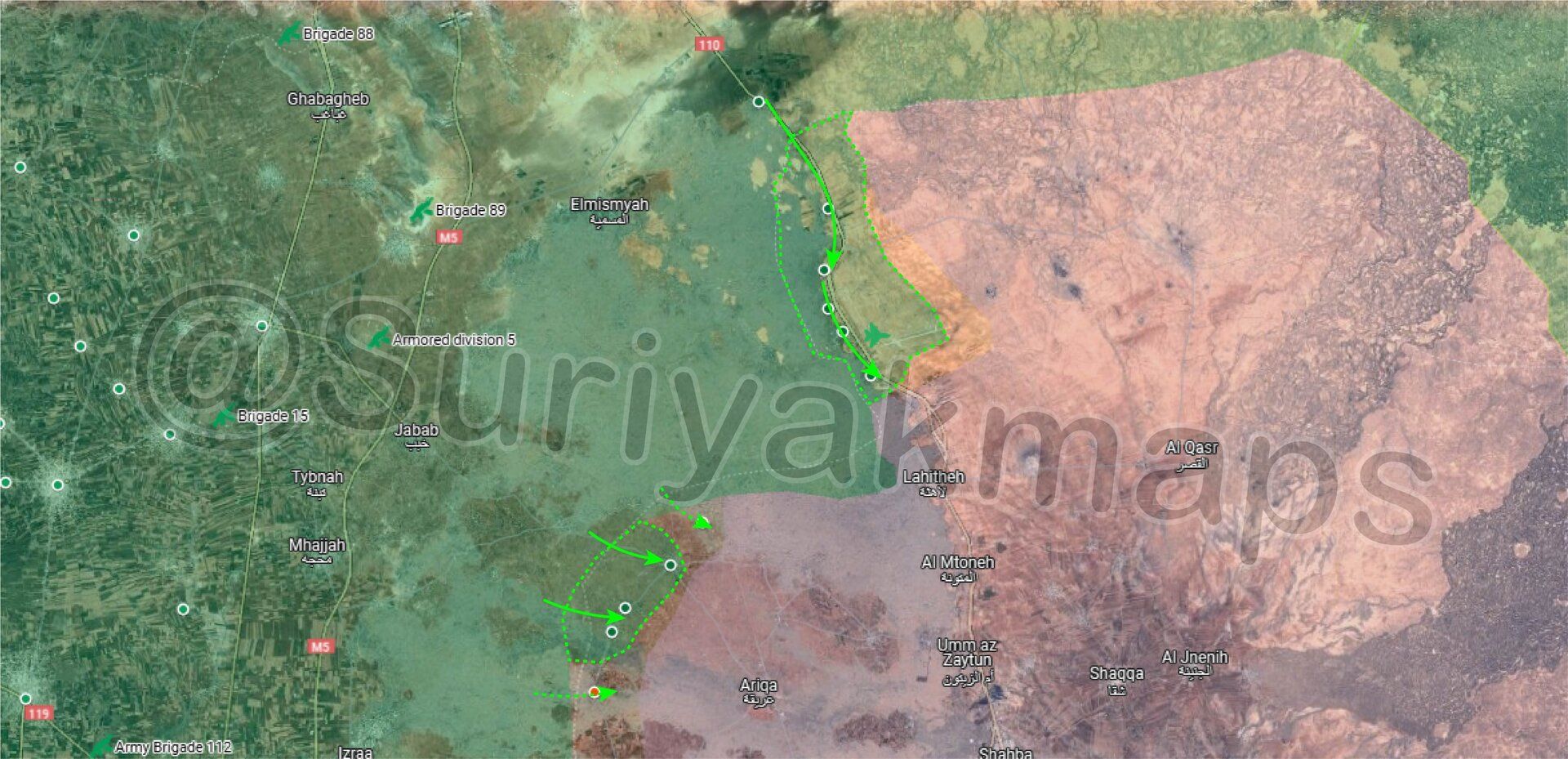
GREEN: Syrian Government Forces. PURPLE: Druze community
14 July – Druze Counterattack & Israeli Strikes
Suriyak: Druze militias reversed STG gains in parts of Suwayda. STG advanced on Najran and suburbs west of Suwayda city.
Lister: Syrian military entered Suwayda for the first time in years, breaking past agreements. Druze militias ambushed troops, executed several, and shelled Bedouin areas. Israel intensified drone strikes targeting STG armour and troop convoys.

JULY 14TH
15 July – Urban Combat & First Ceasefire Attempt
Druze sheikhs allowed STG and Interior Ministry forces into Suwayda city under a ceasefire deal.
Lister: Hijri rejected the ceasefire. Israel resumed airstrikes. Regime troops were ambushed across nine zones.
Suriyak: Druze fighters pushed STG out of most of Suwayda city. STG forces regrouped and re-entered Sawarah al-Kebirah, Hazm, Khalkhalah, and reached Al-Anqoud Roundabout.

JULY 15TH
16 July – Second Ceasefire, Renewed Fighting, US-Turkey Deal
Morning: STG briefly regained 50% of Suwayda city. Heavy street battles continued.
Later: Second ceasefire announced, again rejected by Hijri. Protests erupted in Jaramana.
Evening: Third ceasefire reached via U.S. and Turkish mediation:
Syrian military withdrew.
Interior Ministry took over city control.
STG forces redeployed to outskirts, attacking Atil, Qanawat, and retaking Dhakir.
Suriyak: Reports atrocities by STG-aligned fighters before withdrawal. Conflicting maps show contested control, but Ariqa, Shahba, and Al-Qrayya remain under Druze control.

JULY 16TH
JULY 17TH - COMPLETE GOVERNMENT WITHDRAWAL
Following the implementation of the agreement and cessation of hostilities, Ministry of Interior security forces and remaining STG units fully withdrew from Suwayda Governorate.
Druze militias rapidly filled the power vacuum, taking full control of the entire governorate within hours.
They advanced to the borders of Rif Damascus and Daraa, establishing full territorial control.
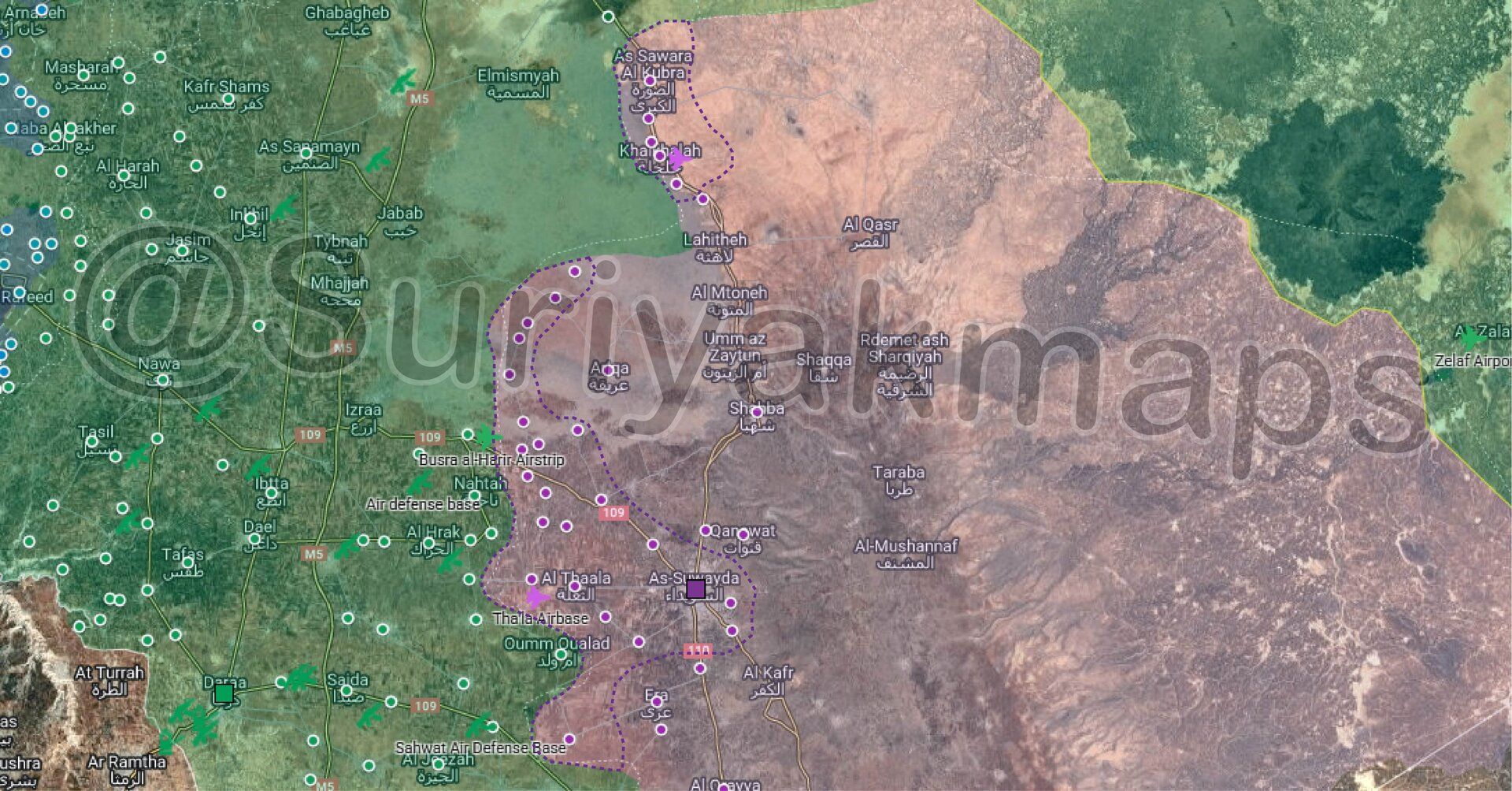
JULY 17TH
KEY ACTORS IN SOUTHERN SYRIA:
This section will primarily focus on actors in the current southern conflict. Notable actors across the wider Syrian geopolitical space will require much more analysis and will be saved for another day.
ISRAEL
Israel has supported the Druze community in multiple ways. It has allowed civilian evacuations across the border and launched major airstrikes against the Syrian government, targeting troop convoys, military installations, the Interior Ministry, and the Presidential Palace in Damascus.
Israel’s strategic goal is to keep Syria weak (an adversary since the late 1940s). While in talks with the new Syrian government, Israel continues using military pressure to limit Syria’s regional influence and hard power. Supporting the Druze serves as a means to establish a buffer zone, expand local influence, and deny legitimacy to the new government.
TRANSITIONAL SYRIAN GOVERNMENT
The government’s top priority is unifying Syria under one state. This includes outreach to the U.S.-backed Syrian Democratic Forces (SDF) and efforts to reintegrate the Druze.
Al-Sharaa (Al-Jolani) seeks unification for two main reasons: to consolidate internal control and to reduce foreign influence that has historically hindered Syrian decision-making. Both the SDF and Israeli-backed Druze factions can obstruct this goal. Al-Sharaa is attempting to balance relations with regional rivals, especially Israel. In a national broadcast, he stated: “Syria knows well who’s trying to drag us into war and division… Since the fall of the regime, Israel has sought to dismantle Syria… This crisis with Israel was resolved only thanks to American, Arab, and Turkish mediation.”
DRUZE COMMUNITY
Under Assad, the Druze enjoyed partial autonomy, including exemption from military mobilisation. They remained neutral during the civil war, refusing to back the FSA in southern Syria.
Relations with Damascus declined 6–12 months before Assad’s fall due to corruption, drug trade disputes, and clan tensions. Now, the community is divided. Some are open to integration, while others, notably the Suwayda Military Council, resist it to preserve autonomy and control over local smuggling routes. With Israeli backing, these factions have pushed back militarily, asserting a distinct political identity and resisting central authority.
TURKEY
Though not militarily involved in southern Syria, Turkey played a key role (alongside the U.S.) in brokering the latest ceasefire. Despite past clashes with Al-Sharaa during the Idlib rebel wars, Turkey remains a primary backer of the former opposition.
Turkey views Syria as a buffer zone to project regional influence and counter Iran and Israel. Avoiding direct conflict, Ankara has relied on diplomacy to displace Israeli influence in the south. Its soft-power approach aligns with broader goals of shaping Syria’s future without military overreach
Sources:
@Charles Lister on X
@SuriyakMaps on Telegram.
TWEET OF THE DAY
Any of our readers body language experts?… we’re puzzled by this one 😅
You don’t have to be a body language expert
— ĐⱤØ₲Ø🇺🇸 (@KAGdrogo)
8:52 PM • Jul 16, 2025
TODAY IN HISTORY
(July 17, 1936): A coordinated military uprising by Nationalist forces against Spain’s Republican government began on this day in 1936. The rebellion triggered a brutal civil war that lasted until 1939, culminating in a Nationalist victory and the rise of Francisco Franco to power.
