- Basedment
- Posts
- Frontline Reality From Interview With Ukrainian Commander
Frontline Reality From Interview With Ukrainian Commander
Your daily dose of geopolitical updates and strategic analysis. Unbiased, but not unbased.

Editor-in-Chief
October 11, 2025
THE BRIEFING
Here’s what’s happening in geopolitics today.
Geopolitical movement across all corners of the world today. In Gaza, Palestinians are returning north as the Israel–Hamas ceasefire holds under Trump’s peace plan. In China, Beijing tightened rare-earth export controls ahead of a possible Trump–Xi meeting, raising trade tensions alongside 100% tariffs being threatened by Trump.
In Washington, Melania Trump said she worked with Putin to reunite Ukrainian children separated by war. Denmark unveiled a $4.2 billion Arctic defence boost, adding F-35s and ships in Greenland.
Meanwhile, North Korea’s Kim Jong Un revealed the Hwasong-20 ICBM at a parade with Russian and Chinese officials, signalling deeper military ties.
Today we’re going to analyse and read-between-the lines from a very informative interview with journalist Neil Hauer and Ukrainian commander ‘Bobruk’.
THE LAST 24 HOURS IN GEOPOLITICS
1. Thousands of Palestinians return to North Gaza as many questions remain
Tens of thousands of Palestinians are returning to northern Gaza as a ceasefire between Israel and Hamas takes hold under the first phase of a peace deal. Israel has begun partial troop withdrawals, and U.S. President Donald Trump announced that Israeli captives will be released Monday. Hamas, PIJ, and the PFLP rejected any foreign oversight of Gaza. Gaza officials demand war crimes investigations, while UNRWA urges border openings for 6,000 waiting aid trucks.
read more
2. Denmark to boost Arctic defence by spending over $4 billion, wants to buy F-35’s
Denmark has announced a $4.2 billion defence expansion to strengthen security across Greenland, the Arctic, and North Atlantic. The plan includes two new Arctic ships, patrol planes, drones, early warning radar, and a new Arctic Command HQ in Nuuk. Additionally, Denmark will buy 16 more F-35 jets from the U.S., bringing its total to 43. The move follows Trump’s renewed calls to acquire Greenland, citing its strategic and resource value, as Denmark balances deterrence and NATO commitments.
read more
3. China tightens export controls on five additional rare-earth metals
China has tightened export controls on five additional rare-earth metals—holmium, erbium, thulium, europium, and ytterbium—bringing its total restricted minerals to 12 out of 17. The move, citing national security, also limits exports of refining technology and equipment starting December 1. Coming ahead of a Trump–Xi meeting, analysts see it as a strategic bid to gain leverage in ongoing U.S.–China trade talks. The U.S., which relies on China for 70% of its rare-earth imports, faces mounting pressure on its defense and tech industries.
read more
4. First Lady reveals she has been working with Putin for months over lost children
Eight Ukrainian children taken to Russia have been reunited with their families after months of secret diplomacy led by U.S. First Lady Melania Trump, who said she has been in direct communication with Vladimir Putin. Trump revealed that Russia agreed to return more children soon, including those who turned 18 after being displaced. She emphasized cooperation “for the benefit of all people involved in this war,” with both sides sharing health records. Melania vowed to continue reunifications “until each individual returns home.”.
read more
5. North Korea holds major military parade for 80th anniversary of its ruling party
North Korea held a major military parade in Pyongyang marking the 80th anniversary of its ruling Workers’ Party, showcasing its new Hwasong-20 intercontinental ballistic missile, described as the country’s most powerful nuclear weapon. Kim Jong Un oversaw the event attended by Chinese Premier Li Qiang, Russia’s Dmitry Medvedev, and Vietnam’s To Lam. Kim and Medvedev held talks pledging deeper cooperation, with Medvedev praising North Korean soldiers fighting alongside Russian forces in Ukraine. Analysts believe the new ICBM could carry multiple warheads.
read more
DAILY DEEP DIVE
READING BETWEEN THE LINES FROM UKRAINIAN INTERVIEWS
Journalist Neil Hauer recently interviewed “Bobruk,” a commander from Ukraine’s 14th Brigade and it’s one of the most insightful on-the-ground perspectives we’ve seen in months. The full article will be released soon but he has dropped a questions and answers type thread on X that we have linked below. We’ve broken down some of the most interesting parts, added context, and read between the lines to answer a few common questions many newcomers to the conflict often have.
Read here
1. “Bobruk and his team had just completed a 90-day rotation, spending nearly the entire time on the zero line (the grey zone between forces) followed by just five days of rest, mostly within the Donetsk region.”
When analysts discuss Russia’s manpower advantage, the focus is often on its ability to apply constant pressure. What’s less often mentioned is why that’s possible: Russia’s rotation system, which relies on maintaining troop strength at roughly 92–95% of intended levels. This allows Moscow to withdraw units that have dropped to around half strength for rest and replenishment, replacing them with fresh troops to sustain momentum. These rotations help prevent total exhaustion and preserve short-term combat tempo. However, analysts note the system is unsustainable long-term without better-equipped reserves or new large-scale mobilisations. While the exact rotation cycle varies depending on logistics, unit condition, and intensity of fighting, Russia’s ability to rotate troops consistently across the front contrasts sharply with Ukraine’s limited manpower — leaving many Ukrainian units fatigued, understrength, and prone to errors. Russian assault units are tiny, often one to four soldiers. In many cases, just a single soldier is sent as a DRG (recon-sabotage group) to avoid drone detection. Groups larger than two are easily spotted and quickly targeted.
2. “When major Russian assaults occur, they are almost always launched on motorbikes. Bobruk recalled one such attack involving 112 motorbikes, each carrying two soldiers, 224 men in total. Only ten survived.”
These motorcycle assaults are the modern equivalent of Napoleonic-era dragoons: fast-moving and capable of rapid flanking attacks, but extremely lightly armoured. At least one rider per squad typically carries electronic warfare equipment to jam enemy drones. They often strike from the flanks to overwhelm small Ukrainian positions but suffer heavy losses.
3. “Pro-Russian civilian support remains a serious challenge in many frontline villages.”
This is a reality often overlooked by pro-Ukrainian commentary. For clarity, we do not support either side, but the ethnic and political landscape in eastern Ukraine is complex. Both Russian and Ukrainian forces face issues with civilians operating in or near combat zones, particularly in areas behind Russian lines. In the age of smartphones and the internet, civilians can cause enormous damage — a single photo, message, or location tag can reveal troop movements and lead to drone or artillery strikes within minutes.
4. Bobruk does not believe a major Russian offensive is coming this fall. “They’re already doing all they can, throwing manpower constantly,” he said. “They don’t have the strength, and armour no longer has the same impact it did earlier in the war.”
This aligns with our previous assessments. While we may see localised operational pauses, already observed on several fronts, a large-scale offensive is unlikely. The winter of 2024 saw Russia make its most notable gains, and it remains in Moscow’s interest to maintain its constant-pressure strategy rather than slow operations entirely.
For added context Bobruk has been fighting east of Pokrovsk city at Novoekonomichne.
Sources:
Sources available upon request, not shown to maintain visual integrity of page.
TWEET OF THE DAY
What do our friends across the pond think of this?
UK becomes a two-party system of Reform and LibDems, finally completing their transformation into USA Jr.
— 𝖓𝖎𝖓𝖊 🕯 (@atlanticesque)
5:33 PM • Oct 9, 2025
TODAY IN HISTORY
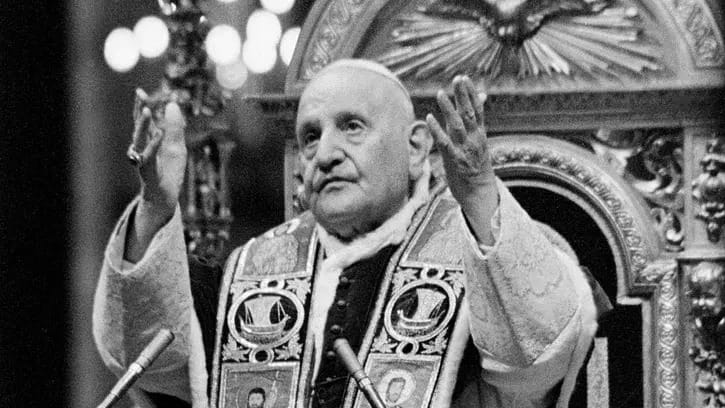
(October 11, 1962): Second Vatican Council Opens
The Second Vatican Council officially opened in Rome, marking a turning point for the Catholic Church. Announced by Pope John XXIII in 1959, the council aimed to modernise the Church’s relationship with the contemporary world. Over the next three years, it introduced sweeping reforms in worship, language, and interfaith relations — changes that remain both influential and controversial to this day.