- Basedment
- Posts
- Gaza Talks, Texas Tragedy, and Russia’s Tank Revival
Gaza Talks, Texas Tragedy, and Russia’s Tank Revival
Your daily dose of geopolitical updates and strategic analysis. Unbiased, but not unbased.

Editor-in-Chief
July 08, 2025
THE BRIEFING
Here’s what’s happening in geopolitics today.
From deadly floods in Texas to diplomatic chess games in Washington, global affairs are shifting rapidly.
Netanyahu’s hush around a possible Gaza ceasefire contrasts Trump’s tariff threats against BRICS nations, while U.S. officials tout unexpected progress in talks to curb Hezbollah’s power in Lebanon. Meanwhile, Kenya’s streets erupted in violence as police fired on protesters marking a pro-democracy anniversary.
Against this backdrop of geopolitical turmoil and shifting alliances, we turn our focus today to Russia’s tank industry. Big claims have been made for many years that Russia is running out of tanks, we explore how true this is.
THE LAST 24 HOURS IN GEOPOLITICS
1. Netanyahu and Trump to discuss new Gaza deal at White House
Israeli Prime Minister Benjamin Netanyahu arrived at Joint Base Andrews ahead of his scheduled meeting with U.S. President Donald Trump at the White House. The discussions are expected to focus on a potential 60-day ceasefire in Gaza, with indirect negotiations between Israel and Hamas ongoing in Doha. While Trump has expressed optimism about reaching an agreement, Netanyahu has remained silent on the matter, reflecting the complexities surrounding the ceasefire talks.
read more
2. Death toll rises to 82 after catastrophic Texas flood
The death toll from the catastrophic Texas floods has risen to at least 82, with 68 fatalities reported in Kerr County, including 28 children. The floods, triggered by over 12 inches of rain, caused the Guadalupe River to surge 26 feet in just 45 minutes, devastating areas like Camp Mystic, where several campers and a counselor remain missing. While skies have cleared, offering some respite, search and rescue operations continue for the 41 individuals still unaccounted for.
read more
3. Trump threatens extra 10% tariff on nations siding with BRICS
Trump has threatened to impose an additional 10% tariff on countries aligning with the BRICS bloc, labeling their policies as "anti-American." This announcement coincided with the BRICS summit in Rio de Janeiro, where leaders from member nations, including Brazil, Russia, India, China, and South Africa, gathered to discuss multilateral cooperation and global governance reforms. The proposed tariffs have sparked concerns over escalating trade tensions and their potential impact on global economic stability.
read more
4. U.S. ‘unbelievably satisfied’ with Lebanon’s reply to proposal on disarming Hezbollah
U.S. special envoy Thomas Barrack expressed strong approval of Lebanon's response to a U.S. proposal concerning the disarmament of Hezbollah. After meeting with Lebanese President Joseph Aoun, Barrack described the government's reaction as "spectacular," adding he was "unbelievably satisfied" with the reply. Although details of the response were not shared publicly, it was confirmed that Aoun’s team had submitted a detailed seven-page document addressing the June 19 American proposal. This development comes despite Hezbollah indicating in recent days that it would not fully relinquish its weapons. The outcome suggests potential progress in U.S.-Lebanon diplomatic efforts addressing regional security concerns.
read more
5. Kenya police open fire on charging crowd of protesters in Nairobi
Kenyan police opened fire on protesters in Nairobi on July 7 during nationwide demonstrations marking the 35th anniversary of the pro-democracy Saba Saba movement. The protests, sparked by the death of blogger Albert Ojwang in police custody, have intensified longstanding grievances over tax hikes, corruption, and police brutality. Authorities responded with tear gas, water cannons, and live ammunition, resulting in at least one demonstrator being injured, as tensions continue to escalate across the country.
read more
DAILY DEEP DIVE
Russia’s Tank Industry in Transition: Modernisation, Limits, and Strategic Shifts
A new report by the Conflict Intelligence Team (CIT) on Russia’s tank production has sparked widespread interest among analysts and military observers. The report provides detailed insight into Uralvagonzavod’s expanding T-90M output, refurbishments of older models, and the broader trends in Russia’s armoured vehicle strategy.
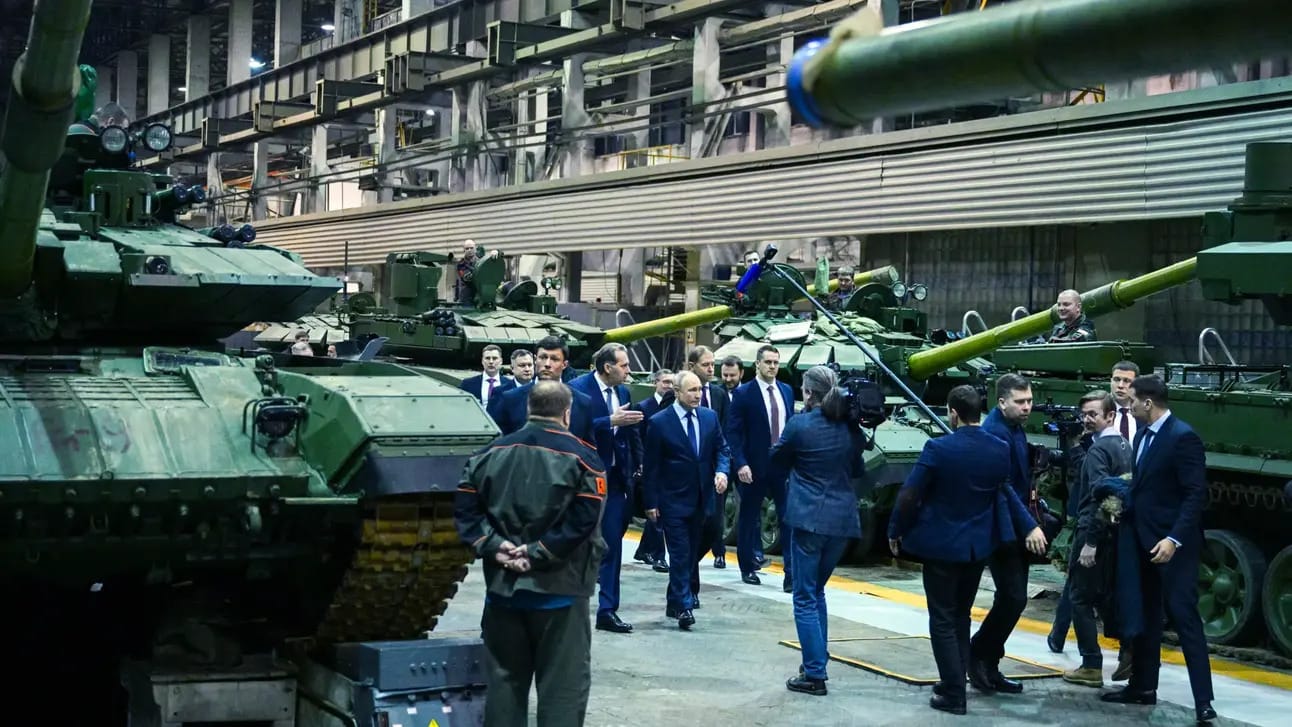
Putin at the facility.
1. Uralvagonzavod's Output and T-90 Production: Past, Present, and Future
Russia’s main tank manufacturer, Uralvagonzavod (UVZ), has emerged as a central pillar of Moscow’s wartime rearmament strategy. Prior to the full-scale invasion of Ukraine in 2022, UVZ had produced between 120 and 150 original T-90s and around 280 T-90A variants. By February 2022, the Russian army had between 65 and 85 T-90M Proryv tanks, in addition to 370–380 older T-90 models.
Production has sharply increased since then. UVZ built an estimated 60–70 T-90Ms in 2022, followed by 140–180 units in 2023 as the factory transitioned to a 24/7, three-shift operation. By 2024, output is believed to have reached 250–300 new T-90M tanks annually. Unlike earlier periods, all tanks currently being produced are new builds, not upgrades.
Estimates suggest that since 2022, 540–630 T-90M tanks have been produced or upgraded, with at least 130 destroyed (or severely damaged) in combat. This leaves approximately 410–500 T-90Ms in service, making up around 15% of Russia’s deployed tank fleet (2025). Efforts to scale production further are underway. UVZ has issued tenders for new welding stations and machining stands, with an eye toward future growth. However, a substantial increase would require long-term investment in new assembly lines and modern equipment.
2. Modernisation and Cannibalisation of T72’s and T80’s
Alongside new T-90M production, Russia continues to rely heavily on the modernisation of older platforms, particularly the T-72B3 and T-80BVM. Uralvagonzavod has updated the T-72B3 multiple times since the full-scale invasion. T-72B and T-72B1 upgrades to the B3 standard also continue at volume—about 200 modernisations were recorded in 2024.
Cannibalisation remains key to sustaining the armoured fleet. According to NATO estimates (2024), 86% of Russia’s tank output last year consisted of refurbished vehicles. While Moscow holds around 5,000 tanks in storage, a large share are useful only as parts donors due to poor condition. Although Russia announced a resumption of T-80 production in late 2023, tangible progress remains unclear. Open-source analysts estimate that “good condition” T-80s in storage dropped from 1,200 to 300 by early 2025, suggesting the usable stockpile will be exhausted by mid-2026.
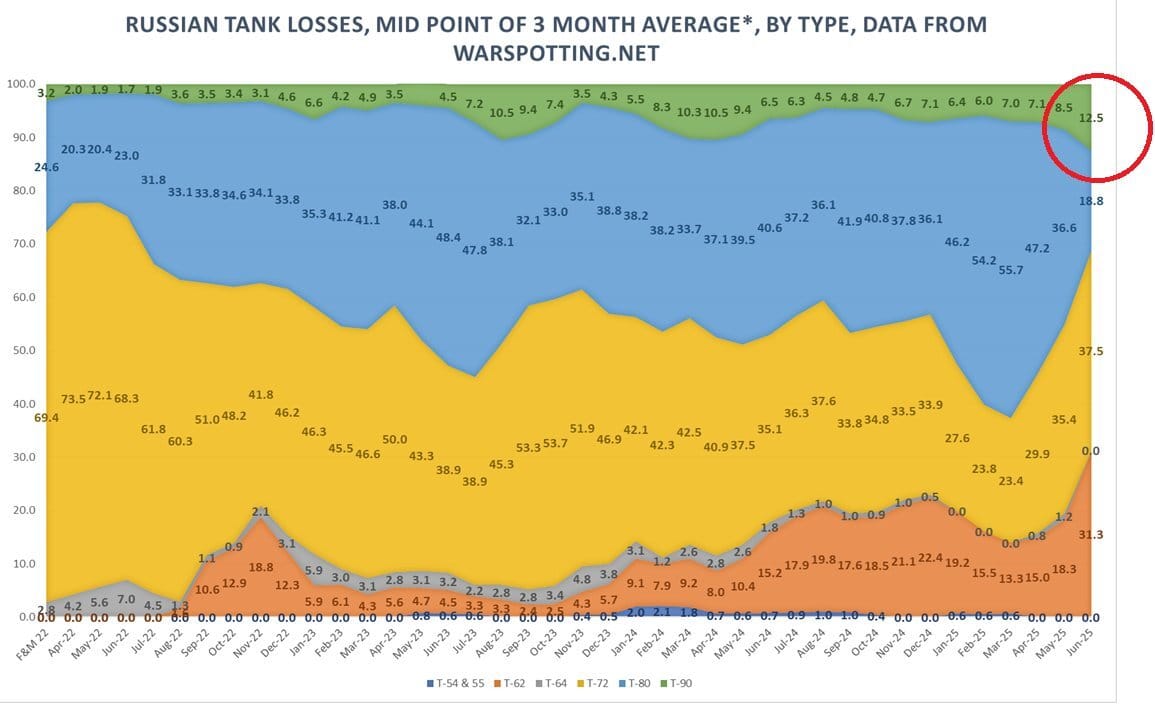
Small uptick in T90 losses is more a statistical anomaly, but focus more on the drastic drop of T80’s (as discussed) and rise of T62’s. These losses are a good indicator of which models are being used more on the front.
3. Electronics, Optics, and Chinese support
Russia’s tank production is closely tied to advancements in optics and electronics, primarily driven by Shvabe Holding, a Rostec subsidiary. Leaked documents from 2024 reveal key ongoing projects, including thermal imagers, fire control systems, and laser tech for tanks and UAVs. Firms like KMZ, Lytkarino, POLYUS, and VOMZ are involved in various upgrades, such as integrating UAVs into tank targeting systems.However, internal records highlight recurring issues with quality control and delays, notably with the OPS-28M system for Mi-28 helicopters.
To sustain production, Russia increasingly depends on Chinese industrial support. Shvabe affiliates, such as Zenit-Investprom, source CNC machines from Chinese firms like Push Ningjiang and Tianjin No.1 Machine Tool. Shvabe Opto-Electronics, based in Shenzhen since 2009 and under U.S. sanctions, continues to supply critical components. These workarounds form the backbone of Russia’s import substitution strategy, allowing production to continue despite Western sanctions.
4. Will Russia Run Out of Tanks?
As of June 2025, Russia recorded its lowest monthly vehicle losses since the war began: 149 destroyed, including 17 tanks — a 30% drop from May, which had already declined 30% from April.
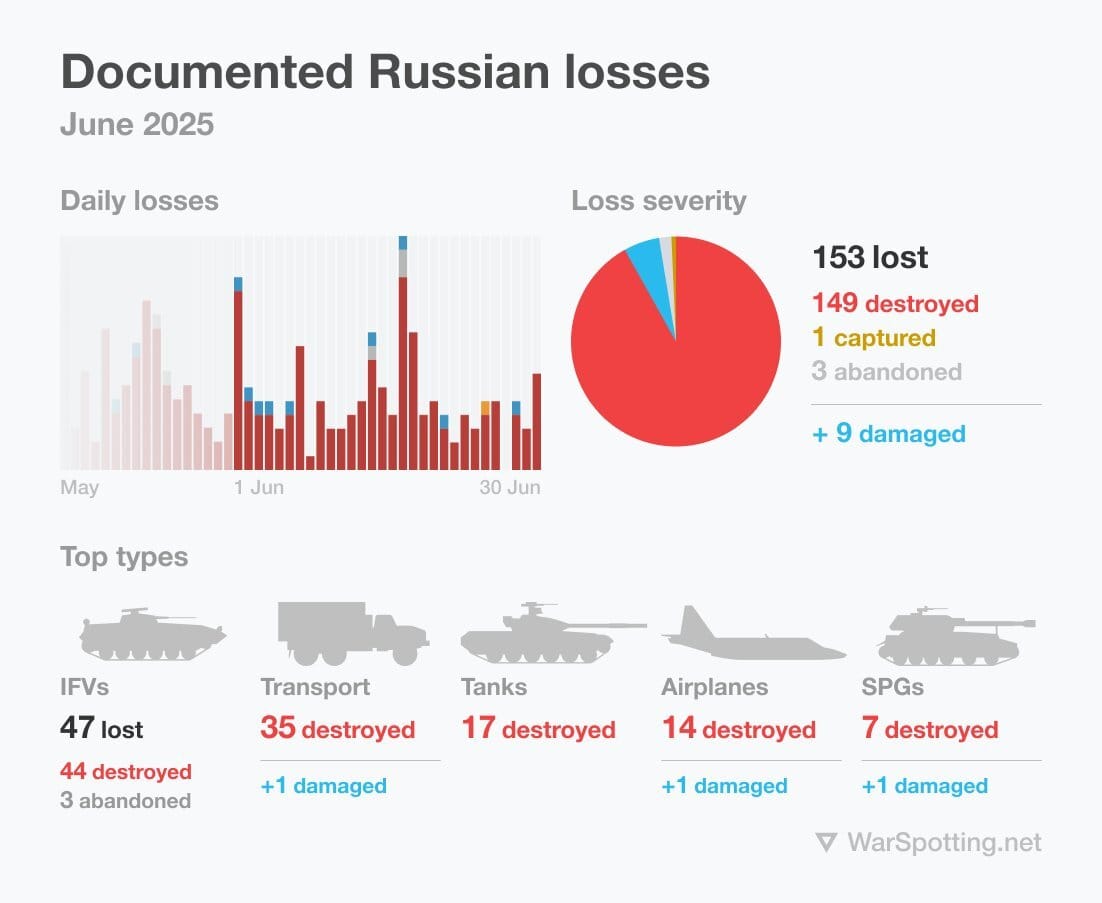
The reliability of the data is up for debate as some would argue it skews data in favour of Ukraine, but importantly it does show considerable drops in Russian losses that corresponds with other research.
Tank attrition in 2025 is far below 2022–2023 levels, largely due to the reduced use of frontal mechanised assaults. Tanks now serve mainly in support and direct-fire roles, especially older models like the T-55, often used from concealed positions.
Despite ongoing quality control issues and reliance on refurbished tanks, Russia’s output of 250–300 new T-90Ms annually, combined with modernisation programs and older stored models, likely sustains operational needs through at least 2026.
However, production expansion is limited. Bottlenecks in barrel manufacturing at Zavod No. 9 and delays in equipment upgrades (evident from 2024 internal correspondence) continue to slow scaling efforts.
Experts like Tatagrami and the Conflict Intelligence Team stress that Stronger enforcement of sanctions and export controls, particularly targeting industrial machinery routed through third countries, remains essential to curb long-term rearmament.
Sources:
CNN – Russia artillery shell production far outpaces U.S. and Europe
https://edition.cnn.com/2024/03/10/politics/russia-artillery-shell-production-us-europe-ukraine
Conflict Intelligence Team (CIT) – How Many Т-90M Tanks Does Russia Produce?
https://notes.citeam.org/eng_t90
Defence UA – Researchers Counted Remaining T-80 MBTs in Russian Storage — Enough to Keep the Army Supplied Until 2026https://en.defenceua.com/analysis/researchers_counted_remaining_t_80_mbts_in_russian_storage_enough_to_keep_the_army_supplied_until_2026-11028.html
Frontelligence Insight – Through the Optics of War: How Shvabe Shapes Russia’s Optical Capabilities
https://frontelligence.substack.com/p/through-the-optics-of-war-how-shvabe
Oryx – Attack on Europe: Documenting Equipment Losses During the Russian Invasion of Ukraine
https://www.oryxspioenkop.com/2022/02/attack-on-europe-documenting-equipment.html
Twitter / X – Richard Vereker
https://x.com/verekerrichard1/status/1941563072918978612
Twitter / X – WarSpotting
https://x.com/WarSpotting/status/1941145142565703718
TWEET OF THE DAY
Did Barron Trump foresee it all…?
Baron is the three-eyed raven
— litquidity (@litcapital)
10:05 PM • Jul 6, 2025
TODAY IN HISTORY
(July 7, 1807): The first of the Treaties of Tilsit was signed between France and Russia after Napoleon's victories over the Russian and Prussian armies. This treaty was signed on July 7, 1807, following Napoleon's victory at the Battle of Friedland.
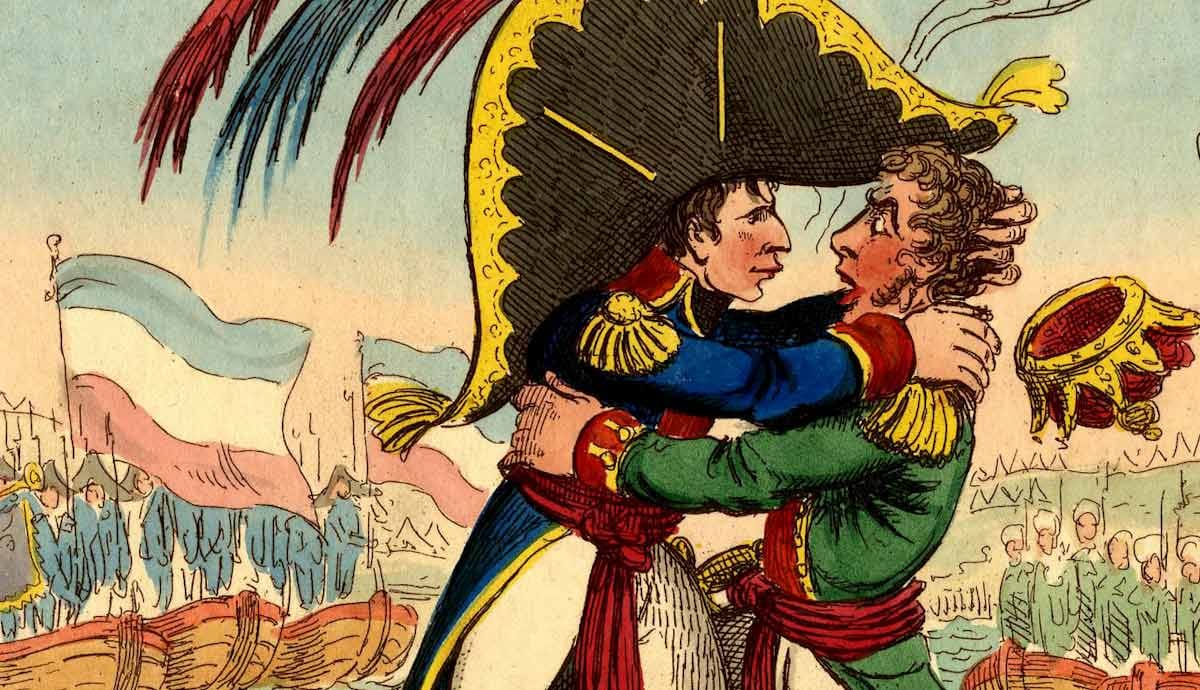
Napoleon vs. Tsar Alexander