- Basedment
- Posts
- GEOPOLITICS DAILY BRIEFING - 25 June
GEOPOLITICS DAILY BRIEFING - 25 June
Your daily dose of geopolitical updates and strategic analysis. Unbiased, but not unbased.

Editor-in-Chief
June 26, 2025
THE BRIEFING
Here’s what’s happening in geopolitics today.
Today's global briefing captures a world in motion, where parliaments, pulpits, protests, and payloads are reshaping headlines.
Iran has taken a drastic step in suspending nuclear cooperation, while Armenia grapples with allegations of a church-backed coup. Meanwhile, floods in China and unrest in Kenya remind us of the compounding pressures from both nature and political discontent.
We wrap the issue with a deeper dive into the battlefield realities in Ukraine, where Russian forces are breaching defensive lines with growing tactical precision
THE LAST 24 HOURS IN GEOPOLITICS
1. Iranian parliament approves bill to suspend cooperation with UN nuclear watchdog
Iran's parliament has approved a bill to suspend cooperation with the International Atomic Energy Agency (IAEA), significantly escalating tensions over its nuclear program. The legislation, passed with 221 out of 223 lawmakers in favor, mandates halting IAEA inspections, surveillance camera installations, and reporting activities. This move follows recent Israeli and U.S. airstrikes on Iranian nuclear facilities, which Tehran claims the IAEA failed to condemn, accusing the agency of bias and endangering its scientists.
read more
2. Armenia arrests archbishop over alleged coup plot
Armenian authorities have arrested Archbishop Bagrat Galstanyan, accusing him of orchestrating a coup plot to overthrow Prime Minister Nikol Pashinyan's government. According to the Investigative Committee, Galstanyan and his alleged co-conspirators recruited over 1,000 individuals, including former soldiers and police officers, to block roads, incite violence, and disrupt communications in an attempt to seize power. This arrest follows the earlier detention of billionaire Samvel Karapetyan on similar charges, amid escalating tensions linked to Armenia's territorial losses in the 2020 conflict with Azerbaijan and the 2023 fall of Nagorno-Karabakh.
read more
3. Over 80,000 people flee southwest China floods
Severe flooding in southwest China has displaced over 80,000 people, particularly in Guizhou province, where torrential rains have submerged cities like Rongjiang. Dramatic footage shows floodwaters cascading through shopping centres and sweeping vehicles into underground garages. Authorities have issued the highest-level flood alerts and are bracing for further challenges as a new tropical depression is forecast to make landfall in the region later this week.
read more


4. 10 injured during rallies in Kenya marking anniversary of deadly protests
At least 10 were hospitalised with gunshot wounds during nationwide rallies in Kenya today marking the first anniversary of the 2024 anti-tax protests that resulted in over 60 deaths. Demonstrators gathered in cities including Nairobi, Mombasa, and Kisumu to honor those killed and to protest ongoing issues such as police brutality, corruption, and economic hardship. The protests were further fueled by the recent death of blogger Albert Ojwang in police custody, leading to murder charges against six individuals, including three police officers. Authorities responded with tear gas and live ammunition, and the government imposed a media blackout on live protest coverage.
read more
5. Astronauts from India, Poland and Hungary launched on first space station mission
Axiom Mission 4 (Ax-4) successfully launched on June 25, 2025, from NASA’s Kennedy Space Center, with a multinational crew aboard SpaceX’s Falcon 9 rocket. During their two-week stay, the crew will conduct approximately 60 scientific experiments, including studies on diabetes management in microgravity and cultivating Indian food staples like methi and moong daal in space. This mission represents a significant step toward a sustainable private space economy and increased international collaboration in space exploration.
read more
DAILY DEEP DIVE
NEW VISUALS OF UPDATED UKRAINE DEFENCES
Since late 2024, Russia has adjusted its battlefield strategy in Ukraine, by leaning heavily on small-unit reconnaissance tactics, electronic warfare, and layered assaults to probe and break through Ukrainian defences.
RUSSIAN ASSAULT TACTICS
Russian reconnaissance teams, often just 5–7 men, now play a central role in initiating attacks. These units operate with EW (electronic warfare) support to disrupt Ukrainian drones and communications, creating “corridors” through which they push as far forward as possible. According to Ukrainian military spokesperson Vladyslav Voloshyn, such micro-assaults occur up to ten times per day in certain sectors. Once vulnerabilities are exposed, Russia escalates the offensive.
Larger assault platoons then follow, breaking into smaller teams tasked with seizing specific positions—homes, trenches, or wooded areas. This tiered approach is not about overwhelming force but about constant attrition and testing of Ukrainian lines. If positions are heavily defended, Russia implements a three-phase attack: first, small infantry groups pin defenders down; second, drones restrict movement and relay target data; third, glide bombs strike fixed positions.
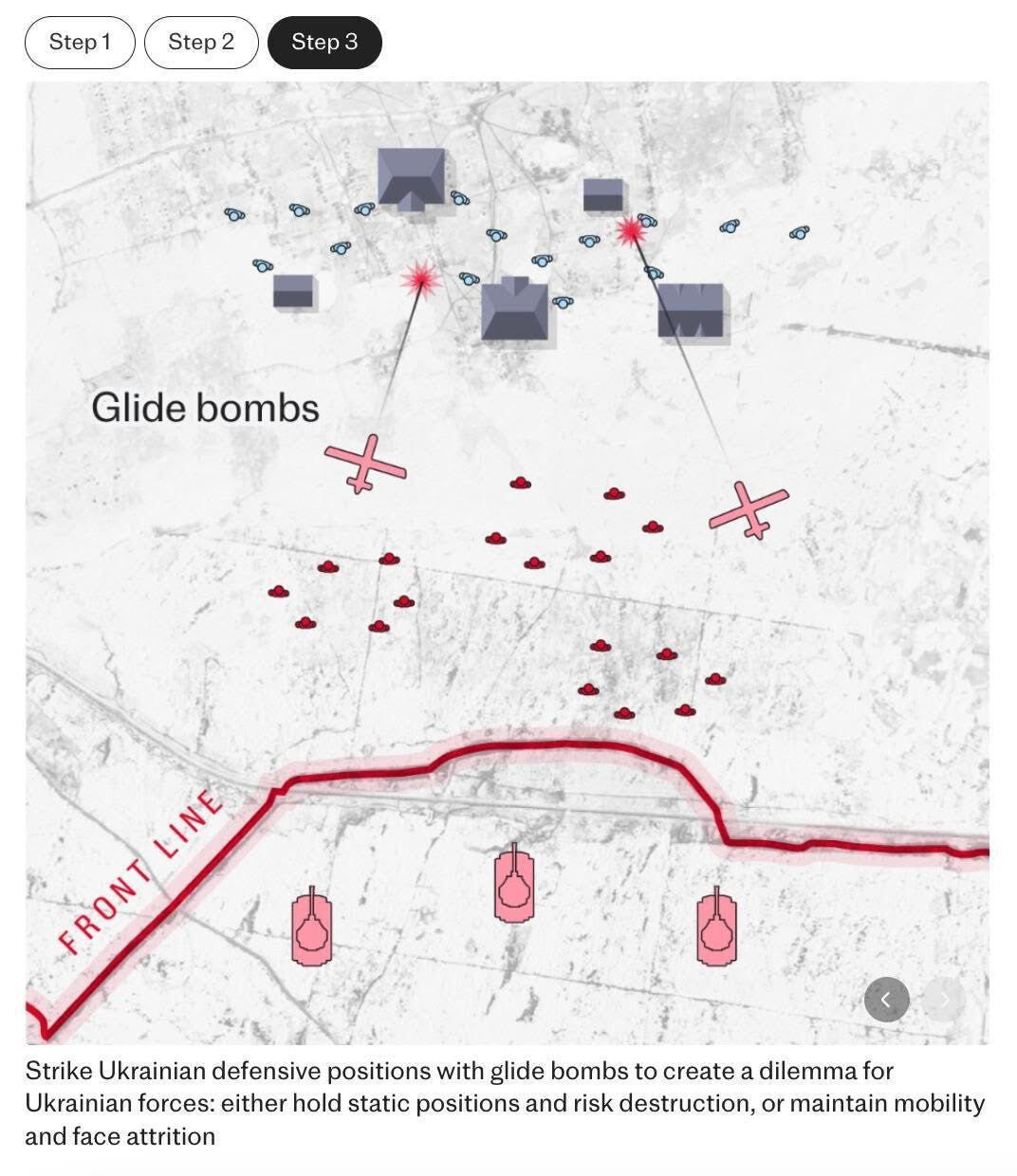
OLD DEFENCES DO NOT WORK
A key vulnerability Ukraine has had to address is the structure of its traditional trench systems. These older lines were often long, straight, and exposed, built for fast digging and wide coverage. They formed predictable corridors visible from the air, with one trench often connecting directly to another in a linear path. If any segment was taken by enemy forces, it could compromise an entire section of the line, forcing a full withdrawal or counter-assault to reclaim it.
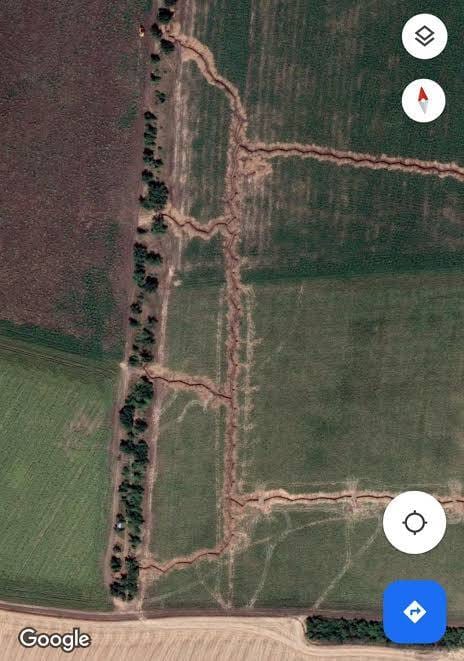
OLD STYLE TRENCH NETWORK
In response, Ukraine is reengineering its defences. New trench systems are now built “in-depth” and dispersed. Instead of long, continuous lines, they resemble a network of covered foxholes, often placed in tree lines to reduce visibility from drones. Each position is more self-contained—if one is lost, others remain defensible. The aim is to reduce predictability, limit cascading failures, and improve survivability against Russia’s updated tactics.

NEW STYLE TRENCH
Sources:
Reuters. (2025, April 17). Russia using new mass assault tactics on battlefield, Kyiv says. Retrieved from https://www.reuters.com/world/europe/russia-using-new-mass-assault-tactics-battlefield-kyiv-says-2025-04-17/
The Telegraph. (2025, May 23). Russia’s triple chokehold tactic is driving Ukraine back. Retrieved from https://www.telegraph.co.uk/world-news/2025/05/23/russias-triple-chokehold-tactic-driving-ukraine-back/
Map Source:
Playfra0 X
TWEET OF THE DAY
Investment bankers reacting to NYC nominating a socialist for Mayor
— litquidity (@litcapital)
2:04 AM • Jun 25, 2025
TODAY IN HISTORY
(June 25, 1950):
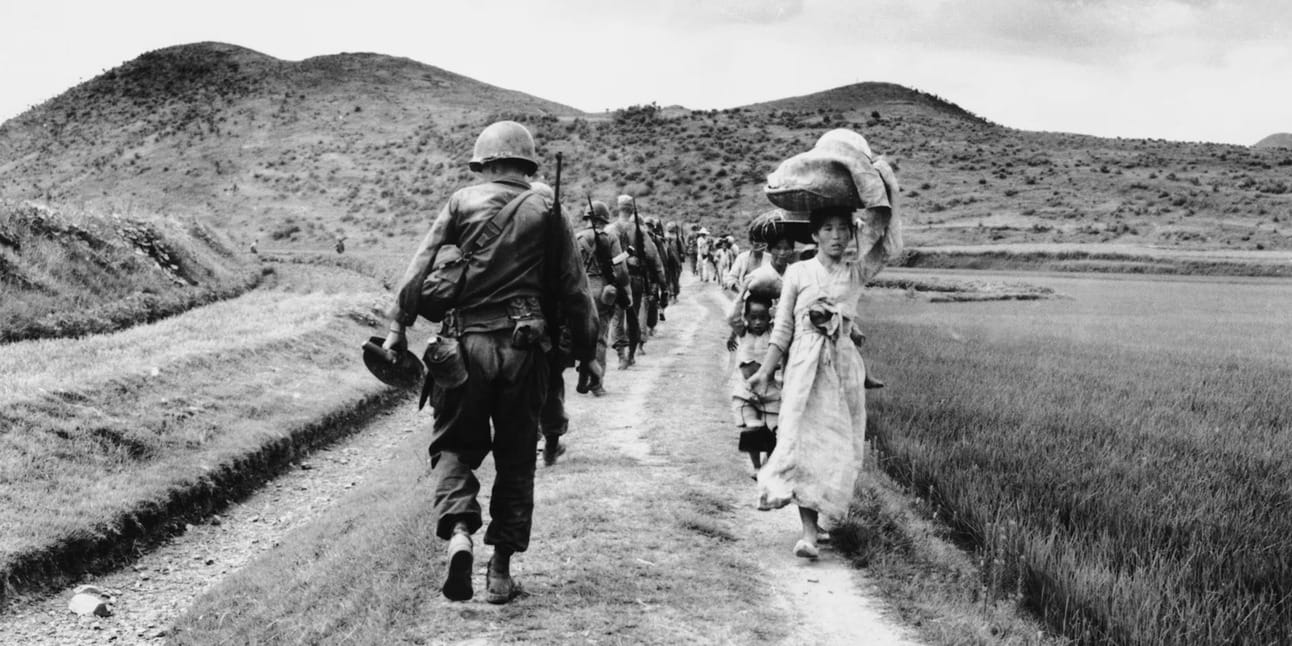
On this day in 1950, North Korean forces launched a full-scale invasion across the 38th parallel into South Korea. In response, the UN Security Council—absent the Soviet Union—approved a resolution urging member states to support South Korea militarily.