- Basedment
- Posts
- GEOPOLITICS DAILY BRIEFING - 26 June
GEOPOLITICS DAILY BRIEFING - 26 June
Your daily dose of geopolitical updates and strategic analysis. Unbiased, but not unbased.

Editor-in-Chief
June 27, 2025
THE BRIEFING
Here’s what’s happening in geopolitics today.
Today’s global briefing reflects a world balancing on the edge of diplomacy, conflict, and shifting alliances.
Trump’s overwhelming praise at NATO contrasts sharply with Iran’s admission of nuclear damage and a hardening stance toward inspections. Meanwhile, tragedy strikes in Central Africa as a deadly explosion disrupts a school, and Germany pivots away from Mediterranean migrant rescues toward addressing root causes of displacement. Turkey steps up its NATO commitments with ambitious plans to upgrade its air defences.
We close with a detailed look into the current IDF operation in Gaza, the expectations, strategy and current reality.
THE LAST 24 HOURS IN GEOPOLITICS
1. Trump praised at NATO for Iran ceasefire and defence spending push
Trump received enthusiastic praise for his role in brokering a ceasefire between Israel and Iran. NATO Secretary-General Mark Rutte commended Trump's "decisive action in Iran," describing it as "truly extraordinary" and something "no one else dared to do" . Rutte's remarks, including a lighthearted reference to Trump as "Daddy" during a press conference, highlighted the U.S. president's influential presence at the summit . The summit also saw NATO members commit to increasing defence spending to 5% of GDP by 2035, a goal strongly advocated by Trump.
read more
2. Iran finally admits nuclear damage and cuts ties with IAEA
Iran's Foreign Ministry has acknowledged that its nuclear facilities sustained significant damage from recent U.S. and Israeli airstrikes. While specific details were not disclosed, this admission aligns with assessments from the CIA and the International Atomic Energy Agency (IAEA), both indicating severe and potentially long-lasting impacts on Iran's nuclear infrastructure . In response, Iran's parliament passed legislation to suspend cooperation with the IAEA, effectively halting inspections and surveillance activities, and signalling a more confrontational stance in its nuclear policy.
read more
3. Explosion and stampede kills 29 students at central African school
A tragic incident unfolded at Barthelemy Boganda High School in Bangui, Central African Republic, where an explosion followed by a stampede resulted in the deaths of at least 29 schoolchildren and injuries to over 250 others. The explosion occurred as power was being restored to a malfunctioning electrical transformer on the school premises, causing panic among approximately 5,000 students present for higher-education exams. Among the deceased were 16 girls, with most victims dying at the scene and others succumbing to injuries at the hospital. The injured students are currently receiving treatment in various hospitals across the city.
read more
4. Germany cuts funding for Mediterranean migrant rescue operations
Germany has announced it will cease funding for non-governmental organisations conducting sea rescues of migrants in the Mediterranean, redirecting the approximately €2 million annual support toward addressing root causes of migration in home countries, such as conflict and poverty . Foreign Minister Johann Wadephul emphasised prioritising humanitarian aid in crisis hotspots like Sudan over financing rescues. NGOs like Sea-Eye, which relied on this funding for operations and claim to have helped save 175,000 lives since 2015, warn that this decision could limit their ability to conduct rescue missions.
read more
5. Turkey backs NATO’s 5% defence budget and plans nationwide air defence
Turkey has endorsed NATO's new defense spending target, a significant increase from the previous 2% benchmark. Currently exceeding the 2% threshold, Turkey ranks among the top five contributors to NATO operations and possesses the alliance's second-largest army. In line with this commitment, Turkey plans to bolster its air defences through the "Steel Dome" project, aiming to develop a layered air defence network incorporating advanced systems such as hypersonic, ballistic, and cruise missiles, unmanned vehicles, and next-generation military platforms like aircraft carriers and tanks.
read more
DAILY DEEP DIVE
THE IDF’S GIDEON’S CHARIOT OPERATION SO FAR
One month into Israel’s latest military campaign in Gaza — Operation Gideon’s Chariot — questions are mounting over its pace, effectiveness, and long-term strategic vision. The offensive, launched on May 16, was billed as the final blow: a full-spectrum operation to dismantle Hamas both militarily and administratively. Yet as of mid-June, the Israel Defence Forces (IDF) have only secured around 54% of Gaza — and even that estimate is fluid, given that over 80% of the strip is currently declared an active Israeli military zone where civilians are forcibly displaced.

THE REALITY ON THE GROUND
However, it should be noted that this is only one month into the operation. But in saying this, the operation was framed as a potential turning point in the war. Thus taking an expected strategic shift, yet many of the tactics echo those of 2024: methodical, risk-averse advances backed by overwhelming air support. The IDF has emphasised minimising casualties, particularly after two high-profile incidents — a building collapse in early June that killed four soldiers, and an attack in Khan Younis where a bomb detonated under a Puma armoured vehicle, killing seven. Following these losses, IDF Chief of Staff Eyal Zamir reinforced a central directive: “Advance as slowly as necessary to ensure troop safety and prevent further casualties.”

A major reason for the IDF’s caution is the ongoing hostage situation — around 50 people are still believed to be held in urban areas like the Central Camps. Earlier operations were more restrained to avoid endangering them. The Biden administration pressure also limited larger offensives. At the same time, a shift in Israel’s military leadership due to the October 7 failures, led to multiple senior officials resigning or being removed. The current operation may also reflect a broader strategic pivot under new IDF Chief of Staff Eyal Zamir, whose appointment has been welcomed by right-wing figures in the government. Zamir has openly stated that 2025 would remain a “year of combat” and is seen as favouring a more aggressive posture toward Gaza and regional adversaries. This may help explain why the operation, though slow-moving, signals a long-term commitment to dismantling Hamas’s infrastructure rather than relying solely on temporary raids.
RISING ATTACKS IN RECORD NUMBERS
While there is no conclusive evidence that Palestinian militant tactics have evolved significantly, the sheer rise in attack frequency suggests a notable shift in momentum on the ground. The number of recorded attacks on Israeli forces rose from 36 in the first month of the current campaign to 147 in the third month — a 116% increase. Hamas and Palestinian Islamic Jihad (PIJ) account for the bulk of the operations, with Hamas responsible for 51% of all attacks to date and PIJ for 38%.
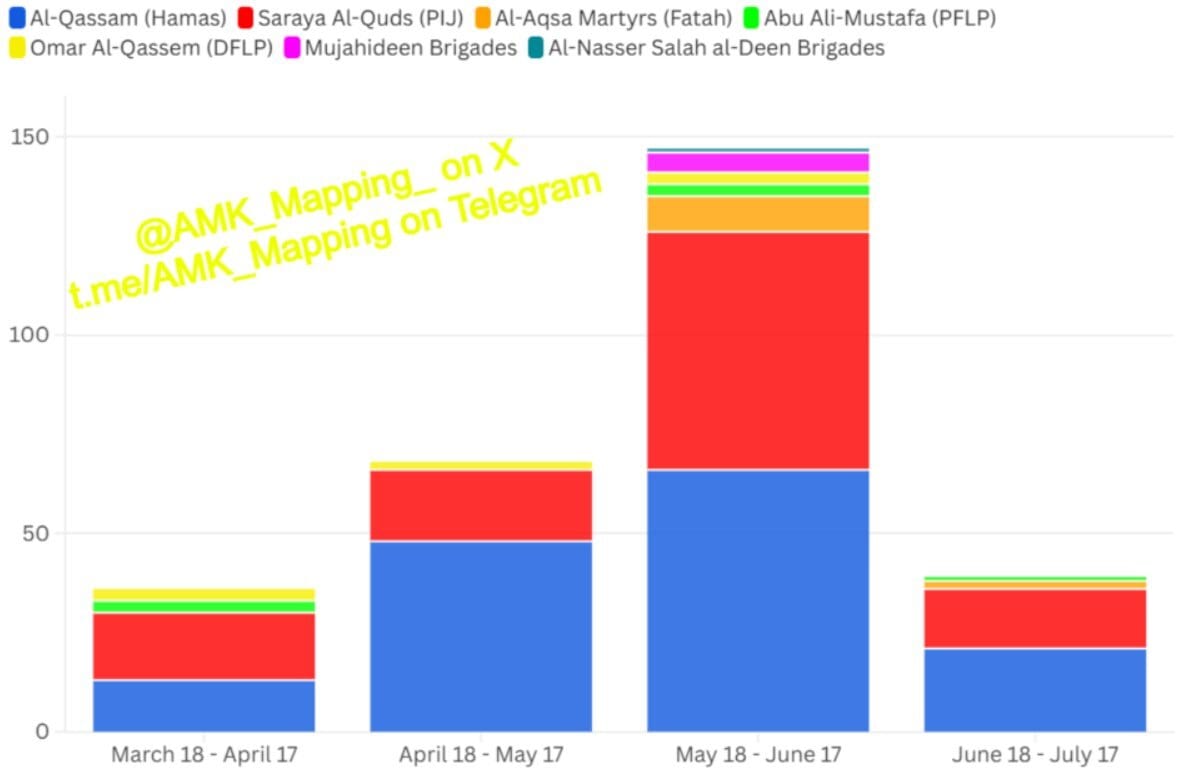
This surge may reflect better coordination, or simply greater desperation and new recruitment based on a new generation of radicalised men across various armed factions. Ceasefires and lulls in hostilities may have allowed these groups to regroup, redistribute resources, and launch more frequent operations. Though siege conditions remain severe, smuggling, black markets, and potential inter-group arms deals have likely helped these factions maintain operational capacity — even in the absence of a robust logistical base.
There may have also been a directive issued by Iran to increase pressure on the IDF during their own engagement with Israel - Or groups showing solidarity with Iran. This may be unlikely, as the attacks were increasing well before the 12-day war began.
OVERARCHING ISRAELI PLAN MAY BACKFIRE
Alongside its military campaign, Israel is pursuing a broader strategy aimed at collapsing Hamas’s civil governance, not just its armed infrastructure. Finance Minister Bezalel Smotrich has openly admitted to this approach, stating that Israel is targeting “ministers, bureaucrats, money handlers — everyone who holds up Hamas’ civilian rule.”
While this broader goal is showing signs of weakening Hamas’s grip on power (growing civilian protests against Hamas), time may not be on Israel’s side. A destabilised landscape with no functioning administration could have adverse effects for the IDF. This strategy risks replacing Hamas with a power vacuum dominated by competing non-state actors. Israeli-backed anti-Hamas groups are already operating, further complicating the picture. For any future governance, it may hinder the re-establishment of formal authority (whether military or civilian) by legitimising armed local factions as de facto power brokers. Moreover, the erosion of centralised control may undermine intelligence gathering, while a fragmented security environment increases the likelihood of uncoordinated or lone-wolf attacks, making Gaza more volatile and potentially undermining the long-term stability Israel aims to establish after Hamas.
The combination of Israel’s risk-averse military manoeuvring, a heavy troop presence, rising militant attacks, and the growing vacuum in governance may signal mounting operational and strategic challenges for the IDF.
Sources:
Al Jazeera. (2025, March 4). Who is Eyal Zamir, the Israeli army’s new chief of staff? Retrieved from https://www.aljazeera.com/news/2025/3/4/who-is-eyal-zamir-the-israeli-armys-new-chief-of-staff
AMK Mapping. Twitter account. @amk_mapping
Associated Press. (2024, November 26). Hostages released as part of Israel-Hamas ceasefire. Retrieved from https://apnews.com/article/israel-palestinians-gaza-hamas-war-hostages-released-76f4aef0816546f5048ca881bcd32e4b
Ben Tzion Macales. Twitter account. @BenTzionMacales
Frantzman, S. J. (2025). Gideon’s Chariots: Making slow progress. The Jerusalem Strategic Tribune. Retrieved from https://jstribune.com/frantzman-gideons-chariots-making-slow-progress/
GazaMaps. (2025). Retrieved from https://gazamaps.com
United Nations Office for the Coordination of Humanitarian Affairs. (2025). Humanitarian Situation Update #297 – Gaza Strip. Retrieved from https://www.ochaopt.org/content/humanitarian-situation-update-297-gaza-strip
TWEET OF THE DAY
In a 1000 years people won’t know how real JD Vance looked like 👀
— Mario (@PawlowskiMario)
5:26 PM • Jun 25, 2025
TODAY IN HISTORY
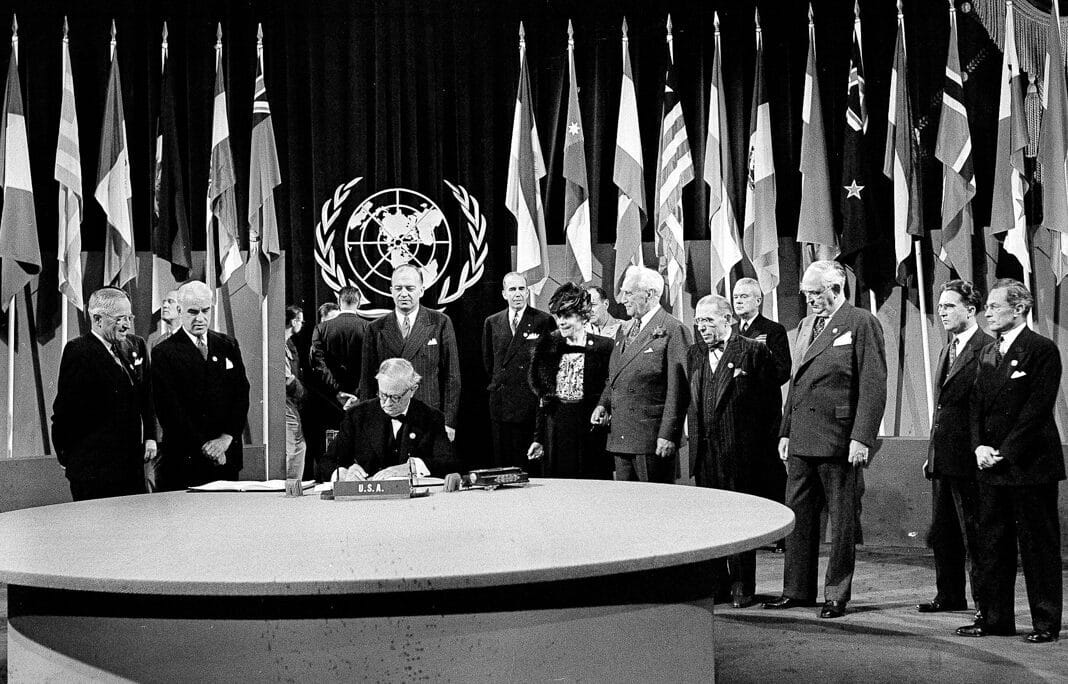
(June 26, 1945):
The Charter of the United Nations was signed in San Francisco by 50 nations, laying the foundation for a new international order after World War II. The Charter established the UN’s purpose, principles, and structure — with the goal of promoting peace, security, and cooperation across the globe.