- Basedment
- Posts
- GEOPOLITICS DAILY BRIEFING - 3 July
GEOPOLITICS DAILY BRIEFING - 3 July
Your daily dose of geopolitical updates and strategic analysis. Unbiased, but not unbased.

Editor-in-Chief
July 04, 2025
THE BRIEFING
Here’s what’s happening in geopolitics today.
From monumental trade deals in Riyadh to political brinkmanship in Washington, today’s headlines paint a vivid picture of a world in flux.
Trump’s massive tax-and-spending bill nears a crucial vote, while hopes flicker for a ceasefire in Gaza even as Ukraine deals Moscow another heavy blow with the killing of a senior Russian naval commander. Tragedy strikes off Bali’s coast as a ferry sinks, and Saudi Arabia and Indonesia forge a $27 billion partnership reshaping regional alliances.
Amid these shifting currents, our deep dive turns to the Battle of Pokrovsk in which we provide a substantial analytical review of both Russian and Ukrainian strategies.
THE LAST 24 HOURS IN GEOPOLITICS
1. U.S. House holds final vote on ‘big beautiful’ tax cuts
The U.S. House of Representatives has advanced President Trump's "One Big Beautiful Bill" to a full debate after a record-breaking voting session. The $4.5 trillion tax-and-spending package, which includes major tax cuts and reductions in social programs, is now poised for a final vote in the coming hours. Republican leaders, bolstered by last-minute negotiations and a late-night push from Trump, are aiming to pass the bill before the July 4 deadline, despite unified Democratic opposition and concerns over its projected $3.3 trillion addition to the national debt.
read more
2. Trump says deal for ceasefire in Gaza is closer after Israel agrees on terms
Hamas has expressed cautious approval of a U.S.-brokered 60-day ceasefire proposal, contingent upon assurances that the truce will lead to a permanent end to the Gaza conflict. The group is reportedly satisfied with mediator guarantees that hostilities will not resume while negotiations are ongoing, viewing this as a pathway toward a lasting resolution. However, key issues remain unresolved, including Israel's reluctance to commit to a full withdrawal and Hamas's demand for a comprehensive cessation of the war.
read more
3. Russian navy leader Mikhail Gudkov confirmed killed in Ukraine missile strike
Major General Mikhail Gudkov, the deputy commander of Russia's navy, was killed in a Ukrainian missile strike on a command post in Korenevo, Kursk region, near the Ukrainian border. Appointed to his naval leadership role in March 2025 by President Vladimir Putin, Gudkov was also the commander of the Pacific Fleet's 155th Marine Brigade and was known for his frequent visits to frontline positions. The attack, which also resulted in the deaths of ten other Russian servicemen, marks one of the most significant losses of a senior Russian military officer since the war began.
read more
4. At least 4 dead and 32 missing after ferry capsizes off Bali coast
A ferry carrying 65 people sank in the Bali Strait near midnight on Wednesday, resulting in at least four deaths and 30 individuals missing. The vessel, KMP Tunu Pratama Jaya, was en route from Banyuwangi in Java to Bali, carrying 53 passengers, 12 crew members, and 22 vehicles. The ferry reportedly sank about 25 minutes after departure, with bad weather cited as a likely cause. A rescue operation involving nine boats continues amid challenging conditions, including 2-meter-high waves. Of those onboard, 31 people have been rescued, some of whom were unconscious after drifting for hours in rough waters.
read more
5. Saudi Arabia and Indonesia sign $27Bn in strategic agreements across energy, defence and technology
Saudi Arabia and Indonesia have signed a landmark $27 billion suite of agreements spanning energy, defense, cybersecurity, and emerging technologies during President Joko Widodo’s visit to Riyadh. The deals align with Saudi Arabia’s Vision 2030 and Indonesia’s green transition goals, focusing on renewable energy, hydrogen production, and petrochemical development. Additionally, both nations committed to enhanced cooperation in counter-terrorism, cybersecurity, and digital transformation, signaling a deepening strategic partnership between the two largest Muslim-majority economies.
read more
DAILY DEEP DIVE
THE BATTLE OF POKROVSK UPDATE JULY 2025
Importance of Pokrovsk
Pokrovsk stands as one of Ukraine’s most critical logistical nodes in the Donetsk region. Sitting at the crossroads of major highways and possessing a strategically placed railway station, the town has long served as a distribution point between the southern front and central Donetsk. Multiple supply lines converge here. Its capture would provide Russia with the most populous city since Bakhmut in 2023 and open up avenues toward Dnipro and Zaporizhzhia.
According to Ukrainian military analyst Mykhaylo Zhyrokhov, Pokrovsk is more than just a town: “It’s a centre of defence. If Pokrovsk falls, the entire frontline could crumble.” This strategic depth has made it a focal point not just for Russian ambitions, but for the sustainability of Ukraine’s broader eastern defences. The town is also flanked by Myrnohrad, a directly neighbouring settlement that further enhances its defensive capacity.
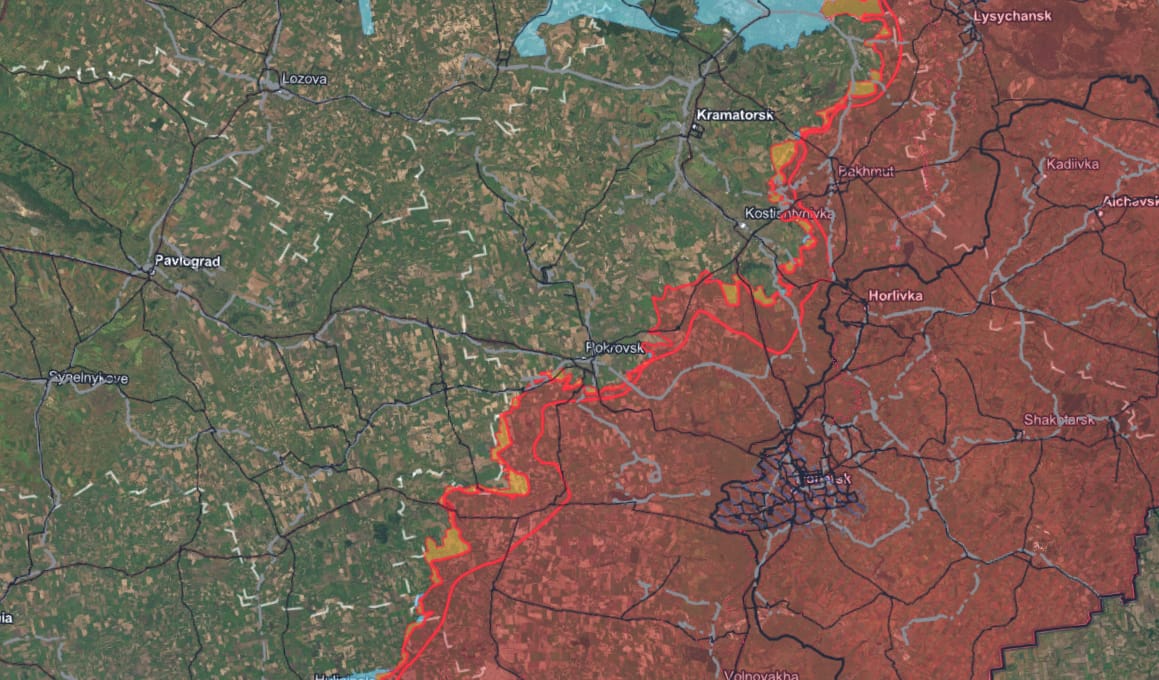
As you can see, “all roads/highways/railways lead to Pokrovsk" as famous quotes goes? (territorial representation outdated)
Russians in No Rush
Unlike earlier battles in Bakhmut or Avdiivka, the Russian advance here has been methodical. Pokrovsk has not seen the same ferocity of frontal assaults. Instead, the Russian command has applied pressure through steady territorial expansion on both the eastern and western flanks. While not necessarily with the aim of encircling the city, the wide-range offensive—resembling a “death by a thousand paper cuts” approach—aims to stretch Ukrainian flanks, expose vulnerabilities, and potentially create conditions for an encirclement.
It also aids expansion into adjacent fronts, as seen with the sudden collapse of the western Toretsk front—a direct consequence of sustained pressure along Pokrovsk’s eastern axis. The tempo has been defined by artillery saturation, FPV drone strikes, and precision air-delivered munitions. In July alone, Russian forces launched 185 assaults across 59 settlements, fired 7 missiles, conducted 62 airstrikes targeting 3 settlements, dropped 93 KABs, and carried out 5,520 artillery barrages—84 of which were from multiple launch rocket systems (MLRS) and deployed 3,194 FPV drones. These figures underscore the relentless pressure applied and further support the “death by a thousand paper cuts” dynamic.
In addition, nearly 1,000 of these strikes over the past three weeks have been concentrated on the western side of the Pokrovsk–Druzhkivka–Kostiantynivka triangle, indicating the sustained attempt to degrade logistics and reinforcement routes behind the front (which has assisted the new encirclement attempts).
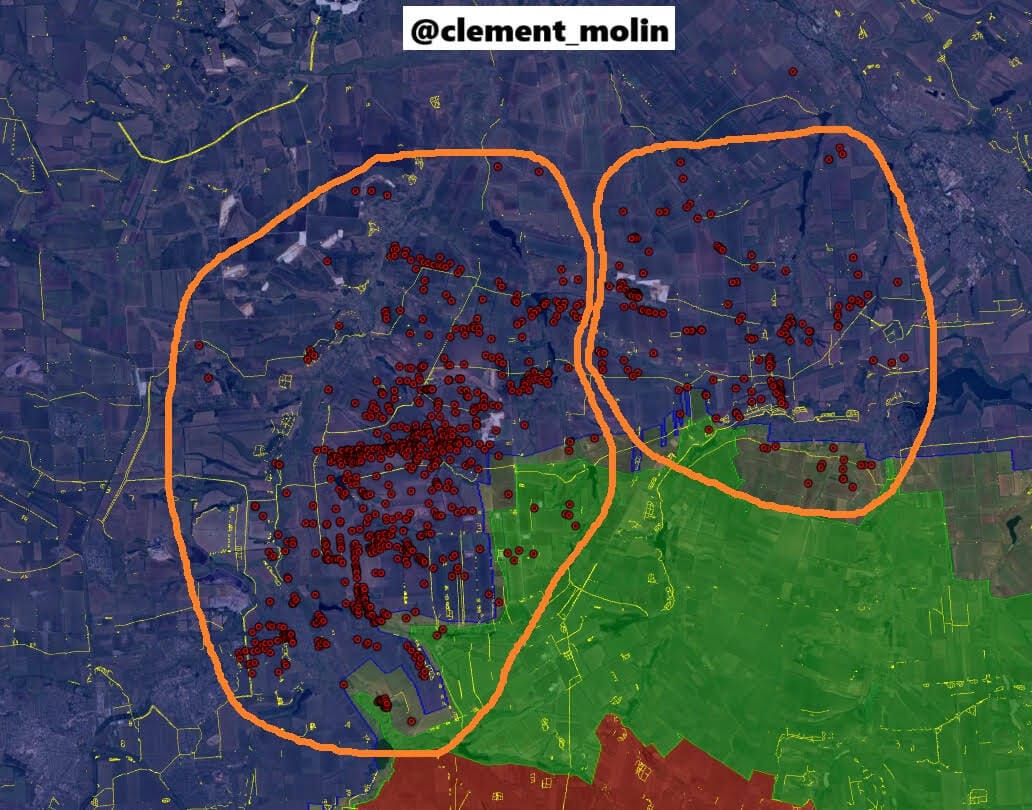
Location of strikes clearly centred as destroying defences east of Pokrovsk
Russian Strategy: Flanking and Envelopment
The push hasn’t been centrally aimed at Pokrovsk until recently. Instead, Russian forces extended their control across a wide arc to the east and west, taking key settlements such as Novotoretske, Koptevo, and Mirnoye. The front has widened by nearly 8 km, covering approximately 21 km². Operations now push towards Razine, Nikolaevka, and Novoekonomichne. The key target appears to be Rodynske (only 8km away) —a central node that, if captured, would sever one of the last remaining logistical highways into Pokrovsk. This move could allow for heavier artillery coverage and continuous FPV drone presence over retreating and reinforcing Ukrainian units.
Simultaneously, activity on the left flank has intensified. Russian forces have entrenched themselves west of Novosergeevka and now probe north, moving toward wooded corridors setting up more pressure on the expected assaults on Udachny and Molodetskoye. These corridors run parallel to railway infrastructure crucial to Ukrainian supply efforts. Any success here would further constrain Ukrainian manoeuvrability and accelerate operational collapse, creating a second axis of pressure in what may become a pincer movement designed to form a cauldron.
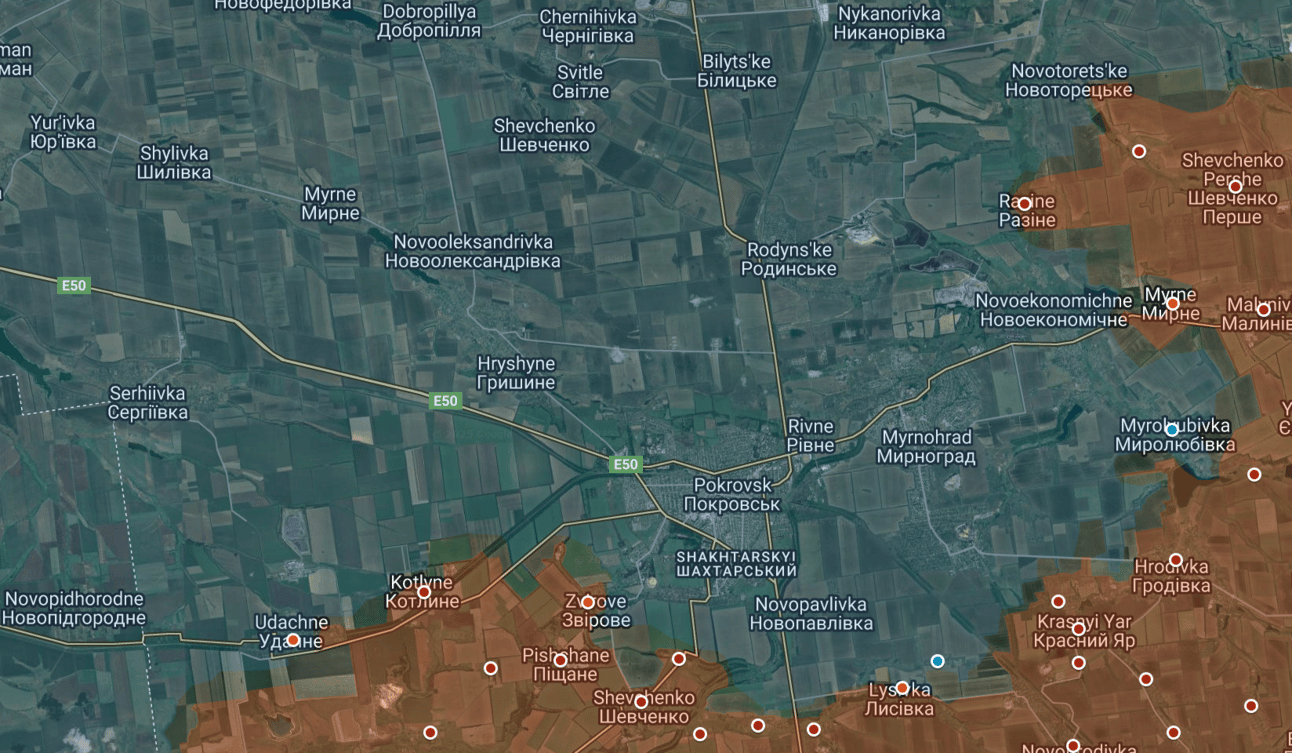
Western and Eastern important towns mentioned can be shown
Ukrainian Strategy: Hold the Line at All Costs
The small river crossing near Razine, now contested, represents a significant line. Ukrainian trench systems west of the river and near two mining mounds north of Myrnohrad—protected by a water barrier—create a temporary bulwark.
However, Ukraine’s manpower issues are showing. Russian momentum has proven difficult to halt, especially with their willingness to sustain high losses for rapid gains—a tactic seen during the fall of Avdiivka. This is evident in their rapid seizure of Razine, a tactically important position due to its proximity to trench lines and a launching pad across the river.

Blue - trench networks - KalibratedMaps

The two mining mounds can be seen here.
Toward the south of the town, Ukrainian units have mounted local counterattacks—many of them successful. It has become common over the last few months to see tit-for-tat exchanges of adjacent villages directly south of Pokrovsk.
According to Serhii “Filya” Filimonov, Commander of the "Da Vinci Wolves," Ukraine’s defences near Pokrovsk suffer from inconsistent fortifications and overstretched units. While some sectors are well-mined and fortified, others remain weak, especially where inexperienced "green" brigades are deployed. Battalions are often covering brigade-sized zones, leaving gaps for Russian infiltration. In some areas, Russian troops are within 15 metres, highlighting the urgent need for reinforcement and structural reorganisation.
Yet while tactical decisions are made in the field, the strategic calculus hinges on Kyiv’s military leadership. The crux of the matter lies with Commander-in-Chief Syrskyi. His decisions during the battles of Bakhmut and Avdiivka have drawn controversy, with some accusing him of delaying tactical withdrawals, earning him nicknames like “Butcher” and “General 200”—the latter referencing the Soviet code for military casualties. Morale issues have also surfaced, with elite brigades reportedly challenging decisions from higher command in some sections of the front.
Will he commit to a vigorous defence of the city, or order a withdrawal? Political considerations must also be acknowledged—losing Pokrovsk would deal a major political blow.
Given the pace of the Russian advance and signs of partial encirclement, the timing of a potential withdrawal order will be pivotal. Delays could result in the loss of entire units or severe degradation of the broader defence network.
Conclusion: The Encirclement Clock Ticks
Pokrovsk has not yet fallen, but the strategic picture grows darker by the day. Russian forces continue to advance with operational patience and growing precision. Their strategy avoids premature frontal assaults—for now—favouring encirclement and gradual attrition. If Rodynske falls, the pressure on Pokrovsk will spike immediately.
Ukraine still maintains defensive advantages through terrain and trench positioning west of Razine—but how long will they last, and what prevents Russia from simply continuing north of these defensive nodes?
The weight of Russian artillery, the flood of FPV drones, and gaps in manpower all compound the challenge. Strategic decisions from Ukrainian high command will determine whether Pokrovsk becomes a repeat of Bakhmut or a case study in timely tactical withdrawal. Do not assume Russia will not begin direct assaults—if Russian command believes they can push through, they will initiate frontal attacks, as history has shown.
The question shouldn’t be what will happen to Pokrovsk, but rather can Ukraine sustain its gamble of grinding down Russian attacks - so far it seems that the plan is failing (for now).
Sources
Babel.ua – The Armed Forces of Ukraine are trying to stabilize the front near Pokrovsk: what is happening there?
https://babel.ua/en/texts/115955-the-armed-forces-of-ukraine-are-trying-to-stabilize-the-front-near-pokrovsk-what-is-happening-there-babel-asked-the-commanders-of-three-units-that-are-located-in-this-direction
BBC News – Pokrovsk: Ukraine's vital eastern town in Russian sights
https://www.bbc.com/news/articles/c785z8917leo
Deepstate maps
Earth 3D Map
https://earth3dmap.com/
Google Maps – Pokrovsk Operational Overview Map 1
https://www.google.com/maps/d/u/0/viewer?mid=1xPxgT8LtUjuspSOGHJc2VzA5O5jWMTE&ll=48.32428413248342%2C37.186702949248776&z=11
KalibratedMaps Telegram Channel
Petrenko Telegram (Mirnograd updates)
RVvoenkor Telegram Channel
Twitter / X – @clement_molin
Twitter / X – @dmitryshchipkov
Twitter / X – @M0nstas
Suriyak Maps
https://www.google.com/maps/d/viewer?mid=1V8NzjQkzMOhpuLhkktbiKgodOQ27X6IV&ll=48.32799962952009%2C37.167379752681946&z=11
TWEET OF THE DAY
Basedment admin Michael is heading on a date tonight - wish him luck with the below game-plan.
TODAY IN HISTORY
(July 3, 1867):
Following three days of intense fighting—casualties numbered more than 50,000—the Battle of Gettysburg ended on this day in 1863 with a victory for the Union forces and was seen as a turning point in the American Civil War.
