- Basedment
- Posts
- Trump’s big bill, Gaza talks, and Somalia’s unfinished war
Trump’s big bill, Gaza talks, and Somalia’s unfinished war
Your daily dose of geopolitical updates and strategic analysis. Unbiased, but not unbased.

Editor-in-Chief
July 06, 2025
THE BRIEFING
Here’s what’s happening in geopolitics today.
From fireworks over the White House lawn to diplomatic ripples across the Middle East and economic tremors in global trade, today’s headlines span the spectrum of geopolitics and domestic upheaval.
Trump’s “One Big Beautiful Bill” is now law, while he simultaneously rattles trade partners with looming tariffs and keeps watch on cautious moves toward a Gaza ceasefire. Meanwhile, Rome reels from a fiery explosion, and Parisians dive into the Seine for the first time in a century.
Against this backdrop, our deep dive turns to Somalia, where a brutal civil war drags on, reshaping regional dynamics and leaving millions caught in its relentless crossfire.
THE LAST 24 HOURS IN GEOPOLITICS
1. Trump signs ‘big beautiful bill’ at July 4th ceremony at White House
President Donald Trump signed the "One Big Beautiful Bill" into law on July 4, 2025, during a celebratory Independence Day ceremony at the White House. The sweeping legislation enacts $4.5 trillion in tax cuts and spending reductions, including permanent extensions of the 2017 tax cuts and new deductions for tips and overtime pay. It also introduces significant cuts to Medicaid and food assistance programs, imposing strict work requirements that could disqualify millions from aid. Critics warn that the bill may add $3.3 trillion to the national debt and disproportionately affect low-income Americans by reducing access to essential services.
read more


2. Hamas responds in ‘positive spirit’ to ceasefire proposal
Hamas has responded "in a positive spirit" to a U.S.-brokered proposal for a 60-day ceasefire in Gaza, signaling readiness to enter negotiations aimed at ending the 21-month conflict with Israel. The proposed deal includes the release of Israeli hostages, the return of deceased hostages' bodies, reciprocal release of Palestinian prisoners, phased Israeli military withdrawal, and immediate humanitarian aid delivery . While Hamas's response is encouraging, key issues remain unresolved, such as Israel's insistence on Hamas's disarmament and Hamas's demand for a comprehensive cessation of the war.
read more
3. Trump says tariff letters to 12 countries signed and going out on Monday
U.S. President Donald Trump has signed tariff letters to 12 countries, which are set to be dispatched on Monday. These letters outline "take it or leave it" tariff proposals, with rates potentially reaching up to 70%, effective August 1, following the expiration of a 90-day negotiation pause on July 9. While Trump did not specify the countries involved, he emphasized that this approach marks a shift from prolonged negotiations to unilateral actions, stating, "The letters are better."
read more
4. Huge explosion at Rome petrol station injures 45 people
A massive explosion at a petrol station in Rome's Prenestino district on Friday morning injured at least 45 people, including police officers and firefighters. The blast occurred around 8 a.m. local time during fuel unloading operations, reportedly triggered by a gas leak that led to a fire and subsequent explosion. The force of the explosion shattered windows, damaged nearby buildings, and set parked vehicles ablaze. Emergency services swiftly responded, evacuating a nearby youth summer camp and residential buildings, actions credited with preventing a greater tragedy. Authorities have launched an investigation into the incident, with preliminary findings pointing to a technical fault during refuelling as the cause.
read more
5. River Seine reopens to public swimming for first time in a century
After more than a century, Parisians can once again swim in the Seine River, thanks to a €1.4 billion cleanup initiative aimed at restoring the river's water quality. Swimming was banned in 1923 due to pollution and navigation hazards, but the recent efforts have led to the opening of three designated swimming zones—Bras Marie, Bras de Grenelle, and Bercy—equipped with showers, lockers, and changing facilities . This project, part of the legacy of the Paris 2024 Olympics, not only provides recreational opportunities but also addresses climate change by offering cooling spaces during heatwaves.
read more
DAILY DEEP DIVE
THE MODERN SOMALIAN
CONFLICT 30 YEARS ON
BRIEF HISTORY
Somalia’s modern conflict began in 1991, when President Siad Barre was deposed, collapsing the central government and plunging the country into civil war. Clan-based militias seized territory, fighting for dominance amid famine and chaos. In 1992, a U.S.-led UN mission aimed to deliver humanitarian aid, but this escalated into combat. The 1993 Battle of Mogadishu, in which 18 American soldiers were killed, symbolized the mission’s failure. Western troops withdrew, and Somalia remained stateless.
The early 2000s saw a brief return of stability under the Islamic Courts Union (ICU), but its rise triggered a 2006 Ethiopian invasion backed by the U.S. The resulting power vacuum gave rise to Al-Shabaab, an extremist group that now controls much of southern Somalian countryside. Though AU forces pushed the group from cities, Al-Shabaab continues lethal attacks and maintains a parallel governance system, often more effective than Somalia’s own institutions.
Over the last five years, conflict has sharpened. President Hassan Sheikh Mohamud launched a large-scale offensive in 2022, combining federal troops and clan militias against Al-Shabaab. While some rural territory was reclaimed, insurgents remain deeply embedded. In response, Al-Shabaab intensified attacks on civilians, aid workers, and infrastructure using IEDs, assassinations, and suicide bombings. More than 1.5 million people were displaced in 2023, and over 4 million now face acute food insecurity.
INTERNAL ISSUES
Inter-clan violence is also worsening. A 2023 ACAPS report shows that Somalia’s conflict is increasingly fragmented along clan lines. Fighting in Las Anod between Somaliland forces and the Dhulbahante clan displaced over 200,000 people and left hundreds dead. Elsewhere, clan disputes over land and power-sharing arrangements in Galmudug, Hiraan, and Lower Shabelle have led to mass displacements, disrupted aid access, and hampered anti-Al-Shabaab efforts.
Despite international support, Somalia’s state-building remains fragile. ATMIS began drawing down troops in 2023, and was replaced by the new AU mission, AUSSOM. However, AUSSOM has also faced its fair share of criticism due to corruption and abuse of power allegations. The Somali government, though gaining legitimacy, remains under-resourced, fragmented, and often reliant on external partners. Furthermore, the Somalian government and AUSSOM lack a comprehensive anti-terrorism strategy that goes beyond battlefield operations.
The judiciary is weak, and military courts continue to handle civilian cases. Journalists face harassment, women and girls suffer from high rates of gender-based violence, and laws protecting human rights remain stalled. Meanwhile, the humanitarian crisis deepens. Drought, floods, and blocked supply routes have created extreme conditions. Al-Shabaab’s siege tactics limit food access in government-held areas. In July 2023, Médecins Sans Frontières withdrew from Las Anod due to attacks on clinics and staff. Mental health services are nearly absent, and the trauma of prolonged war is untreated.
ITS COMPLICATED
Somalia today is not a single war, but overlapping crises—terrorism, clan warfare, environmental shocks, and state failure. As AU troops withdraw and the international spotlight fades, the challenge ahead lies not only in defeating Al-Shabaab, but also in resolving deep-rooted clan grievances and building trust in national governance. Without this, Somalia risks remaining trapped in a cycle of conflict that no foreign army can fix.
GEOPOLITICAL BACKING
Federal Government: Backed by Egypt, the African Union, Turkey, the United States, and Italy (mostly material and military support).
Puntland: Receives assistance from the United States and the United Arab Emirates.
Somaliland: Supported by Ethiopia and the United Arab Emirates.
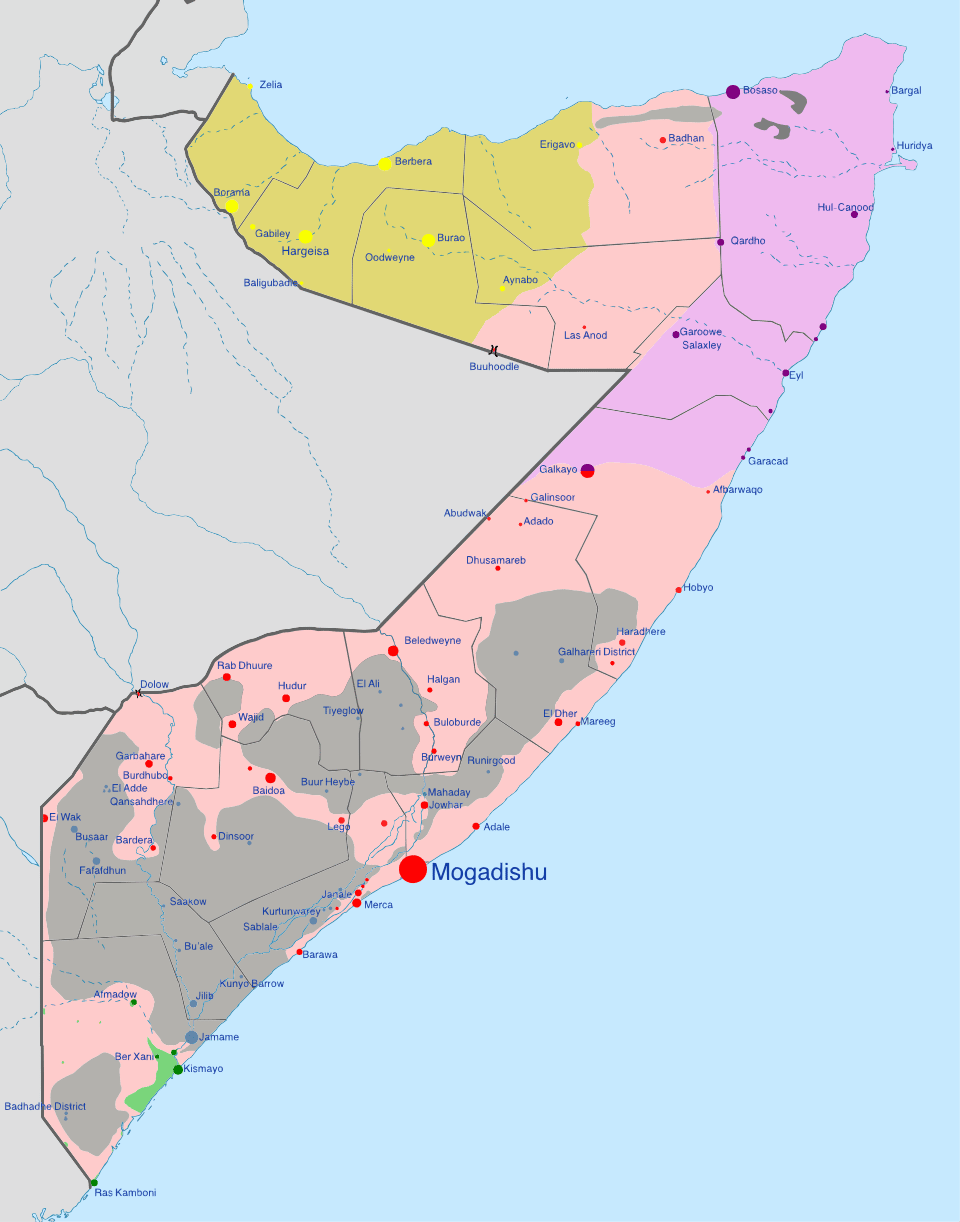
RED: Somalian Government, YELLOW: Somaliland Government, PURPLE: Puntland Government, BLACK: Al-Shabaab, GREEN: Jubaland Dervish Force
Sources
ACAPS. Crisis Impact of Clan Conflicts in Somalia. March 19, 2025. https://www.acaps.org/fileadmin/Data_Product/Main_media/20250319_ACAPS_Crisis_Impact_of_clan_conflicts_in_Somalia.pdf
Council on Foreign Relations. Al-Shabaab. https://www.cfr.org/backgrounder/al-shabaab
Elmi, Afyare Abdi, and Abdullahi Barise. The Somali Conflict: Root Causes, Obstacles, and Peace-building Strategies. African Security Review 15(1):32–54, January 2006. https://doi.org/10.1080/10246029.2006.9627386
Human Rights Watch. World Report 2024: Somalia. https://www.hrw.org/world-report/2024/country-chapters/somalia
Institute for Security Studies. Will the Latest AU Mission in Somalia Achieve Better Results? May 1, 2025. https://issafrica.org/pscreport/psc-insights/will-the-latest-au-mission-in-somalia-achieve-better-results
Voice of America. UN Approves New AU Force to Take on Al-Shabab in Somalia. https://www.voanews.com/a/un-approves-new-au-force-to-take-on-al-shabab-in-somalia-/7916486.html
TWEET OF THE DAY
Who needs the MGM Grand in Vegas or Madison Square Garden in New York if we can watch UFC at the White House…?
Rome never fell
— Spinachbrah 🥗 (@basedspinach)
12:46 AM • Jul 5, 2025
TODAY IN HISTORY
(July 5, 2024): Keir Starmer, leader of the Labour Party, has taken office as the United Kingdom’s new prime minister, bringing an end to 14 years of Conservative leadership. He succeeds Rishi Sunak in the role.
