- Basedment
- Posts
- Greenland: Why It Matters And Why There Is More To The Story
Greenland: Why It Matters And Why There Is More To The Story
Today we take a look at Greenland and how it matters in terms of strategic location, cost to worth ration, and of course resources.

Editor-in-Chief
January 13, 2026
In partnership with

THE BRIEFING
Here’s what’s happening in geopolitics today.
Big moves and rising tensions set the tone today, from Washington tightening the screws on Iran to Canberra preparing for a diplomatic handover in D.C.
We’re also tracking shifts on the battlefield in Gaza, new defence ties taking shape in Asia, and Italy heading toward a high-stakes referendum that could reshape its justice system.
In today’s Deep Dive, we take a look at Greenland and how it matters in terms of strategic location, cost to worth ration, and of course resources.
MESSAGE FROM OUR PARTNER
Dictate prompts and tag files automatically

Stop typing reproductions and start vibing code. Wispr Flow captures your spoken debugging flow and turns it into structured bug reports, acceptance tests, and PR descriptions. Say a file name or variable out loud and Flow preserves it exactly, tags the correct file, and keeps inline code readable. Use voice to create Cursor and Warp prompts, call out a variable like user_id, and get copy you can paste straight into an issue or PR. The result is faster triage and fewer context gaps between engineers and QA. Learn how developers use voice-first workflows in our Vibe Coding article at wisprflow.ai. Try Wispr Flow for engineers.
THE LAST 24 HOURS IN GEOPOLITICS
1. Trump announces 25 percent tariff on countries that trade with Iran
Trump announced that any country that continues to do business with Iran will face a 25 percent tariff on its trade with the United States, saying the measure will take effect “effective immediately” as part of efforts to increase economic pressure on Tehran amid widespread internal unrest. Trump shared the policy on his Truth Social platform, but no formal documentation or detailed legal framework has been published, and the White House did not immediately clarify how the tariffs would be implemented or which specific countries might be affected.
read more
2. Kevin Rudd will step down as Australian ambassador to the US a year early
Kevin Rudd, former Australian prime minister and current ambassador to the United States, announced he will step down from his diplomatic posting on March 31, 2026, a full year ahead of schedule, Prime Minister Anthony Albanese said on Tuesday. Rudd is leaving the post to become global president and CEO of the Asia Society and head its Centre for China Analysis, returning to a role focused on U.S.–China relations after three years in Washington. During his tenure, Rudd helped secure bipartisan support for the AUKUS nuclear submarine deal, a critical minerals framework with the United States, and the negotiated return of Julian Assange to Australia, and his departure comes as Canberra prepares to appoint his successor.
read more
3. Israeli-backed Gaza militia kills a senior Hamas police officer in Gaza
An Israeli-backed Palestinian militia operating near Khan Younis in southern Gaza said it killed a senior Hamas police official in a drive-by shooting, with the group’s leader, Hussam al-Astal, posting a video claiming responsibility and warning others aligned with Hamas that they could be next. Hamas’s interior ministry confirmed the death of Mahmoud al-Astal, head of the criminal police in Khan Younis, and accused “Israeli collaborators” of carrying out the attack, though Reuters has not independently verified all aspects of the claim.
read more
4. Pakistan, Indonesia closing in on jets, drones defence deal
Pakistan and Indonesia are advancing discussions on a potential defence deal that could include the sale of Pakistani JF-17 Thunder combat jets and armed drones to Jakarta, according to security officials familiar with the talks. Indonesia’s defence minister met Pakistan’s air force chief in Islamabad to deepen military cooperation and explore the acquisition of more than 40 JF-17 fighter aircraft as well as Shahpar surveillance and strike drones, though no final agreement or delivery timeline has yet been agreed.
read more
5. Italy to hold referendum on judicial reform on March 22-23
Italy’s government has set March 22–23, 2026 as the date for a nationwide referendum on a contentious constitutional reform of the judicial system, requiring public approval before the changes can take effect. The proposed overhaul, backed by Prime Minister Giorgia Meloni’s right-wing coalition, would separate the career paths of judges and prosecutors, a move supporters say will reduce conflicts of interest and political bias, while opponents warn it could undermine prosecutorial independence. The referendum is being closely watched as a key political test ahead of Italy’s 2027 general election.
read more
DAILY DEEP DIVE
Greenland Another Piece To the Existential Puzzle
When we look at Greenland, on the surface level it doesn’t really seem important. What does it have, 50,000 people and a few cute different coloured houses dotted around the coastline? This is the correct answer if you’re a mum browsing through Pinterest – but we’re in the game of geopolitics, everything matters. Location, location, location as they say is number one. Greenland sits at what could become the primary highway of trade between Asia and Europe. The bases already exist – they’ve just been decommissioned, it’s not like America would be starting from scratch. And lastly, how can we forget the importance of resources! Greenland is littered with resources, but extraction would be a problem. But there is more to this story than meets the eye….
Location, Location, Location.
Firstly, I need you to stop looking at our standard world maps, they do not present the correct picture. Greenland’s strategic importance is not a mystery, nor is it driven by novelty or eccentricity. It is rooted in geography, physics, and long-standing U.S. strategic doctrine. When viewed on a proper polar map rather than a Mercator projection, Greenland sits directly between North America and Eurasia—squarely astride the shortest routes linking the United States and Russia.
Russia concentrates much of its strategic nuclear force on the Kola Peninsula, near Finland. This includes ballistic missile submarines, bomber bases, and supporting infrastructure. Any ballistic or powered missile trajectory from Kola toward the U.S. mainland naturally arcs over the Arctic, with apogee—the optimal interception point—occurring above or near Greenland. From a missile-defense perspective, interceptors launched from Greenland are geographically advantaged: they travel the shortest distance to reach that apogee window. Source for this write up listed below.
This logic underpins why Donald Trump framed Greenland as a national security necessity. His view aligns with a modern interpretation of the Monroe Doctrine—preventing rival great powers from establishing decisive military leverage in the Western Hemisphere and its approaches. Greenland is not “overseas” in strategic terms; it is the forward edge of North American defense.
There is also a maritime dimension. As Arctic ice recedes, the Northern Sea Route is becoming viable for large-scale commercial traffic. Chinese cargo ships will increasingly transit directly between East Asia and Europe, bypassing Suez constraints. Strategic reality follows commerce: Chinese submarines—if not already operating there—will gain easier access to the North Atlantic. Greenland’s northeast coast directly overlooks this emerging corridor. And if we look at Venezuela for example – it had the capacity to strike U.S. bases in the caribbean using Iranian drones, this would definitely have solidified Trump’s views that all the Americas must be under U.S. influence.
Critics, particularly pro-NATO analysts, argue that many of these risks are already mitigated by alliance structures. NATO air defense, undersea surveillance, and intelligence sharing already cover much of the Arctic-Atlantic interface. The U.S. also maintains a permanent presence at Pituffik Space Base, enabled by longstanding treaties with Denmark. That counterargument is valid—but incomplete. Alliances can shift; geography does not. If polar ice continues to melt, Greenland will sit directly on the primary strategic, commercial, and military artery of the 21st century Arctic. Trump’s interest, stripped of rhetoric, reflects that immutable fact. If we take a read through the NSS - there is a hint that current administration believes in this malleable realist geopolitical world. Europeans believe that NATO is a permanent structure, the Americans are doubtful.

The Infrastructure Does Exist (Sort Of)
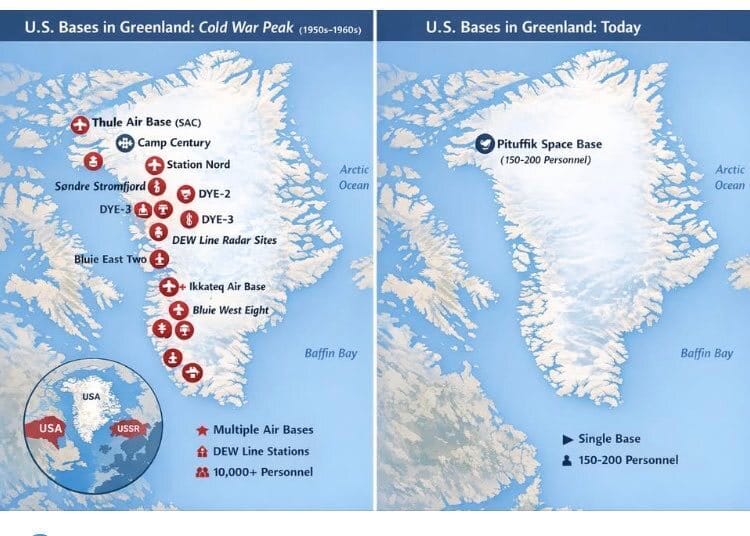
Greenland already functions as part of the U.S. security architecture, which is why renewed attention to it is not as radical as critics suggest. The United States maintains an active military presence on the island, anchored by Pituffik Space Base, a key node for missile warning, space surveillance, and Arctic monitoring. This presence rests on firm legal ground: agreements signed in 1941 and 1951 with Denmark explicitly permit U.S. basing and defense activity in Greenland.
Beyond current facilities, the island still hosts a legacy network of Cold War–era airfields, radar stations, and logistics sites. While dormant, many remain geographically valuable and could be reactivated or adapted far more cheaply than building entirely new infrastructure elsewhere in the Arctic. Nonetheless, there would be costs in operating the bases, supplying them and upgrading them.
Resources - Not As Important As You May Think
Greenland’s resource potential is often cited as a factor behind renewed U.S. interest, but it is a far less decisive driver than geography. Greenland holds significant reserves of critical minerals—rare earths, graphite, and other inputs essential for modern industry—as well as offshore oil and gas prospects. These resources align with U.S. and European Union efforts to dilute Chinese dominance in critical supply chains, a priority repeatedly stressed by Donald Trump.
However, extraction is exceptionally difficult. Greenland lacks roads, deep-water ports, power infrastructure, and a large workforce. Mining and drilling would require massive upfront capital with long timelines before profitability, compounded by Arctic conditions and environmental restrictions.
This uncertainty makes major firms cautious. We have already seen ExxonMobil hesitate in Venezuela, citing high costs and political instability. Greenland carries similar risks: policy direction can shift rapidly, sometimes with a single political announcement, deterring long-term investment despite the resource promise.

Is Something Big Coming (a personal opinion)
From the admin that mostly writes the Deep Dives — given all the admins have slightly different views and perspectives on politics:
I have strongly suspected since Trump’s second campaign run that this administration is preparing for the long haul, for a possible existential threat. Again, I advise all of you to read the NSS, there is an undertone that the administration believes something big is coming and the USA must having everything in order.
I suspect that the administration believes that either a massive global conflict will erupt and/or that internal forces (namely the democrats) will lead to the downfall of the USA. Whether you like Trump or not, we have not seen this many changes, executive orders, laws etc in many years. Many of these actions gigantic endeavour, not things you do when you know it may all be reversed in the next election cycle. This is an administration that I presume does not think it will lose the next election — take that for how you will.
So when we see the Oil-tanker seizures, Maduro extraction, and now talks of buying or military intervention of Greenland — view it from the existential lens that those in Trump administration see it. If you knew (assume this is the base belief) that a global conflict was without a doubt confirmed, you would not be asking the international legality of certain actions, given you are facing an existential threat. It’s why I’ve stated before to expect a fall in credibility and legitimacy from international law, especially if one major power stops caring — others will quickly follow.
We’re re-entering the Great Powers era of the 18th-19th century.
Sources
News/Journal sources available upon request, not shown to maintain visual integrity of page.
TODAY IN HISTORY
(January 13, 1404): The threat of alchemy
King Henry IV of England outlawed alchemy on this day in 1404. By preventing the creation of gold from base metals—the goal of alchemy—Henry was trying to prevent challenges to his reign. His law was eventually repealed in 1688.