- Basedment
- Posts
- Has Russia's Offensive Failed?
Has Russia's Offensive Failed?
Your daily dose of geopolitical updates and strategic analysis. Unbiased, but not unbased.

Editor-in-Chief
August 27, 2025
THE BRIEFING
Here’s what’s happening in geopolitics today.
Today’s briefing brings together a mix of global headlines, from shifts in Germany’s security planning to a major policy change for refugees in Thailand.
Pope Leo has weighed in on the Israel–Hamas conflict, while President Trump prepares to chair high-level talks on Gaza. Meanwhile, Berlin continues to sharpen its defence posture with a new military service bill.
And in our deep dive, BILD has declared the Russian offensive has failed, but how true is that? We explore the successes and failures of the 2025 Summer Offensive.
THE LAST 24 HOURS IN GEOPOLITICS
1. Germany creates centralised council to improve security planning
The German government has approved the establishment of a standing National Security Council, replacing the previous Federal Security Council and Security Cabinet to better coordinate medium- and long-term security planning. Chaired by Chancellor Friedrich Merz and supported by key ministers, this council brings together diverse governmental perspectives under one roof, situated within Merz’s office for swift strategic response. It signals a shift in Germany’s security posture, with policymakers acknowledging the need to embed cross-ministerial alignment and preparedness following the shocks of Russia’s 2022 invasion.
read more
2. Pope Leo calls for ceasefire, hostages’ release in Israel-Hamas conflict
Pope Leo XIV made a heartfelt appeal on Wednesday during his weekly Vatican audience, urging the global community to push for a permanent ceasefire, the release of hostages, and safe, unimpeded humanitarian aid to Gaza. He emphasized the importance of respecting international humanitarian law as the conflict nears its two-year mark. Though he stopped short of naming specific parties, his message was clearly directed at all sides caught in the devastating Israel–Hamas conflict.
read more
3. Thailand grants some Myanmar refugees right to legal work
Thailand has announced a major policy change to grant legal work rights to around 80,000 long-staying Myanmar refugees living in camps along its border, many of whom have been there for decades. The Labor Ministry’s proposal, approved by the cabinet, aims to address a potential labor shortage highlighted by a recent exodus of Cambodian workers, and to better integrate refugees into sectors like construction, agriculture, and services. The move has been hailed by the UN Refugee Agency as a “strategic investment,” saying it will transform refugees into contributors to the economy, reduce reliance on aid, and strengthen resilience across communities and the country as a whole.
read more
4. Donald Trump to chair meeting on Gaza as residents say Israeli forces advance
Israeli tanks advanced into the Ebad-Alrahman neighborhood on the northern edge of Gaza City late Tuesday, destroying homes and forcing residents to flee deeper into the city amid mounting shelling fears of a broader offensive. Meanwhile, U.S. President Donald Trump will chair a high-level White House meeting on Gaza Wednesday to consider a comprehensive post-war plan, with the administration hoping to resolve the conflict by year’s end, while Secretary of State Marco Rubio meets with Israel’s foreign minister.
read more
5. German cabinet passes bill for voluntary military service
Germany’s cabinet has greenlit a draft law launching a voluntary six-month military service program, designed to bolster its ranks amid increasing security pressures and rising NATO commitments. The measure seeks to double the number of trained reservists from around 100,000, with the option to reinstate compulsory conscription if recruitment targets (20,000 in 2026; 38,000 by 2030) aren’t met. This comes as part of a broader push to expand Germany’s armed forces to 260,000 by the early 2030s and strengthen readiness in the face of heightened Russian threats.
read more
DAILY DEEP DIVE
THE 2025 SUMMER OFFENSIVE: SUCCESS OR FAILURE?
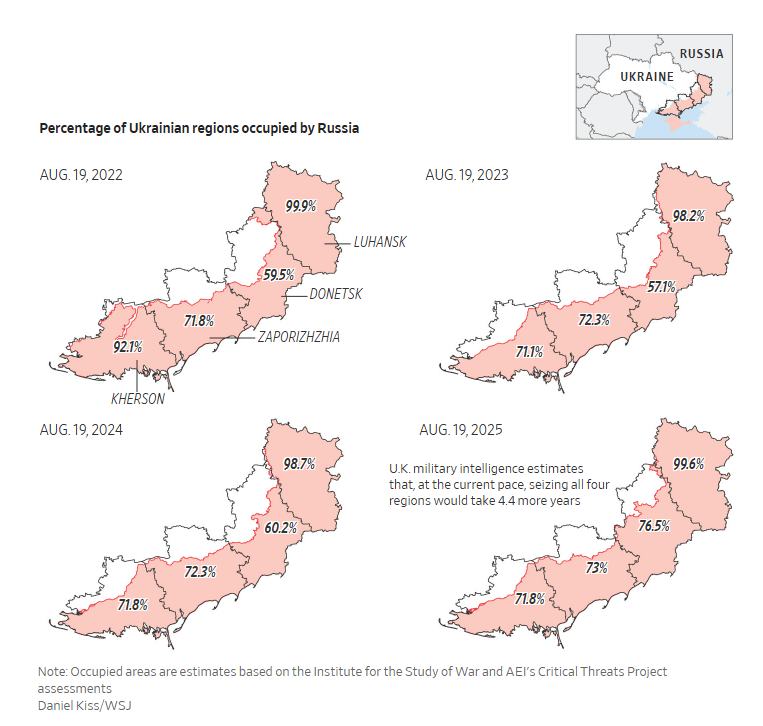
A statement from BILD’s senior reporter, Julian Röpcke, has sparked debate online. He declared that Putin’s summer offensive has officially failed, noting that Pokrovsk was not captured, buffer zones in the Chernihiv, Sumy, and Kharkiv regions were not established, and the front line in the Zaporizhzhia and Kherson regions remained frozen.
In the 3 summer months, Russian troops captured about 1,800-2,000 km², which is 0.3% of Ukrainian territory with an ever growing death toll. Did Russia achieve a grand strategic breakthrough? No, nor did any serious analyst expect them to. But has Russia made important gains? Yes.
Let’s dive in.
Note: This topic could easily fill ten pages, but for clarity we will focus only on the offensive itself, setting aside broader factors like economics and long-range strikes that, while important, fall outside the scope of this analysis.
ISW map of Russian progress
Röpcke’S ASSESSMENT
Pokrovsk
Pokrovsk still has not fallen after almost a year of operations beginning for the city, we would consider this a failure for Russia. Ukrainian forces continue to defend strongly, even regaining ground in the southern suburbs. Yet the situation in Pokrovsk remains catastrophic: Russia holds an operational encirclement, drone units dominate the only supply route, and soldiers describe using it as a 50/50 chance of survival.
While the city has not yet fallen, we would be cautious about Röpcke’s claim that its capture was the central objective of Russia’s summer offensive. Most analysts expected Pokrovsk to fall later (around September) while Russian commanders seem more invested in consolidating the Dobropillya salient, which offers greater operational value than the now largely symbolic fight for Pokrovsk. That Dobropillya salient is holding, stabilising, and even pushing eastward.
For Ukraine, a strategic counterattack to break the siege would likely require a significant collapse in Russian defences. The Mayne infiltration hinted at this potential by cutting the Pokrovsk–Kostiantynivka highway, but much like Russia’s own grinding push near Dobropillya, it lacks the momentum to achieve a decisive breakthrough (for now).
Chernihiv, Sumy, and Kharkiv
The frontline is hundreds of kilometres long, and the idea that Russia could establish a buffer zone to halt incursions into its territory was always questionable. The main pressure has come at Sumy and Kharkiv, forcing Ukrainian units onto the defensive rather than allowing them to launch strikes deeper into Kursk and Belgorod.
Still, the buffer zone has not materialised. This was a stated objective of Russian officials and pro-Russian commentators, yet in Kharkiv the evidence points the other way. Take Vovchansk: a border city reduced almost entirely to rubble, with over 90% of its buildings destroyed. Despite this devastation, Russian units still lack control and are no closer than they were a year ago. Russia has had more success in Sumy, though Ukraine has regained the initiative in some sectors. The Russian position there remains stronger than in Kharkiv, but overall, the “buffer zone” claim has backfired given that territorial gains have stalled. However, it can be argued In an operational sense Ukraine's ability to conduct cross-border operations has been significantly reduced. As now significant forces are needed to defend in Sumy and Kharkiv.
Note: We would add that in the geopolitical space, these are significant bargaining chips. Russia can use these small territorial gains in Sumy and Kharkiv for possible land-swap exchanges.
Zaporizhzhia and Kherson regions remained frozen
The Zaporizhzhia and Kherson fronts have largely remained frozen. But this was never the primary focus of Russia’s summer offensive, as evidenced by the concentration of manpower, armour, and artillery in Donetsk and Luhansk. Moscow’s priority has consistently been to grind down Ukrainian defences in the Donbas, where territorial gains carry both symbolic and operational weight. By contrast, Zaporizhzhia and Kherson have been secondary fronts; important for fixing Ukrainian units in place and preventing reinforcements from shifting north, but not expected to deliver decisive breakthroughs. Measuring the success or failure of the offensive based on these static southern fronts misreads where Russia actually intended to commit its main effort.
Other Fronts
The Kupiansk sector remains under considerable risk of encirclement in the coming months, with Ukrainian positions east of the Oskil River facing the same danger. If Russia consolidates here, it could force Kyiv into another difficult withdrawal.
At the same time, Russia has finally achieved localised breakthroughs in the Donetsk fortress belt of Sloviansk–Kramatorsk. The battle for Kostiantynivka has begun earlier than most analysts anticipated. This only became a priority when the Russian eastern pincer for Pokrovsk also expanded through Ukrainian defences west of Toretsk and south of Kostiantynivka. Both sides began to commit reserves and reinforcements, after what was considered a surprise new area of focus to both.
There have also been advances on the Siversk and Lyman fronts, areas that had held firm for years under rigid Ukrainian defence. Even small movements here suggest Russia is testing and stretching Ukrainian lines in ways that go beyond Röpcke’s focus on Pokrovsk.
Our comment:
No serious analyst expected grand strategic gains, given the nature of this conflict and the lessons of the past. Russia’s summer offensive has not collapsed outright, but nor has it achieved the sweeping objectives claimed by its own officials; instead, it has produced grinding attrition, partial encirclements, and incremental gains in Donbas and along the Oskil front. Ukraine remains resilient and capable of local counter-attacks, yet manpower shortages, attrition, and drone-driven stalemates reveal growing cracks in its defences that Röpcke’s “failure” narrative overlooks. As a closing sentence: The war continues to feel less like a race to win and more like a contest of endurance, with each side waiting for the other to give up instead of forcing a victory.
Sources:
Sources available upon request, included separately to not disrupt the style of the page.
TWEET OF THE DAY
Truly quite fascinating.
Standing under Starship
— Elon Musk (@elonmusk)
5:59 PM • Aug 25, 2025
TODAY IN HISTORY
(August 27, 1576): The death of Titian
Titian, the greatest Italian Renaissance painter of the Venetian school, who was once described as “the sun amidst small stars not only among the Italians but all the painters of the world,” died this day in 1576.