- Basedment
- Posts
- Houthi's Join, Syria Now A Target, Sudan Offensive Continues
Houthi's Join, Syria Now A Target, Sudan Offensive Continues
Today we focus on the escalating conflicts in the MENA region, from the Houthi's joining the war officially to RSF offensive on the Sudan-Ethiopia border

Editor-in-Chief
March 29, 2026
THE BRIEFING
Here’s what’s happening in geopolitics today.
Today’s headlines show just how quickly the Iran conflict is rippling across the globe, from Yemen’s Houthis launching a missile toward Israel to regional diplomacy kicking into gear, with Pakistan hosting talks aimed at containing the crisis.
At the same time, Russia and Iran are discussing possible pathways to reduce escalation, India is pushing back on reports about a call involving Donald Trump and Narendra Modi, and Nepal has arrested former prime minister K. P. Sharma Oli over last year’s deadly Gen Z protests.
Today we focus on the escalating conflicts in the MENA region, from the Houthi's joining the war officially to RSF offensive on the Sudan-Ethiopia border
SUPPORT OUR PODCAST!
We just released our first duo-pod, this is a great one to crack open a beer to — more of a relaxed vibe and just a chat about what’s going on in the world.
In the podcast we discussed: Iran, Russia-Ukraine, the potential ground invasion and whether Bibi is alive or not!
Click Here To Listen (And Sub!) - Youtube
We’re Also on Spotify CHA
THE LAST 24 HOURS IN GEOPOLITICS
1. Yemen’s Houthis launch missile attack on Israel as war on Iran intensifies
Yemen’s Iran-aligned Houthi movement said it launched a missile attack on Israel, marking its first direct strike on the country since the war involving Iran intensified. Israeli forces reported detecting and intercepting a missile fired from Yemen, while the Houthis said the attack was carried out in response to ongoing strikes on Iran and its regional allies. The development signals a widening of the conflict, raising concerns that more groups aligned with Tehran could become directly involved.
read more
2. Pakistan set to host top regional diplomats for talks on Iran war
Pakistan is set to host senior diplomats from Saudi Arabia, Turkey, and Egypt for talks focused on the ongoing Iran war and efforts to de-escalate tensions in the region. The two-day meeting in Islamabad is expected to explore possible diplomatic pathways, with Pakistan positioning itself as a potential venue for broader negotiations involving the United States and Iran. The discussions come as regional powers seek “actionable steps” to prevent the conflict from widening and to protect key energy and trade routes affected by the fighting.
read more
3. Russia, Iran discuss ending escalation in the Middle-East
Russian Foreign Minister Sergei Lavrov and Iranian Foreign Minister Abbas Araqchi held talks on the possibility of settling the ongoing conflict through diplomatic means. The two sides discussed the broader military and political crisis in the Middle East and exchanged views on shifting the war toward a political and diplomatic solution based on international law and regional interests. The discussions come as Russia continues close cooperation with Iran while positioning itself as a participant in ongoing diplomatic efforts around the conflict.
read more
4. India denies reports of Musk joining Trump-PM Modi phone call on Iran war
India has denied reports that Elon Musk joined a phone call between Donald Trump and Indian Prime Minister Narendra Modi about the Iran war. New Delhi’s Ministry of External Affairs said the March 24 conversation was strictly between the two leaders and rejected media claims that a third party was involved. The clarification came after earlier reports suggested Musk had been present on the call, an unusual prospect given the discussion concerned the ongoing conflict in the Middle East.
read more
5. Nepal’s ex-PM arrested over deaths during last year’s Gen Z protests
Nepal’s former prime minister K. P. Sharma Oli has been arrested over his alleged role in last year’s deadly crackdown on youth-led “Gen Z” protests that helped topple his government. The protests in September 2025 were driven largely by anti-corruption anger and a social-media ban, and the violence left dozens dead, prompting an investigation that recommended prosecuting senior officials for negligence. Authorities say Oli and former Home Minister Ramesh Lekhak were detained following the swearing-in of a new government, with the case now moving into the courts.
read more
RECEIVE A COPY OF OUR 2026 RUSSIA-UKRAINE WAR PREDICTIONS E-BOOK
In this E-Book you will receive all major frontline updates from Sumy to Kherson, hundreds of kilometres analysed to give you the best predictions of where 2026 will go.
Maps, Units, Analysis, Situation Reports.
Refer five like-minded friends to receive the book!
GLOBAL CONFLICT TRACKER
Iran-USA-Israel
One month in, and the conflict that began with U.S. and Israeli strikes on Iran on February 28th shows no sign of cooling. If anything, the last 48 hours have made things considerably messier.
The biggest development of the week: Iran-backed Houthi rebels fired ballistic missiles toward Israel on Saturday, March 28 — their first such attack since the war began. Israel's military said it intercepted the projectile. It's a significant escalation. The Houthis' entry into the conflict now threatens a second critical maritime chokepoint,the Bab al-Mandab Strait, at a time when the Strait of Hormuz has been effectively sealed shut for a month.
On the battlefield, Friday brought fresh pain. Iran fired ballistic missiles and drones at Saudi Arabia's Prince Sultan Air Base outside Riyadh (a facility shared with U.S. forces) wounding at least 12 American service members, with several in serious condition. A refueling tanker aircraft was also damaged. Simultaneously, Kuwait's Shuwaikh Port in Kuwait City sustained damage in a double drone and cruise missile assault, with no casualties reported.
On the diplomacy front, it's a muddled picture. Trump extended his deadline for Iran to reopen the Strait of Hormuz by ten days to April 6, pausing threatened strikes on Iranian power plants, saying "talks are going very well." Tehran, characteristically, pushed back. Iranian Foreign Minister Araghchi questioned U.S. calls for negotiations, framing Washington's shift in tone as an admission of failure. Pakistan, Egypt, and Turkey have been relaying messages between the two sides, though direct talks remain elusive. Meanwhile, the overall death toll has surpassed 2,000 across the region — over 1,200 in Iran alone, 13 U.S. service members, and at least 1,000 in Lebanon.
Witkoff and Kushner At The Scene
At a Miami conference, Steve Witkoff said the U.S. has extended the deadline and is in ongoing talks with Iran, with possible meetings expected this week. He framed the situation as cautiously positive, noting continued shipping through the Strait of Hormuz. Witkoff stressed the U.S. seeks a diplomatic deal but will maintain pressure, insisting on zero enrichment and rejecting any “second North Korea” scenario. A 15-point proposal has been presented, with Washington now awaiting Tehran’s response.
Source
Syria Is Now A Target Says Iran
Iran and the Islamic Revolutionary Guard Corps have designated key locations in Damascus, including the Four Seasons, Sheraton, and the Presidential Palace, as potential military targets, citing the presence of U.S., Israeli, and British personnel. The IRGC warned that strikes could expand to hotels in the UAE and Bahrain where U.S. forces are believed to be operating. This escalation follows recent attacks on U.S.-linked positions in Syria and Iraq. Syria will be an interesting target given that it was Israel that destroyed much of their anti-air systems around the time that the Assad regime fell. Syria will not be equipped to defend meaningfully against Iranian missiles or even drones possibly.
Sudanese Civil War
Context (March 23rd)
Tasis Alliance forces, led by the Rapid Support Forces and Sudan People’s Liberation Movement-North, captured Kurmuk in Blue Nile State, overrunning army units, seizing equipment, and taking prisoners. The offensive marks their first major joint success, with reported support staged from Ethiopia’s Benishangul-Gumuz region. The offensive was built on a structured cross-border axis, with forces trained in Ethiopia’s Benishangul-Gumuz region before advancing through Yabus toward Kurmuk, while a secondary western front applied additional pressure.
Present (March 28th)
Drone activity has played a key role. UAVs launched from near Asosa targeted Sudanese Armed Forces (SAF) positions south of Kurmuk, alongside broader strikes across Kordofan and White Nile. Reconnaissance flights, reportedly involving Ethiopian-operated Bayraktar Akinci drones from Harrar Meda, suggest increasing ISR (intelligence, surveillance, reconnaissance) integration into rebel operations. The fall of Kurmuk forced SAF units into an organised withdrawal north toward Sali, preserving combat effectiveness but conceding critical terrain. The strategic shift is significant: RSF-linked forces now benefit from a direct, paved supply route into Ethiopia, replacing slower forest logistics and enabling sustained operational tempo.
On the ground, militia forces have adapted after failing to break fortified positions, bypassing strongholds like Silik and targeting weaker adjacent camps such as Maqja, forcing further SAF withdrawals. Rebel forces are estimated to control around 30% of the region. SAF appears to be transitioning toward a defensive containment strategy, aiming to stabilise the front before attempting to regain initiative.
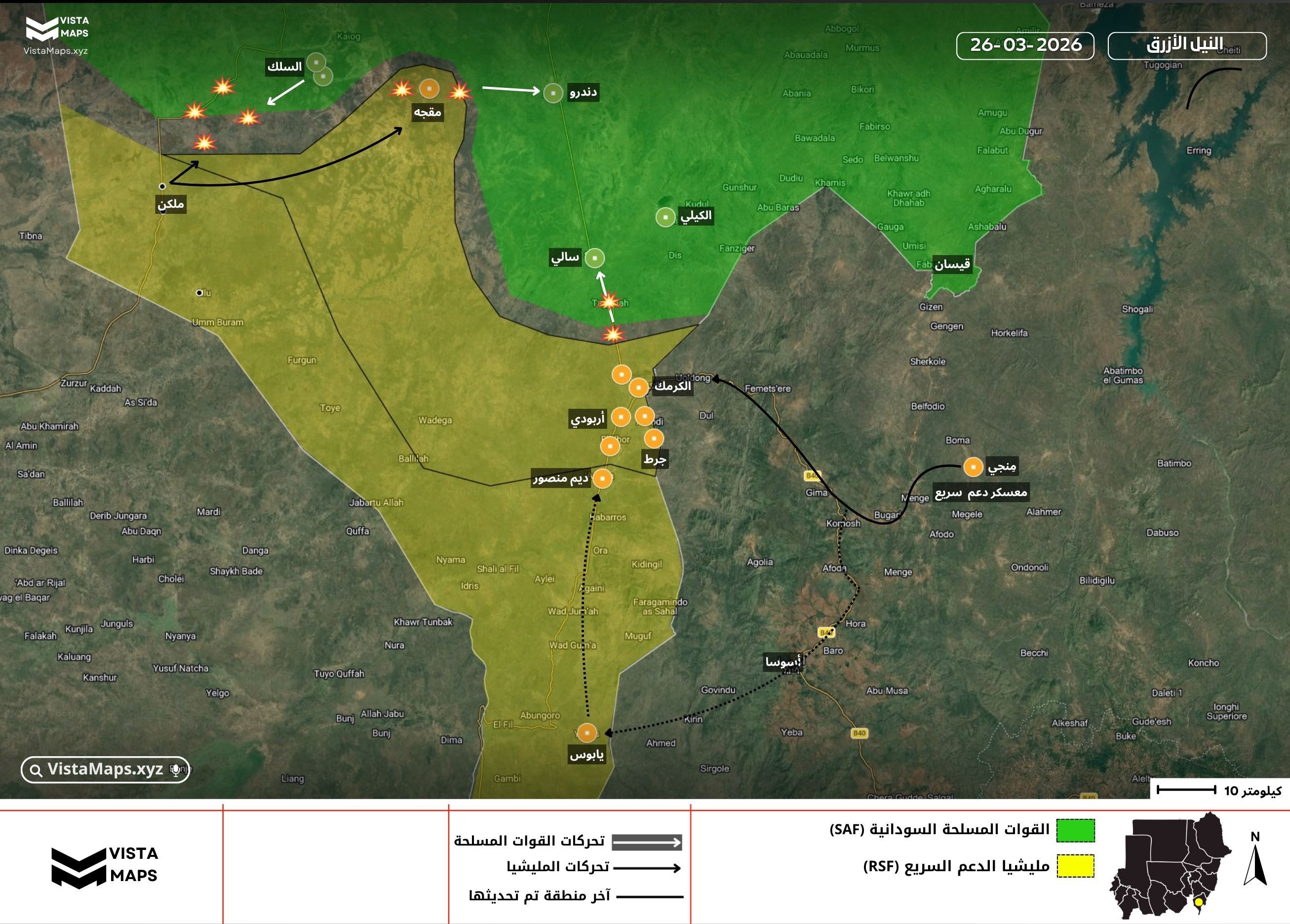
Vistamaps via X and Telegram is source for this map and information. Sudan War Monitor via X is also a source for this post.
Sources available upon request
Will The U.S. Begin Ground Operations This Weekend? |
TODAY IN HISTORY
(March 28, 1919): French labor law regulating baking hours is passed
On this day in 1919, a law regulating “la fabrication du pain” was passed in France, restricting bakers from working from 10 pm to 4 am. This culminated in a quiet cultural shift in which the traditional French boule—which took hours to prepare—was gradually replaced by the baguette, a long, narrow, bread that could be prepared in a fraction of the time. The French staple eventually became commonplace, and today the baguette is protected as a part of the UNESCO Cultural Heritage list.
