- Basedment
- Posts
- How America’s Political Culture Reached Breaking Point
How America’s Political Culture Reached Breaking Point
Your daily dose of geopolitical updates and strategic analysis. Unbiased, but not unbased.

Editor-in-Chief
September 12, 2025
THE BRIEFING
Here’s what’s happening in geopolitics today.
Welcome to today’s global briefing. From a shocking political assassination in the U.S. to rising Gulf tensions that saw Israeli firms barred from the Dubai Airshow, today’s headlines reflect just how quickly global fault lines are shifting.
In Europe, Poland is taking its concerns over Russian drones to the U.N., while Mexico reels from a deadly gas tanker explosion.
Today we look at how America reached a boiling point, a society fractured by decades of division, media manipulation, and political spectacle.
THE LAST 24 HOURS IN GEOPOLITICS
1. Charlie Kirk shot dead in political assassination, manhunt on for suspect
Conservative activist Charlie Kirk was fatally shot Wednesday while speaking at an outdoor event at Utah Valley University, and the gunman who was reportedly positioned in a nearby building roughly 200 yards away, fired a single shot. Authorities say a person of interest was briefly detained but later released; no confirmed suspect is yet in custody, and law enforcement agencies including the FBI are still investigating. The incident has sparked widespread concern over political violence and raised questions about security at public political events.
read more
2. UAE bars Israeli firms from attending Dubai Airshow as regional tensions grow
Israeli weapons makers have been barred from one of the world’s biggest aerospace expos in the United Arab Emirates amid rising anger in the Gulf at Israel’s Gaza offensive and an unprecedented airstrike on Qatar this week. While the official statements said the decision was due to security considerations, senior officials in Israel claim the reason behind the ban is the Israeli Air Force’s strike in Qatar.
read more
3. UN Security Council to meet over violation of polish airspace
Poland has requested an emergency meeting of the U.N. Security Council after Russian drones violated its airspace earlier this week, prompting Poland, with support from NATO allies, to shoot down several of them. The Foreign Ministry says the meeting was called to discuss the breach and ensure accountability following the incident. This marks a significant escalation with NATO formally involved, as Poland moves to rally international backing and deter further incursions.
read more
4. Massive gas tanker explosion in Mexico City kills 3 people and injures 70 others
A gas tanker truck overturned and exploded under a highway overpass in southeast Mexico City’s Iztapalapa district, killing at least three people and injuring around 70 others, many with severe burns. The blast engulfed dozens of vehicles, sent plumes of smoke over the area, and involved injured victims as young as a 2-year-old. Local officials have launched an investigation, with questions already being raised about the truck’s safety and insurance status.
read more
5. U.S. Defense Secretary Hegseth holds call with Chinese counterpart
U.S. Defense Secretary Pete Hegseth spoke by phone with his Chinese counterpart, Dong Jun, making it clear that Washington doesn’t want conflict or regime change in China, but will resolutely defend its vital interests in the Asia-Pacific region. The Pentagon described the call as “candid and constructive,” and both sides agreed to keep up the dialogue moving forward.
read more
DAILY DEEP DIVE
POLITICAL ASSASSINATION: ONE SHOT, 50 YEARS OF DECAY
In the last 24 hours, Charlie Kirk was assassinated by a sniper at a Utah university. Political assassinations are not rare, but this one feels different. It’s not only the brutal killing of a young man in front of his family and thousands of bystanders, the cold, calculated shot, or the bloody footage now circulating online. Rather, this assassination feels like the splitting atom of tensions that have been brewing for decades, finally reaching a boiling point.
We won’t sit here and debate the politics of the man, nor will we rush to blame any individual, group, or organization. What we will call out, however, is the system that fostered such a toxic political climate, one that has brought us to the point we now find ourselves in.
Yesterday I put up a statement that gained a lot of traction amongst our followers which was shared around: “when a political system rewards extreme rhetoric to win votes, the cycle compounds. Eventually it reaches a boiling point - as we’re seeing in America today.”
What this means is that the American political system is built on rhetoric as the price of entry. To even capture attention, let alone win votes, parties must escalate their messaging. In a culture shaped by mass individualism, consumerism, and an all-powerful media establishment, rhetoric becomes entertainment, a show that must get louder and more extreme each election cycle. Over decades, what begins as mild critiques evolves into comparisons with Hitler. Both sides play this game, and the result is an evolution of rhetoric that breeds toxicity, amplified by fragile cultural norms and the constant churn of the media machine.
But now you’re asking “Yeah, but why is it like this?”
Well a large part of it has to do with the fact that voting is voluntary. Most countries have voting as voluntary but 22 nations, including our example Australia don't. A large part of why Australia has avoided the extremes of American-style political theatre (for now) comes down to mandatory voting. When everyone is required to vote, campaigns are naturally pulled toward the centre, competing for the broad middle rather than whipping up a narrow but loyal base. In the United States, where voting is voluntary, elections hinge on turnout, which incentivises politicians to fire up their supporters through culture war battles, polarising rhetoric, and constant outrage. Compulsory voting removes that incentive, you don’t need to stoke division just to get your side to the polls.
“Alright but most of the world has voluntary voting, what makes the U.S so special?” is what you may be thinking, and that’s a great question:
The media establishment has created a landscape that thrives on division and anger, because outrage drives engagement. This is not accidental, the business model itself rewards conflict: more outrage means more clicks, more views, more sales. As the old saying goes, “good news doesn’t sell.” The sad reality is that legacy media giants are structurally incentivised to amplify distrust, despair, and anger across American society, because the more fractured the public becomes, the more profitable the media machine is.
There is also an extreme culture of hyper-partisan media: two distinctive camps. If political parties are the megaphones of extreme rhetoric, their allied media outlets are the loudspeakers at a Metallica concert. This has it’s roots in the Fairness Doctrine, introduced in 1949, requiring balanced coverage of controversial issues. Its repeal in 1987 opened the door to openly partisan media, paving the way for Roger Ailes’ Fox News model built on personality, spectacle, and partisanship. Supporters saw it as free speech; critics argued it fueled sensationalism, rewarding extreme rhetoric. Regardless, the result was politics as entertainment, each cycle demanding louder, sharper messaging to hold attention in a crowded media market.
Then came the rise of 24-hour news, where even the biggest stories turn stale within hours, and the interconnected internet only accelerated the cycle. Together, they create another layer of toxic amplification.
Now let me paint a picture of the modern American society,
The internet, one of humanity’s greatest accomplishments, has also intensified some of its worst traits. It was meant to be an open forum of global discussion, but instead created echo chambers and digital battlegrounds, where opposing sides attack each other before retreating back into closed communities.
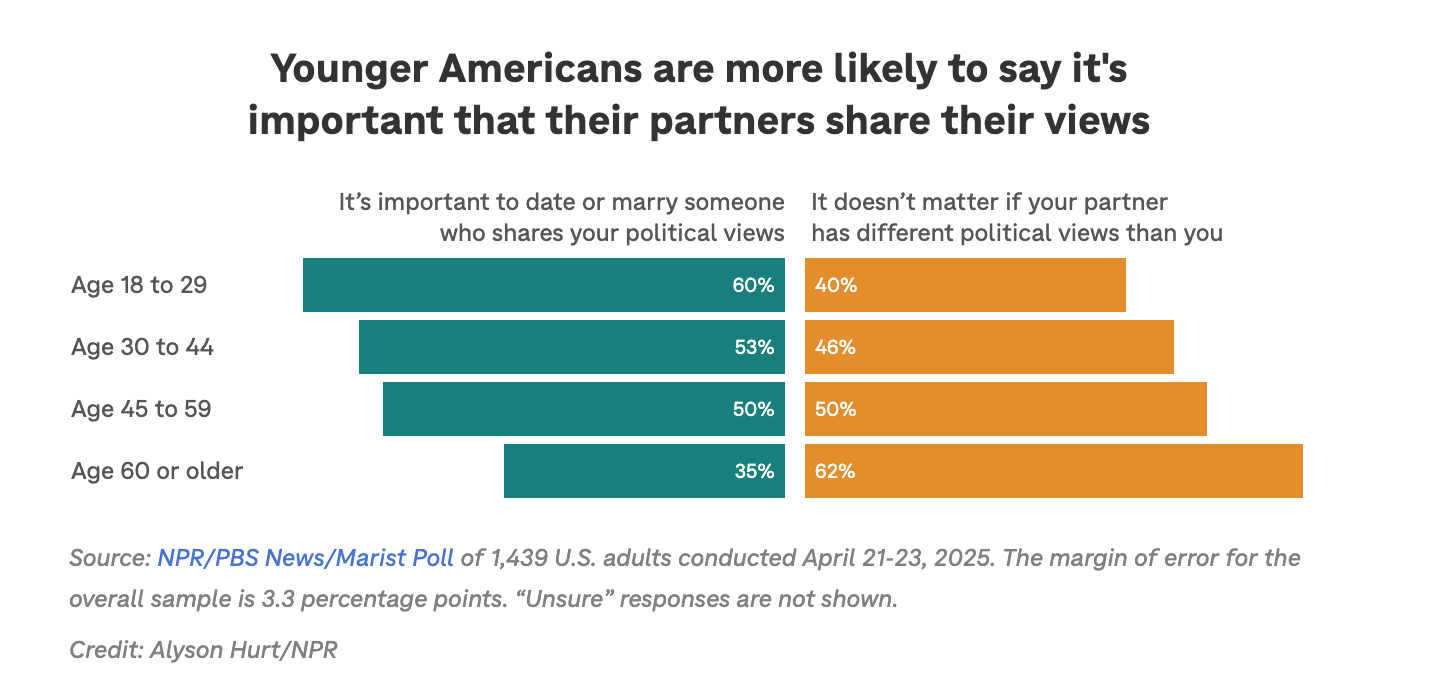
As billions grow more connected to their phones and the virtual space, society has lost vital traits of real-world interaction, such as empathy. It is far easier to hurl insults online than face someone in person. People talk less, trust less, and fracture more deeply. One striking example is dating: increasingly determined by political ties. Men trend more conservative, women more progressive. Where politics once mattered little in relationships, polarisation now drives record levels of loneliness and declining partnership rates, another byproduct of division and the ease of retreating into echo chambers.
Layered onto this is the backbone of modern American culture that emerged after World War II: capitalism. While capitalism has driven innovation and prosperity, it also promotes a culture of materialism, consumerism, and hyper-individualism creating a emptiness in individuals that echoes in society. This hyper-individualism, in turn, laid the groundwork for the rise of identity politics.
Issues were increasingly framed not as policy debates but as battles over identity, race, gender, religion, sexuality, class. Parties discovered that identity appeals were the most effective way to energise their base in a voluntary-voting system. Media outlets, chasing outrage and clicks, expanded the divides. Over time, political culture in America became one where personal identity is weaponised for partisan gain, deepening fractures and eroding the possibility of compromise.
At the core of it all, no matter what identity you claim, millions of Americans are struggling just to get by. And when people feel beaten down, history shows they don’t look for moderation, they look for extremes. That’s why populism is roaring back across the West. It’s driven not only by fear of economic collapse, but by a deep sense of cultural decline. The internet has stripped away the curtain on the wealthy, showing their excess; the mansions, the tax breaks, the lawyers who bend the rules in their favor. Every glimpse of that privilege fuels outrage, and that outrage is now boiling over into a desperate demand for something radically different.
FOREIGN INFLUENCE
Lastly, America has enemies, and they have long sought the downfall of its hegemony. Subversion of society and culture is nothing new, it dates back to the Cold War. In the 1980s, KGB defector Yuri Bezmenov warned that the Soviet Union aimed to weaken America from within through “ideological subversion,” a process of eroding culture, institutions, and trust in four stages: demoralisation, destabilisation, crisis, and normalisation.
Today, the same tactics are repurposed through technology. Online arguments are often with bots built to inflame division, and entire rallies have been staged by tricking opposing groups into meeting at the same place. Crucially, this isn’t just the work of foreign adversaries, domestic actors have adopted the same playbook.
CLOSING REMARKS
So when someone asks, “How does the assassination of a man take place in broad daylight?, the answer is not a single cause - but a cauldron that has been simmering for decades. Economic decline, cultural exhaustion, and a search for meaning twisted into identity battles; media and political machines that profit from outrage; technology that isolates while pretending to connect; a culture of hyper-individualism where community has withered. All of it mixing, churning, feeding into one another until the pressure could no longer be contained.
This assassination feels shocking in the moment, but it is the product of a long journey: decades of pressure, disillusionment, and polarisation compounding until the system itself produced a flashpoint. What happened in broad daylight is not the beginning, but the inevitable boiling point of a society that has been unravelling in slow motion.
Sources:
Sources available on request, reduced to maintain visual integrity of page.
TWEET OF THE DAY
Well said Friedberg.
free speech. but we’ll shoot you.
something is deeply broken in the west. if we don’t fix it, eventually everyone could be ushered at gunpoint to sign the proclamations of the Truth Ministers.— david friedberg (@friedberg)
7:23 PM • Sep 10, 2025
TODAY IN HISTORY
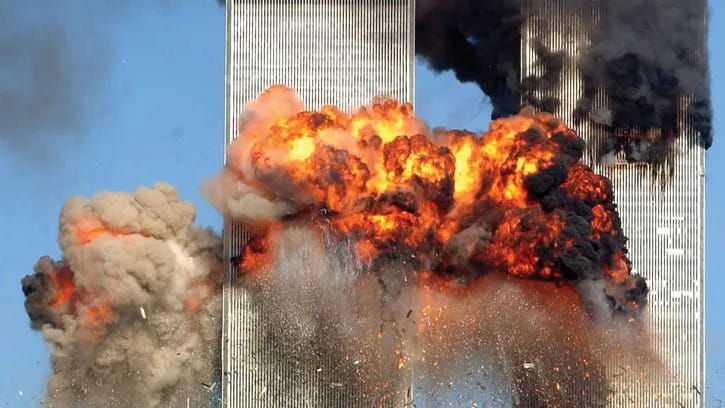
(September 11, 2001): World Trade Center and Pentagon attacked by terrorists
On this day in 2001, 19 militants associated with the terrorist group al-Qaeda hijacked four planes in the United States, crashing three into buildings (the fourth crashed in Pennsylvania) and killing some 3,000 people.