- Basedment
- Posts
- IDF Gaza Offensive: Everything You Need To Know
IDF Gaza Offensive: Everything You Need To Know
Your daily dose of geopolitical updates and strategic analysis. Unbiased, but not unbased.

Editor-in-Chief
September 16, 2025
THE BRIEFING
Here’s what’s happening in geopolitics today.
Welcome back to your daily briefing. Here’s a quick run-through of the biggest geopolitical developments making headlines.
From deadly Russian strikes in Ukraine and a drone scare in Warsaw, to a second U.S. strike on a Venezuelan boat and Denmark’s big investment in Greenland, it’s been an eventful 24 hours.
We’re also watching Thailand’s new prime minister roll out his cabinet as he looks to steady the country’s politics. And in today’s deep dive, the Gaza City operation has officially begun so we are breaking down everything you need to know.
THE LAST 24 HOURS IN GEOPOLITICS
1. Russian strike on Zaporizhzhia leaves 2 dead, 14 injured
Ukraine reported that Russian attacks overnight on Zaporizhzhia and the surrounding Polohivskyi district killed 2 people and injured 14 others, authorities said. The strikes included a volley of multiple-launch rocket system (MLRS) fire around midnight. Damaged infrastructure and injured civilians are under treatment, as regional governor Ivan Fedorov confirmed in his Telegram update.
read more
2. Poland ‘neutralises’ drone flying over government buildings
Poland’s State Protection Service says it “neutralised” a drone flying over sensitive government sites in Warsaw overnight and detained two Belarusian citizens in connection with the incident. Prime Minister Donald Tusk called the breach serious, especially in light of recent airspace violations by Russian drones, and pledged a full investigation to understand who authorised the flight. The authorities say there’s no firm evidence yet that the drone threat was linked directly to Russia, but heightened tensions mean Poland is treating this as potentially part of a broader pattern.
read more
3. Trump says U.S. hit another drug boat from Venezuela
Trump announced that the U.S. military carried out a second “kinetic strike” against a boat from Venezuela alleged to be transporting drugs, killing three people in international waters. The White House claims the vessel was operated by narcotraffickers, calling them “narcoterrorists,” and used video footage showing the boat exploding and catching fire. Critics have raised legal and ethical concerns over using lethal force in drug interdiction without transparency or clear congressional authorisation.
read more
4. Denmark to spend $250M on Greenland’s Infrastructure
Denmark has pledged 1.6 billion Danish crowns (about $250-$253 million) for infrastructure and healthcare upgrades in Greenland from 2026 through 2029. Key projects include building a landing strip in Ittoqqortoormiit, a deep-water port in Qaqortoq, and taking over the costs of Greenlandic patients seeking treatment at Danish hospitals. With rising international interest in Greenland due to its strategic Arctic location and resource potential, the move is seen as Denmark reinforcing its ties and responding to recent pressure from U.S. ambitions over the territory.
read more
5. New Thai PM Anutin finalises cabinet lineup to form government
Thai Prime Minister Anutin Charnvirakul has finalized his cabinet lineup after being elected in Parliament, naming respected figures from outside politics to key portfolios, such as Sihasak Phuangketkeow as Foreign Minister, Ekniti Nitithanprapas as Finance Minister, and Auttapol Rerkpiboon as Energy Minister. The cabinet combines political insiders from Anutin’s Bhumjaithai Party with technocrats and external experts, signalling a push for experience and credibility amid economic uncertainty. Anutin has promised his government will “hit the ground running,” with urgent focus on economic stimulus, restoring public trust, and delivering stability ahead of scheduled elections in four months.
read more
DAILY DEEP DIVE
THE BATTLE FOR GAZA BEGINS? IT BEGAN A WHILE AGO
May – July: The Launch and Stagnation of Gideon’s Chariot
Israel launched Operation Gideon’s Chariot in mid-May with sweeping promises: to conquer Gaza, dismantle Hamas militarily and administratively, prevent the group’s grip over aid, and secure the release of hostages. One month in, however, progress was halting. By mid-June, the IDF controlled just over half the territory, though over 80% of Gaza was effectively a military zone with mass civilian displacement. Tactics emphasized caution, shaped by early battlefield losses and hostage risks, as IDF Chief of Staff Eyal Zamir insisted on methodical urban clearing. Attacks on Israeli forces surged, highlighting militant resilience, while Israel’s push to collapse Hamas’s governance inadvertently eroded Gaza’s civil institutions, creating a fractured landscape of militias and profiteers. The offensive looked less like a decisive campaign and more like a grinding war of attrition.
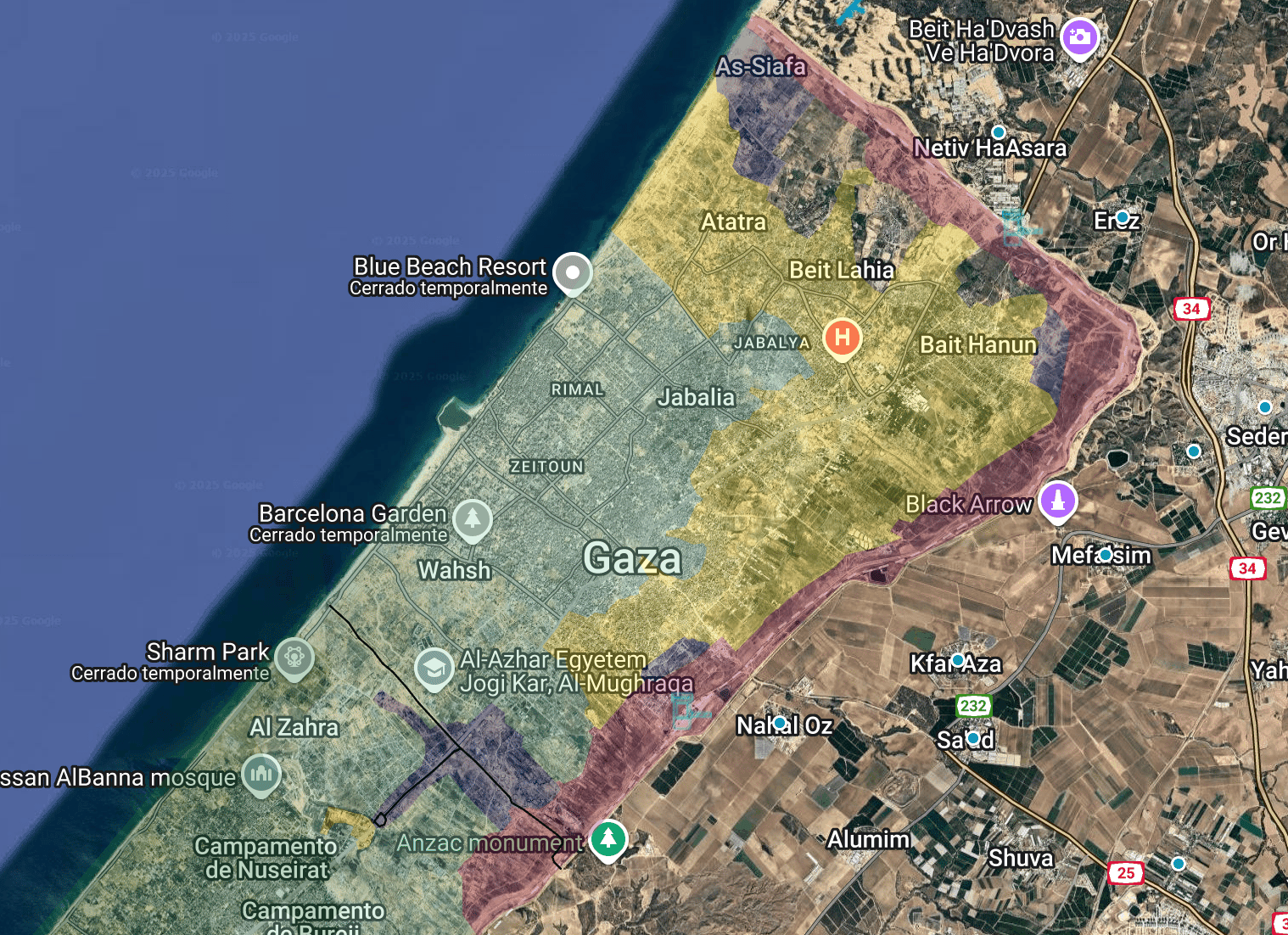
Yellow, red, blue is IDF presence. Green is militant controlled. Suriyak Maps is the source. From Wahsh to the border of Jabalia city is the area of Gaza city.
July – August: The Drawdown and Unfulfilled Goals
By late July, signs of fatigue and strategic limits were clear. Israel began drawing down troops, with the withdrawal of the 98th Division and two reserve brigades signalling that Gideon’s Chariot was closing without achieving its stated goals. Hamas, though weakened, remained a capable force, surrendering in some northern pockets like Beit Hanoun but regrouping in Khan Younis with ambush squads. Civilian relocation south largely failed, with over a million Palestinians still in Gaza City. Efforts to bypass Hamas’s control of aid through the Gaza Humanitarian Foundation collapsed amid chaos, deadly incidents at distribution points, and rising reports of famine, forcing Israel to allow UN and even airdropped assistance. Most crucially, the hostage objective remained unmet, as negotiations with Hamas stalled and U.S.-Israeli mediators withdrew from Qatar. DF Chief of Staff Lt. Gen. Zamir privately admitted the IDF had “reached the lines” set at the start of the campaign. Zamir also warned that a prolonged stay in Gaza was “eroding” the standing army and reserves after nearly two years of continuous fighting. He cautioned that extended deployments risked undermining troop morale and ultimately playing into Hamas’s war of attrition strategy.
Two alternatives were set to be presented to the political leadership by the military: conquering the entire Strip, which the IDF has said it opposes, with the army assessing it could take years to clear all Hamas infrastructure; or continuing to encircle Hamas-held areas and engaging in a war of attrition against the terror group’s guerrilla forces.
August - September: The Battle for Gaza City
The IDF’s newly announced offensive in Gaza City is less about a sudden “entry” and more the culmination of months of gradual expansion: Israeli forces have been operating inside the city since March, and by today they control roughly 46% of it. After partially withdrawing in 2024 to focus on Jabalia, Beit Lahiya, and Beit Hanoun, and later from the Netzarim corridor during the 2025 ceasefire, Israel restarted its campaign by methodically clearing the eastern neighborhoods of Shujaiyya, Kuba, and Al-Tuffah, elevated areas overlooking the border settlements and home to Hamas’s elite Al-Qassam units. Fighting there featured ambushes, rocket fire, and mortar strikes, though the lack of coordination and dwindling quality of Hamas’s equipment and manpower limited the effectiveness of resistance, prompting the IDF to advance cautiously while demolishing structures. In July, operations shifted to Al-Zeitoun, where rapid demolitions accelerated Israeli control and eliminated a significant militant foothold. Combined with heavy pressure in central Jabalia, the IDF now appears to be executing a “squeezing” maneuver — closing in from multiple directions to isolate and clear pockets of the city. Israel claims some 250,000 civilians, around 40% of Gaza City’s population, have fled south, and it is likely that a portion of militants have also relocated to the central camps of Nuseirat, Maghazi, and Bureij, as well as Deir al-Balah, where Hamas and allied groups still retain more coherent and concentrated defensive positions.
The Israeli Air Force says it struck over 850 terror targets and killed hundreds of operatives in Gaza City over the past week, ahead of the ground offensive that began last night. In the last two weeks, we’ve seen an increased focus on leveling the remaining high-rise buildings across Gaza City and Khan Younis. Interestingly, the IDF has introduced a new tactic: loading old M113 armoured carriers with hundreds of kilos of explosives and driving them, via remote control, into the foundations of high-rises before detonating them. This delivers are far larger and deadlier payload than the more standard method of firing missiles directly into the buildings’ foundations.
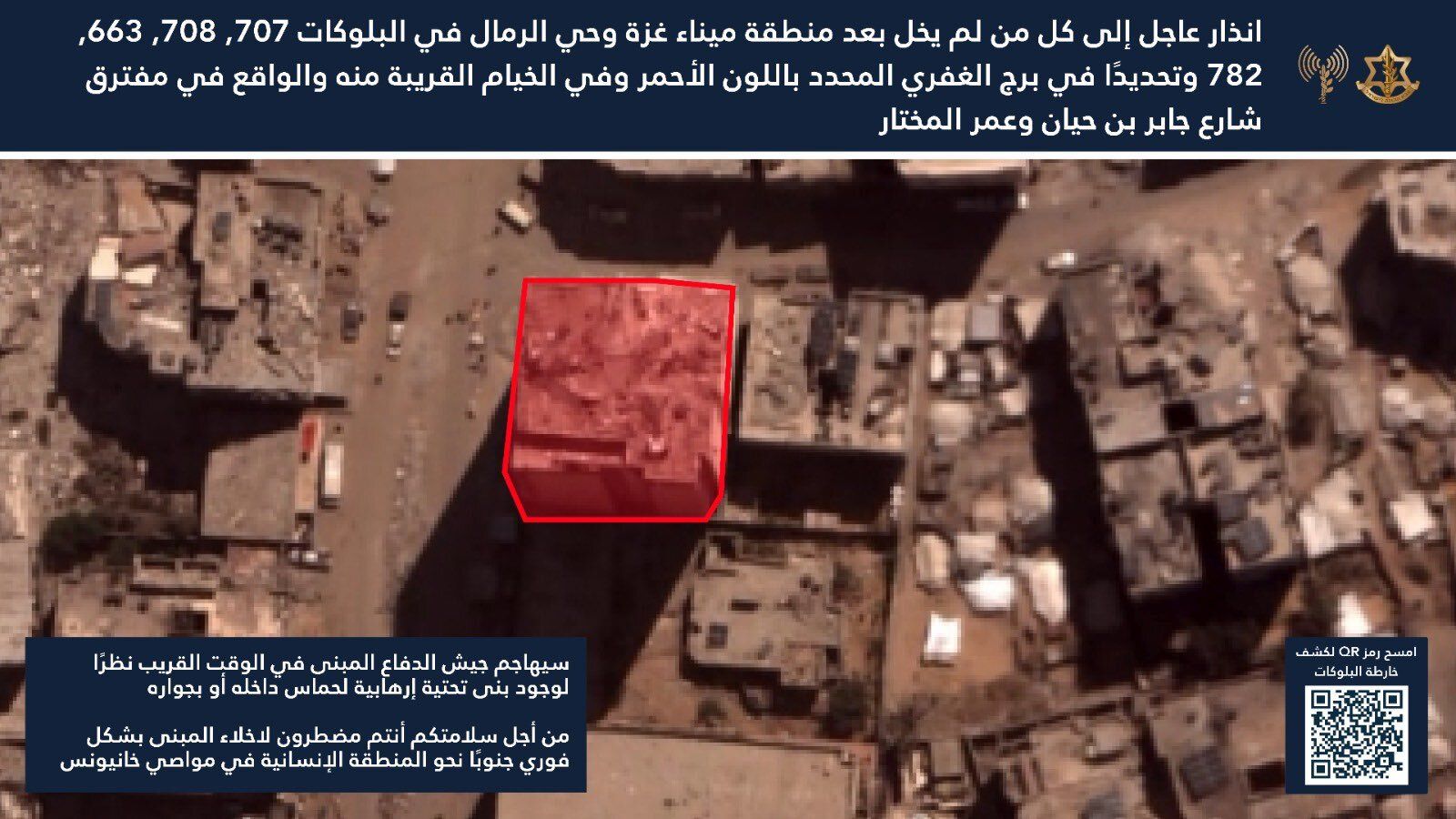
The IDF evacuation warning for Palestinians residing in the vicinity of the Ghafri Tower, ahead of an airstrike.
Today - The Official Start, What to Expect, Internal Disagreements
With around 250,000–350,000 civilians now leaving Gaza City, we can expect the pace of the IDF campaign to pick up in the early stages. Armored units have already begun entering new zones, but the key question is whether the military has adjusted its tactics after the stalls in Khan Younis. Most likely, we’ll see the same slow, cautious block-by-block clearing approach, as Zamir has consistently prioritized reducing IDF casualties. That said, there appears to have been far greater preparation and resource allocation for this battle compared to Khan Younis, and time will soon tell if the heavy airstrikes have meaningfully weakened militant capacity. Another factor is how committed militants will be to defending Gaza City compared to those who have already withdrawn to the remaining strongholds. Coordination and ability have clearly been impacted, which could limit their effectiveness – but Gaza City’s dense urban terrain, rubble, and tight streets remain ideal for guerrilla warfare.
There were also internal disagreements about whether to launch the offensive. Israel’s top security chiefs (IDF Chief of Staff Lt. Gen. Eyal Zamir, together with the heads of Mossad, Shin Bet, and military intelligence) advised Prime Minister Netanyahu against the move. They warned it could endanger hostages, inflict heavy IDF casualties, and still fail to dismantle Hamas, while potentially forcing Israel into direct military rule over Gaza’s two million residents. These concerns may shape how the campaign unfolds, reinforcing a cautious, methodical approach despite the pressure for faster gains.
Sources:
Sources available on request, reduced to maintain visual integrity of page.
TWEET OF THE DAY
Ok now this is low-key scary… We’re in the age of drone warfare, are humanoids next?
Dynamic control trained at SUSTech’s ACT Lab in Shenzhen.
— The Humanoid Hub (@TheHumanoidHub)
4:55 PM • Sep 15, 2025
TODAY IN HISTORY
(September 16, 1998): Central Americans granted independence
On this day in history, the Basque separatist group ETA declared an indefinite cease-fire after three decades of guerrilla attacks in Spain that killed around 800 people. But the peace only lasted 14 months before violence resumed.