- Basedment
- Posts
- Iran: And How It All Went Wrong
Iran: And How It All Went Wrong
Iran’s current protests are not isolated events, but the downstream consequence of decades of strategic overreach, proxy warfare, and inflexible ideology.

Editor-in-Chief
January 09, 2026
THE BRIEFING
Here’s what’s happening in geopolitics today.
From hypersonic missiles over Ukraine to explosions inside a Central American parliament, today’s headlines span battlefield escalation, fragile ceasefires and political volatility across continents.
We’re also tracking mounting pressure on governments, with Israel striking Gaza amid a truce, Iran cutting nationwide internet access as protests grow, and Honduras seeing violence spill directly into its legislature, alongside fresh diplomatic movement between Italy and South Korea.
In today’s Deep Dive, we examine how Iran’s rigid, ideology-driven foreign policy locked it into a one-way path now fuelling internal unrest.
THE LAST 24 HOURS IN GEOPOLITICS
1. Russia hits Ukraine with Oreshnik hypersonic missile
Russian authorities said they fired an Oreshnik hypersonic missile at targets in Ukraine overnight, describing the strike as part of a larger bombardment and retaliation for what Moscow claims was a Ukrainian drone attack on President Vladimir Putin’s residence, a claim Kyiv rejects. The defence ministry said the missile hit infrastructure linked to Ukraine’s military-industrial capabilities, with other drones and long-range weapons also used in the operation, while Ukrainian officials reported impacts on energy sites and other infrastructure. The Oreshnik, an intermediate-range hypersonic weapon capable of speeds above Mach 10 and carrying conventional or potentially nuclear payloads, represents a rare battlefield use of the system.
read more
2. Israeli attack across Gaza kill 14 Palestinians despite ‘ceasefire’
Israeli forces carried out a series of strikes across the Gaza Strip on Thursday, killing at least 14 Palestinians, including women and children, according to local health officials and emergency services, even though a U.S.-brokered ceasefire has been in effect since October. The strikes hit tents and shelters in areas such as Al-Mawasi near Khan Younis and other parts of southern and central Gaza, injuring several others and drawing condemnation from Palestinian authorities.
read more
3. Nationwide internet blackout in Iran as protests over economic crisis persist
Iran experienced a nationwide internet blackout on Thursday as anti-government protests driven by economic hardship continued to spread across the country, with internet monitoring group NetBlocks reporting that connectivity was effectively cut off at a national level amid the unrest. The blackout comes as demonstrators take to the streets in major cities including Tehran, Mashhad and Isfahan to protest soaring inflation and currency collapse, and follows earlier partial throttling of digital access aimed at limiting communication and coordination among protesters. Iranian authorities have not provided an official explanation for the outage.
read more
4. Italian PM Meloni to visit South Korea for summit with President Lee
Italian Prime Minister Giorgia Meloni will visit South Korea from January 17 to 19, 2026, for a summit with President Lee Jae-myung, South Korea’s presidential office announced Friday, marking the first state visit by an Italian leader to Seoul in 19 years. The two leaders are scheduled to hold a summit on January 19 where they will discuss strengthening bilateral cooperation on trade, artificial intelligence, defence and broader international issues. Italy is among South Korea’s top European trading partners, and the visit reflects a strategic effort to deepen ties across economics, technology and security.
read more
5. Explosion injures Honduran lawmaker during live interview
A homemade explosive device was thrown near Honduran opposition lawmaker Gladis Aurora López inside the National Congress in Tegucigalpa on Thursday, injuring her and prompting immediate medical attention, authorities and media reports said. López, a member of the conservative National Party, was struck in the back by the blast during a session where lawmakers were convened amid tensions over the disputed November 30 election results, and her injuries were described as non-life-threatening. National Party officials accused members of the ruling Libre Party of being behind the attack.
read more
DAILY DEEP DIVE
IRAN: WHERE DID IT ALL GO WRONG?
“THE GAME IS THE GAME”
It’s been a rough few months for the anti-Western axis. But if you look back to pre-2022, the picture was very different. Russia controlled Crimea, remained sanctioned but most importantly, retained a far stronger global image. Iran was arguably at its regional peak before October 7. The Houthis were striking Saudi oil facilities during F1 races, Assad had by most accounts “won” the Syrian war and balkanisation seemed inevitable, Hezbollah functioned as a quasi-state straddling Lebanon and Israel, while Iraq sat firmly within Iran’s sphere of influence.
Fast forward to 2025, just two to three years later, and much of that architecture has unravelled. We’ve already discussed Russia: bogged down, overstretched, and with its power projection severely diminished. But Iran, too, has watched its two most important regional allies weakened—one effectively removed from the board entirely.
And isn’t this the essence of geopolitics? If we momentarily strip away the immense human suffering, what remains is a chess game that never ends—one played not just on a board, but with walls and a ceiling. My advice to anyone getting into geopolitics is to understand that the game is the game. The game never changes. And if you haven’t clocked it yet, yes—that’s a reference to The Wire. I tend to view events through a realist lens, but there is real merit in that framing. What I would say to all new readers, or those who may have gotten lost along the way, is that to best understand any of this, you must view everything analytically and without emotion. Absolutism can damage thought processing and decision-making—something I’ll return to shortly.
With that in mind, I want to share my perspective on the Iranian protests and how we arrived here.
Iran: A Case Study In Ideological Absolutism
Iran is a fascinating case study in how a state actor’s own decisions can erode its long-term viability. I’ll focus primarily on foreign policy, though internal dynamics matter too, because Iran’s external posture plays a significant role in the current unrest.
First, Iran locked itself into a rigid, non-adjustable diplomatic trajectory. It was Iran that picked up the sword and positioned itself as the standard-bearer of Islamic resistance against Israel after Arab unity collapsed in the early pan-Arab era. By doing so, Tehran cast itself as the ideological beacon of Islam. This brought short-term benefits: regional legitimacy, domestic support, and strategic clarity. Militarily, Iran became formidable—and despite the setbacks of the 12-day war, its missile arsenal demonstrated real capability even under sustained pressure.
But when a state builds its geopolitical identity around an existential, religious confrontation, it forfeits the ability to recalibrate. If you define your enemy in absolute terms—morally, ideologically, theologically—then reprisals are not just inevitable, they are baked into the strategy. Iran chose that path, and it was effectively a one-way road toward open conflict. As a theocratic system, Iran is further constrained by an inability to acknowledge miscalculation or error—an affliction we’ve discussed before in the context of autocracies. Once committed, course correction becomes almost impossible.
This leads us to the second point. In committing to this existential geopolitical strategy, Iran began funding like-minded groups and allies across the region. Most well-known are Hezbollah, Assad’s government, the Houthis, and Hamas. Another major component is the various Shia paramilitary groups operating in Iraq. Decades of funding, military training, high-tech equipment, espionage, and intelligence support amounted to billions of dollars annually.
The clearest example of this, almost ironic, commitment is Iran’s long-term support for Hamas. For decades, Tehran was one of Hamas’s primary backers, despite Hamas being ideologically rooted in the Muslim Brotherhood—a Sunni tradition historically hostile to Iran’s Shia revolutionary model. This divide became explicit during the Syrian war, when Hamas broke with Tehran between 2012 and 2017 after opposing Bashar al-Assad. Iran would later STILL resume financing and supporting Hamas in opposition to Israel.
The Unraveling
Then came October 7. This was the moment when existing cracks began to widen. Years of sanctions, corruption, and the prioritisation of funding allies and resistance groups across the Middle East coincided with declining living standards at home and rising prices. We can argue over precise figures and funding ratios, but to many Iranians, external actors were being prioritised over internal needs. And it’s important to remember that one of Iran’s strategic weaknesses is its multicultural composition; an existential war against Israel becomes far harder to sustain once it begins to affect the domestic front. Hezbollah was severely weakened, Gaza was flattened, Assad was exiled within a month, and hundreds were killed in Israeli strikes inside Iran. All this would naturally create a whirlwind of societal emotions that was bound to internally combust.
To return to the opening point, Iran chose a one-way trajectory. Whether one supports Iran ideologically or geopolitically, that choice is now a reality, and it carries consequences across the multidimensional board game discussed earlier. Iran’s regional rivals, also Muslim and far more closely linked as Sunnis to the Palestinian cause, have quietly moved in the opposite direction, deepening intelligence cooperation, trade, and economic ties with Israel — applauded as a new era, while all the while Iranians ask themselves: what was all this for? This is the game. And the game never changes.
Sources
News/Journal sources available upon request, not shown to maintain visual integrity of page.
TODAY IN HISTORY
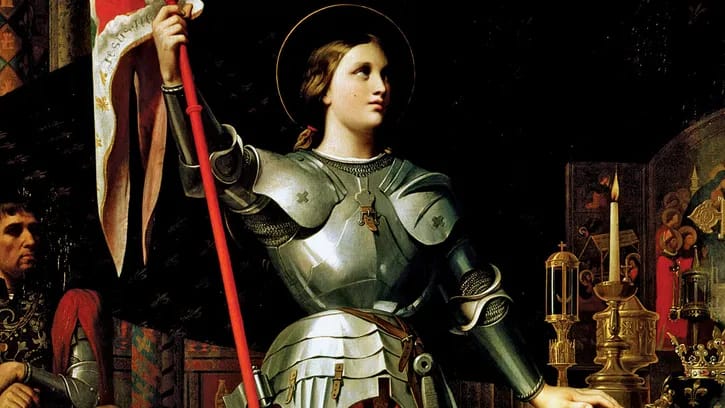
(January 9, 1431): Joan of Arc put on trial
Nineteen-year-old “Joan the Maid,” as she was referred to in court records, was put on trial in France on this day in 1431. She faced more than 70 accusations, including murder and heresy, and she eventually confessed, resulting in a life sentence that was later escalated to execution.