- Basedment
- Posts
- Iran: "Largest Build Up In Decades", Iran Nuclear Talks, And More
Iran: "Largest Build Up In Decades", Iran Nuclear Talks, And More
In today’s deep dive, we’re summarising and analysing a wide range of data — from today’s nuclear talks in Geneva to a very large grouping of U.S. Air Force assets in the Middle East.

Editor-in-Chief
February 18, 2026
THE BRIEFING
Here’s what’s happening in geopolitics today.
Today’s top five run the full diplomatic spectrum - from cautious nuclear progress in Geneva to stalled Russia-Ukraine talks entering a tense second day.
The Vatican has opted out of Trump’s proposed “Board of Peace,” Sara Duterte has fired the starting gun for the Philippines’ 2028 presidential race, and Hezbollah has rejected Beirut’s latest attempt to bring weapons under tighter state control.
In today’s deep dive, we’re summarising and analysing a wide range of data — from today’s nuclear talks in Geneva to a very large grouping of U.S. Air Force assets in the Middle East.
WORD FROM TODAY’S SPONSOR
The Headlines Traders Need Before the Bell

Tired of missing the trades that actually move?
In under five minutes, Elite Trade Club delivers the top stories, market-moving headlines, and stocks to watch — before the open.
Join 200K+ traders who start with a plan, not a scroll.
THE LAST 24 HOURS IN GEOPOLITICS
1. Iran says ‘guiding principles’ agreed with US at nuclear talks
Iran’s Foreign Minister Abbas Araghchi said Tehran and Washington reached a preliminary understanding on a set of “guiding principles” during a second round of indirect nuclear negotiations in Geneva, establishing a framework to guide further discussions even though a final deal is far from certain. Both sides now plan to work on draft texts based on those principles before setting a date for a third round of talks, with Iran cautioning that much detailed work remains. The comments helped ease some market fears mid persistent tensions that include a bolstered U.S. military presence in the region and Iranian military drills near the Strait of Hormuz.
read more
2. Talks on Russia-Ukraine war enter 2nd day in Geneva
Peace talks between Russia, Ukraine and U.S. mediators have entered their second day in Geneva, marking the third round of U.S.-brokered negotiations aimed at ending almost four years of war, with both sides meeting behind closed doors to discuss security, humanitarian issues and mechanisms for potential agreement. The first day was described as “very tense” by sources close to the Russian delegation, and despite more than five hours of discussions on “practical issues,” neither side signalled a major breakthrough before the talks resumed.
read more
3. Vatican says will not partake in Trump’s ‘Board of Peace’
The Vatican has announced it will not participate in Trump’s newly formed “Board of Peace,” even as some countries have joined or plan to observe the initiative. ardinal Pietro Parolin, the Holy See’s secretary of state, said the Vatican’s unique status and concerns about crisis management outside established frameworks, particularly the role of the United Nations, were key reasons for declining the invitation.
read more
4. Philippine VP Sara Duterte announces run for President in 2028
Philippine Vice President Sara Duterte officially announced that she will run for president in the 2028 national elections, making her candidacy the first formally declared bid for the country’s top office. In her announcement, Duterte framed her campaign around addressing issues like corruption, inflation and government performance, while also apologising for her past support of incumbent President Ferdinand Marcos Jr. and criticising his leadership. Her announcement comes amid ongoing political tensions, including multiple impeachment complaints against her and a public feud with Marcos.
read more
5. Hezbollah rejects the Lebanese Govt’s weapons reduction plan and deadline
Hezbollah has formally rejected the Lebanese government’s decision to give the army at least four months to advance phase two of a nationwide plan to bring all armed groups’ weapons under state control, saying it will not accept what it sees as a move that serves Israeli interests. The plan, adopted by the cabinet after the army reported on its strategy, focuses on restricting weapons from areas north of the Litani River to the Awali River in Sidon, but Hezbollah’s leaders called the focus on disarmament a “major mistake” and walked out of a recent session in protest. Lebanon’s Information Minister said the four-month timeline is renewable depending on available capabilities, Israeli attacks and obstacles on the ground.
read more
DAILY DEEP DIVE
Iran-USA Conflict Update Part 1
Quick Brief
In moments like this, the challenge isn’t just what’s happening — it’s the overload of information. The problem is that in the age of 24/7 news the feeds simply move too fast. There is a lot of information and it’s difficult to read, understand, trust and bring it all together.
That’s where we come in. We track movements, cross-reference sources, and organise the data clearly so you don’t have to.
In this edition, we cover: key updates from the Geneva nuclear talks, Iran’s buildup, what a potential strike could look like, and a summary of all air and naval assets moved to the Middle East in the past 48 hours.
Also consider we are primarily focussing on U.S. assets - this does not even cover the significant presence of the Israeli airforce for example.
Note: We provided a very informative infograph on existing U.S. air and naval assets February 17-18th at the bottom of this page. It is astonishing.
Iran-Nuclear Talks
With the Iranian delegation likely already back in Tehran, it’s worth looking at what (and mostly what wasn’t) achieved. Iran is framing the talks as progress. Foreign Minister Abbas Araghchi said “good progress” was made and confirmed agreement on “guiding principles” that could form the basis of a draft deal. Tehran’s position is that there is now a structured path forward, even if technical gaps remain. Washington’s tone is more cautious. Vice President JD Vance described the talks as mixed — negotiations will continue, but Iran has not accepted key U.S. red lines, particularly on enrichment. The White House says diplomacy is preferred, but military options remain available. The difficulty is that when someone is holding a gun to your head (or the world’s largest navy) refusing red lines becomes far more complicated.
Iran Build Up
Satellite imagery indicates Iran has resumed repairs to parts of its ballistic missile infrastructure damaged during last year’s 12-day conflict, while major nuclear facilities remain largely inoperative. Construction has reportedly restarted at more than half of the sites struck by U.S. or Israeli forces, with new roofing observed at Natanz and Isfahan and reinforcement activity near underground tunnel entrances.
Western and Israeli officials assess that progress on restoring uranium enrichment at Fordow, Natanz, and Isfahan remains limited, suggesting missile production may be the short-term priority. Activity has also been observed at the Parchin military complex, including new construction at a site previously linked to high-explosives testing.
In terms of offensive capabilities, it is difficult to assess. If we judge by the 12-day conflict, by the end of the war missile salvos and drone strikes were significantly smaller in scale, though still hitting targets accurately, amid what appeared to be ammunition shortages on the Israeli side.
Iran retains the hypersonic capability, which could be used against bases or carriers and potentially cause significant damage. The challenge for Tehran, however, is that in the event of open conflict, Iran would likely become the most monitored nation on the planet.
Recent military drills in the Strait of Hormuz were described as successful by Iranian officials, largely involving missile salvos against mock targets. Iran’s primary deterrent remains its drone and ballistic missile arsenal, including larger-payload systems that have not yet been publicly demonstrated. Whether Iran has fully recovered from last year’s conflict (amid sanctions, internal pressures, espionage activity, and prior strikes) remains uncertain.
Just A Threat Threat? What Sort of Strikes?
This is a buildup we have not seen since the Iraq War. Some have been speculating this is a threat to force the Iranians to the table — my response? This is an extremely expensive threat; the invoice list would be huge. More seriously, what we have here is a coordinated effort to ensure a possible multi-strike campaign.
If you’re curious how this would play out, I would wager the recent success in Caracas could be a good starting point and source of confidence for such an attack. Electronic warfare systems would aim to paralyse radar, air defence networks, and communications, with primary strikes targeting air defence systems and known missile launch platforms. The initial phase would focus on paralysing an Iranian response. We would then likely see strikes targeting military infrastructure such as known command centres, underground bunkers, and other hardened sites.
We could be looking at regime-change-level strike capability here. If we’re to believe inside sources that a strike was meant to happen weeks ago, then I would have argued that earlier action might have resembled Midnight Hammer, a few key precision strikes, but we’re beyond that now.
There is also the espionage role of Israeli and American assets inside Iran, which during the 12-day war proved instrumental in destroying known launch platforms. They would likely still be active now, and if we put our tinfoil hats on, recent fires across Tehran could be attributed to them.
Given that the protests have been subdued, it’s clear that the Iranian government and military apparatus are willing to dig in and not give ground politically, this could mean a decapitation campaign is also possible.
U.S. Air Force – Middle East Activity Update (17–18 February)
Over the past 24–36 hours, U.S. Air Force movements into Europe and toward the Middle East have accelerated across multiple mission sets: fighters, airborne command and control, tankers, and strategic lift.
Fighter Deployments
A total of 48 F-16s from Aviano, Spangdahlem, and McEntire have deployed toward the Middle East.
The second group of 6 F-22As from Langley AFB is now crossing the Atlantic to RAF Lakenheath. With the first six already positioned, the full 12-aircraft package is expected to be forward-staged shortly.
F-16s provide multi-role capability including precision strike, escort, suppression of air defences, and defensive counter-air missions.
The F-22 is a fifth-generation air superiority platform designed for penetration of advanced air defence systems, air dominance against peer aircraft, high-end strike escort, and early-phase suppression of critical nodes.
During Operation Midnight Hammer, F-22 deployments preceded strike activity by several days, making this a notable indicator.
Airborne Command & Control (E-3 Sentry)
DENALI 2 is airborne and heading east — the first of six E-3 AWACS aircraft moving toward the Middle East.
Six aircraft represent over one-third of the operational U.S. E-3 fleet.
The E-3 provides long-range radar surveillance, airspace monitoring, real-time tracking of aircraft and missile activity, battle management, and coordination of strike packages and tanker flows. These aircraft are typically surged when sustained airspace control is required across a broad theatre.
Tanker Movements
Tanker activity continues to increase.
Within the last hour, five additional tankers launched heading east. At least 17 tanker aircraft repositioned over an 8-hour window to Lajes, Rota, Chania, and Sofia.
KC-46 and KC-135 tankers provide in-flight refuelling for fighters, ISR aircraft, and long-range bombers, extending range, enabling continuous patrol cycles, and supporting long-duration strike missions. Lajes and Chania are historically used as transatlantic refuelling nodes.
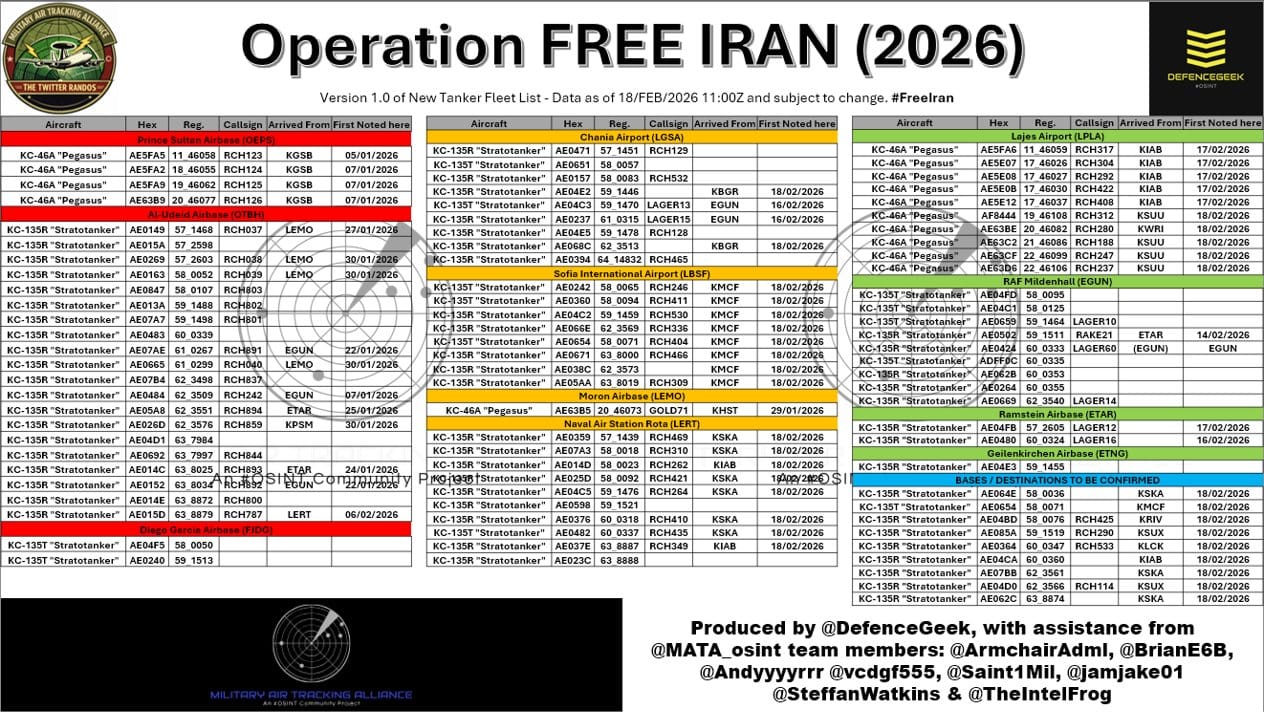
Amazing work by DefenceGeek, direct source linked below.
85 tankers in total.
Image Source - Give these guys a follow.
Strategic Lift
C-17 and C-5 flights now total at least 176, with 24 additional flights in progress. These aircraft transport personnel, equipment, munitions, and logistics required to sustain forward deployments. Strategic lift enables sustainment.
The timing is notable.
Purim (March 2–3) marks the Jewish story set in ancient Persia, centred on survival and reversal. Ramadan begins in Iran tomorrow, when fasting can affect daily rhythms.
Bonus:
Lastly, there are Russian-Iranian military drills happening tomorrow in the Gulf of Oman and Indian ocean. Keep an eye on this. Also Chinese satellites show extensive THAAD and other AD setups across U.S. bases in the ME region.
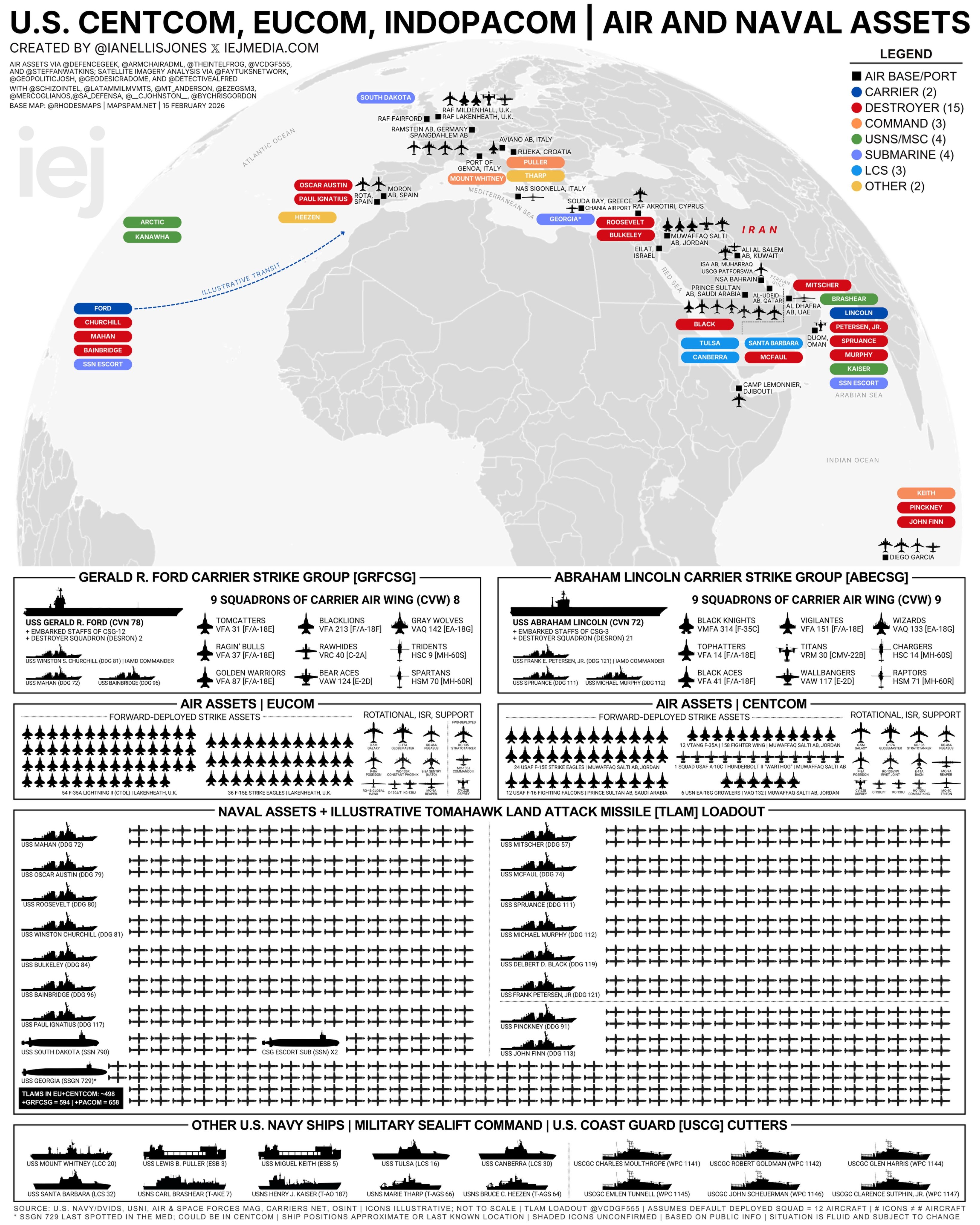
Created by @ianellisjones on X. Amazing Map.
Sources
News/Journal sources available upon request, not shown to maintain visual integrity of page.
TODAY IN HISTORY
(February 18, 2010): The Web site WikiLeaks began posting classified U.S. government documents provided by army intelligence analyst Bradley (later Chelsea) Manning; it was believed to be the largest unauthorized release of state secrets in U.S. history.