- Basedment
- Posts
- Iran-U.S. Nuclear Talks: No Deal Reached
Iran-U.S. Nuclear Talks: No Deal Reached
No nuclear deal reached, but both sides say the meeting was positive, today we analyse whether there is truth to this, as Iran remains extremely vulnerable.

Editor-in-Chief
February 07, 2026
THE BRIEFING
Here’s what’s happening in geopolitics today.
From Europe’s eastern flank to the South China Sea, today’s headlines are a reminder that global flashpoints aren’t cooling off anytime soon.
We’re tracking Poland’s precautionary airport closures after Russian strikes near Ukraine, cautious but “positive” nuclear talks between Washington and Tehran, a deadly suicide bombing in Pakistan, a high-profile shooting in Moscow, and fresh Chinese naval and air patrols in contested waters.
In today’s deep dive, no nuclear deal was reached — but both the U.S. and Iran say the meeting was positive. Today we analyse whether there is truth to this, as Iran remains extremely vulnerable.
THE LAST 24 HOURS IN GEOPOLITICS
1. Two airports in Poland closed due to Russian strikes on Ukraine
Poland temporarily closed two airports in its southeast, Rzeszów and Lublin, after Russian strikes on nearby Ukrainian territory triggered heightened military activity and precautionary airspace measures, the Polish Air Navigation Services Agency said. The closures were intended to ensure the free operation of military and NATO aircraft securing Polish airspace in areas adjacent to the Ukrainian border, where Russian long-range aviation has been active. Officials described the actions as preventive and aimed at protecting state security.
read more
2. Nuclear talks with US in Oman ‘a good start’, Iran says
Iran’s Foreign Minister Abbas Araghchi said nuclear talks with the United States held in Muscat, Oman on Friday were “a good start” and agreed they should continue, after nearly a day of indirect discussions mediated by Oman’s foreign ministry. Araghchi said both sides would return to their capitals to consult on next steps, stressing that Iran wants the talks to focus strictly on its nuclear programme and will not discuss other issues such as ballistic missiles or regional proxies with Washington.
read more
3. At least 31 killed, 169 wounded in Islamabad suicide bombing
At least 31 people were killed and 169 others wounded in a suicide bombing at a Shi’ite mosque on the outskirts of Islamabad during Friday prayers, officials said, making it one of the deadliest attacks in the Pakistani capital in more than a decade. The explosion struck the Khadija Tul Kubra mosque in the Tarlai area, where worshippers were gathered for midday prayers, and the attacker detonated explosives after being stopped at the entrance, according to police and eyewitnesses. The Islamic State (ISIL) affiliate claimed responsibility for the strike.
read more
4. Russian general under US sanctions shot several times in Moscow
Lieutenant General Vladimir Alekseyev, deputy head of Russia’s military intelligence (GRU) and a figure under U.S. and Western sanctions, was shot multiple times by an unidentified assailant in a residential building in Moscow and rushed to hospital in serious condition. Russian authorities opened an attempted murder investigation, and the attacker fled the scene, with a search under way. Alekseyev, 64, has played key roles in Russia’s military operations in Ukraine and Syria and was previously sanctioned by the U.S., U.K. and EU over alleged cyber interference and the 2018 Salisbury nerve agent attack, making him a high-profile target.
read more
5. China conducts naval, air patrols around disputed South China Sea
China’s People’s Liberation Army conducted naval and air patrols around the disputed South China Sea this week, with its Southern Theater Command saying warships and military aircraft operated near Scarborough Shoal as part of stepped-up “combat readiness” operations. Beijing criticised the Philippines for inviting non-regional partners to conduct joint air patrols in the area, accusing them of undermining regional peace and stability, and vowed to remain on high alert to protect its territorial claims.
read more
DAILY DEEP DIVE
U.S. And Iran Deal - Iran Extremely Vulnerable
Wider Context
Talks between Iran and the United States in Oman concluded without any movement on core positions, reinforcing how limited the diplomatic space remains despite renewed engagement. The discussions, held in Muscat and mediated by Oman, marked the first face-to-face contact between senior U.S. and Iranian officials since last year’s 12-day war.
Iran reiterated that it will not end or relocate uranium enrichment, rejecting a central U.S. demand. Foreign Minister Abbas Araghchi framed the talks as a tentative opening rather than a breakthrough. He described the atmosphere as “very positive” but stressed that negotiations must take place “in a calm atmosphere, without tension and without threats,” signaling Tehran’s sensitivity to ongoing military pressure. Araghchi added that while the meeting was “a good start,” its continuation would depend on further consultations in both capitals.
The U.S. delegation included special envoy Steve Witkoff, Jared Kushner, and CENTCOM commander Adm. Brad Cooper—an unusually senior lineup that underlined the stakes. While much of the engagement followed the traditional indirect format via Omani intermediaries, sources say U.S. and Iranian officials also spoke directly, a notable departure from Iran’s long-standing preference for purely mediated talks.
Substantively, expectations were low. Washington entered seeking a broader framework that would eventually encompass ballistic missiles and Iran’s regional proxy network, while Iran insisted discussions remain strictly limited to the nuclear file. Araghchi later confirmed that only nuclear issues were discussed, saying flatly: “We do not discuss any other issues with the Americans.”
Our Analysis
I’ll give something to the U.S.: it is far harder to negotiate with someone you are not directly speaking to. That said, Axios claims two sources say some direct talks did take place. If true, that is a genuine positive step toward some form of deal. But if we judge the process purely by outcomes, Iran’s position remains deeply vulnerable.
Expectations were already low, and the result has delivered Iran no real breathing space. Positions have not shifted. Based on comments from the Iranian foreign minister, discussions were confined strictly to the nuclear file, excluding proxies and ballistic missiles. With no progress even on that narrower track, it’s difficult to justify much positive spin.
One notable detail was the inclusion of CENTCOM commander Adm. Brad Cooper. In my view, this was a subtle reminder—bordering on a threat—that diplomacy is occurring under the shadow of force. Still, I do believe President Trump prefers a diplomatic outcome over a military one. Trump called the talks “very good,” confirmed negotiations will resume early next week, and said Tehran appears eager to strike a deal—while warning that failure would carry “very steep” consequences. This is classic optics versus structure: Trump can sell a deal politically even if the underlying risks remain unresolved. Another consideration not mentioned by others is that there is a possibility the Gulf states, particularly the Saudi’s, are in Trump’s ear to not push for strikes that could destabilise the region. The Trump family has a significant business relationship with the Saudi’s and Trump would not want this to fall through. The new 25% tariffs on countries dealing with Iran reinforce this pressure-first approach.
If Iran refuses to halt uranium enrichment but still wants a deal, what remains is negotiation over limits, verification, and guarantees, not surrender. Tehran can cap enrichment levels, stockpiles, and centrifuge use while preserving enrichment on its own soil. Expanded IAEA monitoring and intrusive inspections become bargaining tools, trading transparency for legitimacy. Iran may also accept time-bound freezes or partial rollbacks, paired with phased sanctions relief—especially on energy exports and financial access. At its core, Iran’s objective appears to be security: reducing the risk of a U.S. or Israeli strike rather than dismantling its program. What Iran continues to exclude are talks on missiles and regional proxies, though it has hinted at limited restraint. The enforcement question remains unresolved—particularly given how Iran has continued supplying the Houthis with minimal obstruction. As bloody and brutal as the recent protests have been, they demonstrated that the regime still retains significant strength through its security and military institutions. The unrest was ultimately suppressed, and that matters strategically—had the protests persisted or expanded, a military strike would have been far more likely than it is now.
That leaves the United States deciding whether managed containment is preferable to escalation. Much depends on whether Trump wants to play the “peacemaker” card—agreeing to a deal that stabilizes the moment, benefits both sides just enough, and allows him to claim, once again, that he brought peace to the Middle East.
“Armada” Location:
OSINT update via @MenchOsint: Recent indicators suggest the USS Abraham Lincoln has shifted further north, though its exact position remains unconfirmed. CMV-22B aircraft (169435, 169456) transited from Duqm to Muscat before flying on to the carrier, pointing to a possible CENTCOM commander visit amid Witkoff and Kushner’s continued presence in Muscat.
Satellite cross-checks using Sentinel-2 imagery rule out the previously suspected area (red), placing the carrier more likely within the broader northern search zone (green).
Source
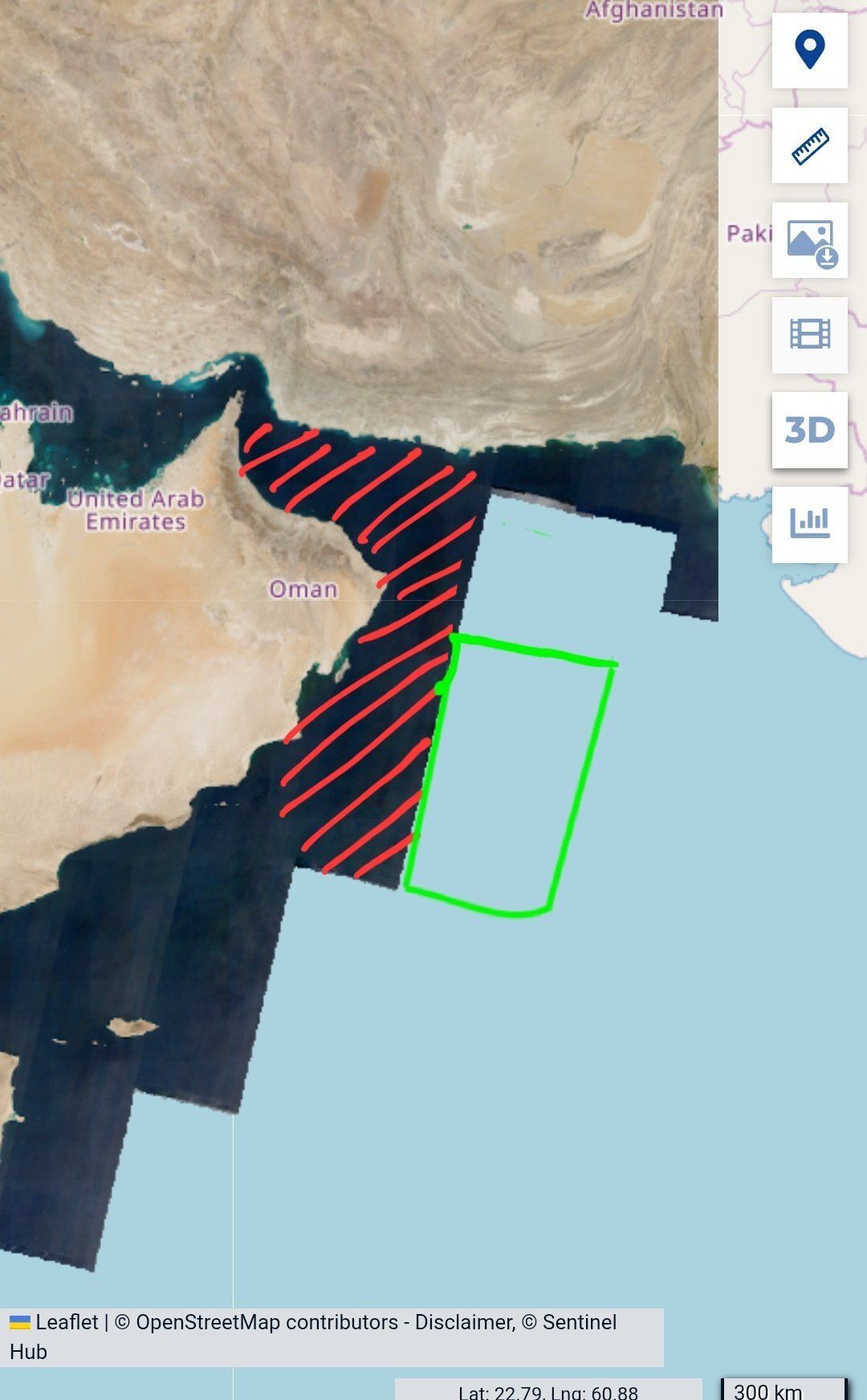
Green zone was most likely location of the fleet, but has possibly moved north, closer to Oman.
Sources
News/Journal sources available upon request, not shown to maintain visual integrity of page.
TODAY IN HISTORY
(February 7, 1914): Charlie Chaplin debuts his “Little Tramp” character
On this day in 1914, Charlie Chaplin debuted his most famous screen character—the Little Tramp. In the 11-minute short film Kid Auto Races at Venice, audiences witnessed the Little Tramp's trademark style, which consisted of a small derby hat, comically large shoes, and a badly fitted suit. While early versions of the Tramp were obnoxious and disruptive, the character eventually evolved into a figure that audiences understood and sympathized with. The Little Tramp, in 1972, earned a record-breaking 12-minute standing ovation at the Academy Awards.