- Basedment
- Posts
- Is A NATO-Russia Conflict Coming? (Part 2)
Is A NATO-Russia Conflict Coming? (Part 2)
Your daily dose of geopolitical updates and strategic analysis. Unbiased, but not unbased.

Editor-in-Chief
September 28, 2025
THE BRIEFING
Here’s what’s happening in geopolitics today.
From a surprise arrest warrant in Syria to fresh drone sightings in Denmark, the past 24 hours have seen plenty of movement on the geopolitical stage.
We’re also covering New Zealand’s break from allies on Palestinian recognition, EU plans for a “drone wall,” and looming U.N. sanctions on Iran. And in today’s deep dive, we
In the second half of our two part special, we’re looking at the wider rift between Russia and NATO and assessing how close the two are at war.
THE LAST 24 HOURS IN GEOPOLITICS
1. Syria issues arrest warrant for Bashar Al-Assad ahead of 2025 elections
Syria has issued an arrest warrant for former president Bashar al-Assad, a move that could be forwarded to Interpol and open the door to international enforcement. According to state media outlet SANA, the warrant accuses Assad of crimes including premeditated murder, torture resulting in death, and unlawful detention. The charges stem from lawsuits filed by families of victims in Deraa, linked to events that took place in November 2011.
read more
2. Fresh drones spotted over Denmark’s largest military base
Danish authorities have reported renewed drone sightings near several military sites, including Karup Air Base sparking concerns over national security. Many of the affected locations also serve dual functions, with military-run or shared airports like Skrydstrup in the mix, leading Denmark to label the incidents a possible “hybrid attack” by a “capable actor.” The government is speeding up plans to improve detection and neutralisation tools as public unease grows.
read more
3. New Zealand breaks with partners, says won’t recognise Palestinian state
New Zealand’s government announced it will not recognize a Palestinian state at this time, citing current uncertainties in Gaza and Hamas’s control as reasons to pause. Foreign Minister Winston Peters said recognition remains a question of “when, not if,” emphasising the need for clearer pathways toward state viability. The decision diverges sharply from recent moves by Western allies such as the UK, Canada and Australia to formally grant recognition.
read more
4. EU Eastern States agree on need for ‘drone wall’ with advanced detection
Frontline EU states have reached agreement on the need for a “drone wall”, a multilayered aerial defence system with advanced capabilities to detect, track, and intercept drones, EU Defence Commissioner Andrius Kubilius confirmed on Friday. The plan comes amid a wave of drone incursions and airspace violations near the bloc’s eastern borders, raising urgency for coordinated responses. Kubilius said the proposal is still in early design stages, but frontline states and Ukraine will help work out a technical roadmap and interoperability standards.
read more
5. UN sanctions on Iran loom after vote to delay fails
The U.N. is set to reimpose sanctions on Iran starting Saturday after a Russian–Chinese proposal to delay the action failed in the Security Council, Britain’s U.N. envoy confirmed. Tehran responded sharply, warning that the West would bear responsibility for any fallout from the sanctions reactivation. The move revives various restrictions on arms, nuclear activity, financial assets and travel—deepening tensions in an already fraught standoff.
read more
DAILY DEEP DIVE
How Likely Is a Russia-NATO War?
Is Russia Already Fighting NATO?
Lavrov has openly said that NATO and Russia are basically at war with each other. How true is this? While NATO has not committed actual troops, it has done everything else. European countries are major backers of Ukraine with funding, military resources, advisors, training, and intelligence. And importantly, NATO soil is the backbone of Ukraine’s war effort, with weapons, equipment, and ammunition stockpiled, repaired, and transferred through hubs in Poland, Romania, and other allied states. While NATO insists it is not a direct belligerent, its territory functions as Ukraine’s arsenal and logistics base. This blurs the line between proxy war and open conflict.
Why Neither Side Wants a Broader War (for Now)
Neither side at the moment wants an open conflict for several reasons. Right now, Russia is bogged down in Ukraine in two aspects. First, militarily, Russia is in a war of attrition — yes, they are making progress, but Ukraine is far from collapsing. Second, Russia is in a war economy built entirely for this conflict, leaving little surplus capacity for escalation. Its missile production is a great example, every missile built is fired and rarely stockpiled.
For NATO, the question is why escalate further when Russia is not making sweeping gains in Ukraine. This war is a race against time, and NATO needs Russia bogged down as long as possible to ramp up support. The harsh reality is that Ukrainian lives are being used as a time buffer for NATO.
As for NATO, it is untested,
and this was shown during the Polish drone incursions. The alliance’s response was slow and costly, firing missiles worth hundreds of thousands at cheap decoys, with several drones still slipping through. Ukrainian officials even highlighted the disparity: while NATO struggles against a dozen drones, Ukraine fends off close to a thousand during major raids. NATO needs time to adapt, and its best option is to observe and analyse every bit of Ukrainian battlefield data. And in some cases, Ukrainian soldiers should be training NATO troops.
NATO Fractures
When Trump stunned the world by saying NATO should shoot down Russian jets, we saw a glimpse of the internal fractures over escalation. Some members (Poland, the Baltics) are hawkish and pushing for stronger action. Others (France, Germany) remain cautious and hesitant to cross Moscow’s red lines. This may seem minor, but in wartime, decisive decisions must be made quickly. This lack of unity is a serious concern.
Economics
Economically, the question is whether both blocs can sustain prolonged war economies. Russia has the advantage here, it began earlier and has a more centralised system. NATO, by contrast, is a mix of hawkish, cautious, and complicated. Trump’s push for 5% defence spending is a step toward readiness, but it will take time and has already created division. Russia no longer has the grip on Europe it once did through oil and gas, but we must consider the effect of repeated attacks on energy infrastructure. These would only escalate if NATO became directly involved. Oil and gas remain soft-power tools for Russia, but right now they cannot provide Moscow with answers against Ukraine, let alone all of NATO. Instead, Russia is already stretched, relying heavily on China. OSINT research shows Beijing has become Russia’s critical external lifeline, quietly supplying electrical components that keep its drones and missiles in production. Without this flow of dual-use tech, Russia’s war machine would stall. With it, Moscow can sustain its attritional strategy despite heavy losses.
Domestic Support
Another under-discussed factor is the attitude of citizens at home.
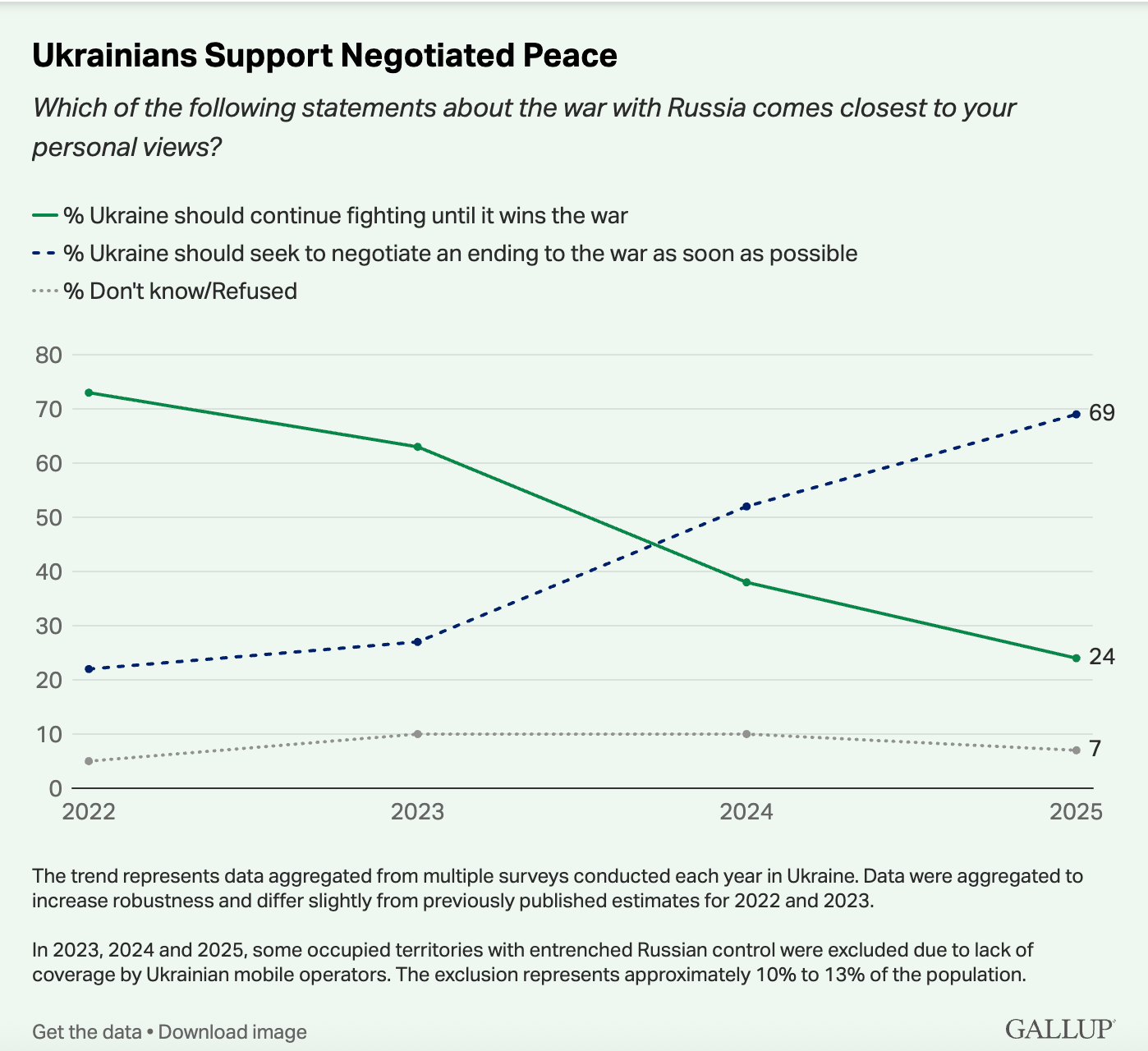
In Ukraine, support is shifting. A new Gallup poll shows 69% of Ukrainians now favour ending the war through negotiations, a near reversal from 2022, when most backed fighting until victory. Approval of U.S. leadership has collapsed from 66% in 2022 to just 16% in 2025, yet Ukrainians still see Washington, alongside the EU and U.K., as critical to peace talks. Across Europe, support for Ukraine remains high but is steadily declining. Approval for hosting refugees has dropped from 88% in 2022 to 71% in 2024, and as low as 60% in Poland. Eurofound surveys show growing dissatisfaction with aid, especially among the economically insecure and those reliant on social media. Military and humanitarian aid debates are now polarised, reflecting war fatigue, economic pressures, and fragmented information sources. And while support for Ukraine still exists, one must ask how far it will hold if NATO troops begin dying en masse in a wider war.
In Russia, meanwhile, the war has become part of life. As long as Putin maintains his grip on power and daily life does not change dramatically, widespread dissent is unlikely. Support in authoritarian systems is always hard to measure, but Putin has framed this as an existential conflict – a war of survival, of systems and identities. With that, plus a strong propaganda machine and incentives, Russia maintains both passive support and active recruitment. Volunteer recruitment alone sits around 30,000 a month without a noticeable dip, largely due to economic incentives, but it cannot be ignored.
The American Question
Trump wants this to become a European problem. He realises the war cannot end as quickly as he once hoped. Washington insiders largely view Trump’s shift as tactical posturing. At the same time, the Pentagon is pivoting inward. Under figures like Elbridge Colby, U.S. defence planning increasingly reflects a Monroe Doctrine–style focus on domestic and regional priorities. And the Dragon in the room, China continues to challenge US dominance. This all coupled with the fact U.S. officials have admitted that critical weapons systems are running low due to heavy commitments in both Ukraine and Israel. This is why Trump is pushing responsibility onto Europe. Support for Ukraine will not stop, but for now, it’s unlikely Kyiv will receive the most critical systems, such as Patriots, from Washington.
Final Assessment
A direct NATO–Russia war still looks unlikely, but the risk of escalation through miscalculation is higher than ever. Russia is bogged down in Ukraine and lacks the capacity for a wider fight, while NATO is content to bleed Moscow indirectly. Internal fractures within NATO and declining public support in Europe raise doubts about long-term commitment. Russia sustains its war effort through Chinese lifelines and steady recruitment, while Putin keeps dissent in check with propaganda and economic incentives. The U.S. factor remains the wild card, Trump’s rhetoric versus the Pentagon’s caution creates ambiguity, leaving allies uncertain and the path ahead dangerously unpredictable.
Sources:
Sources available upon request, not shown to maintain visual integrity of page.
TWEET OF THE DAY
Ok now why does this look like a Hollywood trailer?
"It's a pleasure to be with President @RTErdogan of Turkey, and we've been friends for a long time... he's a highly respected man." - President Donald J. Trump 🇺🇸🇹🇷
— The White House (@WhiteHouse)
3:22 PM • Sep 26, 2025
TODAY IN HISTORY
(September 27, 1066): Norman Conquest begun
On this day in 1066, after being delayed by bad weather, William, duke of Normandy, embarked his army and set sail for the southeastern coast of England in what would be known in history as the Norman Conquest.