- Basedment
- Posts
- Is Russia Rethinking Its Next Move in Ukraine?
Is Russia Rethinking Its Next Move in Ukraine?
Your daily dose of geopolitical updates and strategic analysis. Unbiased, but not unbased.

Editor-in-Chief
August 06, 2025
THE BRIEFING
Here’s what’s happening in geopolitics today.
Today’s briefing covers stories from across five regions. From mass abductions in Nigeria and rising trade coordination between South Korea and Vietnam, to Spain’s push for defence autonomy and Pakistan’s refugee policy shift.
We also look at the political fallout in Bosnia as its most prominent Serb separatist is formally removed from office. Each reflects a different kind of instability - whether it’s security, sovereignty, or supply chain anxiety.
In today’s deep dive, we turn to the evolving Russia–Ukraine conflict, where new territorial movements suggest Moscow may be adjusting its offensive strategy once again. We specifically zoom into the frontline cities of Kupiansk and Siversk as Russia makes new advances.
THE LAST 24 HOURS IN GEOPOLITICS
1. Pakistan extends Afghan refugee deportation deadline to September 1
Pakistan has begun deporting registered Afghan refugees even before the September 1 deadline for voluntary return, surprising civil society actors and humanitarian organisations alike. The United Nations has condemned the move, warning it breaches international refugee protection norms and risks destabilising Afghanistan amid a humanitarian crisis. With over 1.3 million Afghans affected and fears mounting around mass returns, UN agencies are urging a phased, voluntary, and dignified repatriation process.
read more
2. Spain rules out buying F-35, choosing between Euro-fighter or FCAS
Spain has officially ruled out purchasing US-made F‑35 fighter jets, opting instead to select between the European Eurofighter Typhoon and the collaborative Future Combat Air System (FCAS) currently under development with France and Germany. The Spanish government cited strategic priorities—including defense industrial autonomy and a commitment to spend the majority of its additional €10.5 billion defense budget on European suppliers, as key reasons for shelving the F‑35 plans. While Spain continues with an order of 45 Eurofighters under its Halcón program, the decision highlights Madrid’s broader push toward European defense sovereignty amid ongoing FCAS governance disputes between Airbus, Dassault, and Indra.
read more
3. Gunmen abduct 60 in Northern Nigeria, kill villagers in overnight raids
In north-west Nigeria’s Zamfara state, armed bandits abducted over 50 villagers in coordinated overnight raids on Friday, marking a disturbing escalation in mass kidnapping tactics by organised criminal groups. The raid occurred in Sabon Garin Damri within the Bakura district under UN-backed monitoring, highlighting a shift toward large-scale abductions as a tactic for extortion. Community leaders and officials warn the violence, rooted in land disputes and rising banditry, continues to drive displacement, deepen insecurity, and disrupt rural livelihoods.
read more
4. Leaders of South Korea and Vietnam to meet next week amid trade woes
South Korean President Lee Jae‑myung will host Vietnam’s top leader, Tô Lâm, in Seoul next week for a four-day state visit, the first since Lee assumed office in June. Leaders plan to expand technology and strategic cooperation amid looming U.S. tariffs that could hit both economies, particularly in electronics and industrial exports. With South Korean investment in Vietnam totaling roughly US $92 billion both nations are focused on mitigating the impact of escalating global trade pressures.
read more
5. Separatist Bosnian Serb leader Dodik removed from office by Bosnian election authorities
Bosnia’s Central Election Commission has stripped Milorad Dodik, the pro-Russian Bosnian Serb leader, of his mandate as president of Republika Srpska following an appeals court ruling that imposed a one-year prison sentence and a six-year ban on holding political office. The court confirmed that Dodik defied the peace envoy and the Dayton Accords by pushing separatist legislation and rejecting central state authority. Despite the decision, Dodik vows to continue operating with the backing of Republika Srpska’s parliament, while regional allies in Serbia and Hungary denounce the verdict as politically motivated.
read more
DAILY DEEP DIVE
Territorial Update and new trends in Russia’s offensive
Kupiansk
In the Kupiansk region, Russia has successfully taken the western suburb of Moskova. This is a key area with supply lines linking directly to the city. Its loss will complicate resupply efforts to Kupiansk and areas east of the Oskil River. Russian troops advanced along Konstytutsii and Zakhysnykiv Kupianska streets, reaching the areas around Spartak Stadium and Lenin Park. Meanwhile, Russian reconnaissance units have begun probing further south near Sobolivka.
This may be one of the fastest entries into a city we've seen in this war. One has to respect the sheer strength and resilience of Ukrainian soldiers north of Kupiansk, who have held off offensive operations since they retook the city in the Kharkiv offensive in October 2022. Yet, the last six months have seen a gradual decline in the defences north of the city.

Kupiansk
Siversk
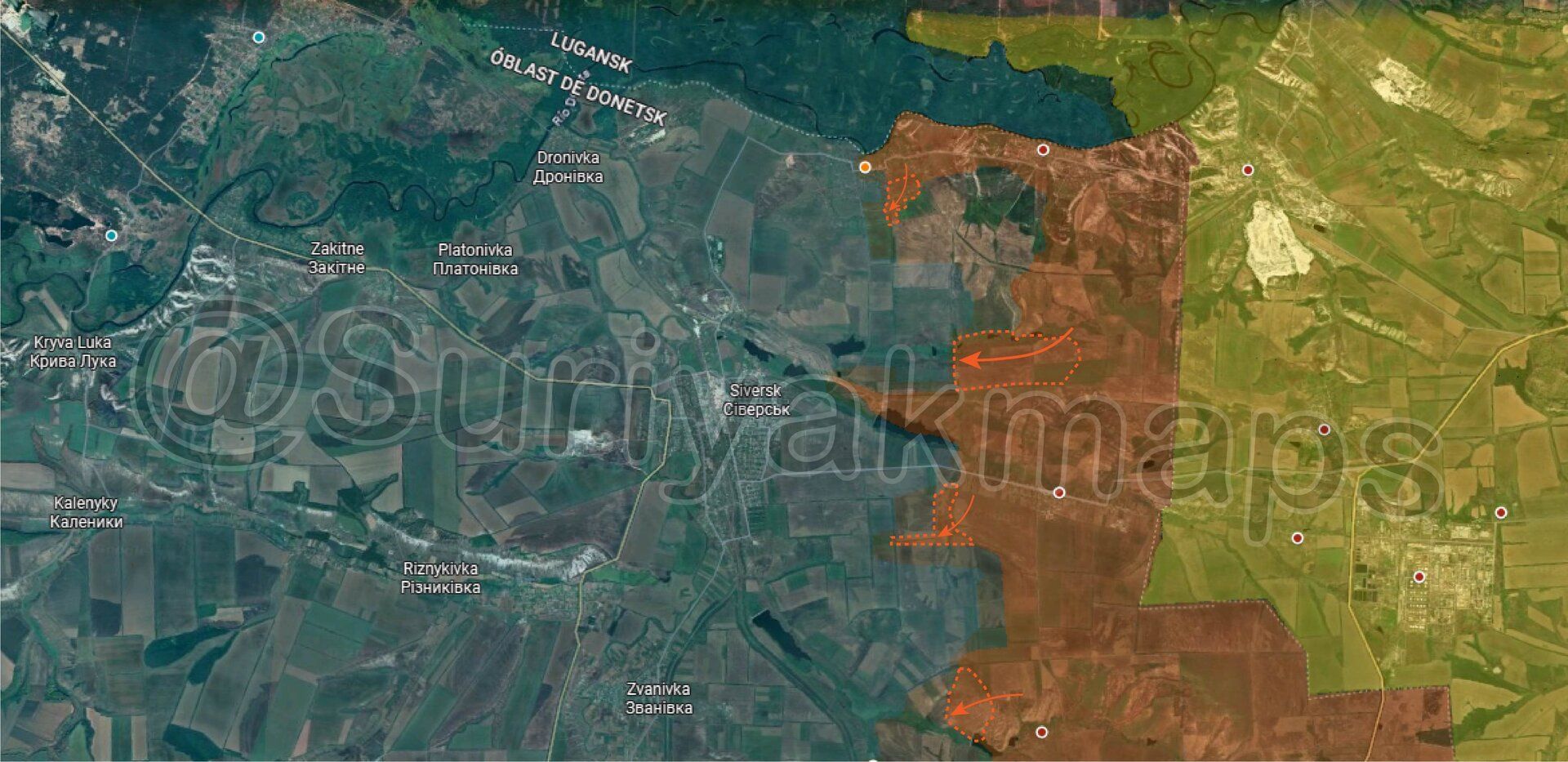
Russian forces have made another breakthrough east of Siversk. If you remember our previous deep dives on this area (or know much about this war) you'll know this has been one of the bloodiest and strongest defensive efforts by Ukraine. An endless number of assaults, counterattacks, raids, mechanised pushes, you name it, have been attempted by the Russians, and all had failed for years.
However, since a few months ago, when Russian troops managed to solidify their positions in the Serebryansʹk forest, we’ve seen a string of successes after years of failure. For context, the forest sits on elevated ground and outflanks the key fortifications east of Siversk, making it easier to apply pressure on Ukrainian defences. Russia recently regained lost ground northwest of Verkhnokamyanske and seized new positions to the southwest, including securing the Novoselivka forest.
Why is Siversk important? If we imagine the remaining Ukrainian-held Donetsk as a fortress, Siversk and the surrounding frontline towns and forests are its outer main wall. They’ve held firm for years, largely due to strong Ukrainian leadership, experienced troops, and layered defences that predate the current conflict. If Siversk were to fall, it would expose much of this “wall” and provide Russian troops with a clearer path to the inner fortress of Sloviansk and Kramatorsk.
Siversk
Trends of 2025’s Summer Offensive
Ukraine has had its best month of the year in terms of regaining territory, but that is simply dwarfed by the scale and pace of Russia’s offensive. Ukraine has had success in Sumy and Kharkov, counter attacking and pushing Russian units back. And yes, we all know this is moving at a snail’s pace; but what’s different this year is that heavily defended cities and towns such as Kupiansk and Pokrovsk have shown quicker signs of decline (DRG units, urban expansion) than in previous years. Notably, we’re also seeing more localised breakthroughs, Russia is getting better at exploiting weak points and achieving tactical gains, even if not yet at a strategic level.
Sources:
References available upon request. A full citation list has been omitted to preserve the visual integrity of the page.
Map sources: SuriyakMaps on Telegram
TWEET OF THE DAY
White House meme game strong?
“Have you seen the Sydney Sweeney ad?”🗣️
— The White House (@WhiteHouse)
12:14 AM • Aug 6, 2025
TODAY IN HISTORY
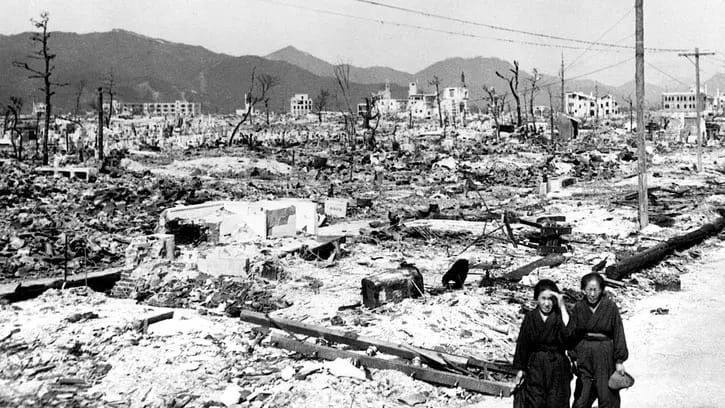
(August 6, 1945): On this day in 1945, the United States dropped an atomic bomb on Hiroshima, Japan, killing over 70,000 people and leveling much of the city. The attack was intended to accelerate the conclusion of World War II.