- Basedment
- Posts
- Is The Horn of Africa Turning Into A Much Larger Regional Conflict?
Is The Horn of Africa Turning Into A Much Larger Regional Conflict?
Today we zoom into the Horn of Africa as it seems localised conflicts could soon be blurred into a large full-scale regional confrontation between two distinct groups.

Editor-in-Chief
February 13, 2026
THE BRIEFING
Here’s what’s happening in geopolitics today.
From a political reset in Dhaka to aircraft carriers repositioning in the Middle East, today’s headlines span elections, deterrence and great-power diplomacy.
Bangladesh’s BNP storms back to power, Washington sends another carrier toward Iran’s orbit, Japan detains a Chinese captain at sea, Rubio meets Wang Yi in Munich, and Ukraine and Germany deepen defense ties with a joint drone venture.
In today’s deep dive, we zoom into the Horn of Africa as it seems localised conflicts could soon be blurred into a large full-scale regional confrontation between two distinct groups.
WORD FROM TODAY’S SPONSOR
Learn how to make AI work for you

AI won’t take your job, but a person using AI might. That’s why 2,000,000+ professionals read The Rundown AI – the free newsletter that keeps you updated on the latest AI news and teaches you how to use it in just 5 minutes a day.
THE LAST 24 HOURS IN GEOPOLITICS
1. Bangladesh’s BNP wins sweeping election majority, promise of stability
The Bangladesh Nationalist Party (BNP) has won a sweeping two-thirds majority in the country’s 2026 general election, securing at least 212 out of 299 seats in the Jatiya Sangsad and returning to power after two decades, according to electoral results and local broadcast reports. The election, widely viewed as the first genuinely competitive vote since the 2024 Gen Z-led uprising that ousted long-time Prime Minister Sheikh Hasina, saw high voter turnout and raised hopes among many for political stability after months of unrest. BNP leader Tarique Rahman, son of the party’s founding figure, is poised to become prime minister.
read more
2. Another U.S. aircraft carrier expected to head to Middle East
The United States is deploying another aircraft carrier (the USS Gerald R. Ford) from the Caribbean to the Middle East to join the USS Abraham Lincoln and its strike group amid rising tensions with Iran, according to U.S. officials cited by multiple news outlets. The move, part of an expanded U.S. naval presence overseen by U.S. Central Command, reflects Washington’s effort to maintain military readiness in the region as indirect nuclear talks with Iran continue and diplomatic efforts remain inconclusive.
read more
3. Japan seizes Chinese fishing vessel and arrests captain
Japanese authorities have seized a Chinese fishing vessel and arrested its 47-year-old captain after the boat allegedly refused to stop for an inspection in Japan’s exclusive economic zone off southwest Nagasaki Prefecture, Japan’s Fisheries Agency said Friday. The captain, a Chinese national, was taken into custody after the vessel failed to comply with orders to halt for inspection, marking the first seizure of a Chinese fishing boat by Tokyo since 2022.
read more
4. Rubio to meet China’s top diplomat Wang Yi on Friday
U.S. Secretary of State Marco Rubio is scheduled to meet Chinese Foreign Minister Wang Yi on Friday on the sidelines of the Munich Security Conference, marking another high-level diplomatic engagement between Washington and Beijing. The talks come as U.S. and Chinese leaders prepare for a possible President Trump–Xi Jinping summit in April, with both sides signalling interest in stabilising bilateral relations after recent positive high-level exchanges.
read more
5. Ukraine and Germany to launch joint drone manufacturing plant
Ukraine and Germany are launching a joint drone manufacturing initiative, with production facilities soon to open in Germany under a Ukrainian-German venture, part of broader efforts to scale up industrial support for Kyiv’s defense needs, Ukrainian officials said at the Munich Security Conference. The project builds on existing cooperation between Ukrainian firms like Frontline Robotics and German partners such as Quantum Systems to mass-produce combat and reconnaissance drones for the Ukrainian Armed Forces.
read more
DAILY DEEP DIVE
Is The Sudan Conflict Turning Into Larger The Red Sea Conflict?
Ethiopia And RSF Connection
Has the Sudan War Become a Red Sea Proxy Conflict? Ethiopia has been hosting and training thousands of RSF fighters on its northern border for months. According to Reuters, Ethiopia is hosting a large RSF base near the Sudan border, marking its first direct support in the conflict. Around 4,300 fighters are reportedly training there, with UAE logistical backing. Asosa airport has been reinforced, including a drone control station, underscoring deepening regional entanglements.
Reuters Source
Ethiopian Conflict
Ethiopia has begun redeploying federal forces toward Tigray following renewed clashes with the Tigray Defense Forces (TDF), marking the most serious escalation since the 2022 Pretoria Agreement. The buildup suggests preparations for a prolonged northern conflict that could draw in Eritrea, which is reportedly backing the TPLF despite past hostilities. Recent TDF offensives targeted disputed areas near the Amhara border, citing failures to implement the peace deal. Eritrean forces are reportedly positioning inside Tigray, raising the risk of a broader regional proxy war involving Red Sea powers such as Egypt, Saudi Arabia, and the UAE.
See Full Report
Drawing on analysis by Clement Molin, the 2022 Pretoria Peace Deal is increasingly fragile. The Tigray war ended in military stalemate, but internal TPLF divisions and territorial concessions to Amhara reignited tensions. Federal attempts to disarm Amhara militias triggered a wider insurgency, with Fano forces now controlling much of the countryside and forming the Amhara Fano National Movement. Their sustained battlefield successes have tied down the Ethiopian National Defense Force (ENDF), limiting its ability to project power externally, including toward Eritrea, and raising the risk that Ethiopia’s internal fragmentation could spill into a broader regional confrontation.
Read Clement Molin’s full thread
Is UAE Big Push Leading To A Regional Catastrophe?
The UAE has attempted to reshape the balance of power by a heavy use of soft power. With large cashflow they have been able to mark their influence significantly in many African countries. Besides the more obvious reasons of establishing military bases and keep trade routes under their influence for power projection there's an existential and economic hand at play here. Food security is existential for the UAE, which imports over 85–90% of its food. To hedge against global supply shocks, it has acquired or leased large-scale farmland across Sudan, Ethiopia, Tanzania, and Mozambique, securing agricultural production and water access abroad. At the same time, Africa’s vast mineral wealth strengthens Emirati economic leverage. Gold from Sudan and Mali, alongside cobalt, rare earths, uranium, and oil, feeds into Dubai’s role as a major global commodities hub. Sudanese gold in particular flows heavily to the UAE, Now there is a clear division of power. For the UAE to branch out from a small oil-rich emirate into a regional powerhouse, it needed to upset the status quo — and to do that, it had to fund revisionist groups within the states in which it sought influence. This was naturally going to unsettle the traditional power brokers of the region (Turkey, Egypt, and the Saudis).
While making many friends in Africa, it has also raised eyebrows among its Middle Eastern neighbours. As we have discussed previously, Turkey, Egypt, and Saudi Arabia have begun a coordinated push to counter the UAE, primarily in the Horn of Africa and the Red Sea. First, they blocked airspace for vital UAE deliveries to the RSF, including in African states that fall under their influence. This is another important point, these regional conflicts exist and increase in severity only through the backing of their sponsors. Ethiopia for instance must accept UAE choosing it as a major logistics hub, training RSF fighters (making it a legitimate target) because the UAE bankrolls much of Ethiopia.
With neither the UAE backing down or its rivals, traditional borders will continue to blur as different proxy groups aim to assert influence in an existential struggle that is being funded by opposing Middle East actors.
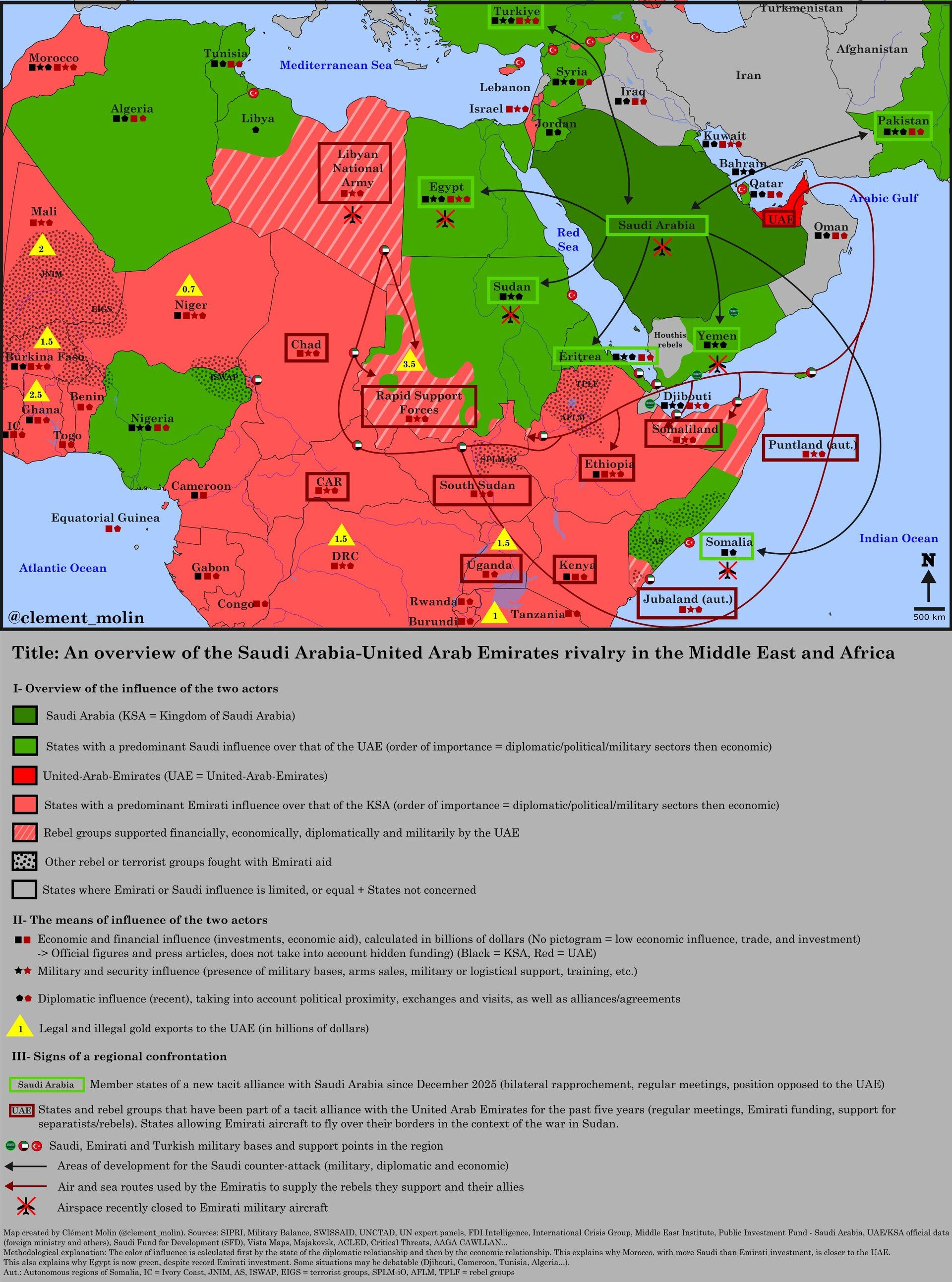
A very, very detailed map created my Molin. Well worth the read over.
Sources
News/Journal sources available upon request, not shown to maintain visual integrity of page.
TODAY IN HISTORY
(February 13, 1689): Following the Glorious Revolution, William and Mary were proclaimed king and queen of England. They ruled jointly as King William III and Queen Mary II until her death in 1694.