- Basedment
- Posts
- Is Trump's Armada Striking Iran And When?
Is Trump's Armada Striking Iran And When?
Today's special edition article looks at Trump's "Armada" that will possibily be striking Iran in what could be very shortly. We look at weather, assets, political and military readiness and more.

Editor-in-Chief
January 27, 2026
THE BRIEFING
Here’s what’s happening in geopolitics today.
Today’s headlines range from fresh U.S. air force drills in the Middle East and deepening defence cooperation in Asia, to mounting scrutiny over a fatal federal shooting in Minneapolis.
We’re also tracking grassroots European support flowing into a freezing Ukraine and Indonesia taking delivery of its first Rafale fighter jets as regional militaries continue to modernise.
In today’s special Deep Dive, we turn to Trump’s much-discussed “armada” headed toward Iran — breaking down the weather, assets, political calculations and military readiness behind what could be an imminent strike.
THE LAST 24 HOURS IN GEOPOLITICS
1. US Air Force to begin Middle East exercise amid Iran tensions
The U.S. Air Force has announced the start of a multi-day readiness exercise across the Middle East aimed at demonstrating its ability to rapidly project airpower in the region amid escalating tensions with Iran and its proxies, military officials said. The drills are taking place as the U.S. military reinforces its presence in response to heightened geopolitical strain following Iranian warnings and regional security concerns. The exercise is intended to improve interoperability and preparedness with partners while signalling deterrence, even as airlines reroute flights and European governments issue heightened warnings over potential conflict escalation.
read more
2. Trump administration defends shooting of Minneapolis man by federal agents
Senior Trump administration officials have publicly defended the actions of federal immigration agents who fatally shot a U.S. citizen, 37-year-old ICU nurse Alex Pretti, in Minneapolis during an enforcement operation, saying the agents fired in self-defence after Pretti allegedly resisted disarmament. Department of Homeland Security leaders, including Border Patrol Commander Gregory Bovino, have described the law enforcement response as justified, and President Donald Trump has said the incident is under review while repeating claims that Pretti posed a threat. Officials have insisted that Pretti approached agents with a firearm and resisted, though multiple videos and local authorities have cast doubt on that account, showing Pretti holding a phone at times, and sparking sharp criticism from state leaders and civil liberties advocates.
read more
3. Czechs raise over $6m to send generators to freezing Ukraine
Czech citizens have raised more than $6 million in just five days through a grassroots crowdfunding campaign to buy generators, heaters and batteries for Ukraine after Russian attacks knocked out much of the country’s power grid during a severe cold snap. The **Dárek pro Putina (“Gift for Putin”) initiative collected roughly 126 million Czech crowns from tens of thousands of donors to provide emergency energy equipment as temperatures plunged below −20 °C and Ukrainian engineers worked around the clock to restore electricity. Organisers have already begun booking diesel-powered generators for delivery to hospitals and smaller health facilities and are coordinating with Ukrainian partners and funds to speed up shipments and avoid customs delays.
read more
4. US, South Korea agree to deepen cooperation on nuclear-powered subs
The United States and South Korea have agreed to deepen cooperation on Seoul’s pursuit of a nuclear-powered submarine programme, with talks between U.S. Under Secretary of Defense for Policy Elbridge Colby and South Korean Defence Minister Ahn Gyu-back emphasising closer defence ties. Both sides said enhanced collaboration on nuclear-powered submarines would strengthen South Korea’s deterrence capabilities and take on a larger role in regional security, particularly as U.S. strategy calls for Seoul to play a more dominant part in deterring threats from North Korea.
read more
5. Indonesia receives first Rafale advanced fighter jets from France
Indonesia has received its first three Dassault Rafale advanced fighter jets from France, marking the initial delivery under a multi-billion-dollar defence agreement aimed at modernising the Indonesian Air Force. The aircraft, delivered this week and now stationed at Roesmin Nurjadin Air Base in Sumatra, are part of an $8 billion contract for up to 42 Rafales, along with French frigates and submarines. Defence officials said the jets are ready for operational use, with further deliveries expected later in 2026 as Jakarta boosts its air combat capabilities amid broader regional security concerns.
read more
DAILY DEEP DIVE
Are The Iran Strikes Happening Soon?
Wider Context
A US aircraft carrier strike group is moving toward the Persian Gulf as tensions with Iran rise again, recalling June’s military buildup that preceded strikes on Iranian nuclear facilities during Israel’s 12-day war with Tehran. At the centre is the carrier Abraham Lincoln, which diverted from the South China Sea more than a week ago. Its escort includes Arleigh Burke-class destroyers armed with Tomahawk cruise missiles and the Aegis combat system, providing both strike and missile-defence capability. Additional air defences for US bases are reportedly under consideration.
President Trump has framed the move as deterrence, calling it a “big flotilla” sent “just in case,” a shift from earlier rhetoric backing Iranian protesters, since violently suppressed. Iran has warned that any attack would make all US regional bases legitimate targets. Despite plans to reduce its Middle East footprint, the US still fields 40,000–50,000 troops in the region. Civilian spillover is growing, with flight disruptions and new US sanctions on Iran’s oil “shadow fleet.”
Our Analysis
Will we see an attack on Iran this month? Polymarket may offer a clue — yes, this is the world we’re living in. One account with nearly $40,000 deposited on Polymarket placed large bets on Israel attacking Iran shortly before a major Israeli airstrike, later profiting almost $130,000. The same account then correctly bet on a ceasefire announcement days in advance, exited all positions on the day it was declared, and achieved gains exceeding 200%. That same account has now placed a bet that Israel will strike Iran by the end of January. Could we be seeing a co-op Israeli-U.S strike on Iran?
This is by no means a “traditional” way to assess geopolitics — but this is 2026. And we can’t ignore these sources, but we shouldn’t make them primary pieces of evidence for analysis.
Another point of note: in recent days, various accounts, largely anti-Iran, have been circulating claims about the number of deaths, estimated to exceed 30,000. The source is an Iranian opposition outlet, which says it possesses extensive evidence drawn from both primary and secondary sources.
The claims published by Iran International are not independently verifiable at this stage and sit far outside existing death toll estimates from other credible trackers. While the outlet cites classified IRGC and Interior Ministry documents, none have been publicly released or authenticated by neutral third parties. Other organisations such as HRANA, Iran Human Rights, Reuters, and the UN consistently describe the toll as in the thousands, not tens of thousands. Additionally, Iran International has in the past faced alleged links to Saudi-connected funding structures, which raises editorial and incentive questions. While its reporting aligns with known patterns of repression and concealment, the 36,500 figure remains uncorroborated and should be treated as provisional.
The sad reality is that many of the large accounts you see on X, Instagram, and Telegram are either government-run or government-funded. When you notice a sudden uptick in the same claims being pushed across multiple accounts, that should set off alarm bells. This is often how the groundwork is laid for a rapid propaganda cycle, one that can later be used to justify strikes on Iran. To be clear, this is not an endorsement of the current Iranian regime. It has killed thousands — not just now, but during past protests, through prison camps, executions, and more. I am simply looking at this at face value.
The Armada
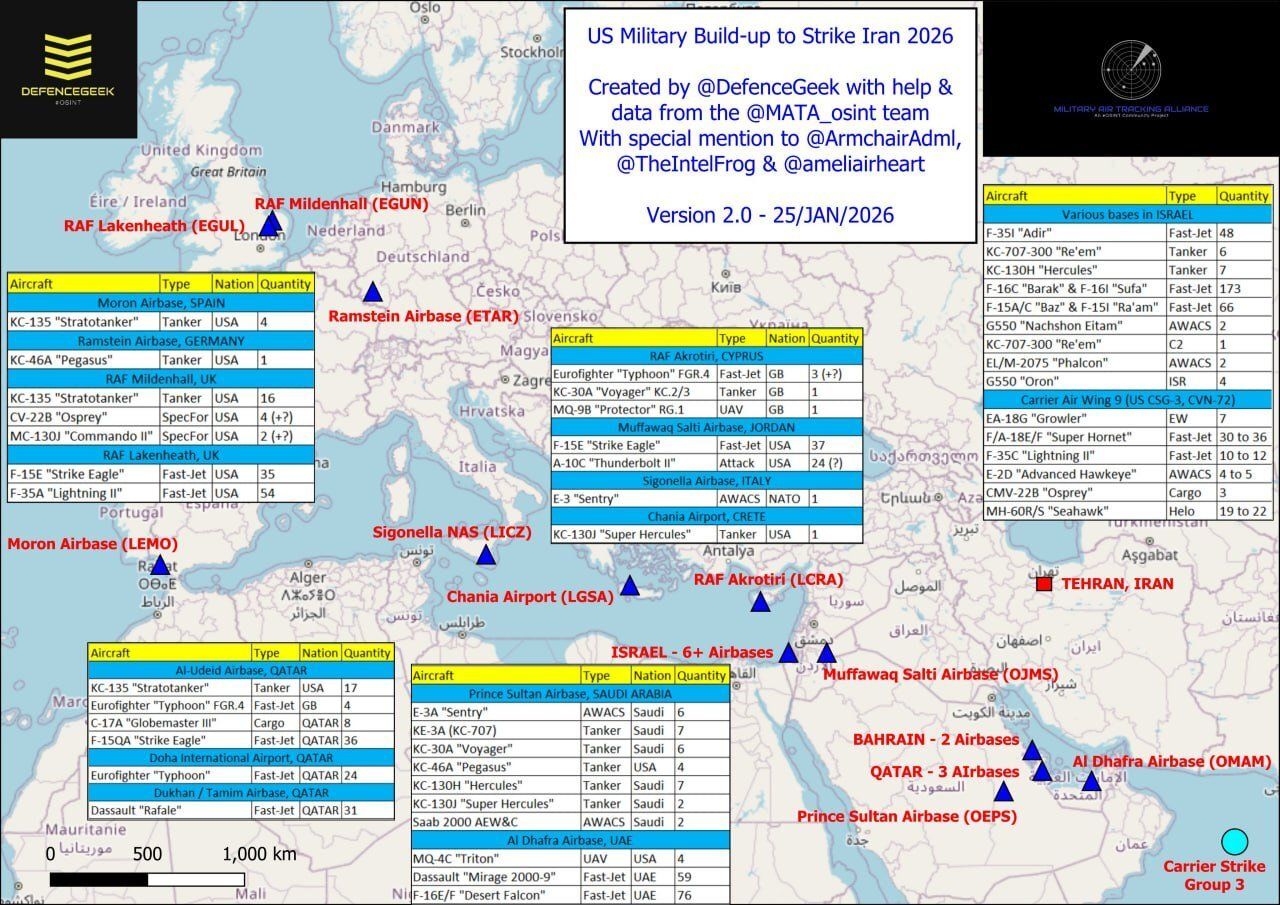
The aircraft mix shown reflects a fully enabled air campaign architecture, not a random deployment. Tankers (KC-135, KC-46) are the critical enablers, extending fighter range and allowing sustained strike and patrol operations deep into Iranian airspace. AWACS and AEW platforms (E-3, E-2D, G550 CAEW) provide the airborne command-and-control needed to manage complex, contested air operations. Electronic warfare aircraft (EA-18G Growler) are specifically designed to suppress and degrade Iranian air-defence networks, a prerequisite for any penetration strike.
The presence of stealth and heavy strike fighters (F-35, F-15E, F-16, Typhoon, Rafale) suggests the ability to conduct precision strikes, escort missions, and defensive counter-air simultaneously. Transports (C-17, C-130) indicate sustained logistics, base reinforcement, and missile-defence support rather than a symbolic show of force. Carrier air wings add an independent strike option less reliant on regional basing.
Taken together, this posture does not confirm an imminent strike, but it clearly establishes credible, executable strike options against Iran, moving beyond deterrence into operational readiness.
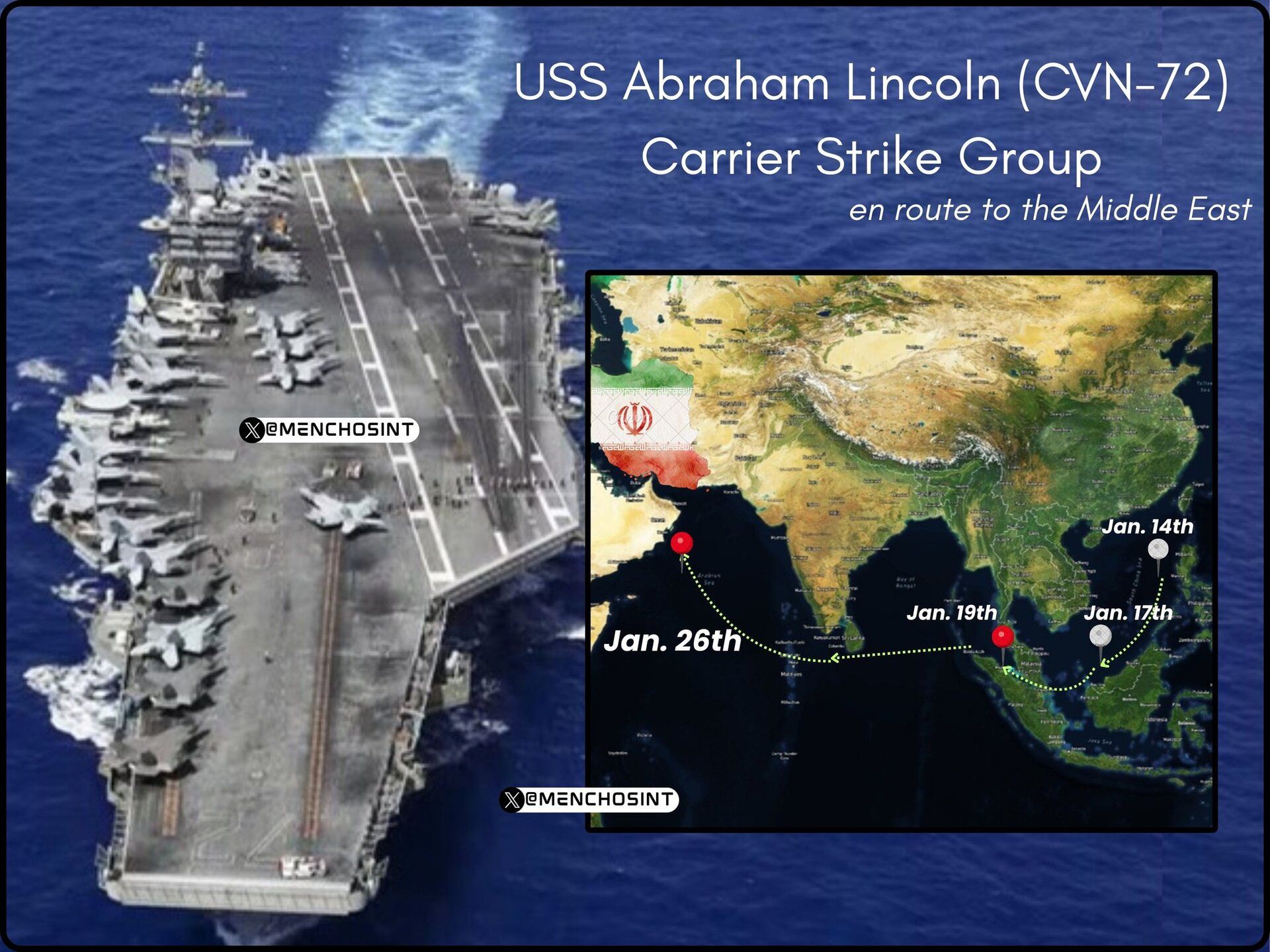
According to MenchOsint, as of January 26, the USS Abraham Lincoln (CVN-72) has arrived off the coast of Oman. Its presence was confirmed this morning by the sighting of a CMV-22B (reg. 169453) operating with the carrier strike group. With a carrier group nearby – it could be time for an attack.
What about timing?
A growing assumption is that any U.S. strike on Iran would be timed for a weekend to minimise market disruption. That logic held for tightly scoped, single-day operations like Midnight Hammer or the action against Maduro — operations designed to be brief, controlled, and narratively clean. An Iran contingency would be none of those. In fact, if anything, a mid-week strike now carries greater surprise value, precisely because recent U.S. precedent has conditioned both markets and adversaries to expect action on weekends. Looking at strike openings, cloud density is low for most of western and central Iran for the next 24 hours, and the weather is overall good for most of the week – but early in the week shows most promise.
What kind of strike are we talking about and Iranian response?
Another consideration is the scope of a potential strike: decapitation, infrastructure, military targets—or some calibrated mix of all three. It remains unclear whether Washington would seek to fully collapse the regime. Gulf partners, reportedly intervening at the last minute in earlier strike discussions, are wary of oil shocks and regional instability. More quietly, there is concern that the removal of an anti-Israel Iran could tilt the regional balance too far in Israel’s favour. Still, the propaganda cycle is clearly underway, with growing calls for regime change.
A military-focused strike may be the most attractive option. Targeting Iran’s military—particularly the IRGC—would further degrade its ability to project power, constrain support to proxies, and limit retaliation if Israel expands operations in southern Lebanon. Such strikes could also reignite domestic unrest and test military loyalty amid public pressure.
Iran’s ability to respond is therefore deeply uncertain. During the last confrontation with Israel, key strike platforms, missile launchers, air-defence systems, radar nodes, and command-and-control facilities were systematically targeted, reducing both capacity and confidence. Beyond physical damage, the psychological and institutional impact may be more severe. Persistent espionage operations and alleged internal penetrations have disrupted trust within Iran’s military and political apparatus, forcing leadership to focus inward on counterintelligence purges rather than external planning.
This comes on the back of widespread protests and a compressed recovery window following the 12-day conflict, leaving limited time to repair infrastructure, replace personnel, or restore coherent decision-making chains. Even if Iran retains the ability to launch retaliatory strikes or activate proxies, execution may be slower, less coordinated, and more cautious than in previous cycles. In that sense, Tehran’s deterrence posture appears degraded—not eliminated, but weakened—raising questions about whether Iran can impose meaningful costs quickly enough to deter further escalation.
Sources
News/Journal sources available upon request, not shown to maintain visual integrity of page.
TODAY IN HISTORY
(January 26, 1905): Basketball player Kobe Bryant, who was considered one of the sport's greatest players, winning five NBA championships with the Los Angeles Lakers, died in a helicopter crash at the age of 41.