- Basedment
- Posts
- Is Trump's MAGA Fanbase turning on Israel?
Is Trump's MAGA Fanbase turning on Israel?
Your daily dose of geopolitical updates and strategic analysis. Unbiased, but not unbased.

Editor-in-Chief
August 04, 2025
THE BRIEFING
Here’s what’s happening in geopolitics today.
From joint naval drills in Asia to post-war recalibrations in Iran, today's headlines reflect the global push to reset strategic positions without tipping into fresh conflict.
South Korea dismantles Cold War-era loudspeakers, India and the Philippines flex regional cooperation, and Thailand and Cambodia inch toward stability, while Russia and China sharpen military coordination in the Sea of Japan. Meanwhile, Iran restructures its defence strategy after its June war with Israel, signalling a long-term pivot in regional posture.
In today’s deep dive, we turn inward to the US, where a surprising shift may be underway: is Trump’s MAGA base starting to turn on Israel?
THE LAST 24 HOURS IN GEOPOLITICS
1. South Korea starts removing anti-North Korean loudspeakers on border
South Korea has begun dismantling the loudspeakers that once transmitted anti-North propaganda along the DMZ, a physical move reflecting President Lee Jae‑Myung’s larger effort to ease tensions and rebuild inter-Korean trust. The broadcasts had been turned off in June, shortly after the new administration took office, and the defence ministry emphasised removal would not compromise military readiness. North Korea has not responded and has repeatedly stated it has “no interest” in dialogue, highlighting how symbolic gestures alone may struggle to bridge a still-frozen diplomatic divide.
read more
2. India and the Philippines stage joint sail and naval drill in the South China Sea
India and the Philippines conducted their very first maritime sail together in the South China Sea, timed with President Ferdinand Marcos Jr.’s state visit to New Delhi. The exercise featured key Indian vessels (INS Delhi, INS Shakti, and INS Kiltan) working alongside Philippine ships BRP Miguel Malvar and BRP Jose Rizal within the Philippines' exclusive economic zone. Philippine military chief Romeo Brawner framed the two-day operation as a signal of growing cooperation among like-minded democracies, especially amid persistent Chinese naval shadowing in the area.
read more
3. Iran sets up new defence council in wake of war with Israel
Iran’s Supreme National Security Council signed off on the creation of a new National Defence Council this past Sunday which revives an institutional structure last seen during the Iran‑Iraq War and linking top government branches with military and intelligence officials into a unified defence apparatus. The decision follows Iran’s titanic 12‐day air war with Israel in June, widely described as the most acute military crisis Tehran has faced since the 1980s. The council will be chaired by President Masoud Pezeshkian and include senior defence, intelligence, foreign affairs, and parliamentary leaders, with the mandate to centrally coordinate strategy and improve armed forces readiness rising out of renewed regional confrontation.
read more
4. Russian and Chinese navies carry out artillery and anti-submarine drills in Sea of Japan
Russia and China launched the “Maritime Interaction‑2025” naval drills in the Sea of Japan on Sunday featuring live-fire artillery exercises, anti-submarine operations, air defence simulations, and joint search-and-rescue training using Russian ASW vessels, Chinese destroyers, and diesel-electric submarines. Though these exercises were pre-scheduled under their 2022 “no‑limits” strategic partnership, they began just two days after President Trump said he had ordered two U.S. nuclear submarines to be positioned in “appropriate regions” near Russia in response to former President Medvedev’s provocative remarks.
read more
5. Cambodia and Thailand begin talks in Malaysia amid fragile ceasefire
Preliminary defence talks kicked off on Monday in Malaysia between Thailand and Cambodia, paving the way for a key ministerial meeting this Thursday, all while a fragile ceasefire takes hold a week after intense cross-border clashes. The agreement, mediated under ASEAN chairmanship and backed by U.S. and Chinese diplomacy, continues despite both sides trading accusations of ceasefire violations ahead of Friday’s General Border Committee session. As evacuated civilians trickle home and military units remain deployed, leaders are racing to formalise monitoring mechanisms, even as mutual mistrust looms large.
read more
DAILY DEEP DIVE
IS TRUMP’S MAGA FANBASE TURNING ON ISRAEL?
A growing faction of the MAGA movement has begun to question America’s long-standing support for Israel, especially amid the Gaza war. In recent weeks, Republican hardliners (from young conservatives to firebrand influencers) have openly challenged the “unique…perverse” US-Israel partnership.
As reported, “a small but vocal contingent” of Trump’s base is increasingly uneasy about Washington’s “blank cheque” policy toward Israel. Figures like Candace Owens have attacked the “strange, disgusting, perverse” US-Israel relationship, while Rep. Marjorie Taylor Greene has gone further, calling Gaza’s siege a “genocide” and pushing bills to cut aid to Israel. This revolt is partly generational: many under‑40 MAGA supporters lack the Cold War context of older conservatives and instead view Israel as “just another ally taking advantage of America’s generosity,” Axios reports.

Rep. Marjorie Taylor Greene speaks to reporters at the U.S. Capitol
As one MAGA podcaster put it, those over 40 generally support Israel, while those under 40 range from “skeptical to wanting to cut all ties”. In short, a subset of Trump’s base now sees unconditional aid to Israel as misaligned with an “America First” agenda, even as the majority of Republicans still back the war effort
TRUMP’S SHIFTING RHETORIC ON GAZA
Trump has begun to reflect this undercurrent in his own messaging. During a meeting in Scotland he broke with Israeli claims by declaring there is “real starvation” in Gaza, a rare public rebuke of Netanyahu’s narrative. He insisted that anyone unmoved by images of starving Palestinian children would have to be “pretty cold-hearted” or “nuts”. In practical terms he even publicly pressed Prime Minister Netanyahu to “make sure [the Gazans] get the food” they need.
These comments mark a sharper humanitarian tone than we often saw previously. At the same time, Trump carefully balanced this with traditional pro-Israel language. He cautioned against “rewarding Hamas” and reiterated Israel’s right to defend itself.
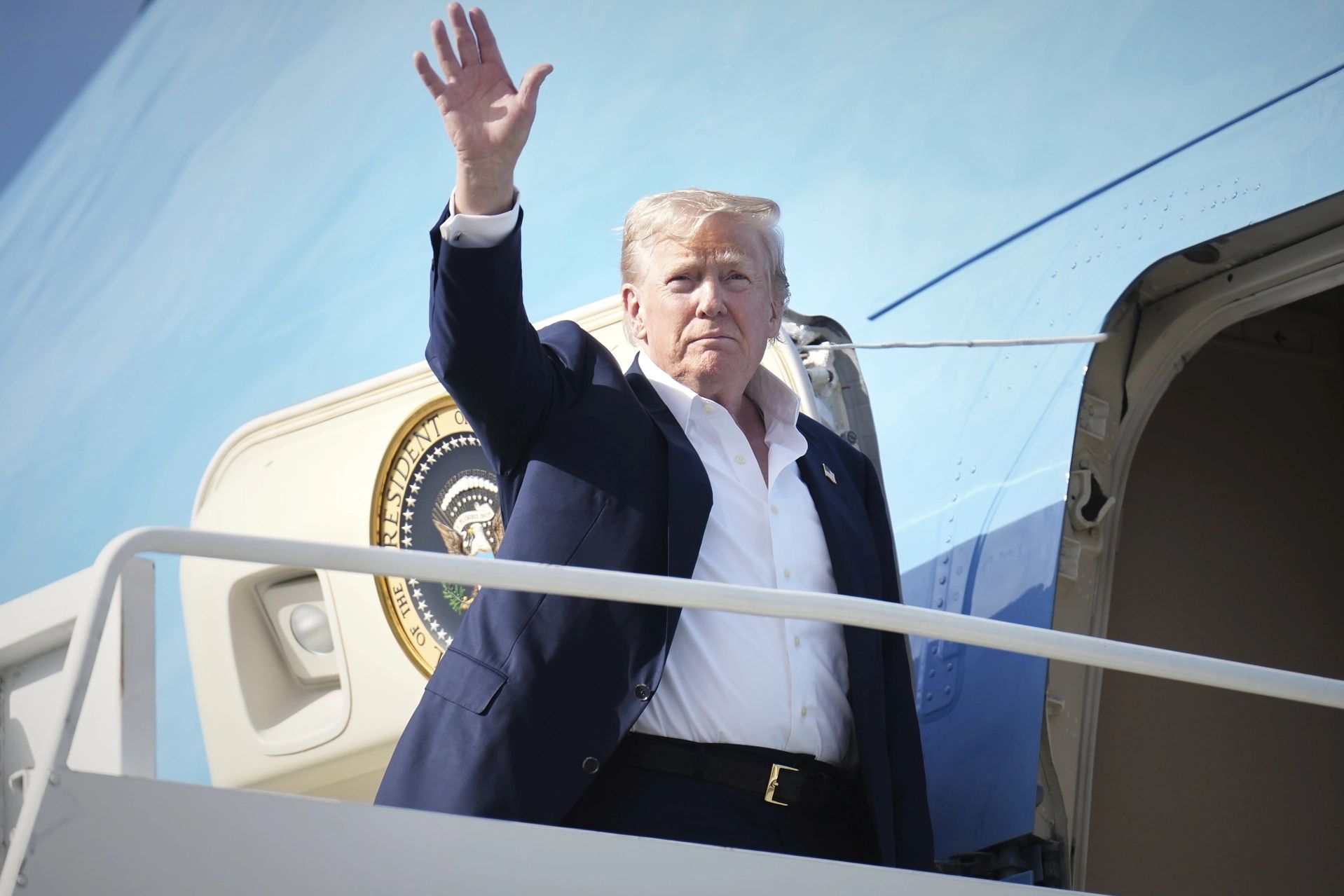
Trump said he doesn’t yet want to pressure Israel to come up with a longer-term solution because you could be “rewarding Hamas”
Trump also warned a major Jewish donor privately that “my people are starting to hate Israel,” signaling awareness of grassroots discontent. In sum, his rhetoric has grown more empathetic to Gazan suffering even as he tries not to fully alienate conservative Israel backers.
POLICY AND POLITICAL IMPLICATIONS
The MAGA-driven debate is reshaping how Trump and his team talk about Middle East policy. On one hand, administration officials insist there is no “wedge” in U.S.-Israel relations. A White House aide stressed that Trump can remain “positive” toward Netanyahu while also wanting to “eliminate suffering” in Gaza. On the other hand, analysts note that Israeli leaders themselves sense the shift. A Cato Institute expert says Israel “see[s] the writing on the wall” that today’s U.S. “blank cheque” may not last beyond the next election. Indeed, Netanyahu has pressed his military campaigns hard, knowing Americans may not back another open-ended war.
Politically, Trump now has to juggle competing pressures. His core MAGA base includes a growing “America First” wing that sees endless foreign aid as wasteful. Yet many influential donors and Republican leaders remain staunchly pro-Israel. Shifting too far toward one side could risk losing key support or turning off parts of the coalition. So far, polls show a gulf: about 70% of Republicans still approve of Israel’s actions, even as many younger conservatives disagree. How Trump navigates this could affect fundraising and turnout. For now he appears to stick to broad support for Israel’s security while signalling sympathy for Gazan civilians, a cautious stance likely meant to keep both sides partly appeased.

Palestinian children amass at a charity kitchen in Khan Yunis in the southern Gaza Strip
In foreign policy terms, these debates hint at a more transactional approach ahead. If Trump runs on a platform of retrenching U.S. overseas commitments, even traditional allies like Israel might find Washington’s support more conditional. But any concrete change would likely await a final election mandate. As one expert observes, Trump “generally reflects whoever he talked to last,” making his Middle East policy somewhat unpredictable.
CONCLUSION
The MAGA movement’s Israel debate has forced President Trump to refine his public stance. He now balances his self-proclaimed pro-Israel credentials with pointed humanitarian appeals for Gaza. That balancing act underscores a broader tension: can a populist “America First” foreign policy coexist with America’s historic alliance with Israel? For the moment, official policy remains largely unchanged, but Trump’s adjusted messaging suggests Americans may see more frank talk about the limits of U.S. support.
In turn, Israeli leaders are watching closely, understanding that the relationship may no longer be completely unconditional. Ultimately, this emerging divide in the Republican coalition will shape both Trump’s 2026 agenda and the future of U.S.-Israel ties, even as traditional strategic bonds endure.
Sources:
Australian Financial Review, Axios, Politico, The Associated Press.
TWEET OF THE DAY
One of the better Ryan Gosling in The Big Short references…
This is my quant
— litquidity (@litcapital)
1:52 PM • Aug 3, 2025
TODAY IN HISTORY
(August 4, 1704): Gibraltar captured by Britain.
During the War of the Spanish Succession, Britain took control of Gibraltar on this day in 1704 after Spain surrendered, and “the Rock” subsequently became a British colony and a symbol of British naval strength.
