- Basedment
- Posts
- Is Ukraine’s Eastern Front Starting to Fracture?
Is Ukraine’s Eastern Front Starting to Fracture?
Your daily dose of geopolitical updates and strategic analysis. Unbiased, but not unbased.

Editor-in-Chief
July 27, 2025
THE BRIEFING
Here’s what’s happening in geopolitics today.
Today’s edition covers another busy stretch in global politics, from border battles in Southeast Asia to major political shifts in Europe and beyond.
Thailand and Cambodia’s cross-border fighting shows no sign of easing, while protests in Malaysia and Iran’s restive southeast signal growing domestic instability. Trump’s trip to Scotland may shape key trade outcomes, and Taiwan’s recall vote has drawn unusually direct attention from Beijing.
Our deep dive today turns to Ukraine, where cracks are emerging along two key frontlines, Kupiansk and Pokrovsk, as Russia tests for vulnerabilities in the east.
THE LAST 24 HOURS IN GEOPOLITICS
1. Thai-Cambodian fighting extends into third day despite ceasefire calls
Fighting between Thailand and Cambodia has entered its third consecutive day, despite growing calls for a ceasefire and international mediation. New clashes have erupted in Thailand’s coastal Trat province, expanding the conflict beyond its initial flashpoints and prompting mass evacuations of more than 130,000 people. With both sides blaming the other for initiating hostilities and artillery fire ripping through border provinces, this has become the deadliest confrontation between the neighbours in over a decade.
read more
2. Trump touches down in Scotland and raises prospect of trade deal breakthrough
Trump has arrived in Scotland where he’s combining leisure time at his golf resorts with high-stakes diplomacy, including a meeting with UK Prime Minister Keir Starmer to refine a U.S.–UK trade deal originally announced in June 2025. European Commission President Ursula von der Leyen is also set to meet Trump in Scotland, as EU–U.S. leaders aim to finalise a new trade framework to forestall looming tariffs on EU imports by August 1. Trump expressed guarded optimism about reaching a deal while remaining skeptical of broader flexibility, especially on steel and aluminum tariffs, which could set precedent across future negotiations.
read more
3. Taiwan votes in major recall election closely watched by China
Taiwan has held an unprecedented recall vote targeting 24 opposition Kuomintang (KMT) lawmakers as civic groups push to reshape parliamentary power ahead of next year’s elections. Supporters frame the recalls as a defence against Beijing-aligned influence and gridlock blocking crucial defence legislation, while the KMT calls the effort a partisan attack undermining democratic norms. China, unusually active in tone and messaging, has openly sided with the opposition by echoing their rhetoric, prompting Taiwan’s government to decry Beijing's interference as a direct threat to its democracy.
read more
4. Five killed in terrorist attack on courthouse in Iran’s Zahedan city
On July 26 in Zahedan, the capital of Iran’s Sistan-Baluchestan province, an armed assault on a local courthouse claimed the lives of at least five civilians and injured 13 others. The Jaish al-Adl militant group reportedly claimed responsibility after attackers stormed the building, using a hand grenade and firearms, prompting security forces to respond and kill three of the assailants. The incident deepens concern over continued unrest in Iran’s southeast, where ethnic Baluch grievances and militant activity have frequently led to deadly confrontations.
read more
5. Thousands rally in downtown Kuala Lumpur for resignation of PM Anwar
Thousands of Malaysians gathered in Kuala Lumpur on July 26, draped in black and chanting “Turun Anwar” (“Step Down, Anwar”), as they demanded Prime Minister Anwar Ibrahim’s resignation amid growing frustration over the cost of living and stalled reforms. Police estimated around 10,000 to 15,000 attendees, though opposition organisers forecast turnout could swell much higher. Former Prime Minister Mahathir Mohamad, who addressed the crowd, accused Anwar of failing to deliver on campaign promises and mishandling governance, while protesters called for judicial integrity and economic relief.
read more
DAILY DEEP DIVE
UKRAINIAN CRACKS IN TWO MAJOR FRONTLINE CITIES
We predict the next few weeks will be difficult for the main Ukrainian frontline. Cracks have begun to appear in at least two major sectors: Kupiansk and Pokrovsk city. We won’t beat a dead horse, but much of the issue stems from Ukraine’s inability to man its entire defensive line at full capacity.
The Russians are creating fires on insignificant or inactive fronts to further draw away Ukrainian manpower. Ukraine now faces an interesting and difficult dilemma: it cannot afford to pull troops away from the Donetsk, Luhansk, and Zaporizhzhia fronts, yet it also cannot allow Russia to exploit these ‘fires’ and turn them into operational breakthroughs.
As we’ve mentioned before, Ukraine has had some success beating back Russian forces in at least two villages in Sumy. Nonetheless, while fighting continues there, it will ultimately be a strategic win for Russia.
THE SITUATION IN POKROVSK:
Both Ukrainian and Russian sources (with video evidence)confirm that Russian DRG (sabotage-reconnaissance) units remain inside Pokrovsk, particularly in the city centre and suburbs like Zvirove and Shakhtarskyi.
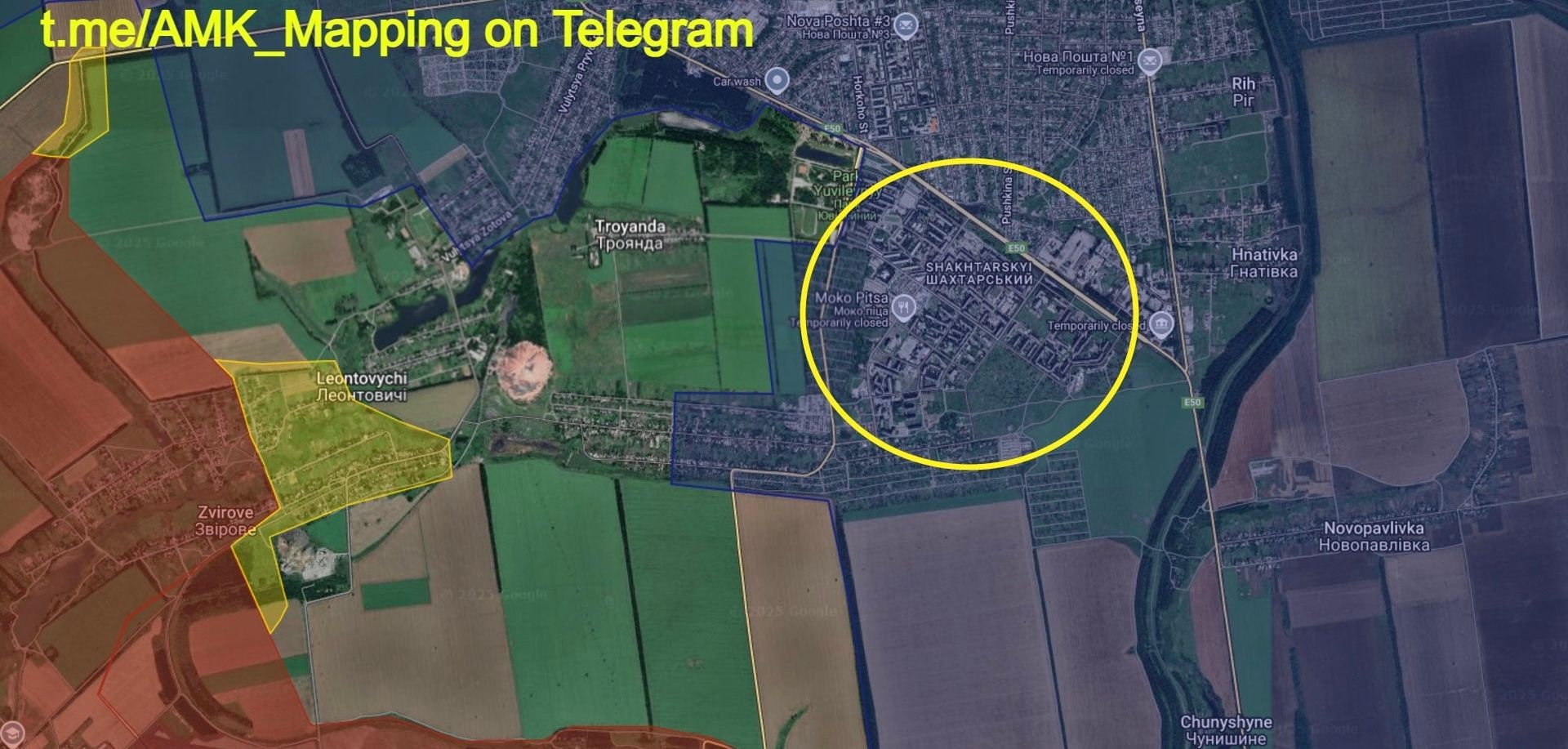
Ukrainian forces have begun evacuating from the outer defensive lines toward the inner suburbs near the city centre.
The situation remains extremely difficult for Ukrainian defenders. Both of the two remaining access roads are now under Russian artillery and drone fire, making reinforcements — and, more critically, the evacuation of civilians and wounded soldiers — extremely difficult.
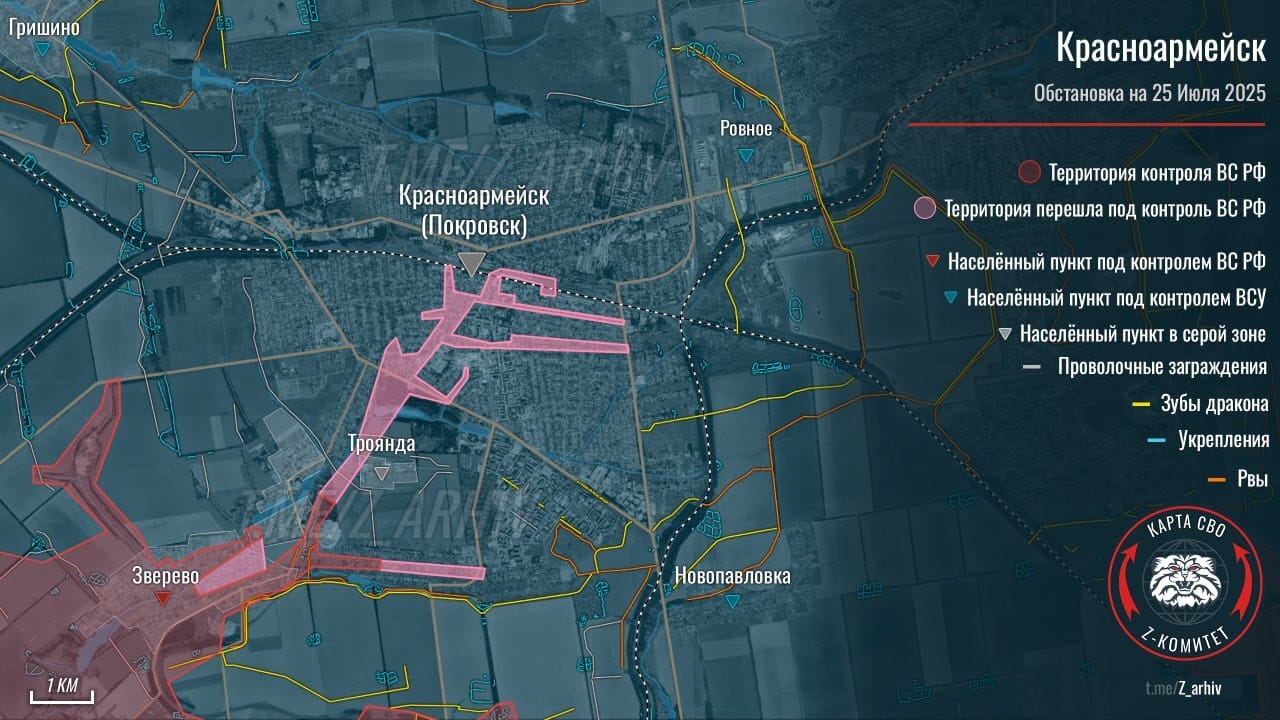
Map made by Pro-Russian Committee, other pro-Russian accounts have refuted these claims. E50 highway can be seen dissecting through Pokrovsk.
Ukrainian troops are likely establishing defensive positions along the E50 highway, which separates the city centre from the southern suburbs, which remain a grey zone. However, this is complicated by reports that Russian DRG units have already moved beyond the E50. While pro-Ukrainian sources like DeepState claim these units have been eliminated, other reliable outlets, such as Playfra, report that they are still operating. Meanwhile, Russian sources are split — Z-Committee claims Russian troops are deep inside Pokrovsk, while others like Radov refute this.
To make matters worse, north of Pokrovsk, Russia has exploited Ukraine’s overstretched defences and expanded its northern flank. This is arguably a bigger issue than the fight for Pokrovsk itself, as Russia is already establishing launch points to attack other logistical hubs like Dobropillya, which has replaced Pokrovsk in operational importance. For that reason, we believe the fall of Pokrovsk may come sooner than many expect.
KUPIANSK:
To say this front has been difficult for the Russians is an understatement. For over a year, their effort to reach northern Kupiansk has faced several costly setbacks. The northern villages and surrounding woodlands were heavily defended by Ukraine. However, over the past four months, those defences have finally begun to crack.
Russia has been on the outskirts of the city since June. The Russian Ministry of Defence has repeatedly claimed to have taken key districts northwest of Kupiansk, such as Moskovka, though many of these announcements were premature, as is often the case with MOD reports.
As of this week, Russian forces have entered and now control the locality of Holubivka, and have pushed into Kupiansk itself from the north, taking control over most of the garage area. They have also secured positions along the streets of Zakhysnykiv Kupianska, Konstytutsii, Michurina, and Mechnykova. In addition, Russian units have reached the outskirts of Moskovka and made new advances west of Radkivka.
Why the sudden advance? Beyond the obvious factor of low Ukrainian manpower, Ukraine is adjusting to new defensive lines. Cities like Kupiansk and Pokrovsk no longer hold the same strategic value they once did, as they are already on the verge of being encircled. Still, we believe the fall of Kupiansk is likely within the next couple of weeks unless Ukraine conducts a tactical withdrawal from all positions east of the city.
That raises another concern: if Kupiansk is at risk of falling, then Ukrainian positions east of the city may need to retreat to avoid being caught in a cauldron.
We’re already seeing a similar realignment along the broader Donbas line, where Ukraine has established deeper fallback positions within its own territory in Donetsk.
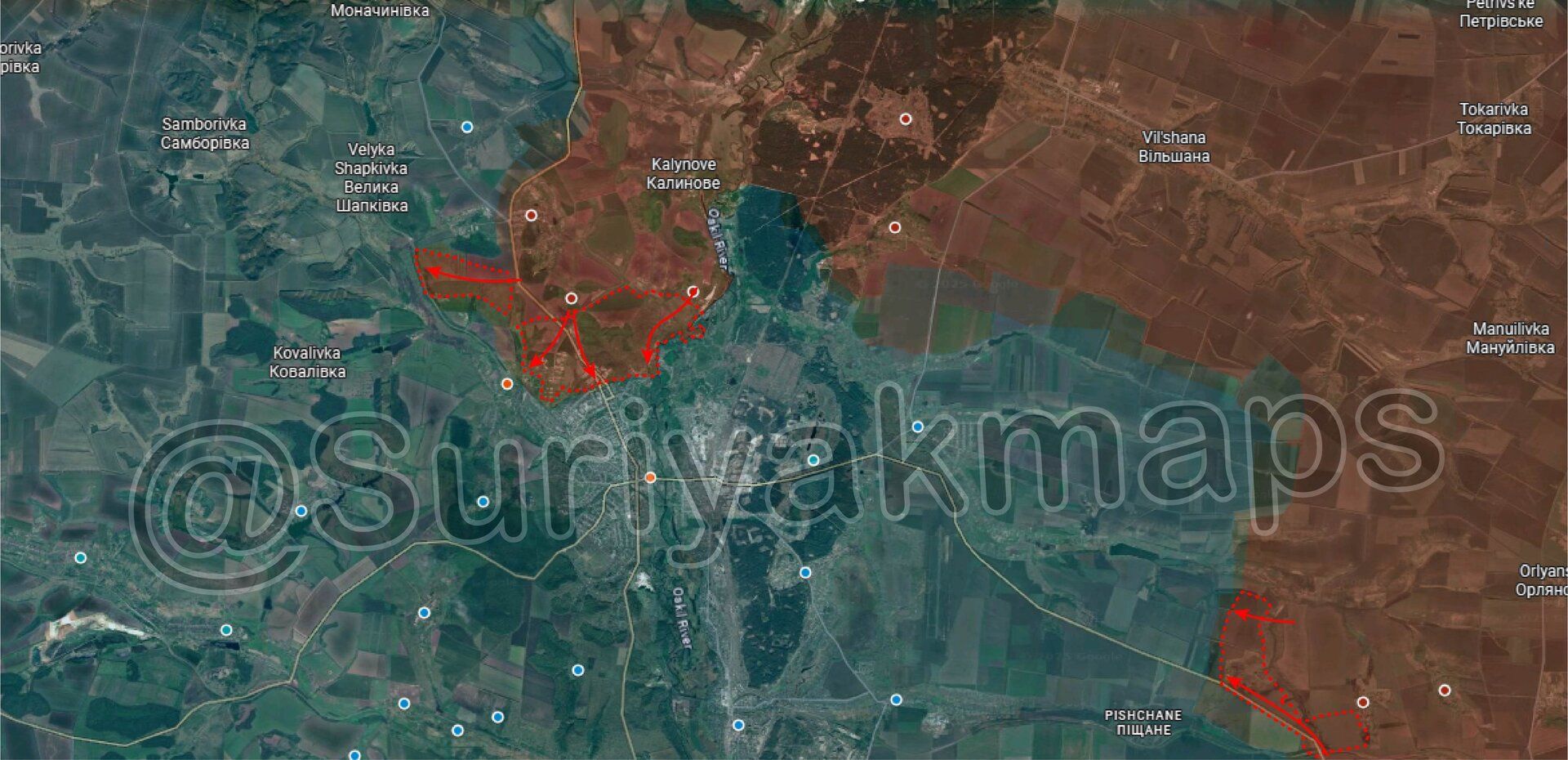
Expansion across northern Kupiansk puts the UKR troops in the eastern woodlands at risk of being cut off.
Note: We always try and use sources from both sides of the conflict.
Sources:
SuryiakMaps on T
AMK_Mapping on T
PlayFra on X
Deepstate on T
Z-Committee on T
Radlov on T
TWEET OF THE DAY
The rumours are that this might be just as effective as Israel’s Iron Dome…? 😂
The world’s first mosquito air defense system
— Massimo (@Rainmaker1973)
7:58 AM • Jul 25, 2025
TODAY IN HISTORY
(July 26, 1956): Suez Canal seized. On this day in 1956, Egyptian President Gamal Abdel Nasser seized control of the Suez Canal and nationalised it, sparking a crisis that later resulted in French, British, and Israeli forces briefly occupying parts of Egypt.