- Basedment
- Posts
- Is Xi’s Military Parade on Wednesday a Warning Shot to the USA?
Is Xi’s Military Parade on Wednesday a Warning Shot to the USA?
Your daily dose of geopolitical updates and strategic analysis. Unbiased, but not unbased.

Editor-in-Chief
September 03, 2025
THE BRIEFING
Here’s what’s happening in geopolitics today.
Today’s briefing takes us from the streets of Belgrade to the squares of Hanoi, where demonstrations and parades are shaping national narratives.
In Europe, Belgium’s recognition of a Palestinian state marks another shift in the region’s diplomatic landscape, while Xi Jinping’s meeting with Putin and Kim Jong Un highlights deepening ties among U.S. rivals. Later this week, Israeli President Isaac Herzog will visit the Vatican for talks with Pope Leo XIV, underscoring the ongoing role of religion in diplomacy.
And for our deep dive, on reader request, we ask: is Xi’s upcoming military parade a symbolic celebration, or a pointed warning shot to Washington?
THE LAST 24 HOURS IN GEOPOLITICS
1. Tens of thousands demand justice and protest against populist rule in Serbia
Tens of thousands of protesters took to the streets of Belgrade on Monday, marching silently to honour the 16 victims of last November’s railway station canopy collapse and calling for snap elections to unseat President Aleksandar Vučić and his SNS party. The student-led demonstrations, which also spread to cities like Novi Sad and Kragujevac, are grounded in deep frustration with systemic corruption as protesters painted government negligence as the root cause of the tragedy.
read more
2. Vietnam celebrates independence day with huge military parade
Vietnam marked its 80th National Day with its largest military parade in decades at Hanoi’s Ba Đinh Square, commemorating independence from French colonial rule on September 2, 1945. The celebration showcased advanced military hardware, including Russian-made Mi-171 helicopters, Su-30 fighter jets, domestically produced drones, and a naval display with Kilo-class submarines and featured appearances by foreign military contingents from China, Russia, Laos, and Cambodia. Communist Party chief To Lam framed the parade as a symbol of Vietnam’s sovereignty and unity, with a U.S. embassy official attending and Secretary of State Marco Rubio sending congratulations.
read more
3. Belgium to recognise Palestinian state & sanction Israel
Belgium announced it will formally recognise a Palestinian state at the upcoming UN General Assembly, aligning with countries like France, Australia, Britain, and Canada under mounting international pressure tied to the humanitarian crisis in Gaza. In tandem, Foreign Minister Maxime Prévot confirmed Belgium’s plan to impose 12 robust sanctions on Israel, including bans on products from settlements, restrictions on procurement contracts, and declaring Hamas leaders persona non grata. The decision, coordinated with France and Saudi Arabia, serves to condemn Israel’s violations of international law while reaffirming Belgium’s commitment to a two-state solution.
read more
4. China’s Xi hosts Putin and Kim Jong Un in challenge to the West
Chinese President Xi Jinping convened a landmark trilateral meeting in Beijing with Russian President Vladimir Putin and North Korean leader Kim Jong Un, demonstrating solidarity among countries that have faced Western condemnation over the Ukraine war and other regional conflicts. This is the first time the three have appeared together. Xi called Putin an “old friend,” while Kim’s armoured train journey underscored the symbolic display of unity, reinforcing a growing alignment between Beijing, Moscow, and Pyongyang.
read more
5. Israeli President to meet Pope Leo at the Vatican on Thursday
Israeli President Isaac Herzog will visit the Vatican on Thursday for a one-day meeting with Pope Leo XIV, who has recently amplified his appeals for a permanent ceasefire in Gaza and the release of hostages. The agenda includes discussions with Vatican Secretary of State Cardinal Pietro Parolin on key issues: freeing hostages, combating global antisemitism, and protecting Christian communities in the Middle East. Herzog will also tour the Vatican Archives and Library.
read more
DAILY DEEP DIVE
Is Xi’s Military Parade on Wednesday a warning shot to the U.S.?
Purpose and narrative
Chinese officials insist the Wednesday parade is a “Victory Day”, in commemoration of Japan’s defeat in World War II, aimed at bolstering national pride and historical narrative. Beijing frames it as a tribute to China’s sacrifices and contributions in the war. Foreign Ministry spokesman Hong Lei told reporters the parade will demonstrate China’s “firm determination to follow the path of peaceful development,” its resolve to safeguard sovereignty, and its capability to “defend world peace”.
In practice, the ceremony is choreographed to mix patriotic pageantry with a heavy dose of modern military hardware. As one report explains, the event will officially stress themes of peace and “international justice,” while in reality “the demonstration of the PLA’s ability to fight high-tech wars” takes centre stage.

The site for the parade
High-profile guests and diplomatic signal
Significantly, about 26 heads of state are attending, overwhelmingly from authoritarian or non-Western countries. On the podium will be Russia’s Vladimir Putin, North Korea’s Kim Jong Un, Iran’s president Masoud Pezeshkian and others. It will be the first time Xi, Putin, Kim and Iran’s president have all met at one venue.
Some publications have noted the gathering of “countries united in their opposition to the west” and dubbed it an “axis of upheaval”. Other guests include leaders of Myanmar, Mongolia, Indonesia, Zimbabwe and several Central Asian states to include 14 land neighbours.
Experts say this lineup is a clear signal of China’s global leadership ambitions. Chatham House’s Yu Jie observes Xi is “laying out his ambition for the global order,” where the world becomes multipolar and led by China alongside other non-Western countries. Seoul’s intelligence service even predicts Kim Jong Un will receive VIP treatment on par with Putin, symbolising three-way unity among major U.S. challengers.
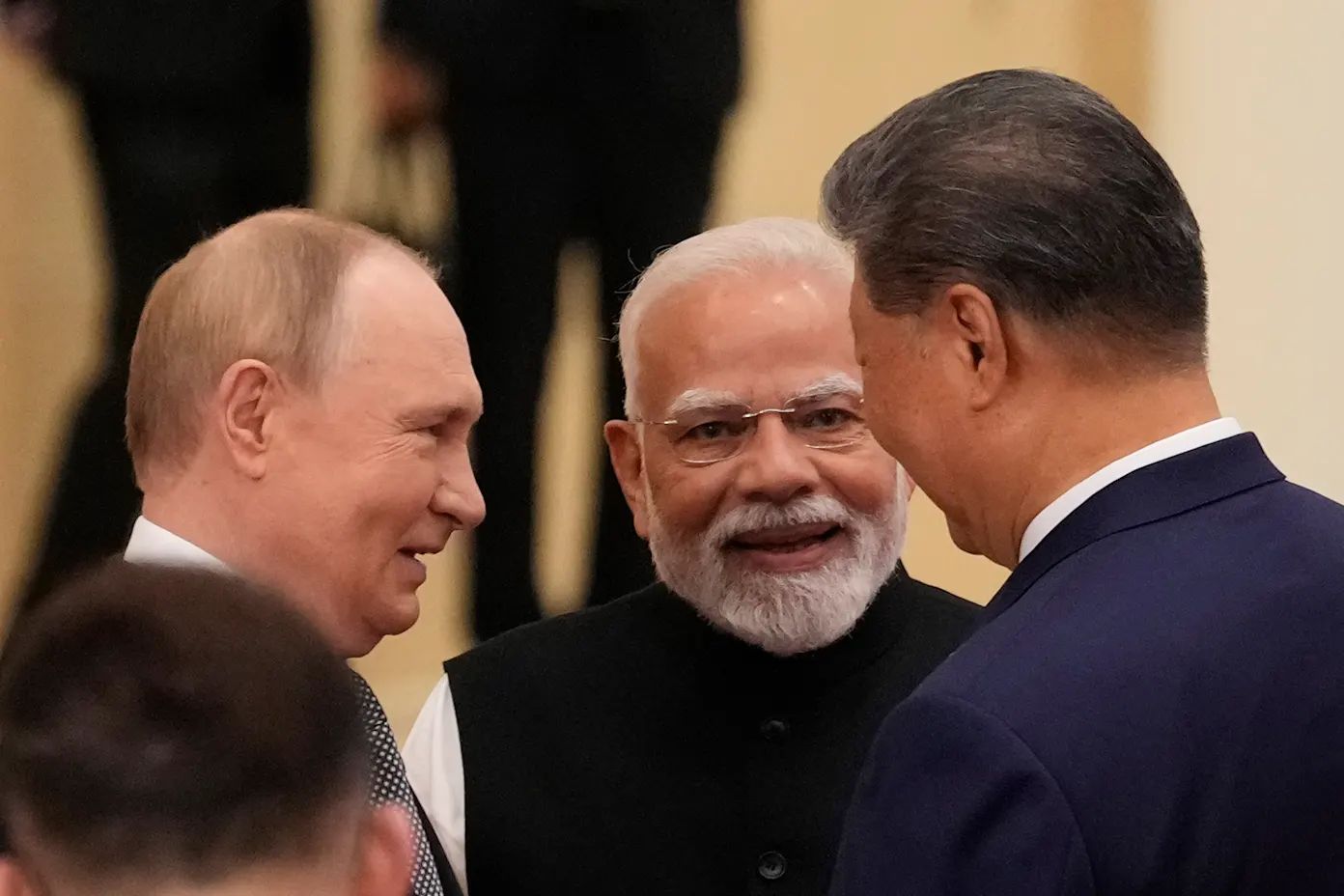
Putin, Modi and Xi at the SCO Summit
Cutting-edge hardware on display
Officials say over 100 domestically-made systems will roll by, reflecting China’s drive for a “world-class” military. Expected highlights include:
Hypersonic anti-ship missiles: New YJ-series missiles (YJ-15/17/19/20) capable of Mach 4–6 speeds, designed to target U.S. carrier groups. These fit China’s anti-access/area-denial (A2/AD) strategy, signaling to Washington that even its naval carriers are “no longer untouchable” in the Pacific
Advanced ICBMs: Road-mobile intercontinental missiles (DF-31AG, DF-41) with ranges above 11,000 km and MIRV payloads, plus the new JL-3 submarine-launched ICBM
Stealth drones and ‘loyal wingmen’: The FH-97 unmanned combat aircraft is expected to debut – a stealthy drone that can accompany J-20 fighters for reconnaissance, attack and electronic warfare
Electronic warfare and directed-energy systems: Less visible but revolutionary, mobile EW units and laser/microwave weapons are likely displayed. These can jam radars, blind incoming missiles, and protect Chinese forces from networks attacks.
Reconnaissance and combat drones (air and underwater): Autonomous drones for surveillance and strike roles, including unmanned underwater vehicles, will highlight China’s increasing ISR (intelligence, surveillance, reconnaissance) capabilities in disputed waters
Advanced jets and armor: Fifth-generation fighters (J-20 stealth) and upgraded tanks are also expected. Analysts note China’s modern jets now use indigenously-built engines, part of a self-reliance push.
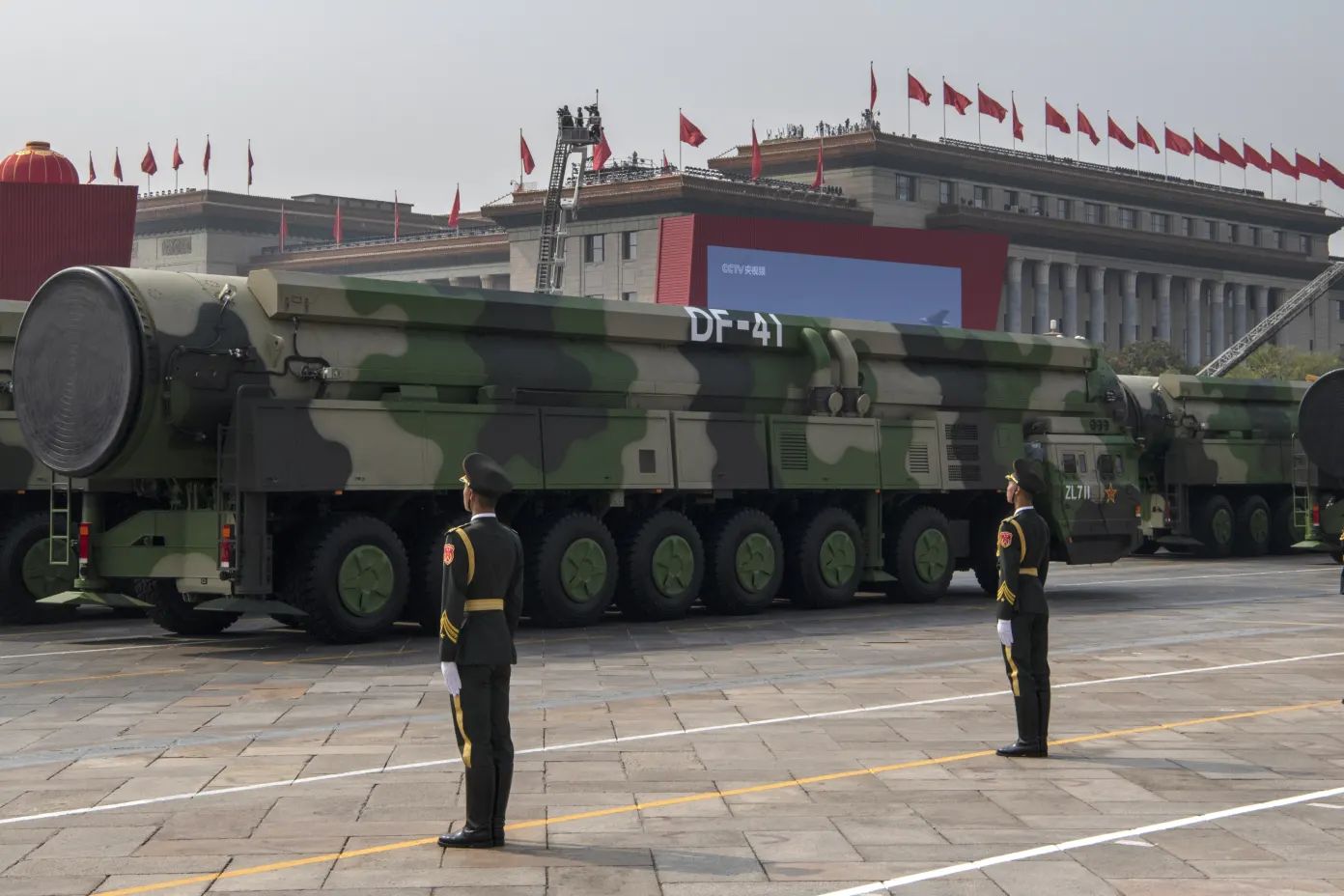
China displaying hypersonic missiles.
Message vs. domestic pageant
How to interpret this spectacle is debated. Officially, China insists it’s not aimed at any country. Foreign Ministry spokesmen stress the parade showcases commitment to peace, not provocation. But many analysts see an unmistakable audience beyond Beijing. The Washington Post notes Xi will use the parade to send a “pointed message” of China’s combat readiness and its ambition to rival U.S. power. Indeed, U.S. officials and experts say recent weapons developments (anti-ship hypersonics, etc.) are tailored to a Taiwan scenario and to counter U.S. forces. Even after the parade, analysts expect the implicit warning to Taiwan and its backers to linger; one RUSI fellow argues Beijing is “sending a message to the Taiwanese that resistance is futile” by parading all this firepower.
At the same time, the parade serves undeniable domestic and regional purposes: rallying nationalism, legitimising the Party (by evoking WWII heroism), and showcasing China’s sway in Asia. The guest list signals China’s leadership in the region. In short, the event is both a domestic propaganda high point and a platform for strategic signalling. Whether it counts as a “warning shot” depends on one’s perspective: Beijing says peace and unity, but the scope, timing and cast of the parade clearly project power in the face of rising U.S.-China competition.
Sources:
Reports from The New York Times/AFR, Reuters, AP, The Guardian, Washington Post, WIRED and others were used for this analysis.
TWEET OF THE DAY
South vs West in one tweet…?
Global South vs The west
— Lord Bebo (@MyLordBebo)
7:58 PM • Aug 31, 2025
TODAY IN HISTORY
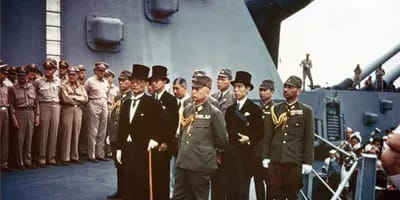
(September 2, 1945): World War II came to an end as Japanese Foreign Minister Shigemitsu Mamoru and General Umezu Yoshijiro signed Japan's formal surrender aboard the USS Missouri.