- Basedment
- Posts
- Israel Begins New Operation In Southern Lebanon
Israel Begins New Operation In Southern Lebanon
In today’s deep dive, Israel has declared it is officially launching a new operation into southern Lebanon - one that may be the largest in Israels history.

Editor-in-Chief
March 16, 2026
THE BRIEFING
Here’s what’s happening in geopolitics today.
Tensions across the Middle East continue to ripple through global headlines, with a drone strike forcing a temporary halt to flights at Dubai’s main airport and U.S. allies Japan and Australia declining to send warships to the Strait of Hormuz.
Elsewhere, Kazakhstan has approved a new constitution in a sweeping referendum, Washington and Beijing are inching toward trade agreements ahead of a potential Trump–Xi summit, and North Korea has staged its latest Supreme People’s Assembly election.
In today’s deep dive, Israel has declared it is officially launching a new operation into southern Lebanon - one that may be the largest in Israels history.
THE LAST 24 HOURS IN GEOPOLITICS
1. Dubai halts flights at Main Airport after fuel tank attack
Flights were temporarily halted at Dubai International Airport after a drone strike hit a fuel tank near the airfield, triggering a fire and forcing authorities to suspend operations as a precaution. Emergency crews quickly contained the blaze and no injuries were reported, though multiple flights were diverted to Al Maktoum International Airport and other destinations.
read more
2. Japan and Australia say they have no plans to send ships to Strait of Hormuz
Japan and Australia have said they do not plan to send naval ships to the Strait of Hormuz, despite Trump urging allies to help secure the vital waterway amid escalating tensions with Iran. Japanese Prime Minister Sanae Takaichi said Tokyo is still evaluating what actions it can take within its legal framework, while Australian officials said no request had been made for warship deployments. The reluctance from two key U.S. allies highlights the challenges Washington faces in building a multinational naval coalition to protect shipping through the strategic oil chokepoint.
read more
3. 87.15% vote in favour of new constitution in Kazakhstan referendum
Kazakhstan has approved a new constitution in a national referendum, with 87.15% of voters supporting the proposal, according to the country’s Central Election Commission. Turnout was reported at just over 73%, giving the vote a strong mandate for the sweeping political reforms. The new constitution restructures parts of the political system, including merging parliament into a single chamber and restoring the post of vice president, changes that analysts say could strengthen the authority of President Kassym-Jomart Tokayev.
read more
4. US, China inch toward trade deals ahead of Trump-Xi Summit
Senior U.S. and Chinese officials are seeking to finalize talks in Paris on potential “managed trade” arrangements and agricultural purchases ahead of a planned summit between Trump Jinping. The discussions, led by U.S. Treasury Secretary Scott Bessent and Chinese Vice Premier He Lifeng, have focused on increasing Chinese imports of U.S. goods such as poultry, beef, and soybeans while addressing issues around tariffs, critical minerals, and export controls. Officials say any agreements reached in Paris would serve as preliminary deliverables for the expected Trump–Xi meeting in Beijing later this month.
read more
5. North Korea holds Supreme People’s Assembly election, KCNA reports
North Korea held elections for its Supreme People’s Assembly, the country’s national legislature, according to state media outlet KCNA. Officials reported voter turnout of 99.99% by early evening, with leader Kim Jong Un casting his ballot at a coal mine as part of the highly choreographed vote. The assembly formally approves government policies and appoints senior officials, though analysts say real political power remains concentrated within the ruling Workers’ Party of Korea.
read more
THE LEBANON FRONT - NEW PHASE OF WAR?
Ground incursions into southern Lebanon have been underway for several days, even before the official announcement of a broader Israeli campaign. What initially appeared to be probing operations along the border now looks increasingly like the early phase of a much larger offensive.
Israeli forces are advancing along three primary axes. The western sector near Ras al-Naqoura, the central corridor through Aita ech Chaab, and the eastern sector around Khiam. Each axis serves a distinct operational purpose, but together they form a coordinated push designed to reshape the battlespace across southern Lebanon.

The eastern axis around Khiam is particularly important. The town sits on elevated terrain just a few kilometers from the Israeli border and near major road junctions linking southern Lebanon to the Bekaa Valley. Whoever controls Khiam effectively controls observation over large sections of northern Israel and the surrounding Lebanese plains. Just as importantly, the road network running through the area forms part of Hezbollah’s logistical routes moving fighters and weapons south of the Litani River. Securing or disrupting that corridor would complicate Hezbollah’s ability to reinforce its southern front.
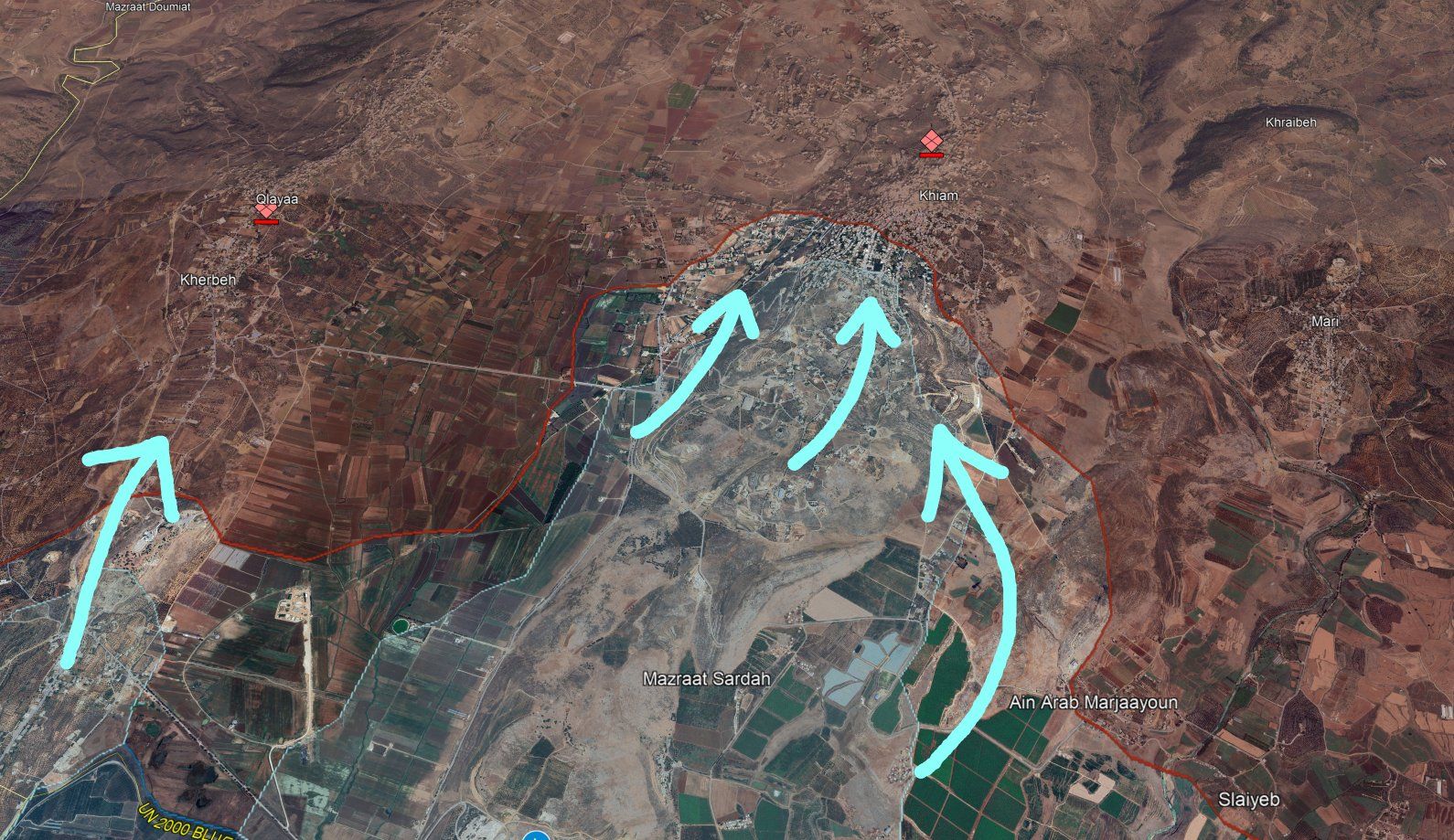
Theti Mapping is information and map source (Map we used yesterday)
Israel also appears to be preparing the civilian battlespace for a deeper advance. Residents south of the Zahrani River (roughly 40 kilometres from the Israeli border) have been told to evacuate, placing around 13% of Lebanese territory under evacuation directives. That scale suggests Israeli planners may be thinking well beyond limited border raids and toward a more durable security zone in southern Lebanon.
At the same time, Israel may soon expand its manpower significantly. Reports from Israeli public broadcasting indicate the government is considering a mobilisation of up to 450,000 reservists, far above the currently authorised ceiling of around 260,000. If approved, this would represent one of the largest mobilisations in Israeli history and would signal preparation for a prolonged campaign rather than a short operation.
On the ground, several formations are already active. The 91st Division is operating in eastern southern Lebanon, the 146th Division in the western sector, while the 210th Division is positioned around Mount Dov (Shebaa Farms).
The broader strategic context also matters. Since October 7, Israeli strikes have systematically targeted Hezbollah’s leadership structure, elite units, and weapons infrastructure. While Hezbollah remains capable, its command network and operational tempo have been under sustained pressure. The current battle for al-Khiam will give us a better clue to Hezbollah’s capabilities on the ground - fighting has been ongoing for days now. Tactics we are likely to see are ambush and guerilla type warfare – with more experienced units taking up the role of actual house to house fighting that we are seeing in al-Khiam.
Israel’s growing air superiority over Iran may also be influencing the battlefield. With Iranian air defences degraded and large strike packages already operating in the region, Israel now has the flexibility to redirect aircraft toward Lebanon. In some cases, sorties striking Iranian targets are reportedly continuing onward to strike Hezbollah positions with remaining payloads.
Politically, however, Lebanon remains stuck in a strategic paradox. The Lebanese government has reportedly engaged French mediators about a potential diplomatic settlement that could even include formal recognition of Israel. Yet Hezbollah has made clear it will not disarm, while the Lebanese Army is unlikely to confront Hezbollah directly.
Sources available upon request
TODAY IN HISTORY
(March 16, 1621): Samoset greets pilgrims at Plymouth Colony
On this day in 1621, Samoset, a member of the Abenaki tribe, made contact with the Pilgrims of Plymouth Colony. He greeted them in English, having learned the language from fishermen along the coast of Maine, and thereafter established a close relationship with the settlers. He later introduced them to Squanto, who became an important part of the Plymouth community. Throughout his life, Samoset helped to establish peaceful relations between Native Americans and settlers, despite occasional wars and disputes—and near the end of his life, he orchestrated the first property sale between the groups.
