- Basedment
- Posts
- Israel Expands Control In Southern Lebanon
Israel Expands Control In Southern Lebanon
Today we explore a variety of sources to better understand the conflict in southern Lebanon

Editor-in-Chief
March 26, 2026
THE BRIEFING
Here’s what’s happening in geopolitics today.
Geopolitics is busy on multiple fronts today: Iran is reviewing a U.S. peace proposal while insisting Lebanon be included in any ceasefire, and G7 foreign ministers have gathered in France trying to close gaps among allies on the wars in Ukraine and Iran.
Meanwhile, Trump is preparing for a May meeting in Beijing with Xi Jinping, the UK has authorised forces under Keir Starmer to board Russian oil tankers suspected of sanctions evasion, and Japan is sending troops to the Philippines for joint drills for the first time since World War II.
In today’s deep dive, we double-click on a variety of sources to better understand the conflict in southern Lebanon,
THE LAST 24 HOURS IN GEOPOLITICS
1. Iran reviewing US peace proposal, calls for Lebanon to be included in ceasefire
Iran is reviewing a U.S. peace proposal aimed at ending the current conflict, with officials saying the plan has been passed to senior leaders for consideration through intermediaries. At the same time, Tehran has told mediators that any ceasefire must also include Lebanon, linking an end to the war with a halt to Israel’s offensive against Hezbollah and other Iran-aligned groups in the region. The discussions come amid continued fighting and competing proposals from both sides, with Iran maintaining that it is not engaged in direct negotiations with the U.S.
read more
2. G7 allies meets in France to narrow transatlantic Iran split
Foreign ministers from the Group of Seven nations are meeting in France this week as wars in Ukraine and Iran dominate the global agenda and strain relations among Western allies. The talks are expected to focus on the Russia-Ukraine conflict, the Middle East situation, and broader security concerns, with partners seeking clarity on U.S. policy and military operations tied to the Iran war. The gathering comes amid growing unease over shifting U.S. foreign policy and disagreements within the bloc about how to respond to the current conflicts.
read more
3. Donald Trump to visit Xi Jinping in May after Iran war postponement
Trump is set to travel to Beijing in mid-May for talks with Chinese leader Xi Jinping, after the visit was postponed due to the ongoing Iran war. The White House said the two leaders are now expected to meet on May 14–15, in what will be Trump’s first trip to China in around eight years. The summit is being closely watched as Washington and Beijing navigate tensions while global attention remains focused on conflicts in the Middle East and Ukraine.
read more
4. UK armed forces authorised to board Russian tankers in British waters
The UK government has authorised its armed forces to board and detain Russian oil tankers passing through British waters if they are suspected of being part of Moscow’s sanctions-evading “shadow fleet.” The move, approved by Prime Minister Keir Starmer, is aimed at tightening enforcement of Western sanctions and disrupting the network of vessels used to keep Russian oil exports flowing despite restrictions. British officials say the policy is part of broader European efforts to pressure Russia and limit revenue that could fund its war in Ukraine.
read more
5. Japan sends troops to Philippines for first time since WWII for joint drill
Japan will send combat troops to the Philippines to participate in joint military drills for the first time since World War II, marking a significant shift in regional security cooperation. Around 300 personnel from the Japan Ground Self-Defense Force are expected to take part in upcoming exercises alongside Philippine and U.S. forces, including the annual Salaknib and Balikatan drills scheduled for April and May. The deployment reflects deepening defense ties between Tokyo and Manila, which have strengthened military cooperation amid rising tensions in the region.
read more
GLOBAL CONFLICT TRACKER
Israel-Hezbollah
Recent fighting across southern Lebanon indicates a continued escalation in both tempo and scale, with Israeli forces attempting multi-axis advances while Hezbollah sustains a high-output defensive and retaliatory posture. The most significant developments are centred around the Taybeh–Qantara axis and Naqoura, where ground manoeuvres are now being contested in depth rather than limited probing raids. Across sources, there is agreement on expanding Israeli ground pressure, but major discrepancies remain around the scale of engagements and claimed losses, particularly from Hezbollah. Simultaneously, Hezbollah’s attack frequency remains elevated, suggesting no degradation in operational capacity despite sustained Israeli pressure on infrastructure.

I wanted to use a more conservative map than the one I posted on the story.
Israeli ground operations appear to be intensifying along multiple fronts, with the most detailed reporting coming from TheIntelMapping. According to their assessment, the IDF’s 36th Division, specifically the 7th Armored Brigade, launched an armored push from Al-Muhaysibat Hill south of Taybeh, advancing roughly 7km toward Qantara. This marks a notable extension beyond previous shallow incursions. The same source indicates continued pressure along the northern Taybeh axis (el-Faqaani) toward Deir Seryan, suggesting a broader attempt to stretch Hezbollah’s defensive lines across the central sector.
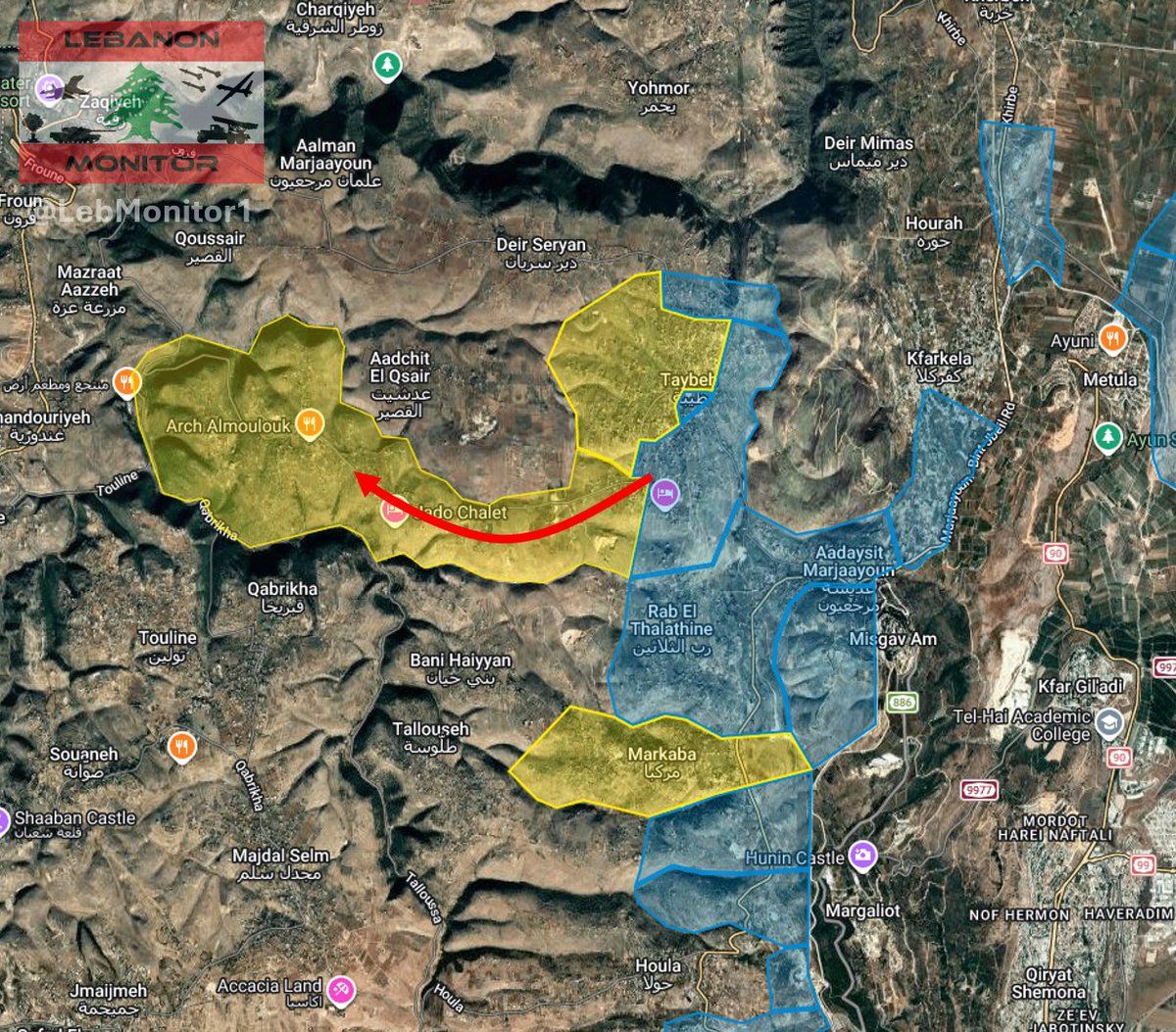
This aligns with Lebanon Monitor’s reporting, which confirms Israeli attempts to advance toward Qantara from Taybeh, with active clashes ongoing. However, their wider sectoral overview highlights a key limitation: due to heavy cloud cover obscuring Sentinel-2 imagery between March 20–25, the full extent of Israeli advances remains unverified. Their mapping instead distinguishes between confirmed IDF presence (via geolocation) and reported advances, noting Israeli activity across western (Naqoura, Aalma al-Shaab), central (Taybeh, Yaroun, Aitaroun), and eastern sectors (Khiam, Halta). This reinforces the assessment of a multi-axis pressure campaign, but stops short of confirming territorial control.
In the western sector, Israeli forces from the 146th Reserve Armored Division reportedly advanced deeper into Naqoura, seizing most of the town and pushing along the Tyre coastal road. Hezbollah presence appears to have thinned in urban centres, with fighters repositioning north into forests, camps, and residential complexes, indicating a transition from forward defence to elastic, terrain-based resistance.
Hezbollah’s account of the Taybeh–Qantara engagement diverges sharply in scale and outcome. They claim to have ambushed a three-platoon Israeli force (estimated 78–165 personnel) near Wadi al-Hujayr, targeting Merkava tanks and D9 bulldozers. Reported losses include up to six Merkavas and two D9s destroyed across multiple engagement phases, with additional mortar strikes on Israeli command posts and medevac units. However, as noted in TheIntelMapping analysis, these claims lack visual confirmation, which is atypical given Hezbollah’s established pattern of documenting ATGM and FPV strikes. The absence of footage raises questions about the scale of losses, particularly as recent IDF tactics have favoured smaller, lower-signature units rather than platoon-sized armored thrusts.
What is consistent across all sources is Hezbollah’s sustained and increasing operational output. Data indicates 60 attack waves on March 24 alone, with 36 involving rockets/missiles (60%), 18 UAVs (30%), and 6 anti-tank systems (10%). Half of these attacks targeted IDF forces inside Lebanon, while the remainder focused on northern Israeli civilian and military zones across varying ranges. Since entering the conflict on March 2, Hezbollah has conducted approximately 975 attack waves, underscoring a sustained high-intensity campaign.

This trend continued into March 25, with Suriyak reporting one of the heaviest combined missile and drone barrages targeting northern Israel, Tel Aviv, and the West Bank, marking a geographic expansion in strike depth. Israeli casualty figures remain relatively limited in confirmed terms, with one Golani Brigade special forces soldier killed and multiple others wounded in recent engagements, though this likely reflects only verified losses.
Overall, the battlefield is shifting toward a more attritional and contested dynamic. Israeli forces are probing deeper and across more axes, but without clear evidence of decisive breakthroughs. Hezbollah, while pressured, continues to demonstrate both resilience and escalation capacity, maintaining high attack frequency while contesting ground advances.
Hezbollah missile launch
Theti Mapping Source for unit and combat info
Israeli attacks on Qantara
Hezbollah attacks statistics
Death of special forces soldier
LebMonitor Info and map Upload
Sources available upon request
TODAY IN HISTORY
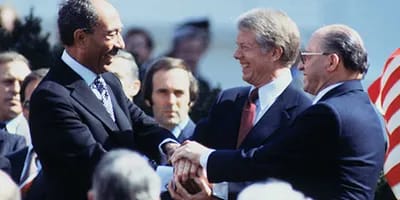
(March 26, 1979): The historic peace treaty between Israel and Egypt, agreed to by Menachem Begin and Anwar Sadat and based on the Camp David Accords mediated by U.S. President Jimmy Carter in September 1978, was signed.