- Basedment
- Posts
- Israel To Destroy All Bridges On Litani River, Both Russia and Ukraine Attack
Israel To Destroy All Bridges On Litani River, Both Russia and Ukraine Attack
In today’s deep dive Iranian launches continue to stablise as Israeli Defence Minister says “big surprises are coming”, we also focus on the Kostyantynivka front today.

Editor-in-Chief
March 18, 2026
THE BRIEFING
Here’s what’s happening in geopolitics today.
Energy, alliances, and escalation dominate today’s headlines, with Iraq and Kurdistan moving to restart oil exports, Trump taking aim at NATO over the Iran war, and China using the global energy crunch to pitch reunification to Taiwan.
Meanwhile, Iran confirms the death of a top security official in ongoing strikes, and Israel continues its campaign in Lebanon with a strike in the heart of Beirut.
In today’s deep dive Iranian launches continue to stablise as Israeli Defence Minister says “big surprises are coming”, we also focus on the Kostyantynivka front today.
THE LAST 24 HOURS IN GEOPOLITICS
1. Iraq and Kurdistan reach deal to resume oil exports via Turkey
Iraq’s federal government and the Kurdistan Regional Government have reached an agreement to resume oil exports through the pipeline to Turkey’s Ceyhan port, ending a halt caused by political disputes and regional instability. Under the deal, crude produced in the Kurdish region will be handed over to Iraq’s state oil marketer for export, helping restore flows that had previously accounted for hundreds of thousands of barrels per day. The agreement is seen as critical to stabilize Iraq’s oil revenues and ease tensions between Baghdad and Erbil, as exports remain vital to the country’s economy amid wider regional disruptions.
read more
2. Trump calls NATO’s refusal to help Iran war ‘very foolish’
Trump has criticized NATO for declining to support military operations linked to the war with Iran, calling the alliance’s stance a “very foolish mistake.” He said most NATO members had expressed support for the objectives of the campaign but refused to participate directly, particularly in efforts to secure the Strait of Hormuz. The comments highlight growing tensions between Washington and its allies, as NATO countries maintain the conflict falls outside the alliance’s defensive mandate.
read more
3. Iran’s national security council confirms death of its chief, Ali Larijani
Iran’s Supreme National Security Council has confirmed the death of its chief, Ali Larijani, one of the country’s most senior political and security figures. Iranian state media said Larijani was killed in recent strikes linked to the ongoing conflict with Israel, marking one of the highest-profile losses in Iran’s leadership since the war began. His death is seen as a major blow to Tehran’s command structure, with Larijani having played a central role in national security policy and strategic decision-making.
read more
4. China makes energy security ‘reunification’ offer to Taiwan
China has offered Taiwan what it described as “energy security” guarantees if the island agrees to Beijing’s rule, framing the proposal as part of its long-standing push for “reunification.” The offer comes as the Middle East conflict disrupts global energy markets, with Beijing highlighting Taiwan’s heavy reliance on imported fuel and positioning integration with China as a way to ensure stable supplies. Taiwan has consistently rejected such proposals, and no major political party on the island supports reunification under Beijing’s terms.
read more
5. Israel strikes and destroys building in heart of Beirut
An Israeli airstrike has destroyed a building in central Beirut, with strikes reported in areas close to the city’s downtown, including the Bachoura district. The Israeli military said it targeted a site linked to Hezbollah, with some warnings issued ahead of certain strikes, though others occurred without prior notice. Casualty figures remain unclear in some areas, but separate strikes across central Beirut have killed and injured civilians as the conflict continues to intensify.
read more
CONFLICTS AROUND THE WORLD
RUSSIA-UKRAINE
Context
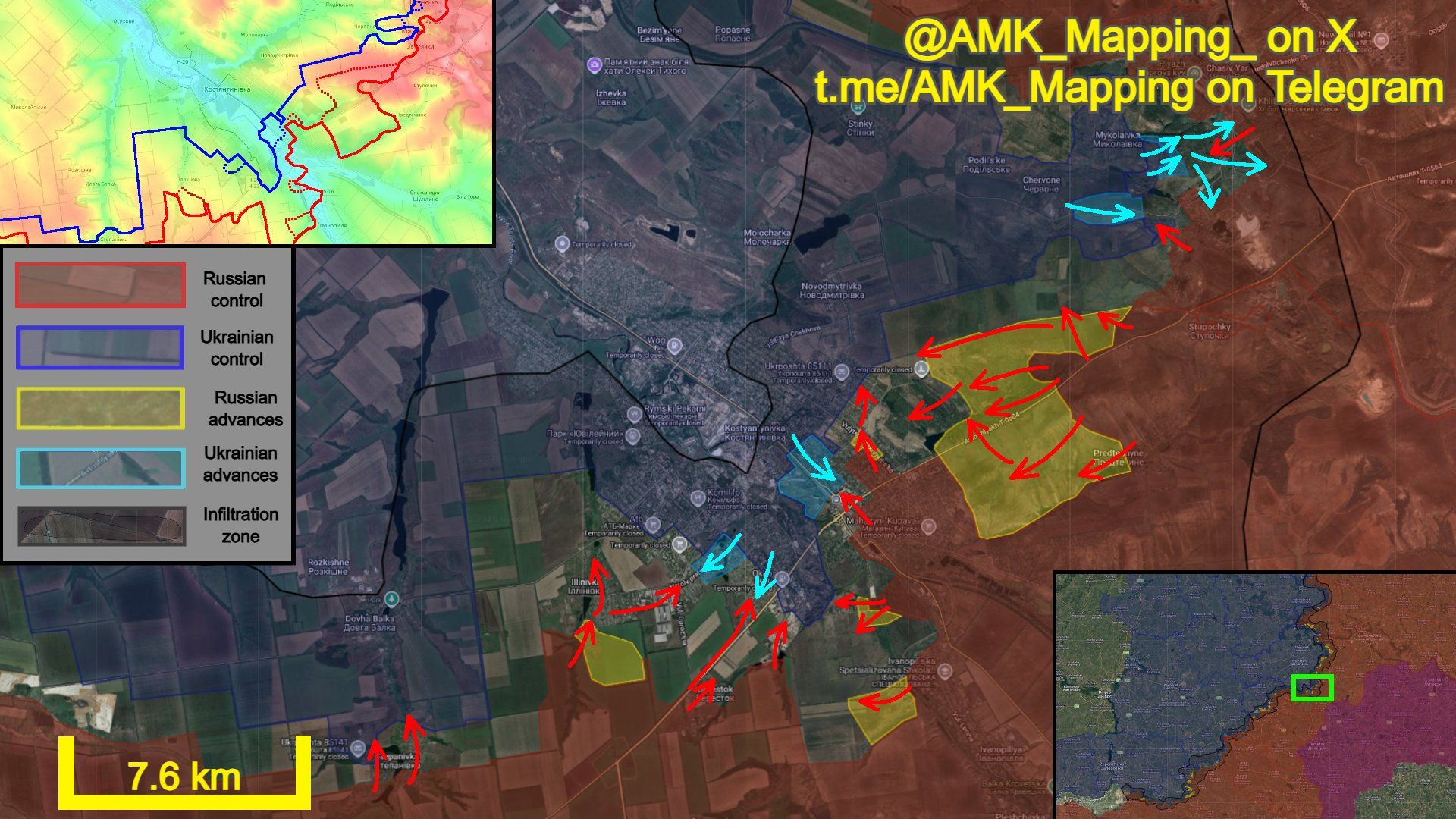
In the Kostyantynivka direction, both Ukrainian and Russian forces have made gains amid extremely high casualties. Ukrainian troops pushed deeper into southwestern Chasiv Yar, expanding control and reaching the city centre, while also advancing toward the Siverskyi Donets Canal. Russian forces, relying heavily on FPV drones and artillery, recaptured parts of Predtechyne and advanced along key heights toward Kostyantynivka. Fighting is ongoing across multiple districts, including near the railway station. The battles remain fluid, with large grey zones forming. Logistics are critical, with both sides facing disruptions from flooding, drones, and contested supply routes, slowing overall progress.
My comment:
Ukrainian resistance on the Chasiv Yar flank is significantly slowing Russian attempts to advance on Kostyantynivka. Russian units have made limited progress here and, in some areas, have been pushed back. As a result, they are focusing on previously identified weak points, which Ukrainian forces are already defending. However, Russia is increasing the use of airstrikes to suppress Ukrainian positions and enable gradual expansion. At the same time, intensive drone activity is disrupting Ukrainian logistics, making resupply into the city increasingly difficult and placing additional pressure on defending forces.
IRAN-USA/ISRAEL CONFLICT
Israel’s Defence Minister Israel Katz has warned that “significant surprises” are expected across all arenas, signalling a further escalation of the conflict. Developments over the past hours suggest that phase may already be underway.
In Iran, Israeli officials claim the killing of Intelligence Minister Esmaeil Khatib in overnight strikes on northern Tehran. Additional strikes have reportedly targeted Basij checkpoints in the capital (a key internal security force used to suppress dissent) as Israeli messaging increasingly calls for internal pressure against the regime. Claims have also emerged that the killing of Ali Larijani was enabled by intelligence from Tehran residents; however, this remains unverified and should be treated with caution.
On the Lebanon front, Israel has issued evacuation warnings for areas south of the Litani River, stating it intends to destroy all crossings linking southern Lebanon to the north. If executed, this would effectively isolate Hezbollah-controlled areas and significantly disrupt logistics and movement.
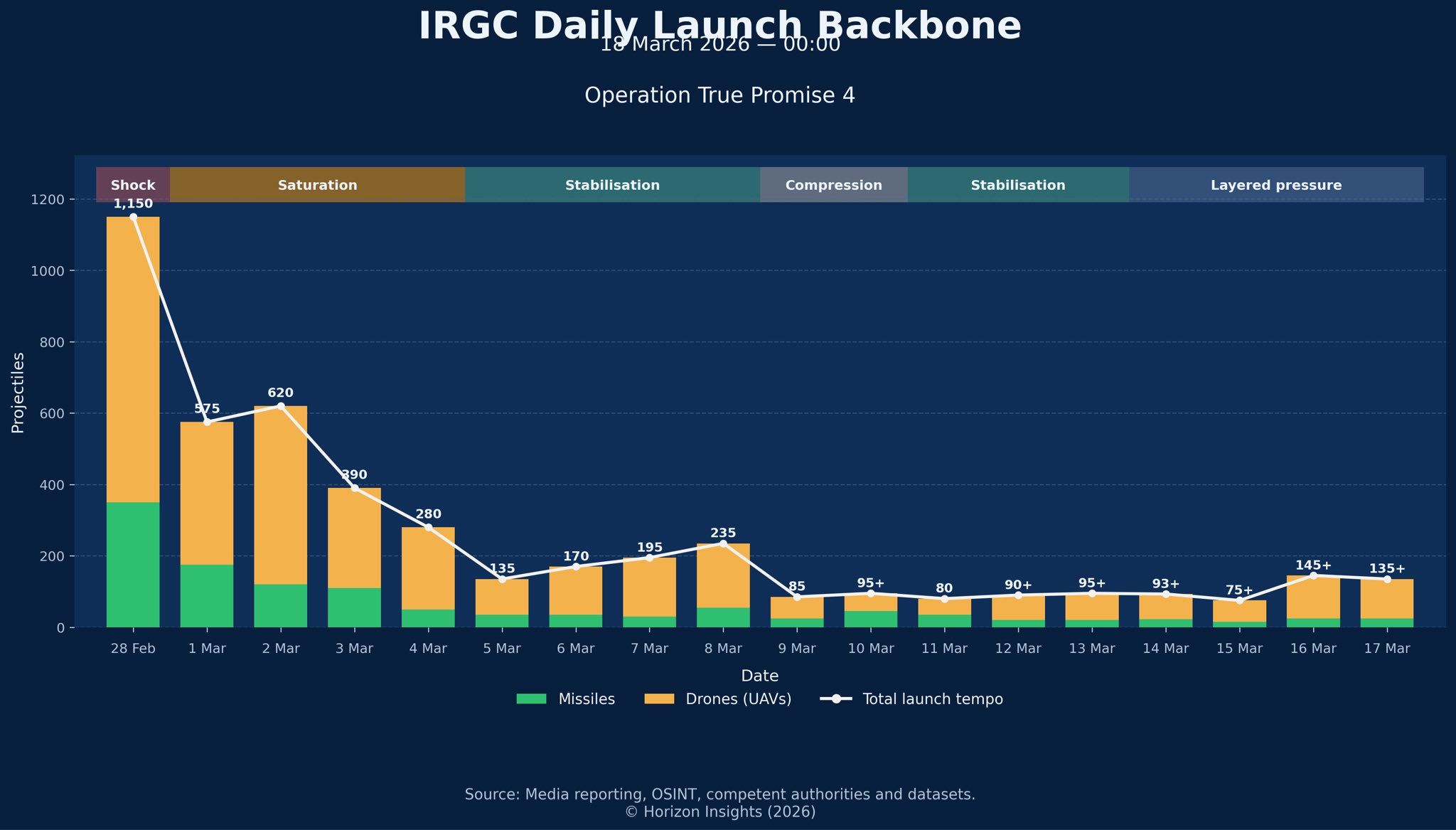
Meanwhile, Iran has launched Wave 62 of Operation True Promise 4, deploying a mix of ballistic missiles (including Ghadr, Kheibar Shekan, Emad, and the Haj Qassem) alongside kamikaze drones. Targets span across Israel, including Acre, Haifa, Tel Aviv, and Beersheba, as well as multiple U.S. bases across the region such as Al-Udeid, Al-Dhafra, and Camp Arifjan.
Notably, the Haj Qassem missile was used for the first time yesterday, likely indicating Iranian confidence that U.S.–Israeli air defence systems have been sufficiently degraded to allow more advanced systems to be deployed.
As I said in the podcast, week three and week four will give us the most information about how this war is going. The first two weeks were essentially when the conflict was still in its infancy, meaning patterns could not be tracked and such forth. But now we’re seeing a consistent missile launch salvo, and somewhat consistent drone launch. Missiles are sitting around 25 daily — drones have bounced back which is interesting.
Source: @IbrahimJalalYE via X
Sources available upon request
TODAY IN HISTORY
(March 18, 1662): Blaise Pascal's transit service begins running in Paris
On this day in 1662, Blaise Pascal's public transit system began operating in Paris. It involved horse-drawn carriages that would transport people around the city; they would charge a small fee and arrive at “stops” at fixed intervals. The coaches ran across five different routes, and each one seated eight passengers. Though Pascal's service was popular with wealthier Parisians, many residents could not afford the fares, leading to carriages being vandalized. The service officially shut down in 1667—it had been ahead of its time, but pickpockets and overcrowding contributed to its demise.