- Basedment
- Posts
- Macron Warns Zelensky About U.S.
Macron Warns Zelensky About U.S.
Today’s Spiegel leak exposes the deepest rift yet between Europe and the U.S. over the Ukraine peace process, revealing Macron and Merz warning Zelensky that Washington may trade away Ukrainian territory for a quick deal.

Editor-in-Chief
December 06, 2025
THE BRIEFING
Here’s what’s happening in geopolitics today.
It’s another busy day on the geopolitical chessboard, from U.S. military strikes in the Caribbean to Washington green-lighting Australia’s nuclear-submarine future under AUKUS.
Putin is in New Delhi promising uninterrupted fuel supplies, Xi is giving Macron a rare VIP tour of Chengdu, and Norway is quietly bulking up its submarine and missile arsenal.
On today’s Deep Dive, we break down the explosive Merz–Macron leak — a moment that lays bare Europe’s fear that the U.S. could trade Ukrainian territory for a fast peace, fracturing Western unity at the worst possible time.
THE LAST 24 HOURS IN GEOPOLITICS
1. U.S. Military kills four in latest strike on boat in the Caribbean
The United States military confirmed a strike that killed four people aboard a boat in the Caribbean, describing the vessel as an alleged narcotics-smuggling craft. The attack is the latest in a series of operations under what the U.S. calls its anti-drug campaign, with officials saying the boat was traveling along a known smuggling route.
read more
2. Pentagon confirms it’s moving ahead with AUKUS nuclear submarine deal
The United States Department of Defense has officially confirmed the 10-month review of the AUKUS nuclear-submarine pact is complete and backed the agreement, clearing the way for the sale and future deployment of U.S. nuclear submarines to Australia. Pentagon officials said the review identified opportunities to strengthen the pact’s structure and push it forward on “the strongest possible footing,” aligning it with current U.S. defence strategy. Australia’s Defence Minister confirmed receipt of the review and described the decision as a green-light for the deal, clearing major uncertainty and signalling a renewed push to build its future nuclear-powered submarine capability under AUKUS.
read more
3. Putin pledges ‘uninterrupted’ fuel shipment to India amid U.S. sanctions
Putin pledged that Russia will continue to provide “uninterrupted shipments” of fuel to India, reaffirming Moscow’s role as a steady energy supplier despite mounting U.S. sanctions pressure. The commitment was made during a summit in New Delhi with Indian leader Narendra Modi, where both countries signed a broad economic cooperation program aimed at boosting trade through 2030 and deepening ties across energy, defence, and industry.
read more
4. China’s Xi joins France’s Macron on rare trip with a global leader
Xi Jinping joined Emmanuel Macron on a rare trip to southwestern China’s Chengdu, a gesture rarely made by a Chinese leader walking outside the capital to accompany a foreign head of state. Their visit comes as the two countries signed 12 cooperation agreements covering areas including nuclear energy, demographic ageing, and panda conservation, as Beijing and Paris seek to deepen their strategic partnership.
read more
5. Norway to buy two more submarines, long-range missiles
The Norwegian government has approved a plan to purchase two additional German-made submarines, increasing its total submarine fleet to six. Alongside the submarine deal, Norway will also acquire long-range missiles capable of striking targets up to 500 km away, boosting its deterrence and strike capabilities. The expanded procurement reflects growing concern over regional security and aims to strengthen Norway’s ability to monitor and respond to potential threats in the North Atlantic.
read more
DAILY DEEP DIVE
THE EU LEAKED CALL
Context
A confidential European leaders’ call — reported by Germany’s Spiegel — reveals deepening distrust inside the Western alliance as Washington pushes ahead with its fast-tracked Ukraine peace plan. According to the transcript, French President Emmanuel Macron and German Chancellor Friedrich Merz both warned President Volodymyr Zelensky that the United States may sacrifice Ukraine’s core interests in its rush to secure a deal with Moscow.
Macron’s language was unusually blunt. He reportedly told Zelensky there was a real possibility the U.S. might “betray Ukraine on territory” without providing concrete, enforceable security guarantees. The concern is simple: Washington is driving the negotiations, but Zelensky may be pressured to accept a deal that trades land for a ceasefire with only vague assurances that Russia will not return.
Merz reinforced the warning, cautioning Zelensky that U.S. envoys are “playing games” and urging him to be “very careful” in the coming days. His point reflects a broader worry in Europe, that the Trump administration’s peace track is being shaped behind closed doors by advisers like Steve Witkoff and Jared Kushner, with Europe largely sidelined.
The call took place on Monday, just 24 hours before Witkoff and Kushner sat down with Vladimir Putin in the Kremlin, a five-hour meeting that produced no breakthrough. European officials have already been uneasy about the original 28-point U.S. plan, which was leaked in November and widely seen as skewed toward Russia’s maximalist demands. Although the document has since been revised in Geneva, the level of U.S.–Russia backchanneling has alarmed European capitals.
What’s funny is that if Kirill Dmitriev did leak the original document, this kind of infighting is exactly what he would have been hoping for. President Trump already has a strained relationship with parts of the EU camp, and with figures like JD Vance and Witkoff doing little to smooth diplomatic waters, tension was inevitable. Once the gears started turning and Ukraine sat down with the U.S. delegation, European leaders were always going to scramble. And to their defence, several elements of the 28-point plan required EU involvement — involvement they were never informed about. From their perspective, Washington appeared to be negotiating commitments on Europe’s behalf without consultation. If Dmitriev’s intention was to sow distrust between the U.S., Europe, and Ukraine, the fallout from the leak ( mixed messaging, political panic, and competing narratives ) is almost exactly the scenario Moscow would have wanted.
We then have to consider this Spiegel leak, like I have said multiple times, this is an information war. Leaks are weapons, someone has leaked this information for a reason. Leaking the Merz–Macron call would serve one core purpose: to fracture the Western negotiating front at a critical moment. By exposing two of Europe’s most influential leaders openly warning Zelensky that Washington might “betray” Ukraine, the leak fuels mistrust between Kyiv, Brussels and Washington. It paints the U.S. team as unreliable, undermines confidence in the Trump administration’s intentions, and pressures Ukraine to doubt American guarantees. At the same time, it sows friction inside the EU by revealing private doubts about U.S. motives. Whether leaked by a foreign intelligence service or an internal actor, the strategic effect is the same: division weakens the West’s leverage in any peace settlement.
Sources:
News/Journal sources available upon request, not shown to maintain visual integrity of page.
TODAY IN HISTORY
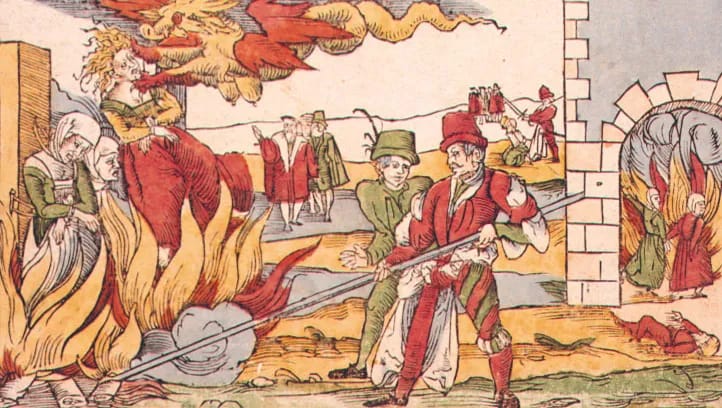
(December 5, 1484): Witchcraft condemned by Pope Innocent VIII
Innocent VIII condemned witchcraft this day in 1484 via papal bull, and subsequently he dispatched inquisitors to Germany to try witches and persecuted a chief exponent of Renaissance Platonism, Giovanni Pico della Mirandola.