- Basedment
- Posts
- Military drills in the Pacific & Epstein saga continues
Military drills in the Pacific & Epstein saga continues
Your daily dose of geopolitical updates and strategic analysis. Unbiased, but not unbased.

Editor-in-Chief
July 20, 2025
THE BRIEFING
Here’s what’s happening in geopolitics today.
A sweeping mix of diplomacy, legal battles, and shifting global alliances defined the overnight headlines. From Trump’s $10 billion lawsuit over Epstein reporting to renewed peace talks in the Congo and fresh military aid flowing into Ukraine, the geopolitical chessboard is in motion.
Meanwhile, Canberra steps up its global presence with tank deliveries to Kyiv and fresh sanctions on Moscow, as Pakistan makes a strong trade pitch in Washington.
Another year, another major multinational military exercise in Northern Australia, Operation Talisman Sabre. Over 40,000 troops, new systems, and evolving tactics, all under the watchful eye of China. We break down the strategic significance of this high-stakes drill.
THE LAST 24 HOURS IN GEOPOLITICS
1. Trump sues Wall Street Journal over Epstein report
Trump has filed a $10 billion defamation lawsuit against The Wall Street Journal and its parent companies, including Rupert Murdoch’s News Corp, over a report alleging he sent Jeffrey Epstein a sexually suggestive letter and drawing in a 2003 birthday tribute. Trump denies the allegations as “false, malicious and defamatory,” asserting the paper acted with “actual malice,” and has called for the unsealing of grand jury transcripts to address broader Epstein-related concerns.
read more
2. Congo, M23 rebels to sign declaration of principles to end fighting
Congo and M23 rebels are set to formalise a declaration of principles in Doha, aiming to end months of brutal conflict in eastern DRC under strong U.S. pressure. The declaration includes commitments to an immediate ceasefire, launching formal negotiations on a peace agreement, and reestablishing state authority, though sensitive issues like detainee releases and bank operations remain unresolved. The move follows a landmark Washington peace deal between the DRC and Rwanda in June, but experts warn that the M23’s absence from that accord and lingering support from Kigali could pose significant barriers to a lasting resolution.
read more
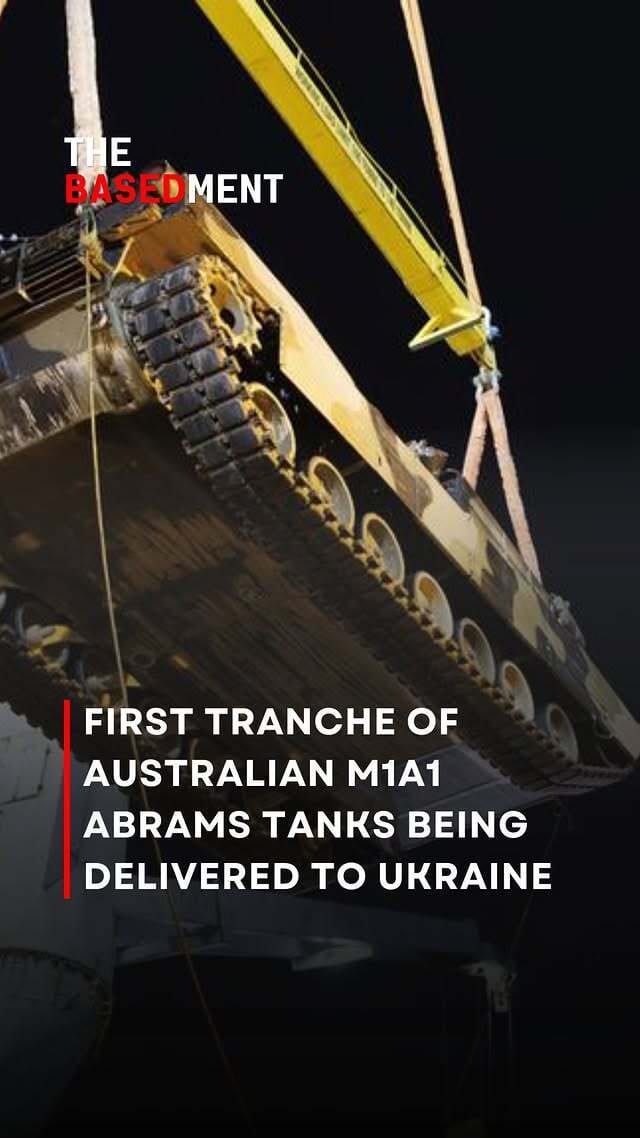
3. Australia delivers Abrams tanks to Ukraine
Australia has delivered the majority of its pledged 49 M1A1 Abrams tanks to Ukraine, part of a US$160 million military aid package included in a broader A$1.5 billion support effort, as confirmed by Defence Minister Richard Marles. These decommissioned but upgraded tanks will bolster Kyiv’s armoured forces amid escalating Russian aggression. Canberra also extended sanctions to around 1,000 Russian individuals and banned alumina and aluminium ore exports to reinforce its stance against Moscow.
read more

4. Pakistan’s Finance Minister in US to push for trade deal
Pakistan’s Finance Minister has embarked on a mission in Washington to finalise a bilateral trade deal with the United States, aiming to ease the steep 29% tariffs imposed on his country’s exports. In meetings with US Commerce Secretary Howard Lutnick and Trade Representative Jamieson Greer, both sides expressed satisfaction with the productive progress, with technical discussions expected to conclude in the coming week. Key negotiation points include reducing reciprocal tariffs, importing more U.S. goods such as crude oil, and opening Pakistan’s mining sector to American investors, as part of a broader strategy to rebalance and expand their economic relationship.
read more
5. UK joins EU push to hit Russia by cutting crude oil price cap
Russia and the EU, with support from the UK, have agreed to implement a tighter oil price cap on Russian crude, setting it 15% below current market rates, designed to curb Moscow’s revenues funding its war in Ukraine. The sanctions package also targets Russia’s “shadow fleet” operations and bans transactions with banks and pipelines linked to Moscow’s energy sector.
read more
DAILY DEEP DIVE
Operation Talisman Sabre heats up the Indo-Pacific region
Talisman Sabre is again well underway, first beginning in 2005 as a US–Australia bilateral exercise, but now includes 19 participating countries, 40,000 personnel, including 15,000 US troops. Held from 13–27 July, the exercise spans 80+ Australian training areas and bases across northern Australia, including 7 live-fire events. The total area of the exercises spans 5,300km east to west. And, for the first time, drills on Papua New Guinean soil.
Participating Nations
Returning countries: Australia, US, Canada, Fiji, France, Germany, Indonesia, Japan, New Zealand, Papua New Guinea, Philippines, South Korea, Tonga, UK.
New participants: India, Singapore, Thailand, Netherlands, Norway.
Observers: Malaysia and Vietnam.
Key note: The inclusion of new participants is a public address to the widening inclusion of geopolitical allies in the Indo-Pacific, ranging from NATO members in Europe, economic powerhouses like Singapore, and Chinese rivals like India and (complicated) Vietnam. This is a clear sign of deepening strategic alignment and military coordination, and a public signal to China.
New Learning
A noticeable difference this year is the many “firsts” planned during the operation: over 79 new weapons, tactics, and systems are being tested.
Notably, Australia conducted its first live firing of the HIMARS system, alongside Singapore and the US. HIMARS has gained global recognition due to its successful use by Ukraine for deep strikes against Russian-controlled areas both in Russia and Russian occupied territory in Ukraine.
Another significant milestone was the first live firing of the US Typhon missile system outside the continental United States. The system, also provided to the Philippines (though not yet fired there), represents a counterweight to China’s growing naval expansion and can deploy both SM-6 and Tomahawk missiles.
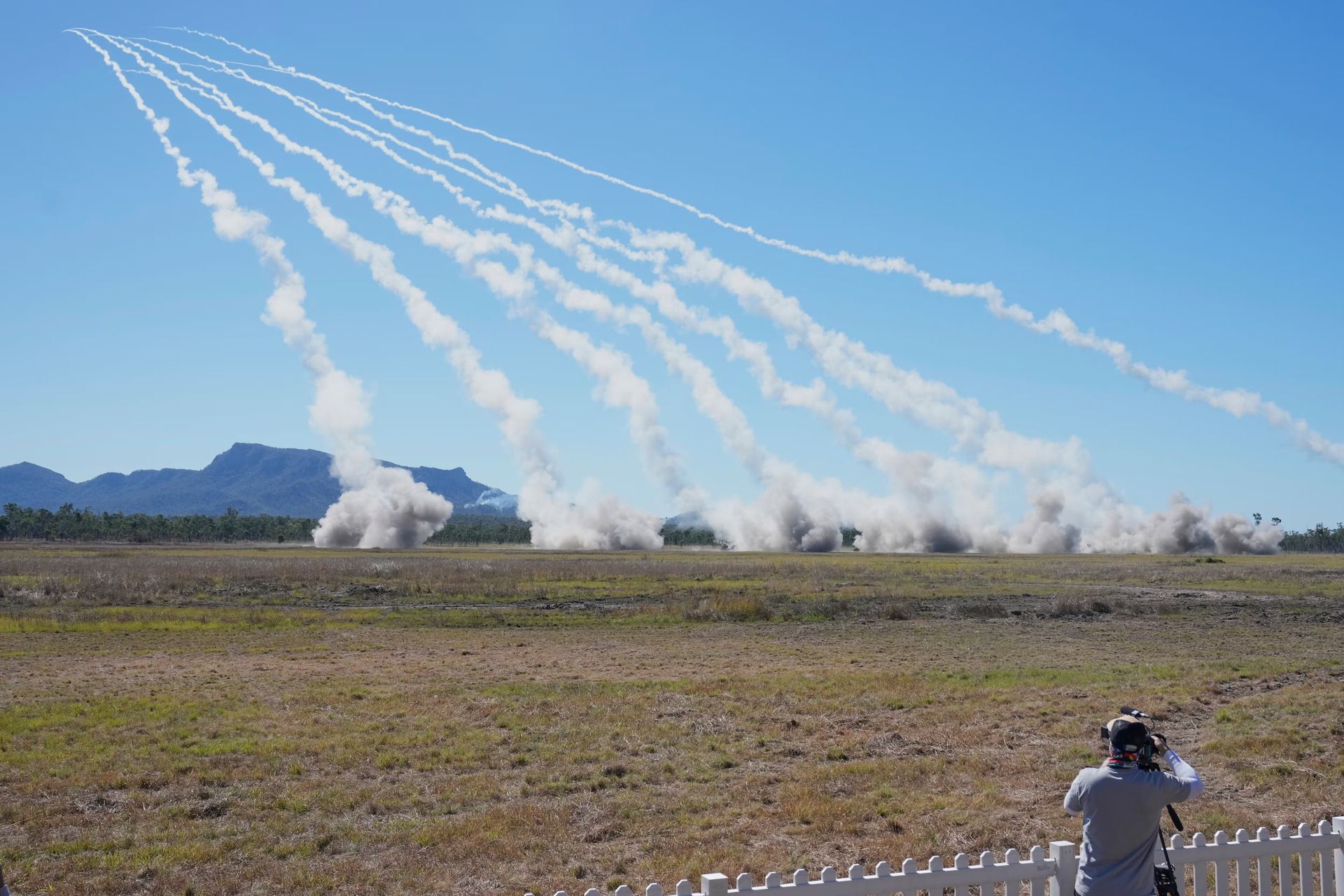
HIMARS firing in Northern Australia
Beyond weapons testing, there was significant technological and tactical experimentation:
For the first time, classified-level integration of force-on-force systems between the US and Australia was achieved, creating a shared operating picture across both nations.
At a wider operational level, divisional-plus ground operations were conducted within a corps framework.
Amphibious landings were executed by Australia, Japan, South Korea, and the US Marine Corps.
Special forces coordination has also played a prominent and expanded role.
Objectives
The core operational objectives of Talisman Sabre 2025 are:
Increase interoperability of military systems and technologies across allied forces.
Enhance operational coordination of land, sea, and air forces, with an emphasis on rapid crisis response. This is a crucial aspect as it will directly relate to any conflict with Taiwan. Rapid response will be crucial in any defence of the Island nation. Furthermore, much like WW2, there will be an emphasis on Island hopping in any (key word) conventional conflict with China.
Send a political deterrence signal to China through the scale, scope, and multinational unity of the exercise.
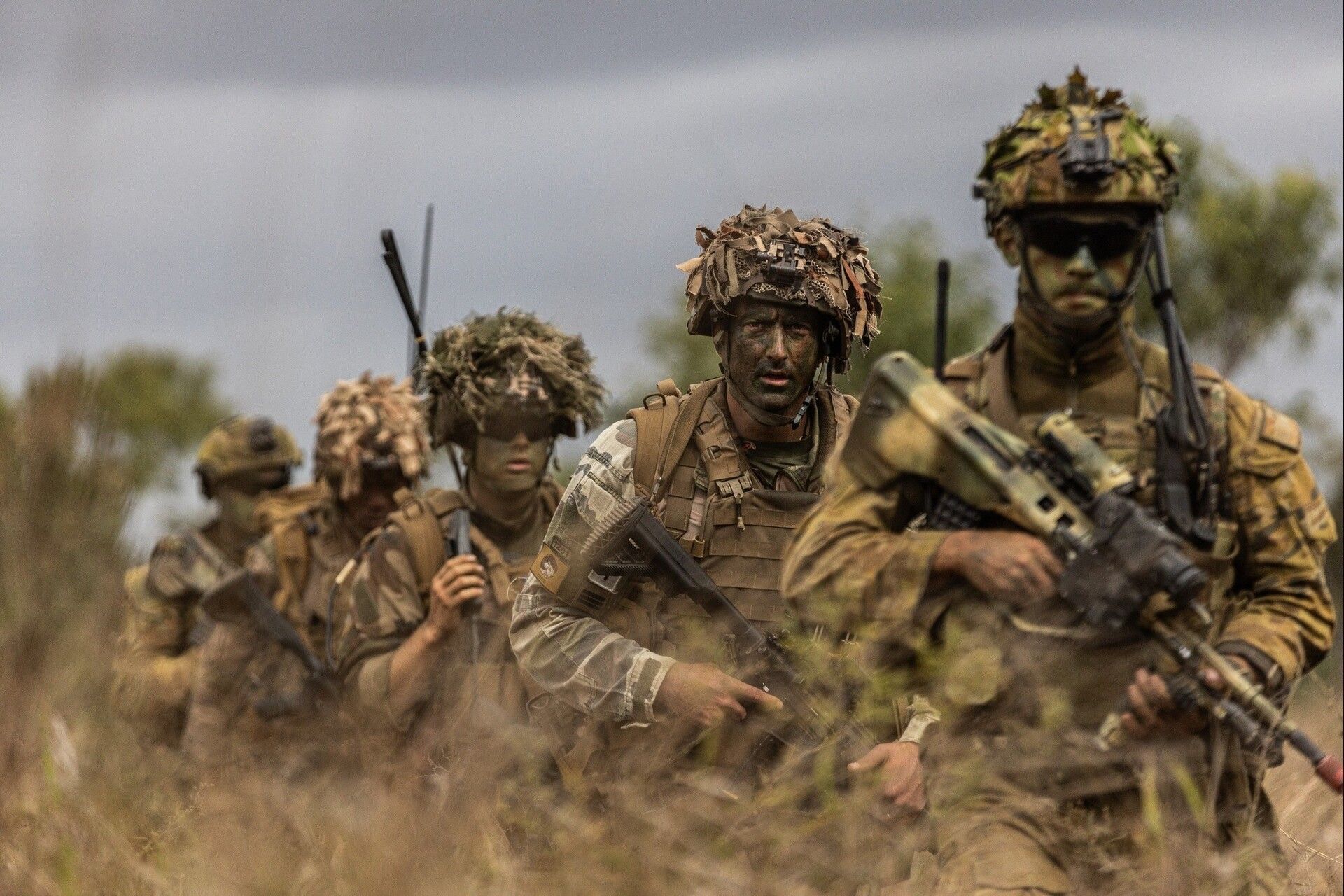
Australian participating in drills.
Chinese Expansion
China continues to increase its regional and global naval assertiveness:
Docked warships at Cambodia’s Ream Naval Base (2024).
Conducted drills in the Gulf of Tonkin near Vietnam.
Alongside Russia, it breached Japanese waters and airspace in late 2024.
Regional military spending rose 6.3% in 2024, totalling US$629 billion.
The People’s Liberation Army Navy (PLA-N) is the fastest-growing navy in the world, projected to:
Surpass the US Navy by 2035.
Reach 430 ships, including 270 blue-water capable vessels.
Note: There is debate on the definition of the “largest Navy”. Primarily due to the fact it is recorded on total tonnage of the Navy. China currently includes many non-traditional ships as part of its Navy thus inflating the number. But this stat is more tailored toward the fact that one of China’s clear goals is to expand its Navy significantly.
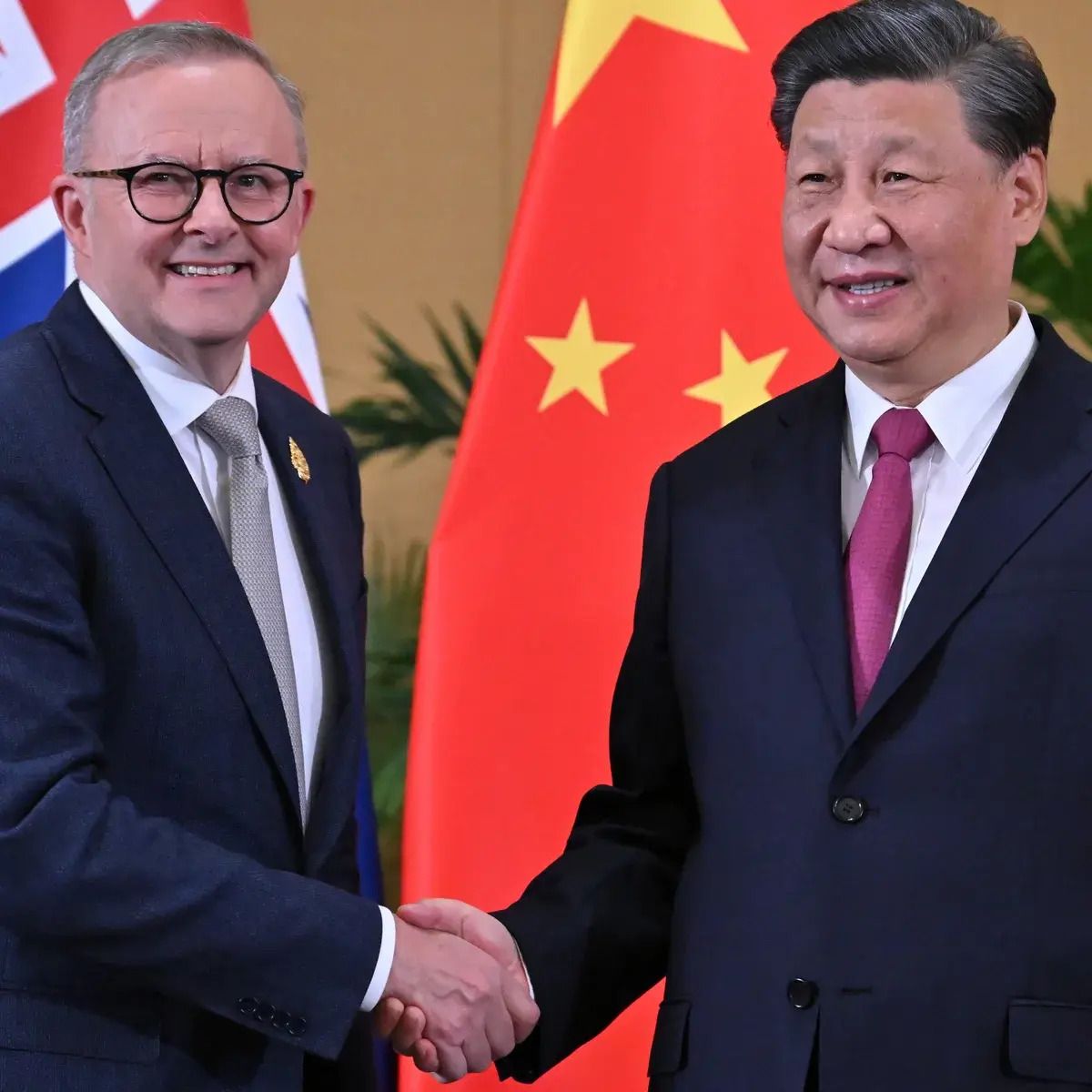
Chinese surveillance ships have also monitored Talisman Sabre drills in previous years. The current exercise coincides with Prime Minister Albanese’s visit to China, where he is scheduled to meet President Xi Jinping for the fourth time. Albanese dismissed concerns about Chinese surveillance, stating it is routine and expected, and clarified he would not raise the issue during his meeting with Xi.
Political Clashes
While this large-scale military coordination occurs across the Indo-Pacific, US foreign policy under President Trump remains a source of strategic uncertainty. Allies face complicated and shifting bilateral relations with the United States. Many participating nations have experienced diplomatic friction with Washington—particularly over Trump’s tariff policies and defence spending demands. For example, Japan cancelled a meeting amid a dispute over increased defence spending, highlighting tensions even among core allies.
TWEET OF THE DAY
Male college grads are now just as likely to be unemployed as people who never went to college
Same is not true for women, who are much more likely to land a job once they graduate college
The data is just eye opening. We are leaving young men behind like never before
— Boring_Business (@BoringBiz_)
10:39 PM • Jul 18, 2025
TODAY IN HISTORY
(July 19, 1848): The Seneca Falls Convention marked the official launch of the women's suffrage movement in the United States. The gathering demanded equal rights for women, with a central focus on the right to vote.