- Basedment
- Posts
- New Information On Ukrainian Gains As Attacks Spread On More Fronts
New Information On Ukrainian Gains As Attacks Spread On More Fronts
Today we examine a wide range of different voices to get a better picture on these Ukrainian counterattacks, as they begin to expand across other fronts.

Editor-in-Chief
February 16, 2026
THE BRIEFING
Here’s what’s happening in geopolitics today.
Today’s top five move from negotiation tables to potential battle lines. Tehran is dangling energy, mining and aircraft deals in renewed talks with Washington, Myanmar has expelled Timor-Leste’s envoy over a war crimes complaint, and Indonesia is preparing troops for a possible Gaza peacekeeping force.
The Pentagon has airlifted a micro nuclear reactor for the first time, and Marco Rubio’s Munich speech sought to steady transatlantic nerves.
In today’s deep dive, we examine a wide range of different voices to get a better picture on these Ukrainian counterattacks, as they begin to expand across other fronts.
WORD FROM TODAY’S SPONSOR
Ready to Plan Your Retirement?

Knowing when to retire starts with understanding your goals. When to Retire: A Quick and Easy Planning Guide can help you define your objectives, how long you’ll need your money to last and your financial needs. If you have $1 million or more, download it now.
THE LAST 24 HOURS IN GEOPOLITICS
1. Iran says potential energy, mining and aircraft deals on table in talks with US
Iranian officials say that in ongoing negotiations with the United States over their long-standing nuclear dispute, potential energy, mining and aircraft deals have been discussed as part of efforts to secure mutual economic benefits, with Tehran emphasizing areas like oil and gas fields, mining investments and aircraft purchases. The comments came ahead of a second round of talks in Geneva, where negotiations are focused on resolving the decades-long dispute and averting military confrontation, even as the U.S. has bolstered its military presence in the region.
read more
2. Myanmar expels Timorese envoy over Junta war crimes complaint
Myanmar’s military junta has ordered the top diplomat from Timor-Leste to leave the country within seven days after Dili’s judiciary accepted a war crimes and crimes-against-humanity case filed by the Chin Human Rights Organization (CHRO) against the Myanmar armed forces under universal jurisdiction. The junta condemned Timor-Leste’s decision to appoint a senior prosecutor to examine the complaint as a breach of Association of Southeast Asian Nations (ASEAN) principles on sovereignty and non-interference, escalating tensions between the two member states.
read more
3. Marco Rubio says US and Europe ‘belong together’ despite tensions
Marco Rubio used his address at the Munich Security Conference to stress that the United States and Europe’s futures are “intertwined” and that Washington does not intend to walk away from the transatlantic partnership, saying the two “belong together” despite recent strains. He offered a more conciliatory tone than some previous U.S. officials, highlighting shared historical and cultural bonds and urging a revitalised alliance, even as he also critiqued some European policies. European leaders welcomed the reassurance but continue to press for stronger, more autonomous defence and cooperation.
read more
4. US Military airlifts micro nuclear reactor for the first time
The U.S. Departments of Energy and Defense this week completed the first air transport of a micro nuclear reactor, flying an unfueled Valar Atomics Ward microreactor on a C-17 Globemaster III from March Air Reserve Base in California to Hill Air Force Base in Utah. The mission, part of efforts to demonstrate how small, portable nuclear power could be rapidly deployed for military and civilian energy needs, was hailed by officials on board the flight as a breakthrough in logistics and advanced energy capability. The reactor is roughly van-sized and will be tested at the Utah San Rafael Energy Lab.
read more
5. Indonesia readies 1,000 troops for potential peacekeeping force in Gaza in early April
Indonesia’s military has announced it is preparing about 1,000 troops to be ready for possible deployment to Gaza by early April 2026 as part of a proposed multinational peacekeeping force linked to the US-backed post-war reconstruction initiative, with up to 8,000 soldiers expected to be ready by June if approved by Jakarta. The planned mission, which still requires final political and international decisions, is intended to be humanitarian and stabilisation-focused, not combat-oriented, emphasising civilian protection, medical support and reconstruction efforts.
read more
DAILY DEEP DIVE
New Information On Ukrainian Adances
Wider Context
Over the past week, Ukrainian forces have conducted a coordinated series of tactical counterattacks along the Pokrovske–Huliaipole axis, and the consensus across ISW, Ukrainian military observers, and independent OSINT mappers is that Russian momentum has stalled. There has been a lot of confusion about the recent Ukrainian attacks. Ukrainian military units have held a very tight OPSEC surrounding this “operation” but have now begun to reveal some information.
Who is saying what?
The Institute for the Study of War (ISW), citing Ukrainian military observer Kostyantyn Mashovets, reports that Russian advances in the Oleksandrivka and Huliaipole directions began slowing around February 8 and have largely stopped. Mashovets assesses that Ukrainian forces have pushed Russian troops back up to 9–9.5 km in certain narrow sectors. However, he is explicit: this is not a large-scale counteroffensive. These are tactical counterattacks, not a Kharkiv 2022 scenario.
ISW agrees with that framing, distinguishing between operational-level counteroffensives and the localised tactical actions currently underway in Zaporizhzhia Oblast.
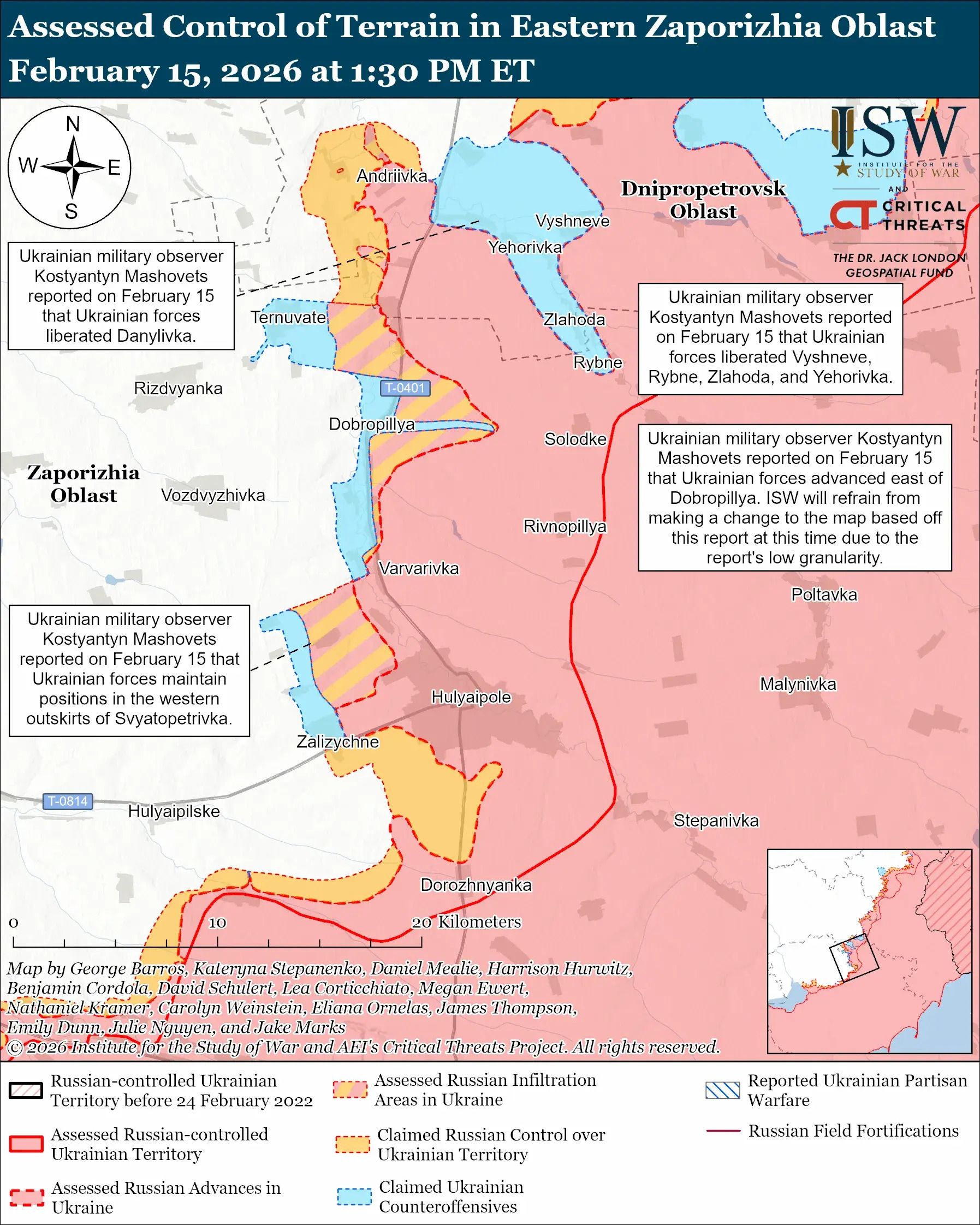
Meanwhile, AMK Mapping goes further on territorial gains. According to their battlefield assessment, Ukrainian forces have regained approximately 52.68 km², particularly in the Pokrovske direction. They detail the penetration southeast of Oleksiivka, the capture of Novooleksandrivka, crossings of tributaries of the Yanchur River near Vyshneve, and coordinated pressure around Verbove. AMK describes Russian withdrawals from multiple settlements — including Danylivka, Yehorivka, Kyrpychne, and Ostapivske — under threat of encirclement.
Spanish analyst Suriyak corroborates these movements, reporting Ukrainian recapture of Kosivtseve, infiltration into northern Dobropillya, and crossings of the Haichur River near Pryluky. He emphasizes that Ukrainian troops have established positions on the west bank before pushing eastward toward Dobropillya and Varvarivka, though consolidation remains incomplete.
Polish military commentator Thorkil presents the most structured interpretation. He argues that what Kyiv publicly labels “local counterattacks” is in reality a more coordinated operational effort launched around February 6. According to his analysis, two main axes are visible:
• Verbove–Novohryhoriwka–Uspeniwka
• Pryluky–Rivnopila
Thorkil assesses that the broader objective may be to pressure and potentially isolate elements of Russia’s 36th Combined Arms Army, attacking at the seam between Russian formations (29th, 36th, and 5th Armies). He also frames auxiliary pushes near Ternuvate, Vidradne, Vyshneve, and Berezove as fixing operations — designed to prevent Russian redeployments.
Other Fronts, And Our Assessment
It’s now publicly being confirmed by Ukrainian channels that these “clearing operations” (as Kyiv is framing them) have expanded beyond Zaporizhzhia and are now spreading into the Lyman and Slovyansk directions as well.
What is notable to me is not just the gains themselves, but the geography of where Ukraine is choosing to apply pressure.
Ukrainian forces are now actively attacking across three of the most obvious battle zones for the coming Spring–Summer campaign.
The first — and largest — has been the Pokrovske–Huliaipole axis, where at least for now the direct priority appears to be control of the Haichur and Yanchur river lines. These are natural defensive barriers. If Ukraine can consolidate along these river corridors, it complicates any renewed Russian push from the east. Rivers matter. Tributaries matter. Even shallow water lines become significant when layered with trenches, anti-vehicle obstacles, and artillery overwatch.
Next, clearing operations south of Zaporizhzhia have reportedly inflicted significant local setbacks on Russian forces, forcing them back several kilometres in some areas. This matters because a major battle for the Orikhiv–Zaporizhzhia direction remains highly likely. Pushing Russian units back here increases the buffer from Zaporizhzhia City and, more importantly in the near term, reduces the risk of Orikhiv’s western flank being outflanked or pressured prematurely.
The same logic applies further east.
On the Kostiantynivka axis, Ukrainian units are reportedly making incremental progress in and around the remnants of Chasiv Yar. Any eastern approach to Kostiantynivka becomes severely compromised if Russian forces cannot fully secure and consolidate Chasiv Yar. Without that anchor, staging a coherent push westward becomes significantly harder.
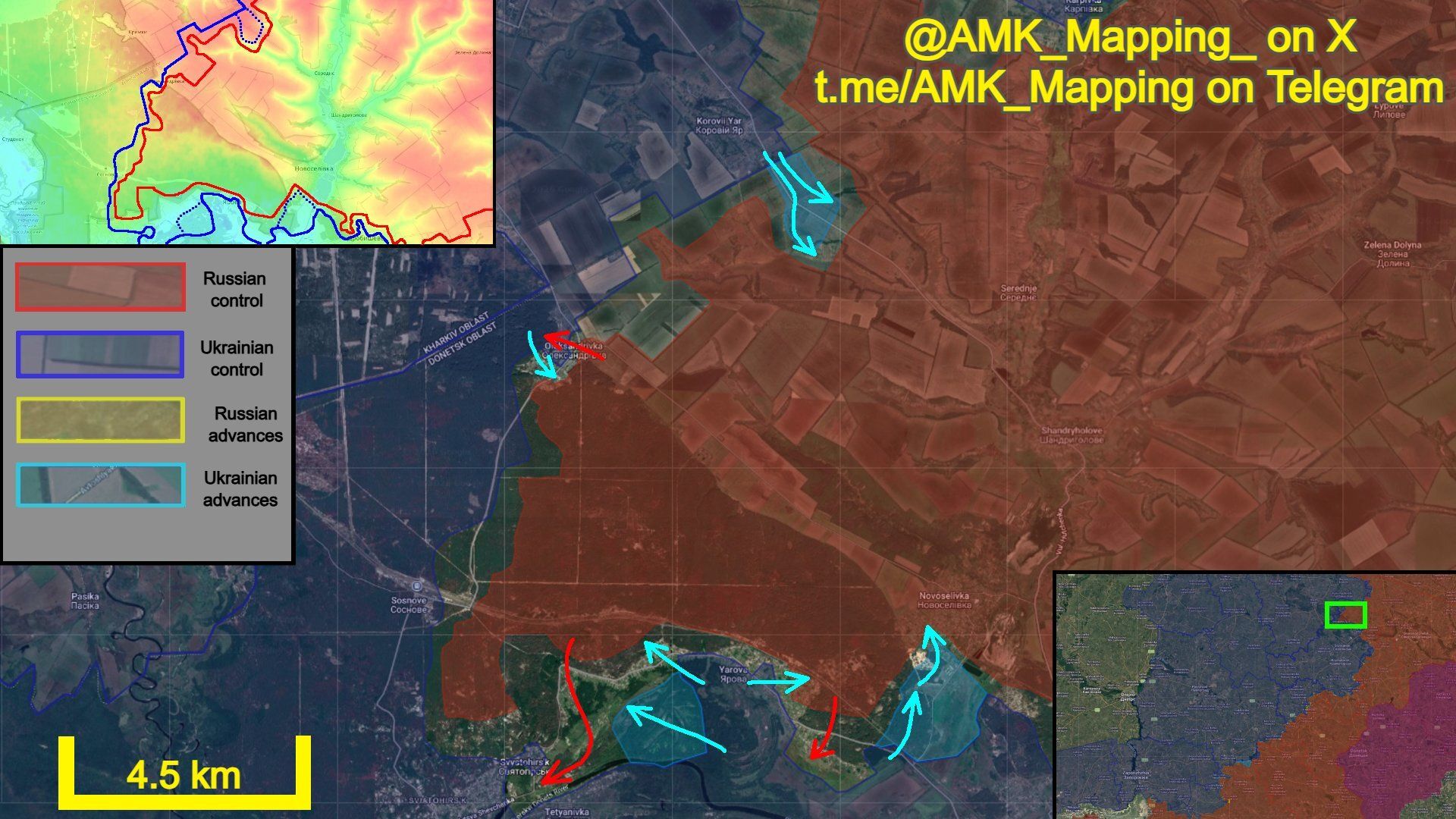
And finally, Sloviansk and Kramatorsk remain strategic prizes. They are political and operational objectives. Counterattacks along the Lyman front therefore make strategic sense. If Lyman were to fall decisively into Russian control, it would provide a much stronger springboard for larger-scale operations toward those cities. Disrupting that now (even through localized counterattacks) is preventative shaping.
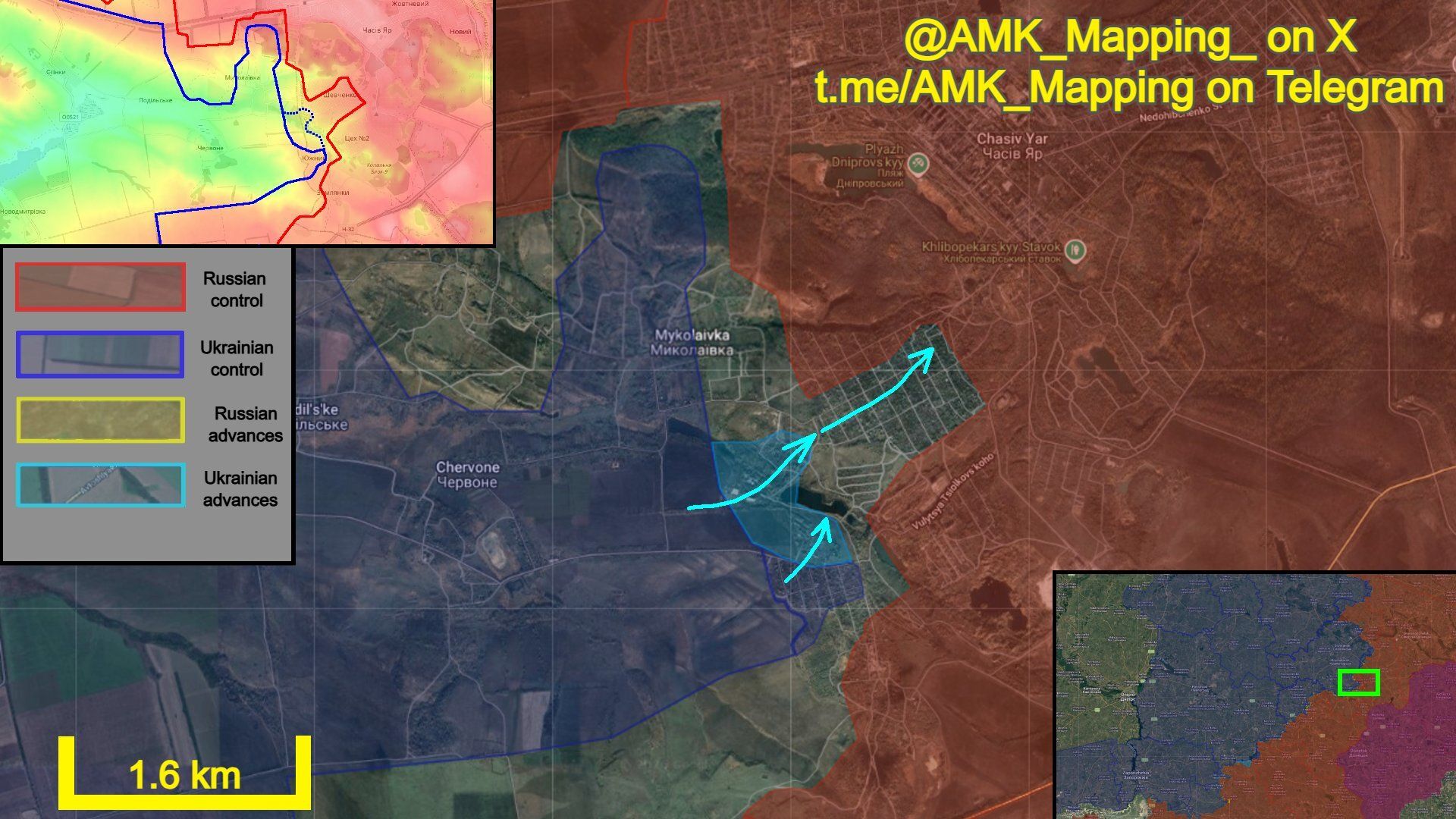
Overall, though, beyond the tactical map arrows, there is a more practical element at play. For every kilometre Russia is pushed back, Ukraine gains breathing space. Breathing space for engineers. Breathing space for fortifications. Breathing space to turn exposed open ground into layered defensive belts. The speed of Russia’s earlier advances (particularly on the Pokrovske–Huliaipole front) caught Ukrainian forces in vulnerable positions, often operating in open terrain with insufficient preparation.
Sources
News/Journal sources available upon request, not shown to maintain visual integrity of page.
TODAY IN HISTORY
(February 16, 1861): Abraham Lincoln meets a pen pal
On this day in 1861, as he was traveling to Washington, D.C., for his inauguration as president, Abraham Lincoln stopped at Westfield, New York. “I have a little correspondent in this place,” he called out, “and if she is present will she please come forward?” That pen pal, 12-year-old Grace Bedell, made herself known. Lincoln remembered Bedell because, in an 1860 letter to him, she suggested that he grow a beard. She thought it would help him win the presidency. Late in 1860, he did. And he won. No one can say whether Bedell was actually the cause of Lincoln's beard, but in Westfield he gave her the credit: “You see,” he said, pointing to his face, “I let these whiskers grow for you, Grace.”