- Basedment
- Posts
- New Russian airstrike tactics, Iran agrees to nuclear talks and more
New Russian airstrike tactics, Iran agrees to nuclear talks and more
Your daily dose of geopolitical updates and strategic analysis. Unbiased, but not unbased.

Editor-in-Chief
July 21, 2025
THE BRIEFING
Here’s what’s happening in geopolitics today.
Today’s briefing spans a world toying with both human tragedy and strategic recalibration. South Korea’s national security adviser travelled to Washington ahead of the August 1 tariff deadline. In the Middle East, calm has returned to Syria’s Sweida as tribal fighters withdraw, while Israeli fire killed dozens in Gaza. In Africa, Kenya arrested activist Boniface Mwangi over protest ties. Meanwhile, Iran has agreed in principle to nuclear talks with the UK, France, and Germany.
For today’s deep dive we explore Russia’s changing tactics since Operation Spider Web and the overall effectiveness of the operation thus far.
THE LAST 24 HOURS IN GEOPOLITICS
1. SK national security adviser heads to Washington
South Korea’s national security adviser Wi Sung-lac has travelled to Washington for further talks ahead of the United States’ August 1 tariff deadline. This follows President Trump’s threat to impose a 25 percent tariff on South Korean imports. Discussions are expected to focus on trade, security, and investment as Seoul seeks to avoid new economic penalties and maintain bilateral stability.
read more
2. Calm reported in Syria’s Sweida as tribal fighters withdraw
Residents reported calm in the Syrian city of Sweida on Sunday after the Islamist-led government declared that Bedouin fighters had withdrawn from the predominantly Druze city and the United States stepped up calls for an end to fighting. There was no sound of gunfire on Sunday morning, according to a resident speaking from the city outskirts, while a Druze source in the region said there was calm in most areas.
read more
3. At least 36 Palestinians killed by Israeli gunfire near aid site in Gaza on Saturday
At least 36 people were killed by Israeli fire in Gaza early Saturday morning as they were reportedly making their way to an aid distribution point in Khan Younis, according to Gaza’s Health Ministry and Nasser Hospital. Witnesses said Israeli tanks and drones opened fire on the crowd before any aid had been handed out, leaving nearly 100 others wounded. The Israeli military claims its troops fired warning shots after spotting what it described as suspicious individuals near the area, and says the incident is under review.
read more
4. Kenyan police arrest human rights activist after protests
Kenyan police have arrested prominent human rights activist Boniface Mwangi, accusing him of facilitating terrorist acts linked to last month’s deadly anti-government protests. He is also charged with unlawful possession of ammunition after police reportedly seized tear gas canisters and a blank round at his home. Mwangi’s arrest follows nationwide demonstrations over police brutality, corruption, and economic hardship. According to Kenya’s human rights commission, 19 people were killed on June 25 and 31 more on July 7.
read more
5. Tasnim reports Iran agrees to Nuclear talks with UK, France and Germany
Iran’s semi‑official Tasnim news agency reports that Tehran has reached an agreement in principle to hold upcoming talks with the United Kingdom, France, and Germany on its nuclear program, although details like timing and venue are still being finalised. This development comes amid mounting pressure from the E‑3, which have issued stern warnings that they could reinstate UN “snap‑back” sanctions by the end of August if meaningful progress isn’t made.
read more
DAILY DEEP DIVE
Operation Spider Web: Strategic Assessment So Far

Ukrainian Capability and PR Gains
This operation served as a significant public relations and morale victory for Ukraine. Unlike the 2023 counteroffensive or the Kursk border incursion, which were costly and yielded limited gains, Operation Spider Web delivered highly visible success. It coincided with President Zelensky’s European tour lobbying for long-range strike capabilities, giving Western leaders a real-world demonstration of what Ukraine could achieve with such tools. The strike generated global headlines and reinforced the narrative of a David versus Goliath struggle.
Loss of Equipment
Several Russian strategic aircraft were damaged or destroyed, including Tu-22 and Tu-95 bombers, though the exact count remains contested. The destruction of these expensive, long-range platforms was a psychological and material blow.
Janes: Destroyed 12 aircraft, damaged two, and possibly damaged eight others. Seven Tu-95MSs (‘Bear-H’), four Tu-22M3s (‘Backfire-C’), and one An-12 (‘Cub’) were destroyed. One Tu-22M3 and one Tu-95MS were confirmed damaged. Two A-50s (‘Mainstay’), five Tu-22M3s, and one Tu-95MS were possibly damaged.
Change in Strategy
Following the attacks, Russia accelerated the construction of reinforced hangars (already in motion prior to the strike, but significantly hastened in pace).
It is worth noting that online claims suggesting Russia was forced to keep bombers visible due to the START Nuclear treaty is incorrect. Russia formally suspended from START in 2023 and is no longer compliant. The lack of protective infrastructure was more a result of bureaucratic inertia and corruption.

Before and After
Morale
The strikes demonstrated that even Russia’s most secure airfields are vulnerable, particularly in its far eastern territories. While Russia framed the attacks as Western-orchestrated terrorism, domestic perception and military morale may have been impacted.
Russian Strategic Shift Since the Attack
Russia has moved to a deep-launch strategy. Strategic bombers such as the Tu-95 now take off from eastern airbases—including Ukrainka in Amur Oblast—and fly over 3,800 km across Russia before launching hypersonic missiles at Ukraine. This complicates early-warning systems and tracking methods, which previously relied on predictable launch windows and flight patterns.
Bonus Fact: Operation Spider Web targeted the Ukrainka air base but failed when the drone transport vehicle caught fire and exploded.
Russia has shifted from using open frequencies or simple radio maskers to encrypted comms. One example includes activation of a masker on combat frequency 4389 kHz ahead of Tu-95MS departures. This marks a deliberate effort to conceal operations and avoid radio-based detection.
Yes, it has taken the Russians years to do this.
Following Operation Spider Web, Russia introduced tighter border controls, especially on routes from Kazakhstan. Long queues now form at entry points critical for importing black-market electronics and dual-use components (vital for Russia’s military production) . These routes were also used by Ukrainian operatives and smugglers to bring in parts and materials for Operation Spider Web. Delays of hours or even days now strain Russian logistics and complicate illicit supply chains.
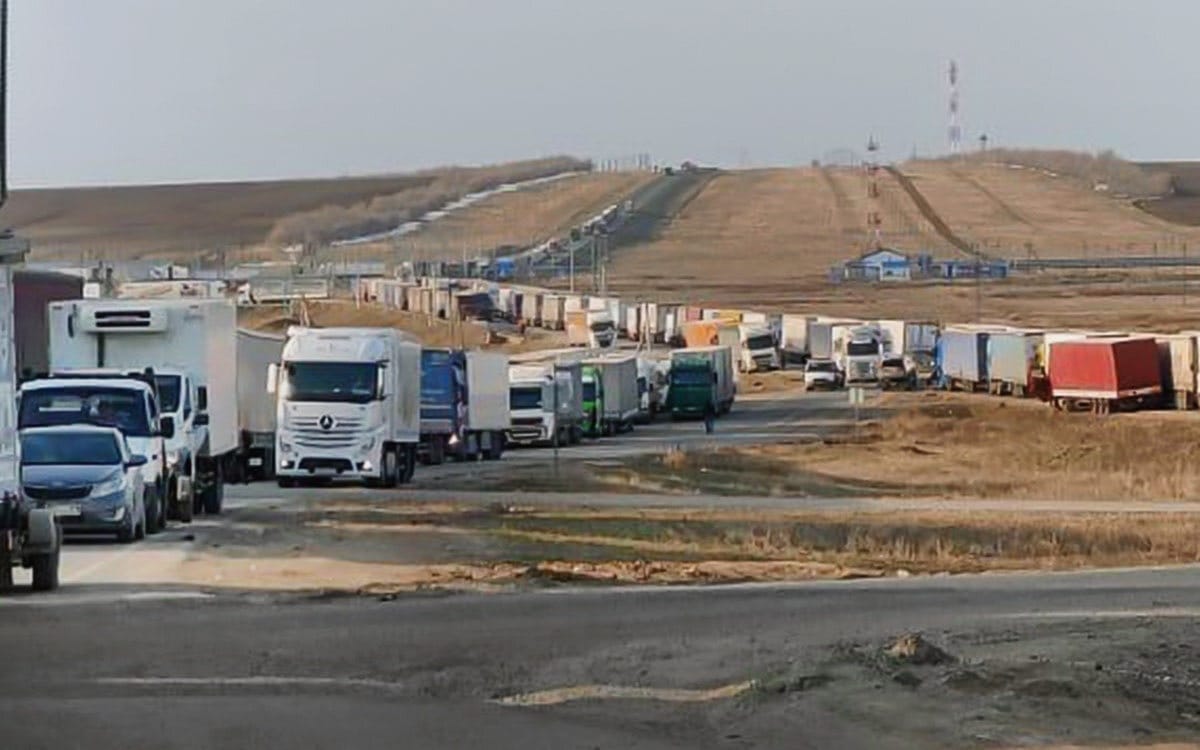
Russia and Kazakstan border
Outcome and Strategic Impact
Contrary to optimistic Western and pro-Ukrainian analysis, Operation Spider Web did not significantly degrade Russia’s overall airstrike capabilities. While it forced adaptations and inflicted material losses, Russia’s air campaign has intensified rather than slowed. Mainly due to a shift in doctrine, noted well before the Operation.
For example, Russia’s reliance on cruise missiles launched from the Black Sea has decreased due to Ukraine’s effective targeting of the Black Sea Fleet. In place of these launches,
Russia has ramped up its use of drones, particularly Shahed-136 and Geran-2. These form the bulk of nightly aerial assaults and are often followed by smaller volleys of ballistic, hypersonic and cruise missiles.
While there has been no direct impact (as of yet) by the operation on Russia’s air campaign, the other limitations placed on Russia are still considerable and may complicate matters more in the future.
Bonus: Strategic Takeaway for NATO
While the direct impact on Ukraine was limited specifically regarding Russia’s strike capabilities in Ukraine, the operation revealed vulnerabilities in one leg of Russia’s nuclear triad. This operation is arguably of more strategic value to NATO than to Ukraine, particularly in the event of future large-scale conflict with Russia.
Sources:
Janes. (2025, May 10). Operation Spiderweb: Ukraine’s covert drone strike inside Russia. Janes. https://www.janes.com/osint-insights/defence-and-national-security-analysis/post/operation-spiderweb-ukraine-covert-drone-strike-inside-russia
Reuters. (2025, June 4). Putin openly questions peace talks after blaming Ukraine for deadly bridge attack. Reuters. https://www.reuters.com/world/europe/putin-openly-questions-peace-talks-after-blaming-ukraine-deadly-bridge-attack-2025-06-04/
SU_57R. (2025, April 28). Russia shifting Tu-95 launch operations from Ukrainka with encrypted comms on 4389 kHz [Tweet]. X. https://x.com/SU_57R/status/1931836523022032987
Victoriaslog. (2025, May 27). Ukrainka air base targeted during Operation Spider Web – drone truck reportedly exploded before takeoff [Tweet]. X. https://x.com/victoriaslog/status/1945526073350889472
TWEET OF THE DAY
Russia alone builds more kamikaze drones than Ukraine and NATO combined.
— Gabe (@GabeZZOZZ)
11:36 AM • Jul 20, 2025
TODAY IN HISTORY
(July 20, 1969): On this day in 1969, the Eagle lunar landing module, carrying U.S. astronauts Neil Armstrong and Edwin (“Buzz”) Aldrin, landed on the Moon, and several hours later Armstrong became the first person to set foot on its surface.

Neil Armstrong