- Basedment
- Posts
- New U.S Intelligence Sharing to Ukraine: What Does It Change?
New U.S Intelligence Sharing to Ukraine: What Does It Change?
Your daily dose of geopolitical updates and strategic analysis. Unbiased, but not unbased.

Editor-in-Chief
October 03, 2025
THE BRIEFING
Here’s what’s happening in geopolitics today.
From Europe’s push to double steel tariffs to Israel’s interception of a Gaza-bound flotilla, the headlines span trade, security, and political flashpoints.
We’re also watching new moves in Papua New Guinea’s security ties with Australia, unrest in Morocco, and the White House’s funding freeze amid the ongoing U.S. shutdown.
And in today’s deep dive, we look at the Trump administration’s decision to provide intelligence for deep strikes on Russian energy targets, and assess how much real value this move could bring.
THE LAST 24 HOURS IN GEOPOLITICS
1. EU to propose doubling tariff rate on steel imports to 50%
The European Commission is preparing a plan to slash steel import quotas by nearly half and impose tariffs as high as 50% on any volumes exceeding those limits, aligning its stance with protectionist moves in the U.S. and Canada. This step aims to shield EU steelmakers from surging global overcapacity, especially from subsidised producers. But critics warn it could spark retaliation, raise domestic steel prices, and disrupt supply chains across European manufacturing.
read more
2. Israeli Navy intercepts Flotilla boats, detains activists
The Israeli Navy intercepted a flotilla of about 40 boats carrying activists and humanitarian aid bound for Gaza and ordered them diverted to the port of Ashdod, where many passengers were detained. Among those aboard was Swedish climate activist Greta Thunberg, drawing sharp international criticism over Israel’s enforcement of its maritime blockade. Organisers say the flotilla was conducting a peaceful protest in international waters, a claim Israel rejects, citing security concerns.
read more
3. White House freezes funds for Democratic states following shutdown
The Trump administration has frozen roughly $26 billion in federal funding going to Democratic-led states and projects as part of its strategy during the government shutdown. Most of this suspended money covers key initiatives like New York transit ($18 billion) and green energy programs across states like California and Illinois. Critics accuse the White House of using the freeze as political pressure rather than routine budget tightening.
read more
4. Papua New Guinea Cabinet approves defence treaty with Australia
Papua New Guinea’s Cabinet has officially approved a landmark defence treaty with Australia, marking a major step in formalising a security alliance. Under the treaty, both nations are obliged to come to each other’s aid in the event of an attack, and up to 10,000 Papua New Guineans may serve under dual arrangements with the Australian Defence Force. While the agreement aims to counter increasing Chinese influence in the Pacific, it still needs ratification by both countries’ parliaments.
read more
5. Anti-Government protests in Morocco turn deadly, with 2 killed
Youth-led protests in Morocco turned deadly in the town of Leqliaa, near Agadir, where police opened fire on demonstrators and killed two people, reportedly in self-defence after protesters attempted to storm a gendarmerie post. The unrest, organised under the banner “GenZ 212”, began over demands for better healthcare and education and has since spread to many cities. Authorities say over 400 arrests have been made, hundreds of security officers injured, and the use of force has sparked debate over government priorities and response.
read more
DAILY DEEP DIVE
INTEL SHARING ON DEEP STRIKES ON RUSSIAN ENERGY TARGETS
The Summary
The United States has taken a decisive step in its Ukraine policy, agreeing to provide Kyiv with intelligence on long-range energy targets inside Russia. According to officials, this intelligence will enable Ukraine to strike at refineries, pipelines, and power plants. While Washington has long shared battlefield intelligence, this marks the first time the U.S. is assisting with operations that extend deep into Russian territory. NATO allies are being asked to join the effort, a signal of wider Western coordination to pressure Moscow’s finances.
At the same time, the U.S. is weighing whether to provide Ukraine with Tomahawk cruise missiles. With a range of 2,500 kilometers, these weapons would allow Ukraine to strike not only Moscow but most of European Russia. Ukrainian engineers have already fielded their own long-range option, the Flamingo missile, though production numbers remain unclear. If Tomahawks are green-lit, they would represent a massive leap in Ukraine’s ability to hold Russia’s energy infrastructure at risk.
This shift comes amid President Donald Trump’s reversal in tone on Ukraine. Just last week, he wrote that Kyiv (with European support) could fight to retake all of its original territory. This contrasts sharply with his campaign rhetoric earlier this year, which centred on “quickly ending the war.” Trump has also tied the pressure campaign directly to energy, demanding that European allies halt purchases of Russian oil in exchange for U.S. sanctions on Moscow. He has already announced tariffs on India to push it away from Russian crude and has lobbied Turkey to cut imports as well.
Russia’s Response
Russia’s response has been predictably dismissive. UN Ambassador Vassily Nebenzia described Trump as a “special kind of politician” seeking quick fixes in a war that resists them. Foreign Minister Sergei Lavrov likewise argued that supplying Tomahawks would not alter the battlefield balance. Putin’s spokesman Dmitry Peskov warned Russia would “respond accordingly” and claimed Washington already provides Kyiv with real-time intelligence. He added that such media reports “don’t appear out of thin air” and insisted it was “not news” to Moscow.
Our Assessment
The major thing to consider is that there already is a strong intelligence partnership between the U.S and Ukraine. This cooperation traces back decades, beginning after Ukraine’s independence, intensifying after Russia’s 2014 annexation of Crimea, and becoming indispensable following the full-scale invasion in 2022. U.S intelligence has been critical from a tactical, strategical and political level; From satellite imagery to target acquisition data. But the relationship is not one-sided: Ukraine shares its own intelligence with Washington, particularly in areas where it has unique expertise, such as Russian disinformation campaigns, cyber threats, and battlefield developments. Analysts note that when Washington briefly paused intelligence sharing under Trump, it left Ukraine “blind” and raised doubts among European allies about U.S. reliability. Today, despite political strains, U.S.–Ukraine intelligence cooperation remains central to Kyiv’s war effort, with NATO and the U.S. actively monitoring Russian positions, especially in the Black Sea where American drones have had close encounters with Russian jets.
The key difference is that U.S. intelligence will now reach beyond the frontlines and into the heart of Russian territory. But this raises the question: how likely is it that Ukraine’s allies haven’t already been quietly assisting with such deep strikes, just without officially acknowledging it? Ukraine has sharply escalated drone strikes on Russian oil refineries in recent months, causing fuel shortages and price hikes in parts of Russia. BBC analysis shows 21 of Russia’s 38 major refineries have been hit since January, with successful attacks already 48% higher than in all of 2024. Many commentators suggest this new intelligence sharing will primarily focus on Russian energy infrastructure – yet based off the statistics they clearly already have it or don’t need it.
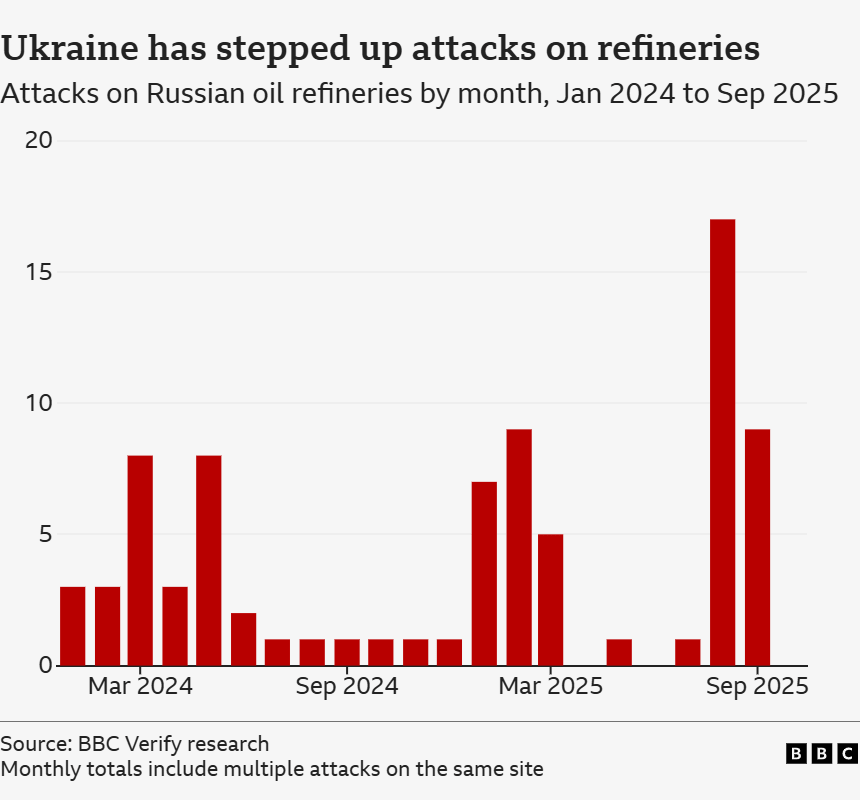
BBC Graph
The same argument applies to the debate over supplying Ukraine with Tomahawk cruise missiles. Historically, new weapons systems provided to Ukraine have had limited long-term impact on the battlefield. They often bring an initial wave of success, only for Russian forces to adapt and blunt their effectiveness. Could this be the weapon Zelensky requested from Trump in their recent talks, without naming it publicly? Possibly, though Ukraine is also producing its own FP-5 Flamingo cruise missiles. This raises the question: are production numbers too limited, or is performance insufficient, making Tomahawks a necessary supplement?
Another consideration is whether this marks just another political jab at Russia. In the first half of the year, the Trump administration was pressuring Zelensky, but now the focus has shifted to pressuring Putin. At the same time, Washington is showing signs of turning inward. This became clear when Denmark, on the verge of finalising a multibillion-dollar air-defence deal, saw U.S. negotiators suddenly pull back despite earlier interest. Pentagon officials, led by Undersecretary of Defense Elbridge Colby, argued that Patriot missile systems are in short supply and should be prioritised for U.S. use. The strain is compounded by difficulties in replenishing interceptor stocks after recent large transfers to Israel. We’ve also seen the Pentagon request a shift towards national issues rather than a focus on China and Russia (started in 2018).
Ultimately, the question is whether these moves represent a genuine escalation in Western commitment to Ukraine, or merely political manoeuvres aimed at pressuring Moscow while Washington recalibrates its own priorities. What remains clear, however, is that Ukraine has already proven its ability to strike deep inside Russia—raising doubts over whether Tomahawks or expanded intelligence truly alter the battlefield, or if their value lies more in symbolism than in strategy.
Sources:
Sources available upon request, not shown to maintain visual integrity of page.
The Atlantic. (2025, September). The U.S. Is Quietly Pausing Some Arms Sales to Europe. Retrieved from https://www.theatlantic.com/national-security/archive/2025/09/arms-sale-europe-trump-colby-ukraine/684274/
Walton, C. (2025, March 12). U.S.-Ukraine intelligence sharing: A conversation with Calder Walton. Belfer Center for Science and International Affairs. Retrieved from https://www.belfercenter.org/research-analysis/us-ukraine-intelligence-sharing-conversation-calder-walton
BBC News. (n.d.). Surge In Ukrainian Attakcs Retrieved from https://www.bbc.com/news/articles/czx020k4056o
TWEET OF THE DAY
Is it all a big coincidence…?
Good game everyone
— Robert (infra 🏛️⌛️) (@infraa_)
12:19 PM • Oct 1, 2025
TODAY IN HISTORY
(October 2, 1836): Charles Darwin's return to England
Naturalist Charles Darwin returned to England this day in 1836 after a five-year journey on the HMS Beagle, on which he gathered the specimens and observations that led to his theory of evolution by natural selection.
