- Basedment
- Posts
- Oreshnik Strike And Russia Counterattacks in Kupiansk
Oreshnik Strike And Russia Counterattacks in Kupiansk
Today we take a look at Russia's new advances in Kupiansk after a humiliating month and it's recent strike using the Oreshnik.

Editor-in-Chief
January 11, 2026
THE BRIEFING
Here’s what’s happening in geopolitics today.
From the streets of Aden, where thousands rallied behind Yemen’s southern separatists, to U.S. jets striking ISIS targets across Syria, today’s headlines underscore how fragile security dynamics remain across the Middle East.
Iran raised the stakes with fresh warnings to Washington and an espionage arrest tied to Israel, while Slovakia quietly shifted gears by moving closer to a major nuclear energy partnership with the United States.
In today’s Deep Dive, we address the latest Russian advances in Kupiansk and the Oreshnik missile strike which shocked analysts worldwide.
THE LAST 24 HOURS IN GEOPOLITICS
1. Thousands rally in support of Yemeni separatist group
Thousands of Yemenis took to the streets on Saturday in the southern city of Aden to show support for the United Arab Emirates-backed Southern Transitional Council (STC), defying recent announcements about the group’s dissolution and ongoing pressure from Saudi-backed government forces. Protesters waved flags of southern Yemen, displayed images of exiled STC leader Aidarous al-Zubaidi, and chanted slogans calling for independence and denouncing both the Saudi-backed Yemeni government and Riyadh’s influence.
read more
2. US military strikes Islamic State group targets in Syria
The United States military carried out large-scale airstrikes across Syria on Saturday targeting Islamic State (ISIS) group positions, U.S. Central Command said, in a campaign linked to Operation Hawkeye Strike, launched after a deadly ISIS ambush in December that killed two U.S. soldiers and a U.S. civilian interpreter. The strikes, conducted alongside partner forces, hit multiple ISIS infrastructure and weapons sites at dozens of locations using fighter jets, attack helicopters and precision munitions, with U.S. officials saying the campaign aims to degrade the group’s capabilities, deter future attacks and protect both American and allied forces.
read more
3. Iran warns Washington it will retaliate against any attack
Iran’s parliament speaker warned on Sunday that Tehran would retaliate against the United States if Washington were to launch a military attack, saying any such action would prompt strikes against both U.S. and Israeli targets that Iran considers legitimate. The statements came amid widespread anti-government protests and heightened tensions after U.S. officials signalled possible intervention in response to Iran’s internal unrest, with Israel reportedly on high alert for regional escalation. Iranian leaders framed the warning as a deterrent against foreign intervention, emphasising that any attack, real or perceived, would trigger a forceful response.
read more
4. Iran’s IRGC arrest foreigner accused of spying for Israel
Iran’s Islamic Revolutionary Guard Corps (IRGC) intelligence division announced the arrest of a foreign national on suspicion of spying for Israel’s intelligence service, Mossad, saying the individual entered Iran “under cover” to collect information and assess the activities of covert operatives. According to the IRGC statement, evidence of espionage was found at the suspect’s hideout and among his belongings, though Iranian authorities provided no details about the individual’s nationality or how long he had been operating inside the country.
read more
5. Slovakia to sign Nuclear Energy Cooperation Agreement with USA
Slovak Prime Minister Robert Fico announced that Slovakia will sign a nuclear energy cooperation agreement with the United States next week, part of broader efforts to advance a deal to build a new large nuclear power unit with U.S. support in partnership with companies such as Westinghouse. The proposed plant, to be constructed at the Jaslovské Bohunice nuclear power site, is expected to have a capacity of almost 1,200 megawatts and will remain under full state ownership, officials said. The intergovernmental agreement follows government approval last October and a December invitation from Trump for Fico to travel to Washington to finalise the cooperation.
read more
DAILY DEEP DIVE
Ukraine War Update
Kupiansk Information
In the Kupyansk direction, both Russian and Ukrainian forces are advancing on both banks of the Oskil River, producing a fluid, multi-axis fight.
In the north, Russian units reinforced by elements of the 47th Tank Division renewed assaults from Holubivka, seizing forested positions east of Radkivka and pushing toward the village itself. Additional assault groups consolidated parts of northern Kindrashivka before infiltrating west into Tyshchenivka, now assessed as grey-zone.
To the southeast, Russian forces counterattacked east of Kupyansk, retaking industrial sites and probing toward Podoly. In the south, Ukrainian troops cleared southwestern Kupyansk, secured the Yuvileynyi district and central market, while airstrikes target encircled Russian elements at Kupyansk Central Hospital.
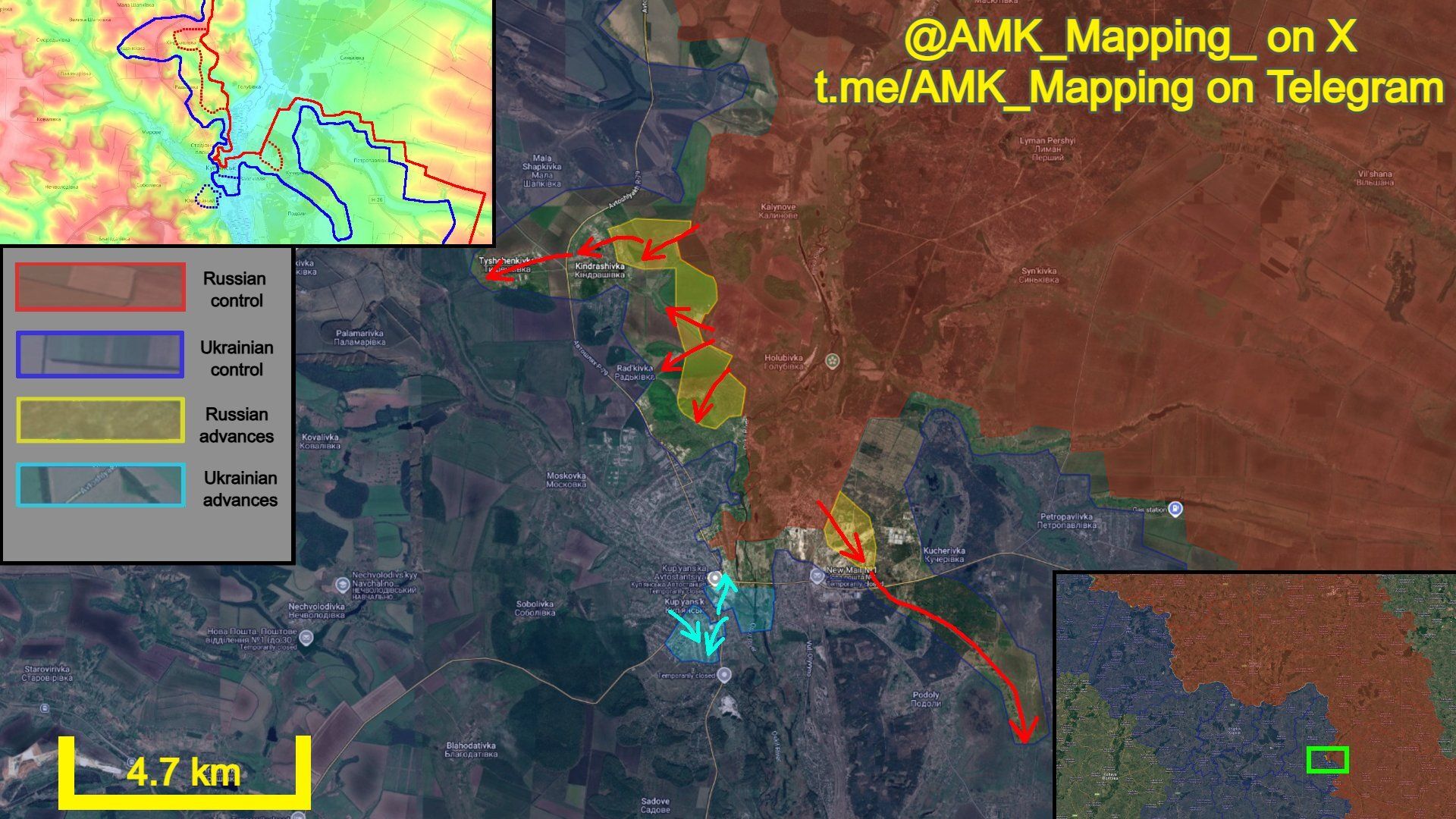
Map and information source tonight is AMK_Mapping
Our Comment:
What is particularly surprising is that Ukraine has allowed Russian forces to counterattack and seemingly consolidate their positions over the past few days. This is significant because if Russia manages to firmly secure Kindrashivka and its western flanks, Ukrainian units in Radkivka will become vulnerable to pressure from multiple directions. Should both villages fall, it would once again open a direct approach for Russian forces into the northern suburbs of Kupiansk. What may complicate Russian efforts this time, however, is the absence of gas pipelines, which previously enabled easier covert infiltration.
Another notable and concerning development for Ukraine is the DRG penetration east of the Oskil River. This poses a serious risk for Ukraine. As seen repeatedly across the front, deep DRG incursions often indicate insufficient manpower to fully man defensive lines, creating gaps that can lead to operational leakages and, in worst cases, sudden localised collapses.
Russia’s Orshenik strike:
According to AMK_Mapping and Kim Hovik the attack appears to be not on the gas facility as originally thought, but the Aviation plant. According to a geolocation analysis of POV footage from the Oreshnik IRBM strike on Lviv, the impact site has been identified as the Lviv State Aviation Repair Plant.
The facility—known for servicing MiG-29 fighter aircraft—appears to have been operational prior to the strike. The site was reportedly struck by 36 MIRVs delivered by the Oreshnik missile.
POV location: 49.79611, 23.94444
Facility location: 49.81721, 23.9351
If you saw the video that we shared on our page you might be asking why it looked so different to the usual ballistic missile, or any kind of missile strike. It’s because of the sheer speed of the Oreshnik and a lack of warheads - yep, lack of warheads. The Oreshnik’s warheads are assessed to carry little to no conventional explosives. Instead, its submunitions function primarily as kinetic penetrators. After ballistic launch and high-altitude flight, the missile deploys multiple reentry vehicles that strike the target at hypersonic speed. Their destructive power comes from velocity and mass, releasing enormous kinetic energy on impact rather than an explosive blast. This allows them to punch through hardened structures, industrial facilities, and underground targets, producing deep penetration and structural collapse instead of wide-area fragmentation. The design also complicates interception, as defenders face multiple fast-moving objects rather than a single explosive warhead.
I would wager this definitely had something to do with the oil-tanker seizure near Greenland. Within 24 hours Russia launched this, nuclear capable, missile near the border of NATO. This was a show of force and also a test.

Sources
News/Journal sources available upon request, not shown to maintain visual integrity of page.
TODAY IN HISTORY
(January 11, 1878): The Day Milk Got Contained
On this day in 1878, fresh milk was delivered for the first time in glass bottles, sealed with a lid, in New York City. It was an important step toward greater food safety in the United States.