- Basedment
- Posts
- Rubio’s Munich Speech: A Softer Voice for the Same Doctrine
Rubio’s Munich Speech: A Softer Voice for the Same Doctrine
Today we read between the lines of Marco Rubio’s Munich speech — which has divided European listeners on its greater meaning.

Editor-in-Chief
February 15, 2026
THE BRIEFING
Here’s what’s happening in geopolitics today.
From Gaza’s frontlines to Munich’s conference halls, today’s headlines trace the hard edges of diplomacy and deterrence.
Israeli strikes continue in Gaza, Rubio heads to Central Europe after a closely watched appearance in Munich, Australia doubles down on AUKUS submarines, Canada toughens its stance on Tehran, and the U.S. expands its air campaign against Islamic State targets in Syria.
In today’s deep dive we read between the lines of Marco Rubio’s Munich speech — which has divided European listeners on its greater meaning.
THE LAST 24 HOURS IN GEOPOLITICS
1. Israeli airstrikes kill at least 9 Palestinians across Gaza in the past 24 hours
At least nine Palestinians were killed in a series of Israeli airstrikes across the Gaza Strip on Sunday, with fatalities reported in both the northern and southern parts of the enclave, according to Gaza’s Health Ministry and civil defence officials. Among the casualties were four people killed in a strike on a tent camp for displaced families and five others in Khan Younis, a major population centre in southern Gaza. The Israeli military said the strikes were in response to multiple alleged violations of an October ceasefire by Hamas and other militants.
read more
2. Rubio to visit Slovakia, Hungary to strengthen ties with pro-Trump leaders
Marco Rubio is embarking on a two-day visit to Slovakia and Hungary to strengthen ties with their conservative, pro-Trump leaders, following his participation in the Munich Security Conference, the U.S. State Department said. Rubio is scheduled to meet Slovak Prime Minister Robert Fico in Bratislava and Hungarian Prime Minister Viktor Orban in Budapest, with discussions expected to cover energy cooperation, NATO commitments and broader bilateral cooperation. Both Slovakia and Hungary have maintained warmer relations with Trump’s political faction and have occasionally clashed with the EU over issues such as democratic standards, energy ties with Russia and defence spending.
read more
3. Australia commits $2.7B to advance construction of nuclear submarine shipyard
Australia has pledged US$2.76 billion to advance the construction of a nuclear submarine shipyard at Osborne in Adelaide, marking a major step in delivering nuclear-powered submarines under the trilateral AUKUS defence partnership with the United States and the United Kingdom. Prime Minister Anthony Albanese described the funding as a “down payment” on a much larger project, officially projected to cost around A$30 billion over coming decades, aimed at building the infrastructure to construct and sustain Australia’s future fleet of conventionally-armed, nuclear submarines.
read more
4. Canada pushing for regime change in Iran, announces more sanctions
Canadian Foreign Affairs Minister Anita Anand said at the Munich Security Conference that Canada wants to see a change of government in Iran and will not reopen diplomatic ties until that occurs, sharply outlining Ottawa’s position toward Tehran’s current leadership. Anand also announced additional sanctions targeting seven individuals linked to the Iranian government over human rights concerns, part of Canada’s long-standing pressure campaign on Tehran.
read more
5. US launches airstrikes on dozens of Islamic State targets in Syria
The U.S. military carried out 10 airstrikes against more than 30 Islamic State targets in Syria as part of Operation Hawkeye Strike, aimed at degrading ISIS infrastructure and weapons storage sites, U.S. Central Command said. According to CENTCOM, the strikes used precision munitions delivered by fixed-wing, rotary-wing and unmanned aircraft and are intended to “sustain relentless military pressure” on the extremist group following a deadly attack last year that killed U.S. and Syrian personnel. Over two months of operations, more than 50 ISIS fighters have been killed or captured and over 100 infrastructure targets struck.
read more
DAILY DEEP DIVE
Rubio’s Speech: Reassuring Or
Wider Context
After a very long stretch of bland speeches from western leaders in recent years, we’ve now had Carney at Davos and just yesterday Rubio at Munich. Both speak to us that the rules-based order is no more, an illusion of the past. Yet, as widely acclaimed Rubio’s speech was, it was equally criticised by many across both ends of the Atlantic pond. It’s easy to see why, because on the surface of this speech is a carefully well written and powerfully delivered reassurance of alliances, but ultimately a repackaging of JD Vances speech the year before. Two different tones, two different deliveries, but both very in line with the released National Security Strategy.
Marco Rubio’s Speech
Secretary of State Marco Rubio’s Speech
Secretary of State Marco Rubio’s speech emphasises the shared Christian values and Western history binding the United States and Europe — a recurring theme throughout his remarks. He reinforces this civilisational link through historical references, including Christopher Columbus’ westward journey, to situate the American project firmly within a European lineage. As Rubio frames it, the transatlantic relationship is not merely strategic but civilisational: although the United States was founded 250 years ago, its cultural, religious, and historical roots lie in Europe. Those who built the nation carried inherited traditions, collective memory, and Christian faith, forming a bridge between the Old World and the New. Both sides of the Atlantic, in this telling, belong to the same Western tradition, bound by centuries of shared history, faith, language, ancestry, and common sacrifice. As several commentators have already noted, this civilisational framing is likely to resonate strongly with conservative audiences on both sides of the Atlantic. With right-wing parties and populist movements continuing to gain traction across Europe, Rubio’s emphasis on tradition, continuity, and shared values serves as reassurance — and implicit validation — for constituencies skeptical of post-national or purely technocratic visions of the West.
The speech is also marked by heavy use of inclusive language — repeated references to “we” and “us” — particularly when addressing climate policy, deindustrialisation, and free trade in the post–Cold War era. Rather than assigning blame, Rubio frames these developments as collective Western miscalculations, advancing a narrative of shared responsibility: “we got it wrong.” At the core of this critique is the belief, echoing the “end of history” thesis, that great-power rivalry and systemic conflict had been consigned to the past within a U.S.-led rules-based order. Rubio’s rejection of this assumption signals a broader shift away from post-Cold War liberal optimism toward a more contested, civilisational understanding of international politics.
The NSS and JD Vance Connection
The speech encompasses many of the objectives and strategic interests outlined in the National Security Strategy (NSS) regarding Europe. In particular, both emphasise the need for Europe to assume greater responsibility for its own defence and reduce structural dependencies that undermine strategic resilience. Rubio’s civilisational framing complements the NSS critique of regulatory overreach, economic stagnation, and declining self-confidence, suggesting that Europe’s challenges are not merely economic but political and cultural. His call for a negotiated end to the war in Ukraine and the restoration of strategic stability with Russia also mirrors the NSS priority of preventing escalation while preserving a balance of power in Europe. Finally, the speech reinforces the NSS objective of strengthening sovereign European nations—especially in Central and Eastern Europe—while ensuring that transatlantic economic ties remain fair, reciprocal, and strategically aligned.
NSS Strategy (a MUST read to understand this administration)
In contrast to Rubio, Vance's speech was very direct, and almost hostile but directed rather towards the bureaucratic elite of Europe, carefully in-line with populist talking points. While differing in tone—Vance confrontational and populist, Rubio diplomatic and historical—both speeches align with the Trump NSS’s broader vision: a sovereign, civilisationally confident Europe that takes primary responsibility for its defence, resists supranational overreach, restores democratic legitimacy, and contributes to a balance of power grounded in strategic realism rather than liberal universalism.
Vance 2025 Speech
The Criticism
And here lies the division in how the speech has been perceived. On the surface, this represents a dramatic shift in tone from JD Vance’s speech last year, and Rubio’s address came at a sensitive moment — just after the latest political mudslinging over Greenland and tariff threats. The speech received a standing ovation from many in the room. Just listen to the words of the host afterward: “Mr. Secretary, I’m not sure you heard the sigh of relief through this hall when we were just listening to what I would interpret as a message of reassurance, of partnership.” – many were preparing for another unaccustomed lack of word-mincing.
Yet the concern for many Europeans, behind the veil of applause, is that actions speak louder than words. When you read between the lines, the substance remains consistent with the administration’s talking points since coming into office. The main difference is delivery. Rubio presented it in a tone and format that European bureaucrats, policymakers, and conference audiences are accustomed to — the same message, but packaged in the language of partnership, reassurance, and shared history rather than confrontation.
What do you think? Send us a DM!
Sources
News/Journal sources available upon request, not shown to maintain visual integrity of page.
TODAY IN HISTORY
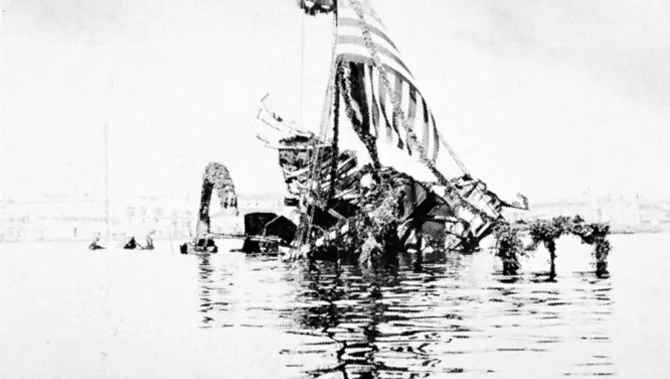
(February 15, 1898): “Remember the Maine, to hell with Spain!”
On this day in 1898, an explosion sank the USS Maine while it lay at anchor in Havana Harbor. It had arrived a few weeks earlier to protect U.S. interests in Cuba. At the time, Spain ruled Cuba, although the leaders of a decades-long independence movement had taken control of much of the island. About 350 men were onboard the ship; more than 70 percent of them were killed. Investigations by Spanish and American authorities disagreed on the cause of the explosion, though that did not matter for some American newspapers, which used the slogan “Remember the Maine, to hell with Spain!” to stir outage in the United States. The result was the Spanish-American War and, eventually, independence for Cuba.