- Basedment
- Posts
- Russia Counter-Attack On Pokrovske Front, Syrians Push Back Against Israel
Russia Counter-Attack On Pokrovske Front, Syrians Push Back Against Israel
Today we provide an update on the Russia-Ukraine front, as well as the developing situation on the Israeli-Syrian border.

Editor-in-Chief
April 03, 2026
THE BRIEFING
Here’s what’s happening in geopolitics today.
The global picture remains tightly wound: Donald Trump says the Iran war is nearing its endgame, while Washington shifts gears in Venezuela by lifting sanctions on Delcy Rodríguez and NATO chief Mark Rutte heads to the U.S. amid growing alliance tensions.
Elsewhere, backlash is building over Israel’s new death penalty law, and the UK is scrambling to coordinate a 35-nation response to reopen the Strait of Hormuz as energy and shipping risks mount.
Today we provide an update on the Russia-Ukraine front, as well as the developing situation on the Israeli-Syrian border.
SUPPORT OUR PODCAST!
We just released our first duo-pod, this is a great one to crack open a beer to — more of a relaxed vibe and just a chat about what’s going on in the world.
In the podcast we discussed: Iran, Russia-Ukraine, the potential ground invasion and whether Bibi is alive or not!
Click Here To Listen (And Sub!) - Youtube
We’re Also on Spotify CHA
THE LAST 24 HOURS IN GEOPOLITICS
1. Trump says ‘core strategic objectives’ in Iran are nearing completion
Trump said Washington’s “core strategic objectives” in the Iran war are nearing completion, signalling what he described as a potential turning point in the conflict. He pointed to significant military progress, including efforts to degrade Iran’s missile systems, naval capabilities and broader military infrastructure, while indicating operations could conclude in the near term. However, uncertainty remains around the endgame, with continued strikes and regional tensions persisting despite the administration’s claims of progress.
read more
2. US lifts sanctions on Delcy Rodriguez, Venezuela’s acting president
The United States has lifted sanctions on Venezuela’s acting president Delcy Rodríguez, removing her from the Treasury Department’s sanctions list in a move that signals a major shift in policy. The decision effectively recognises Rodríguez as the country’s legitimate authority following the removal of former leader Nicolás Maduro, and allows her government to engage more freely with U.S. businesses and financial systems. The step is part of a broader effort by Washington to rebuild diplomatic and economic ties with Venezuela, including potential cooperation in the oil and energy sectors.
read more
3. NATO Chief Mark Rutte to visit Washington next week
NATO Secretary-General Mark Rutte is set to visit Washington next week for what officials describe as a long-planned trip, confirmed by both NATO and the White House. The visit comes at a sensitive moment for the alliance, as U.S. President Donald Trump has publicly criticised European allies and raised the possibility of the U.S. withdrawing from NATO. While details of the agenda have not been disclosed, the trip is expected to focus on managing growing transatlantic tensions amid the ongoing Iran conflict.
read more
4. Eight Muslim-majority countries condemn Israel’s new death penalty law
Eight Muslim-majority countries have jointly condemned Israel’s new law introducing the death penalty for Palestinians convicted of deadly attacks, calling the move highly provocative. The countries (including Pakistan, Turkey, Egypt, Indonesia, Jordan, Qatar, Saudi Arabia and the UAE) urged Israel to refrain from actions that could further escalate tensions in the region. The criticism follows broader international backlash, with the law widely described as discriminatory and raising concerns over human rights and regional stability.
read more
5. UK to host meeting of 35 countries on reopening Strait of Hormuz
The United Kingdom is set to host a virtual meeting of around 35 countries to coordinate efforts to reopen the Strait of Hormuz, a critical global shipping route that has been disrupted by Iran amid the ongoing conflict. The talks, chaired by UK Foreign Secretary Yvette Cooper, will bring together nations including France, Germany, Japan, Australia and the UAE to explore diplomatic, political and potentially military options to restore freedom of navigation.
read more
GLOBAL CONFLICT TRACKER
Iran-USA-Israel
The passage of Israel's death penalty law for Palestinian prisoners has acted as a flashpoint in southern Syria, triggering tribal declarations of jihad in Daraa and accelerating tensions that were already simmering along the Israeli-occupied border zone. What appears on the surface as a reaction to the new legislation is likely layered with longer-standing grievances and strategic opportunism.
Tribal forces from Daraa are advancing toward Quneitra, historically the symbolic centre of Israeli-Syrian confrontation, while the Syrian Transitional Government (STG) is deploying forces not to support them, but to contain them. This reveals an immediate fracture: the tribes and the al-Julani-aligned government are not operating in concert. The STG's priority appears to be preventing an uncontrolled escalation it cannot manage militarily or diplomatically.
The Druze dimension adds significant complexity. Israel has long positioned itself as the protector of Syria's Druze community, a relationship that has kept the Druze largely outside the Syrian state's orbit in the last 12 months. The tribes appear to be using this moment of broader regional pressure on Israel to force a reckoning; pushing the Druze toward realignment with Damascus while settling older scores from previous conflict cycles. With Israel simultaneously engaged in Iran, Gaza, and Lebanon, the tribes may be calculating that Israeli bandwidth to project force into southern Syria is genuinely constrained.
Strikes on Hezbollah assets in Syria or escalation into Lebanon cannot be ruled out. We could see a three-way conflict break out here where Syrian forces attack Lebanese and Hezbollah border forces. For over a year there has been a gradual increase in escalation on the border as Islamists in Syria push for an attack on northern Lebanon to unify Sunni’s under one Levantine Islamic banner.
Russia-Ukraine
The situation across the Pokrovskaya–Velikomikhailovskaya–Novomykolaivka axis highlights a familiar divergence between more independent reporting and large-establishment battlefield assessment. Suriyak framed the past week as tactically favourable, claiming repelled Ukrainian incursions and the recapture of positions across Novoivanivka, Novohryhorivka and Novomykolaivka. These gains are presented as enabling follow-on advances toward Zlahoda, Pryvillya, and renewed pressure south of Ternove, alongside reported entry into Boikove and continued movement toward Ternutave. The narrative suggests localized momentum and a stabilisation of previously contested sectors.
However, assessments from Institute for the Study of War introduce a more restrained interpretation. While geolocated footage confirms a Russian presence in Boikove, ISW assesses this as a limited infiltration rather than a meaningful shift in control or the forward edge of battle area (FEBA). This aligns with a broader pattern of “flag-raising” operations—tactically shallow actions amplified for informational effect rather than territorial consolidation. Operationally, Russian forces appear to be relying on small assault groups and localized counterattacks to contain Ukrainian activity, while reinforcing positions with redeployed units. At the same time, Ukrainian strikes on personnel concentrations, drone control nodes, and command posts indicate continued pressure on Russian rear and tactical infrastructure.
Further south, the Hulyaipole direction reinforces this dynamic. Ukrainian forces have achieved minor advances near Zaliznychne, while Russian attacks(often involving high-risk tactics such as motorcycle assaults) have failed to produce confirmed breakthroughs. Overall, the trend remains the same — gruelling fighting for sheer metres of land. Russian claims of regained momentum remain contested, with available evidence suggesting limited tactical gains offset by persistent Ukrainian interdiction and defensive resilience.
In the broader scope, we’re seeing much more activity across most of the frontline not just in Huliaipole and Pokrovoske. Last night we discussed the Pokrovsk front, but there have been gains made by both sides in Siversk, Kostiantinyvka, Kupiansk and Soledar. This makes sense, as April sets in expect the fighting to intensify.
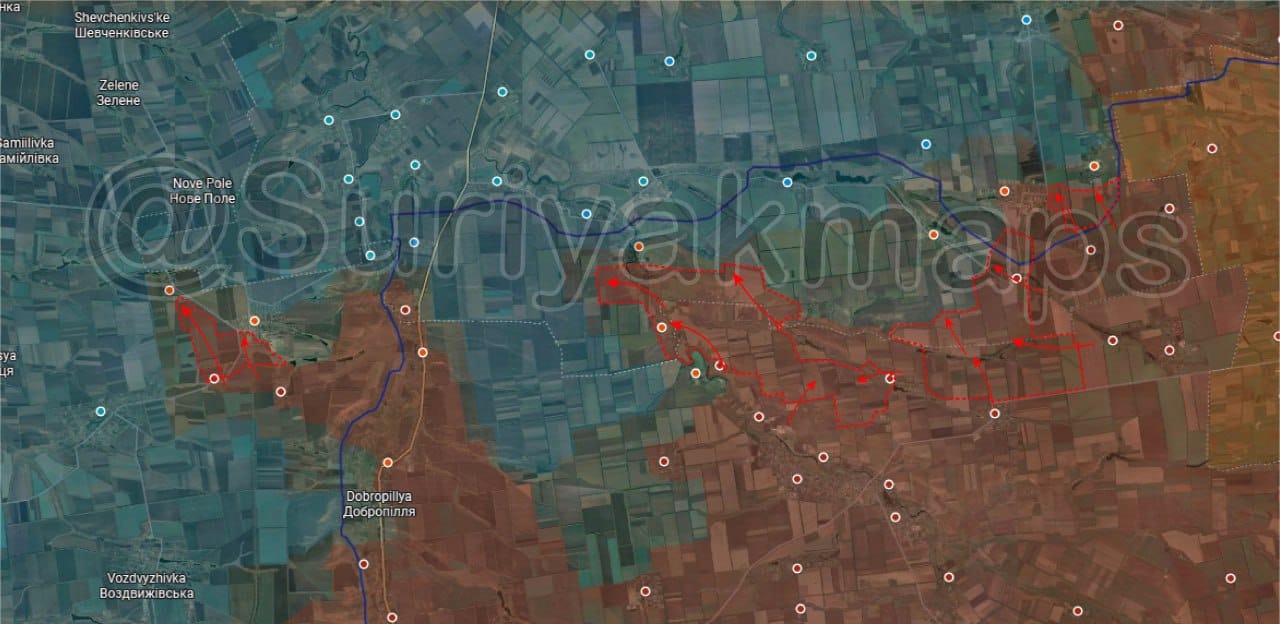
Suriyak info and map source via telegram
Sources available upon request
TODAY IN HISTORY
(April 2nd, 1863): Protesters march in Richmond bread riot
On this day in 1863, residents of Richmond, Virginia, rioted to protest a dire food shortage in the city. On March 27, Confederate Pres. Jefferson Davis called for a day of fasting and prayer—which angered many. More than a hundred women began marching toward government storehouses on April 2, yelling “Bread or blood!” It was only after Davis threatened to shoot the rioters (who had started ransacking warehouses) that things settled, though more than 60 rioters were arrested.
