- Basedment
- Posts
- "We Are At War": Says Russia's FM Lavrov Part 1
"We Are At War": Says Russia's FM Lavrov Part 1
Your daily dose of geopolitical updates and strategic analysis. Unbiased, but not unbased.

Editor-in-Chief
September 27, 2025
THE BRIEFING
Here’s what’s happening in geopolitics today.
From U.S. warnings over Israeli annexation plans to fresh turbulence in Europe’s elections, the past 24 hours have delivered no shortage of political drama.
We’re also watching new tariffs out of Washington, Switzerland’s humanitarian gesture toward Gaza, and a stunning court ruling against a former French president
And in a two part special edition we examine the realities of a possible war between Russia and NATO. First, we take a look at the frontline situation in Ukraine.
THE LAST 24 HOURS IN GEOPOLITICS
1. Trump says he ‘will not allow’ Netanyahu to annex West Bank
Trump declared from the Oval Office that he would “not allow” Israel to annex the occupied West Bank, telling reporters “it’s not going to happen.” His statement marks a noticeable departure from his usual staunch alignment with Israeli policies and appears timed to respond to regional objections from Arab states. While skeptics question how enforceable his warning is, it underscores how annexation has become a flashpoint in U.S.–Middle East diplomacy.
read more
2. Poland bars Moldovan politician amid election interference claims
Moldovan election authorities barred the pro-Russian party “Heart of Moldova,” part of the Patriotic Bloc, from contesting Sunday’s parliamentary election following a court ruling that limits the party’s operations for one year. The Central Election Committee cited illegal financing in its justification, while “Heart of Moldova”’s leader, Irina Vlah, is under EU sanctions over alleged links to Russian interference. With dozens of candidates removed and tensions already high, many see this move as raising the stakes in a tight election that could determine whether Moldova continues its path toward the EU or tilts back toward Russian influence.
read more
3. Trump plans new tariff push with 100% rate on patented drugs
Trump announced sweeping new import tariffs that will take effect on October 1, including a 100% duty on imported branded pharmaceuticals unless drugmakers are building plants in the U.S., a 25% tariff on heavy-duty trucks, and steep levies on furniture and cabinetry. The administration says these measures are needed to protect U.S. manufacturing and national security, invoking Section 232 of the Trade Expansion Act. Critics warn the tariffs could stoke inflation, disrupt supply chains, and strain relations with trade partners, especially those with exports in pharmaceuticals and vehicles.
read more
4. Switzerland to take in 20 Gazan children for medical treatment
Switzerland has announced plans to take in about 20 injured children from the Gaza Strip for medical treatment, working alongside the World Health Organization to identify patients in need. The government will manage logistics and transportation, while Swiss cantons or individual hospitals will voluntarily cover the medical costs. Security checks will be required for both the children and their family members, and upon arrival they will go through Switzerland’s asylum process.
read more
5. Former French President Sarkozy handed 5-year jail term in stunning downfall
Former French President Nicolas Sarkozy has been handed a five-year prison sentence by a Paris court after being found guilty of criminal conspiracy tied to efforts by his aides to solicit funding from Libya’s Gaddafi regime for his 2007 presidential campaign. The verdict makes him the first modern French head of state to be ordered to serve prison time, even if he appeals, a seismic moment in French political history. Sarkozy has maintained his innocence, calling the ruling “a scandal,” and his legal team is preparing to challenge it.
read more
DAILY DEEP DIVE
THE OVERALL SITUATION AT THE FRONT
It is almost unbelievable to think how far we have come into this regional conflict, yet how close we are to a global one. Both Slavic nations are hard pressed into a war economy since 2022, with neither side having the decisive advantage to end the bloodiest conflict since the end of WW2. It’s clear Trump has had a bleak realisation that the war will not be his “easiest” one to end, as he has said many times. In effect, he has been gradually pawning it off to his European allies. Russia has made multiple incursions into NATO airspace — some confirmed, some not. Europe is continually expanding its role in support of Ukraine. Trump now says NATO should shoot down Russian planes. Where does this all end? Let’s hope this becomes part of the “nothing ever happens” meme, because we are one press of a button away from a major escalation that could turn this into a global conflict.
We’re going to start the premise of this article on the current situation at the frontline. In part two, we will step back to discuss the broader picture. Please, if you like this content, be sure to subscribe and spread the word. You won’t get this analysis anywhere else.
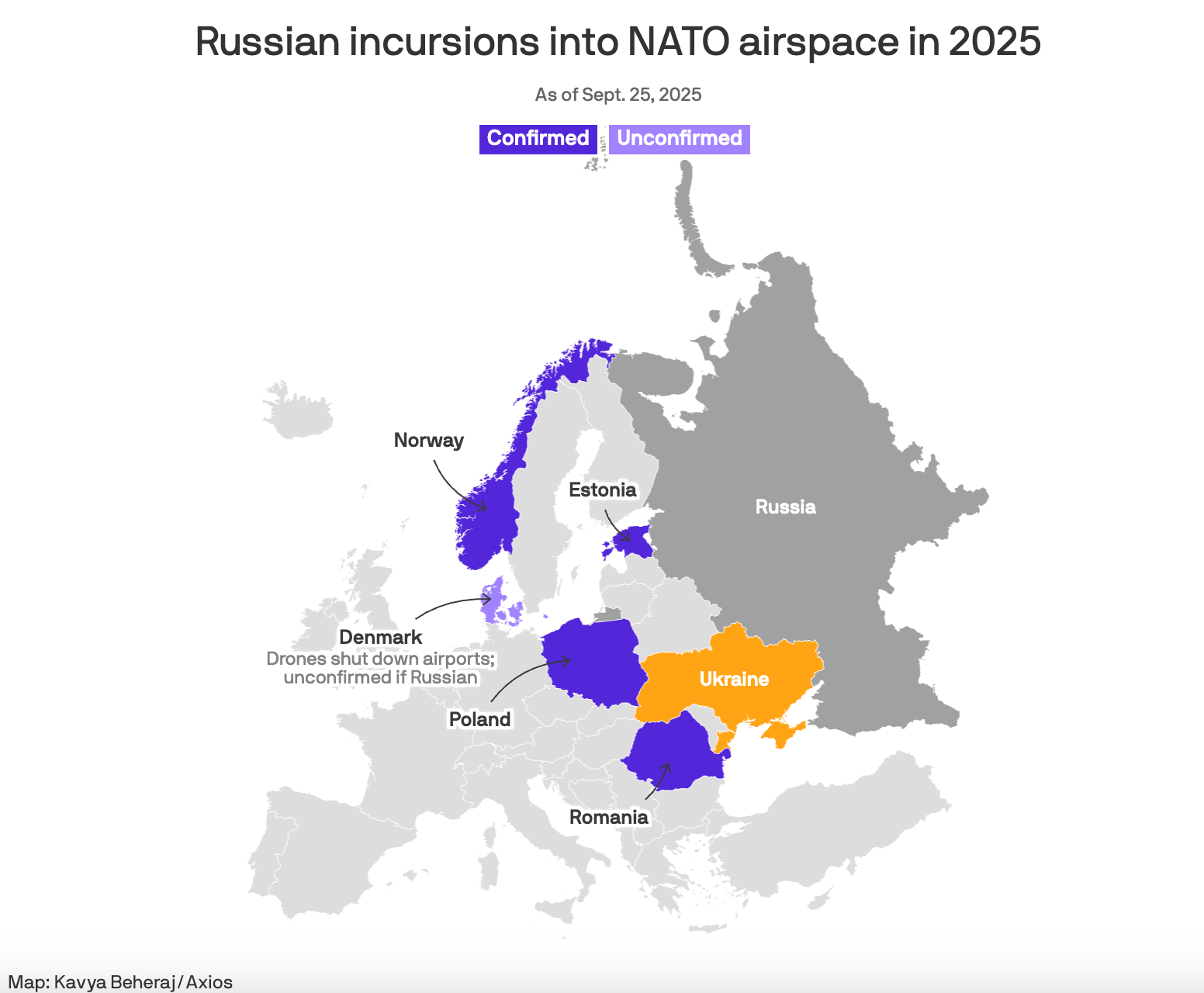
MAP SOURCE: Kavya Beheraj / Axios
The Front Line
September has not been a particularly strong month for Russian advances. Summer is over, and the rain and mud season (rasputitsa) is approaching. There has been a rare radio silence from both sides across the Pokrovsk frontline for quite a while. The situation at the Dobropillya salient appears difficult for the Russians, while in Pokrovsk city, Russian units maintain a solid presence in the southern suburbs. Looking back at Avdiivka, the front only began to move once the Russians rapidly applied pressure on the flanks. At present, we’re not seeing that — neither at Udache (western flank) nor north at Rodynske. Russia has been making advances between Shakove and Rusyn Yar, and we believe this is an area to keep an eye on.
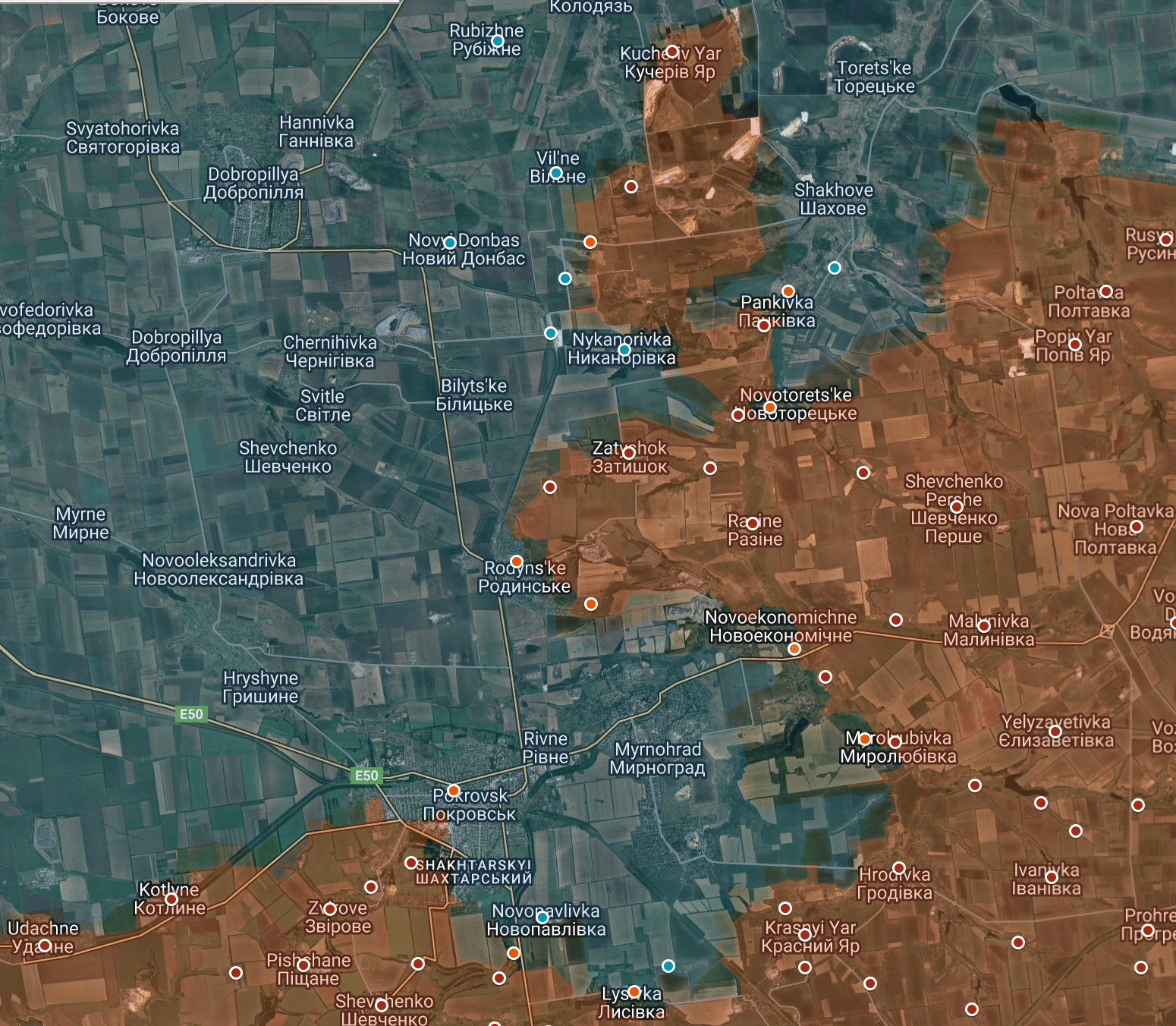
Pokrvosk front (map from Suryiak), Rusyn Yar top right, full name cut off.
Russia has seen significant localised success at the Lyman front, where Russian units have managed to leap from village to village. We suspect Ukraine is applying as much pressure as possible on the encirclement of the Dobropillya salient, both for a political and military victory. There has also been progress north of Siversk, with Russian forces taking much of the Sererbryanskyi forest (whatever is left of it). This puts the fortress town of Siversk at real risk of being outflanked,
for the first time in many years it is in danger of falling. As many of you know, the Lyman to Siversk front is part of a strong, fortress-like belt defence system. For Ukraine, these advances are worrying. Still, Russia remains far from reaching Sloviansk and Kramatorsk, the final pieces Putin needs to secure Donetsk.
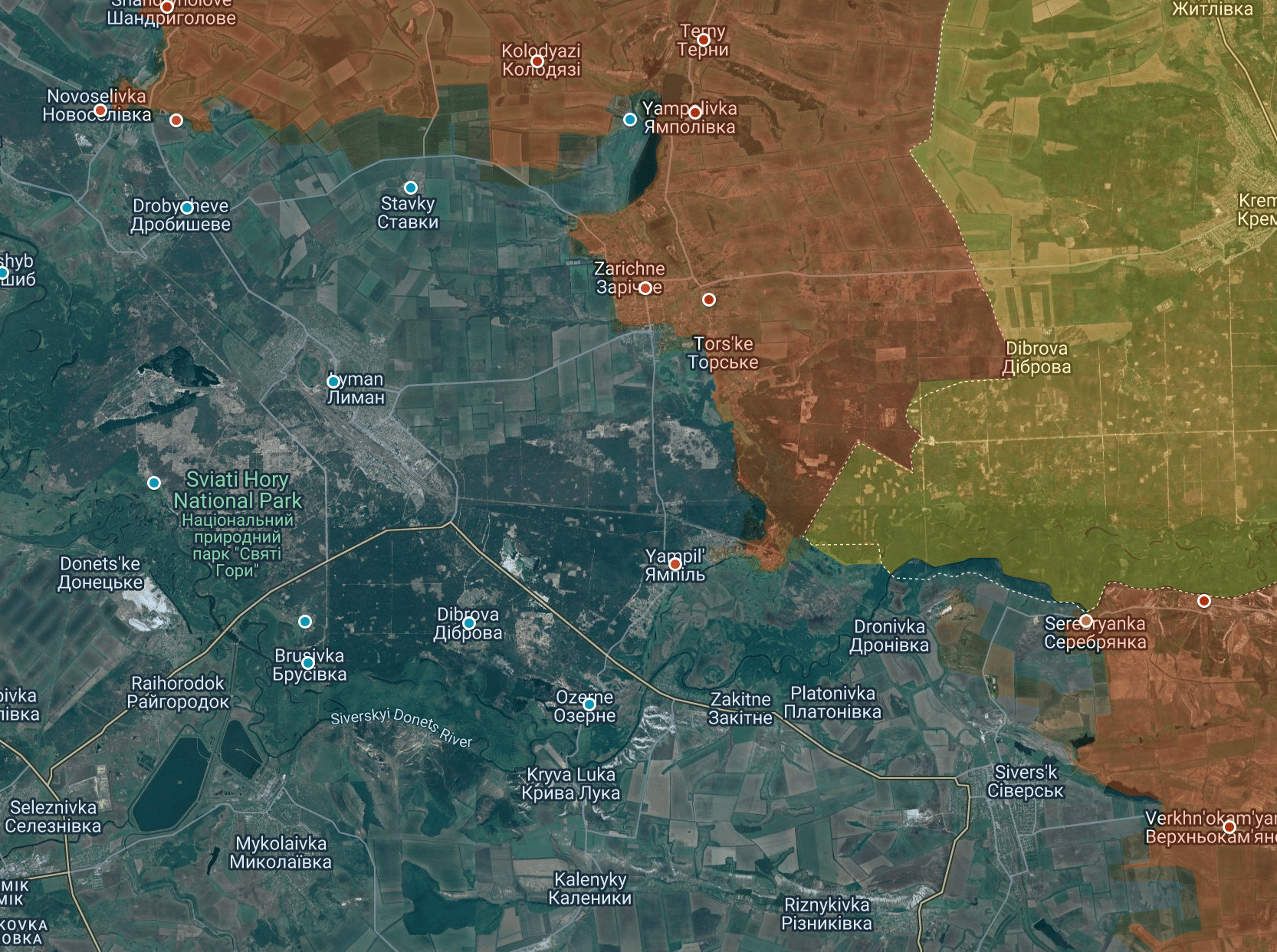
Map of Lyman to Siversk front, Yellow Pre-2022 Russian control, Red post-2022)
Toretsk and Kostyantynivka have not shifted substantially in weeks. Russian DRG units continue probing towards the outer suburbs of Kostyantynivka, but there are no concrete gains. The village of Predtechyne remains contested after months of fighting over this tactically important position. Ukrainian defence is stubborn in Kostyantynivka, because its fall would expose the underbelly of Sloviansk and Kramatorsk, bypassing the fortress belt. Russia may eventually use the growing position at Rusyn Yar and Shakove to hit the western flank, which is why we are saying: keep an eye on it.
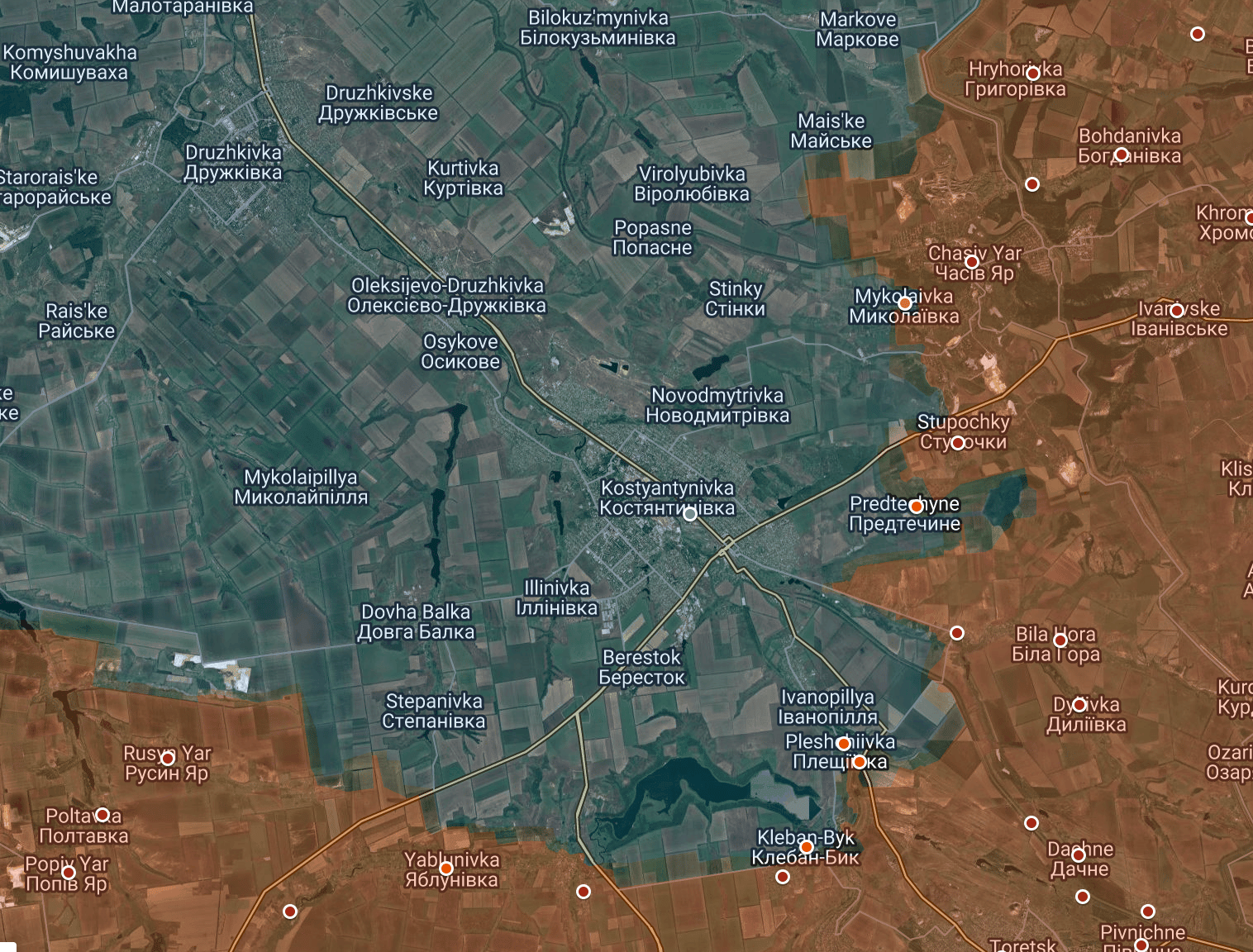
Kotyantynivka and Toretsk front
Russia’s best success has come in Kupiansk and the Dontesk-Zaporizhzhia border. Russian units are steadily advancing in the centre of the city and have made a tactical breakthrough across the Oskil River, pushing along its banks. This threatens the eastern defences of the Oskil, potentially cutting them off from Kupiansk and its main supply road. The western flanks are also muddy. Moskova is arguably mostly under Russian control, but Sobolivka remains contested, with Russian DRG units active there.
At the Donetsk–Zaporizhzhia border, Russia has continued to make gains. Possibly it’s largest in terms of overall land taken in comparison to other fronts. Progress has been similar to what we’ve seen around Lyman: slow, village-to-village advances.
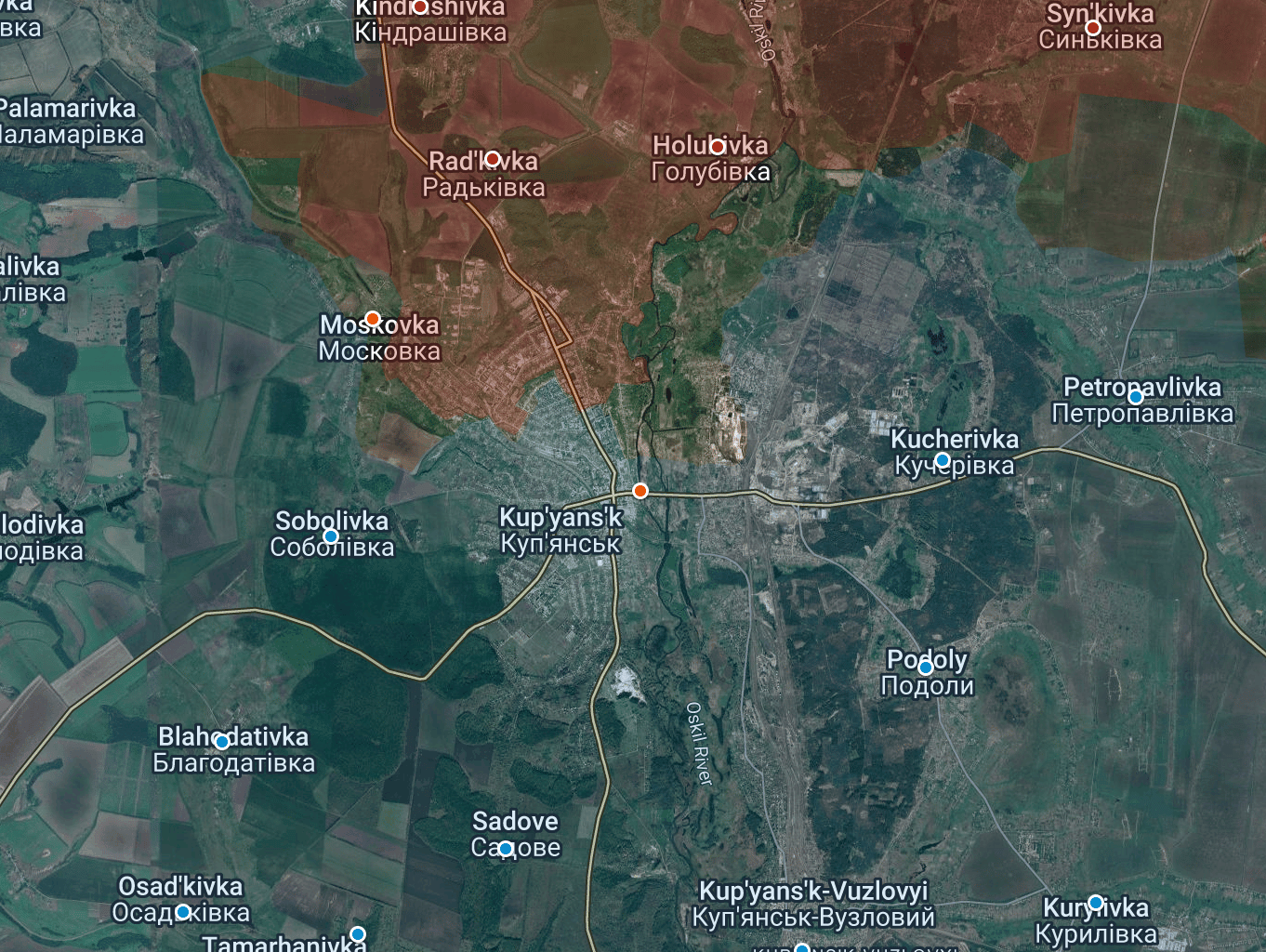
Kupiansk front. Note, grey zone near red dot has strong Russian presence running along the Oskil river.
Lesser Importance:
Sumy and Kharkiv remain slogfests, with neither side winning much. These aren’t primary Russian objectives, especially over the winter. Their focus remains Donetsk and Kupiansk.
The Kherson and Zaporizhzhia fronts are largely stalled. Neither side has the intent or the capacity to advance meaningfully there. Russian units have gained a bit of ground in southern Zaporizhzhia, but it’s minimal.
Other Notable Considerations
Due to the inability to counter drones effectively, both sides (especially Russia) are employing tactics involving two- to four-man infiltration teams, sometimes expanding into squad-sized operations. These extremely small tactical advances further mitigate any meaningful progress. Neither side has the strategic capability to perform far-reaching manoeuvres given the influential role of drones.
Russia has lost a substantial amount of equipment, and that’s an understatement. But so has Ukraine, which is often overlooked. But Russia retains a stronger capacity to replace equipment, particularly tanks, as we’ve discussed before. It’s misleading to suggest otherwise: Russia is producing a lot and should not be discounted.
Ukraine is currently dismantling Crimean air defences. This could signal an imminent strike, or it could be a tactic to lure Russian systems into the area and spread them thin. So important that Russia has even claimed its recent airspace violations are linked to Ukrainian actions in Crimea.
Both sides are scaling up drone production with different approaches. Ukraine is decentralised, Russia centralised. The result: both are wreaking havoc on each other’s infrastructure.
There is a water shortage on the Russian frontline and in Donetsk city. Soldiers rely on volunteer-donated water systems on some parts of the front, a stark reminder of the brutality of this war.
The fog of war is only deepening. With small tactical groups, infiltrations are rampant, particularly from undermanned Ukrainian units. This makes it harder to confirm gains and losses. Meanwhile, a kind of “flag war” has emerged: units on both sides risk their lives to plant flags in enemy zones, either for their commanders or for the internet.
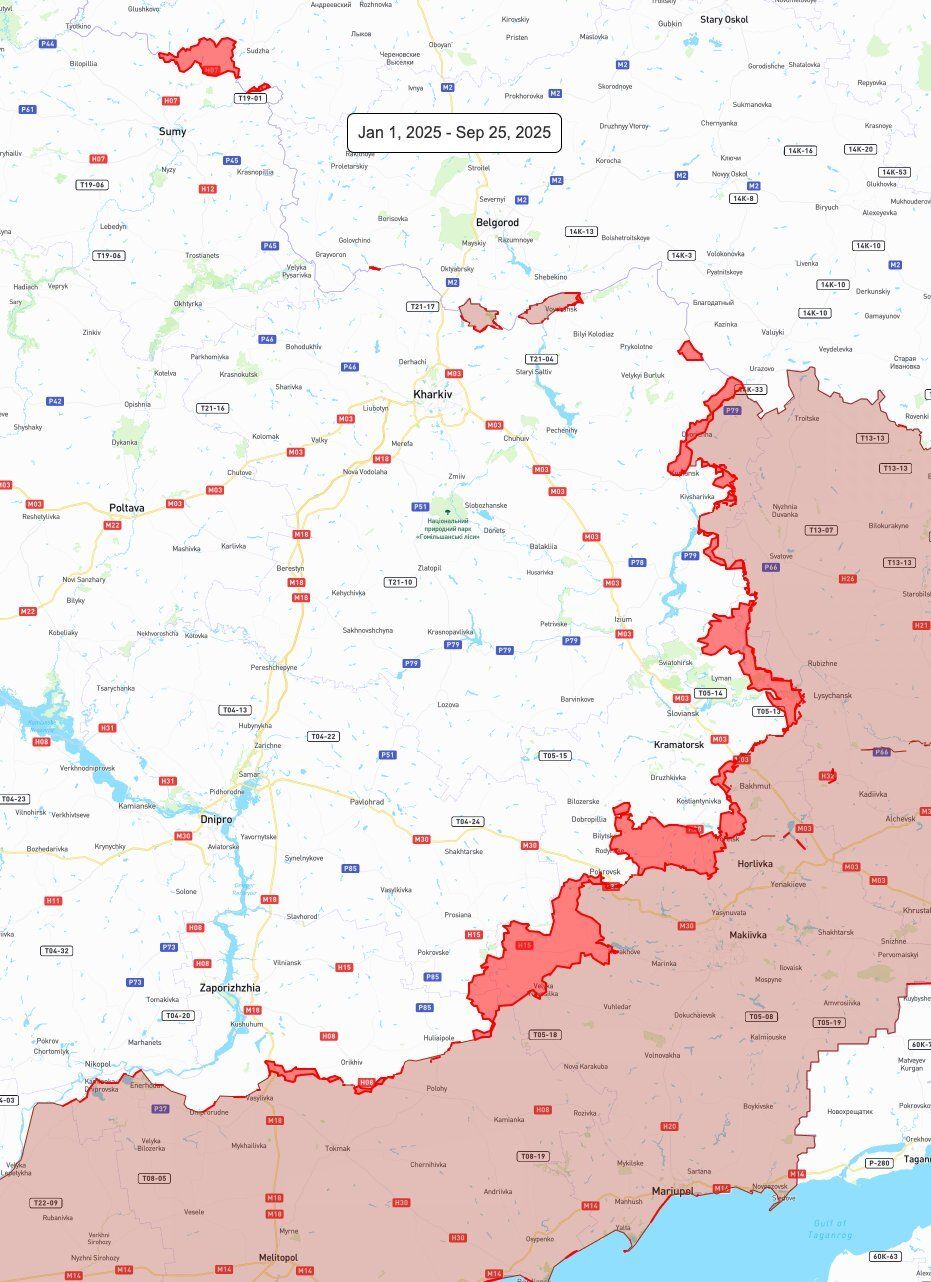
Overall gains since January. Main source is Deepstate. That big red blob towards the south of the front is the Donetsk-Zaporizhzhia border.
Sources:
Sources available upon request, not shown to maintain visual integrity of page.
Regarding maps, we’ve primarily used SuriyakMaps for the sake of consistency. Has generally been more on Russian bias, but is overall one of the better objective mappers.
Deepstate is used here, they are heavily pro-Ukrainian but show a good overall map of gains.
TWEET OF THE DAY
No caption needed.
REPORTER: “Mr. President, Jasmine Crockett recently…”
*entire room bursts into laughter* 🤣🤣🤣
— Margo Martin (@MargoMartin47)
8:56 PM • Sep 25, 2025
TODAY IN HISTORY
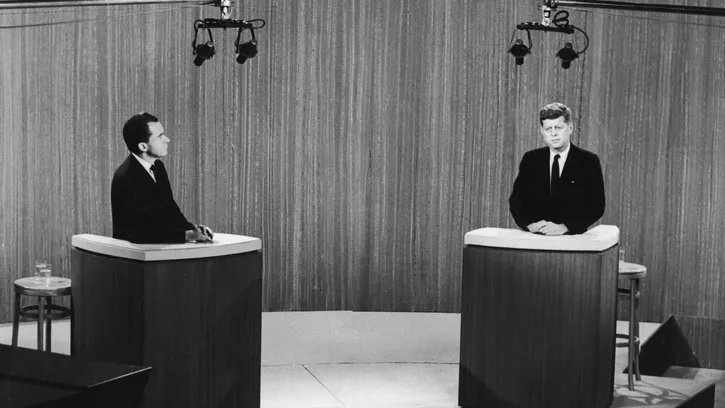
(September 26, 1960): First televised U.S. presidential debate
The first in a series of historic televised debates (seen by some 85 to 120 million viewers) between U.S. presidential candidates John F. Kennedy and Vice President Richard M. Nixon was broadcast this day in 1960.