- Basedment
- Posts
- Russia's Oil Crisis: No End In Sight
Russia's Oil Crisis: No End In Sight
Your daily dose of geopolitical updates and strategic analysis. Unbiased, but not unbased.

Editor-in-Chief
August 25, 2025
THE BRIEFING
Here’s what’s happening in geopolitics today.
Today’s briefing brings together a mix of stories that show just how wide the global spotlight stretches.
From a helicopter crash in Britain to fresh strikes in Gaza and Yemen, and even shifting security ties in the Pacific, the headlines are varied but interconnected. We also track Ukraine’s deepening drone campaign inside Russia, which is now hitting energy and nuclear infrastructure.
In our deep dive, we’ll unpack how this new phase of strikes is fuelling an oil crisis already affecting millions of Russians.
THE LAST 24 HOURS IN GEOPOLITICS
1. Helicopter crashes into field on Isle of Wight
A helicopter crashed into a field near the seaside town of Ventnor on Britain’s Isle of Wight on Monday morning, with emergency services scrambling to the scene shortly after 9:24 a.m. A critical care team was dispatched, though it remains unclear how many people were on board or if there were any injuries. Local authorities have closed the nearby road and urged the public to steer clear as investigations and updates continue.
read more
2. Journalists among 15 killed in Israeli strikes on Gaza’s Nasser Hospital
An Israeli airstrike on Nasser Hospital in southern Gaza on Monday killed at least 15 people as confirmed by Palestinian health officials, in what appeared to be a “double-tap” strike that hit the fourth floor and then struck again as rescue teams and media personnel arrived. Among the victims were Reuters cameraman Hussam al-Masri, AP freelance visual journalist Mariam Abu Dagga, Al Jazeera’s Mohammed Salama, and NBC’s Moaz Abu Taha, while another Reuters contractor photographer, Hatem Khaled, was wounded.
read more
3. Australia pushes to ratify Nauru security treaty ahead of China investment
Australia is fast-tracking the ratification of a landmark security and economic treaty with Nauru out of concern that a recently announced A$1 billion Chinese investment could violate its terms, officials said. Under the treaty, Canberra must be consulted before Nauru enters into deals affecting critical sectors including security, banking, and telecommunications, in exchange for A$100 million in budget aid and A$40 million for security enhancements.
read more
4. Israeli strikes in Yemen’s capital kill six
Israel carried out airstrikes on Sunday in Yemen’s capital, Sanaa, targeting a military compound, two power plants, and a fuel storage site with strikes reportedly in response to recent ballistic missile launches from Houthi rebels toward Israel. A Houthi health ministry spokesperson confirmed the attack resulted in six deaths and 86 injuries, underscoring the escalating spill-over from the Gaza conflict into the broader region.
read more
5. Ukraine drone hits Russian nuclear plant, sparks huge fire at Novatek’s Ust-Luga
Ukraine launched a coordinated drone strike on Russian targets late Sunday, significantly impairing reactor No. 3 at the Kursk nuclear power plant by damaging an auxiliary transformer and reducing its capacity by 50%, though authorities said radiation levels remained stable and no injuries were reported. At the same time, drones ignited a massive fire at the Novatek-operated Ust-Luga fuel export terminal on the Gulf of Finland triggered when debris from intercepted drones set the terminal ablaze.
read more
DAILY DEEP DIVE
OIL AND GAS STRIKES THREATEN RUSSIAN HOME FRONT
Russia is a resource-rich state, its oil and gas industries long shaping both its economy and its geopolitical reach. Domestically, these megacorps are run by men chosen by Putin himself, some who backed his rise, others who gained favour in his decades-long rule. And sometimes, they fall out of favour as well as high-rise windows.
Dwindling Returns
Oil and gas remain the backbone of Russia’s budget, making up roughly 25–30% of state revenues. But 2025 has been punishing. In May, oil and gas income collapsed 35% year-on-year to 512.7 billion roubles ($6.55 billion). Compared with April, revenues dropped 53%, battered by weaker global prices and a stronger rouble. For January–May, the haul stood at 4.24 trillion roubles, down 14.4% from the same stretch in 2024.
The slump has blown a hole in Russia’s finances. The budget deficit reached 3.2 trillion roubles (1.5% of GDP) in the first four months of 2025. The finance ministry has raised its full-year deficit forecast to 1.7% of GDP, up from 0.5%, and cut its energy revenue outlook by 24%. June revenues are already projected to fall short by another 40.3 billion roubles.
Moscow has resisted OPEC+ output hikes, desperate to keep prices high enough to balance its war-driven budget. Yet even as oil income falters, military spending keeps climbing: 15.5 trillion roubles in 2025, up from 3.4% of GDP just a year earlier.
A Rough Summer
If falling prices weren’t enough, Ukrainian drones have taken a chainsaw to Russia’s refining capacity. Since early August, strikes have knocked out 13% of national refining, with no end in sight. High-profile hits include the Novatek gas terminal in Ust-Luga (near St. Petersburg) and the Syzran oil refinery in Samara (capacity 8.5 million tons annually, roughly 3% of Russia’s total). Around 20 explosions were reported in Syzran alone. The Defence Ministry claimed 95 drones were intercepted across 13 regions and Crimea yesterday. Each day of downtime bleeds cash. The Ust-Luga refinery alone costs around $12 million per day when shut. Now Russian authorities are saying 50% of it’s Nuclear output at Kursk has been reduced.
How Russia Props Up Fuel
At home, fuel prices are being propped up by costly state schemes. The fuel damper compensates companies for the gap between market and domestic fuel prices, while the reverse excise tax gives rebates tied to production volumes and refinery type.
In 2024, these subsidies cost Moscow 1.815 trillion roubles (~$22.5 billion). A planned 2025 cut was shelved once shortages began to bite. Despite the payouts, fuel is scarce. In the Kuril district of Sakhalin, AI-92 gasoline sales were capped at 10 litres per person on August 20; by August 25, private sales were suspended entirely.
PRIMARY GOAL
Hit Them Where It Hurts
Ukraine’s drone offensive aims at Russia’s war chest. Oil and gas fund the factories churning out record-numbers of missiles, drones, and tanks. Before 2025, single-drone strikes were more annoying than anything which meant developing strategies against the strikes wasn’t a priority. But strategy has shifted: now swarms arrive, one after another, hitting multiple sections of facilities, crippling output while repairs are underway…and striking again before repairs finish. This also serves as bargaining chip that Ukraine desperately needs. After losing its territory in Kursk and Belgorod it has lost sway in future ‘territorial swaps’. These strikes will give them leverage in negotiations, especially a much needed ceasefire - which Moscow may soon need if strikes aren’t brought under control.
Why the Change?
The Ukrainian defence industry has heavily invested in drone production, drones such as the FP-1 are now mass produced and can fly well over 1000km with rising payload numbers (60kg-120kg for the FP-1). It was common to see various different drones being used in attacks pre-2025, this was because Ukrainian defence companies were testing prototypes and strategy. But 2025 seems to be a year of execution rather than trial. Once Kyiv realised it could launch deep-strikes without western weaponry or much resistance from Moscow, the flood gates opened up. Attacks have also ramped up significantly in the second half of the year. This is probably due to Trump instructing a halt on escalation in the first half of year with a belief he could bring Putin to the negotiating table. Once this seemed less likely, strikes began.
Russia’s size, once a shield, is now a weakness
With thousands of kilometres of infrastructure, from refineries to pipelines to ports, Moscow cannot defend everything. Air defences are stretched across major cities, military hubs, frontlines, and energy sites. Fast, low-flying drones slip through. And Ukrainian teams actively hunt air defence batteries, which cost tens of millions and take a year to replace.
SECONDARY GOALS
Affecting Public Opinion
The Russian population are a hard people, with struggle embedded in their history. Generations have endured oppressive regimes, so rising military deaths do not shift public opinion as they might in the West. It is a cultural difference often overlooked. There are other factors too: the military provides stable employment (if you live) that many outside of Russia’s major cities would never receive. Many see the war as existential (west versus east values) while others feel powerless under an authoritarian state that maintains a tight grip on society.
For most civilians, the war and its human cost will be tolerated until daily life becomes significantly harder. If basic necessities like groceries and fuel become scarce, or a normal routine cannot be maintained, then unrest may follow. Putin’s goal is to keep the conflict distant, shielding the population from the pressures of a war economy. But cracks are starting to appear, with hours long queues at petrol stations and like in the Kuril district private sales being suspended are now what Putin needs.
Projection of Soft Power
Oil and gas are also tools of Russian influence. They buy allies, fund leverage, and split Europe. Ukraine has already targeted facilities supplying Hungary and Slovakia (countries often obstructive to Ukraine in the EU). Meanwhile, India has become one of Russia’s biggest lifelines, with Reliance Industries boosting Russian crude imports from 3% pre-war to about 50% in 2025, refining it in Jamnagar and re-exporting even to sanctioning states like the U.S. and EU. But sustained strikes and export halts risk eroding trust, pushing buyers toward alternatives, and shrinking Moscow’s geopolitical reach.
Sources:
Sources available upon request, included separately to not disrupt the style of the page.
TWEET OF THE DAY
Not sure what to make of this - legend? or rogue move?
Dad is a legend
— MERICA MEMED (@Mericamemed)
7:00 PM • Aug 24, 2025
TODAY IN HISTORY
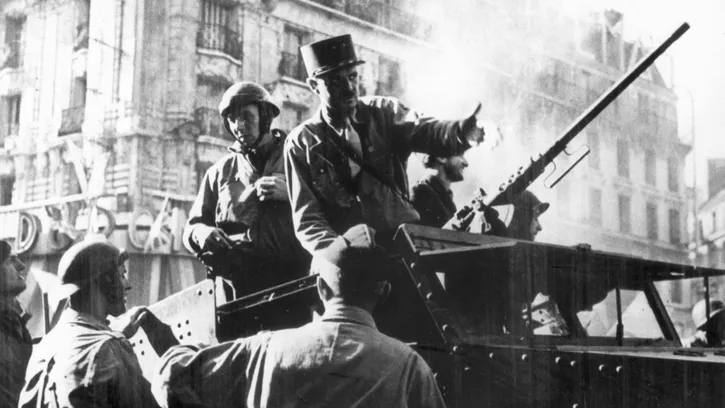
(August 25, 1944): Paris liberated
On this day in 1944, some two months after the Allied invasion of Normandy, Paris was liberated from German occupiers as the Free French 2nd Armoured Division under General Jacques-Philippe Leclerc entered the city.