- Basedment
- Posts
- Russia Sends Reinforcements To Huliaipole, U.S. Targets Iranian Oil
Russia Sends Reinforcements To Huliaipole, U.S. Targets Iranian Oil
Russia sends more reinforcements to Huliaipole as it looks to press the advantage there. While the Iran-USA war enters a new level of escalation.

Editor-in-Chief
March 08, 2026
THE BRIEFING
Here’s what’s happening in geopolitics today.
Another busy day on the geopolitical stage: U.S. and Israeli strikes on Iranian oil infrastructure signal a new phase in the conflict, while an Israeli airstrike in central Beirut underscores how far the fighting is spilling across the region.
Meanwhile, Taiwan’s premier makes a rare and symbolic visit to Japan, protests in New York lead to arrests after suspicious devices are thrown near the mayor’s residence, and Pope Leo XIV calls for an end to the bombing and a return to diplomacy.
In today’s deep dive, Russia sends more reinforcements to Huliaipole as it looks to press the advantage. While the Iran-USA war enters a new level of escalation.
WE HAVE A PODCAST NOW!
EPISODES RELEASED EVERY WEEK, CHECK IT OUT!
This weeks topics:
Geopolitical shift: Leaders increasingly suggest the post–Cold War order is fading, with Trump’s foreign policy reflecting a move toward a more unstable and competitive era.
Conflict reality: The U.S.–Israel war with Iran is becoming more complex than expected, with no rapid collapse of the Iranian system despite the scale of strikes.
Changing battlefield: Ballistic missile barrages have declined, while Shahed drone attacks have expanded, exposing strain on air defences, jamming, and coordination systems.
Escalation risk: Kurdish militant activity in western Iran raises fears of a proxy ground war, with the possibility of troops on the ground not fully ruled out.
Watch on Youtube below!
THE LAST 24 HOURS IN GEOPOLITICS
1. US, Israeli strikes hit Iranian oil depots for first time since war began
U.S. and Israeli forces have struck Iranian oil depots for the first time since the war began, targeting fuel storage sites and energy infrastructure around Tehran and the nearby Alborz province, according to Iranian and international reports. The strikes hit multiple oil storage facilities and a fuel transfer centre, sparking large fires and killing several tanker drivers, while emergency crews worked to contain the blazes. The attacks mark a significant escalation in the conflict, expanding targets from primarily military infrastructure to Iran’s energy network, which plays a key role in domestic fuel distribution and the wider economy.
read more
2. Israeli attack on hotel in Lebanon’s Beirut kills four
An Israeli airstrike hit an apartment inside the Ramada hotel building in central Beirut, killing at least four people and injuring around ten others, according to Lebanon’s health ministry. Israeli officials said the strike targeted Iranian Quds Force commanders believed to be operating in the Lebanese capital and coordinating attacks against Israel. The attack marks one of the first strikes in central Beirut’s Raouche district during the current escalation.
read more
3. Taiwan Premier makes first Japan visit since 1972, defying China
Taiwan’s Premier Cho Jung-tai made a rare trip to Tokyo, marking the first visit by a sitting Taiwanese premier to Japan since Taipei and Tokyo severed diplomatic ties in 1972. Cho described the trip as a personal visit to attend a World Baseball Classic game at the Tokyo Dome, where he appeared publicly alongside Taiwanese officials and fans. The visit risks angering China, which views official contacts between Taiwan and foreign governments as a challenge to its “One China” policy and has previously warned against such exchanges.
read more
4. 6 arrested after ‘suspicious devices’ thrown outside NYC mayor’s home
Six people were arrested after “suspicious devices” were thrown outside the official residence of Zohran Mamdani in New York City during clashes between opposing protest groups. Police said the incident occurred near Gracie Mansion, where smoke-emitting devices containing items such as bolts and screws were reportedly thrown, though no injuries were reported. Authorities, including the FBI’s Joint Terrorism Task Force, are investigating the devices and the circumstances surrounding the protest, which led to multiple arrests.
read more
5. Pope Leo urges end to bombing, calls for dialogue amid Middle East violence
Pope Leo XIV has urged an immediate end to bombing in Iran and across the wider Middle East, warning that the escalating conflict risks spreading further across the region. Speaking during the Angelus prayer in St. Peter’s Square, he called for weapons to fall silent and for renewed diplomatic dialogue to prevent further suffering and instability. The pope said the violence was fuelling fear and hatred, stressing the need for international efforts to open space for negotiations and de-escalation.
read more
IRAN-USA CONFLICT DAY 9 - New Escalation Level
An Iranian drone attack caused material damage to a water desalination plant in Bahrain, the country’s interior ministry has said. It comes a day after Iran claimed the U.S. bombed a freshwater desalination plant on Qeshm Island in southern Iran, setting what Tehran described as a dangerous “precedent.”
The war appears to be entering a new escalation phase centered on economic and civilian infrastructure. U.S. and Israeli strikes have targeted multiple Iranian oil storage facilities, Mehrabad civilian airport in Tehran, and the desalination plant on Qeshm Island. Iran claims it retaliated by striking the Haifa oil refinery with ballistic missiles.
Iranian officials warn that targeting water infrastructure could set a dangerous precedent. Foreign Minister Abbas Araghchi described the strike on the Qeshm desalination facility as a “blatant and desperate crime,” while hardliners are calling for retaliatory strikes on desalination plants in Israel and Gulf states.
Some Iranian analysts believe the strikes aim to gradually dismantle Iran’s security infrastructure, potentially weakening the state long term. Despite this, Iranian officials insist the country is prepared to sustain at least six months of war. At the same time, airstrikes continue in Lebanon, as Israel maintains pressure on Hezbollah positions along the border.
The targeting of oil facilities represents another escalation step. By striking energy infrastructure, Washington and its allies appear to be signaling that Iran will not control the escalation ladder, attempting instead to establish dominance over the economic dimension of the conflict.
Russia-Ukraine Update
The last time we covered the Ukraine–Russia frontline, we primarily centred on the Huliaipole–Pokrovsk’e axis. Today, we’re heading back to the action — and joining us are a collection of Ukrainian and Russian reinforcements. Let’s dive in.
Wider Context
For context, the recent counteroffensive has succeeded in pushing back Russian units from their forward positions, primarily past the Yanchur and Haichur rivers, mostly on the Pokrovsk’e axis. Yet even during the early phases of the counterattacks, there appeared to be much stiffer Russian resistance further south at the Huliaipole front.
Firstly, the expansion of the Huliaipole front is a key priority as it directly leads by road to Orikhiv, a major Russian objective in 2026. Naturally, the best of the Vostok grouping’s fighting strength would be prioritised here. But why not Pokrovsk’e? I wouldn’t necessarily say it has been ignored, but in the broader strategic picture the Russians had already established a foothold past the Haichur River and in the strategic heights around Ternuvate. Pokrovsk’e would become a higher priority if the frontline objectives were deeper, but for now Huliaipole will act as the launching pad for the eastern pincer toward Zaporizhzhia and Orikhiv. This helps explain the stronger Russian formations to the south rather than further north at Pokrovsk’e.
With Ukrainian success pushing Russian forces out of the Yanchur River line and slowing progress at Huliaipole, units from the latter sector were repositioned to support where the offensive was seeing the most success. This in turn allowed Russian forces to continue a tactical advance west of Huliaipole. Russian units were redeployed from the Pokrovsk sector to sustain offensive momentum along this axis. Elements of the Eastern Military District’s 68th Army Corps were transferred back to the Vostok grouping and are now reportedly conducting attacks west of Huliaipole.
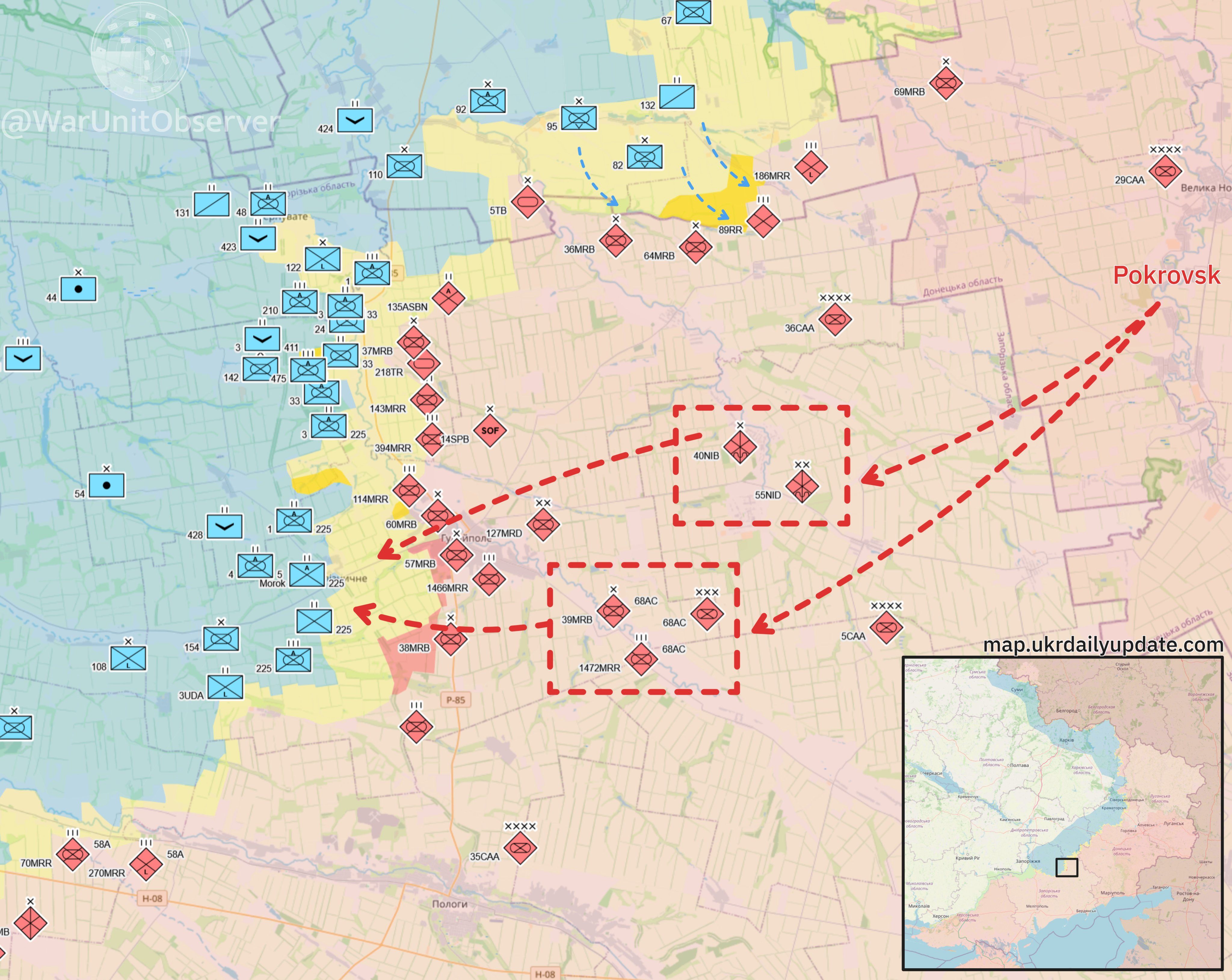
OSINT source for map and unit repositioning: @unitobservor via X
OSINT Information on battlefield report west of Huliaipole:
Heavy positional fighting has been underway since early February 2026 around Verkhnia Tersa, roughly 10 km northwest of Hulyaipole, a key defensive node in Ukraine’s fortified line along the Haichur River. The village protects the Svoboda–Kopani–Verkhnia Tersa road, an important frontline supply route for Ukraine’s XX Corps in the Hulyaipole sector. Ukrainian defenses, held primarily by the 5th Assault Brigade supported by the 1st Battalion of the 225th Assault Regiment, have been heavily fortified since 2022 with trenches, anti-tank ditches, dragon’s teeth, barbed wire, and concealed field shelters.
Russian forces from the 5th Army (Vostok Group) (notably the 127th Motorized Rifle Division and the 60th Motorized Rifle Brigade) launched an offensive in early February after capturing Sviatopetrivka east of the village. The assault has been supported by intense FAB glide bomb strikes, artillery, and TOS thermobaric systems. Fighting is concentrated near Hill 153 northeast of Tsytkove and along the Verkhnia Tersa river valley, where Russian units recently captured Hirke, slowly pushing Ukrainian forces westward. The battle is expected to continue through March.
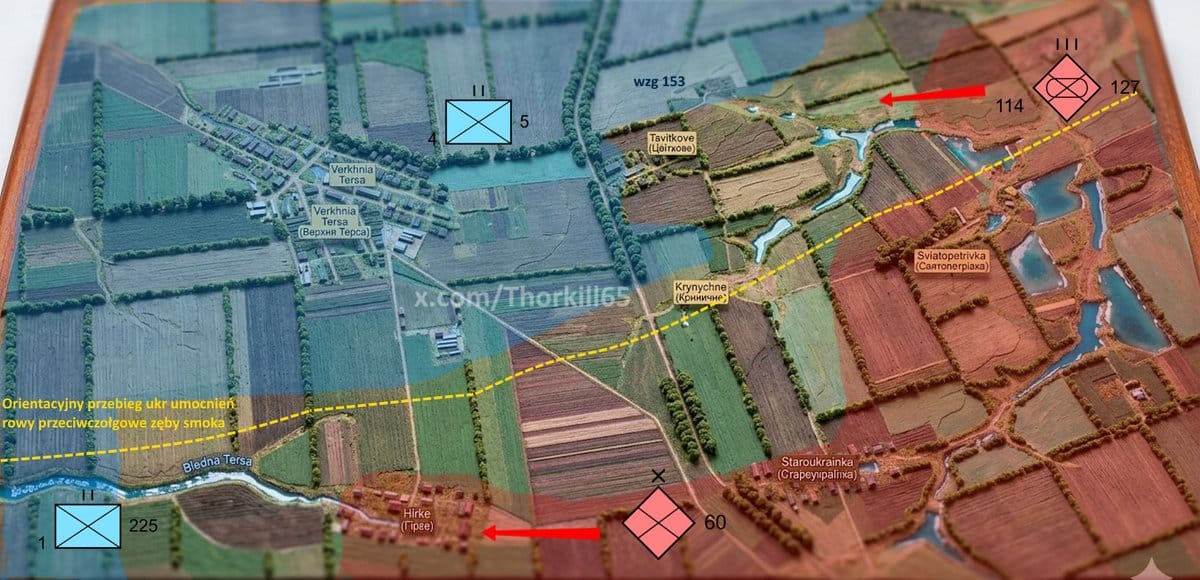
both this map and the information above were created by OSINT account @Thorkill65
Read Here
TWEET OF THE DAY
TODAY IN HISTORY
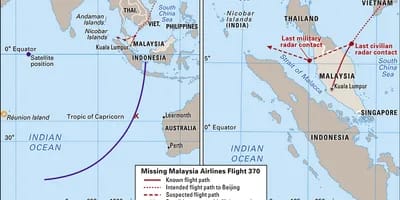
(March 8, 2014): During a flight from Kuala Lumpur to Beijing, Malaysia Airlines flight 370 disappeared, prompting a massive search effort. Though some debris from the aircraft was found in 2015, the full wreckage was never located.