- Basedment
- Posts
- RUSSIA-UKRAINE WAR 2025 IN REVIEW
RUSSIA-UKRAINE WAR 2025 IN REVIEW
Today we explore how the war has shifted and changed in tactics, diplomacy and reality in 2025. From drones, to economy, to Trumpian diplomacy.

Editor-in-Chief
January 02, 2026
In partnership with

THE BRIEFING
Here’s what’s happening in geopolitics today.
From alleged drone plots and New Year violence in Ukraine to a deadly bombing in Syria and fresh unrest on Iran’s streets, geopolitics has wasted no time ringing in 2026 with tension on multiple fronts.
Europe is also grappling with tragedy after a devastating fire at a Swiss ski resort, while Russia and Ukraine trade blame over a deadly New Year’s Eve strike in occupied Kherson.
In this Deep Dive, we’re exploring the 4th year since the full-scale Russian invasion - new tactics, trends, old mistakes repeated and what’s next.
A WORD FROM OUR SPONSOR
Amazon Prime members: See what you could get, no strings attached

If you spend a good amount on Amazon, this card could easily be worth $100s in cash back every year. And — even better — you could get approved extremely fast. If approved, you’ll receive an insanely valuable welcome bonus deposited straight into your Amazon account, ready to use immediately.
You also don’t have to jump through any hoops to get this bonus. No extra work or special spending requirements. Get approved, and it’s yours.
This might be one of the most powerful cash back cards available, especially considering how much most people spend on Amazon each month. It gives you the chance to earn cash back on the purchases you’re already making, turning your routine shopping into something that actually pays you back.
If you shop at Amazon or Whole Foods, this card could help you earn meaningful cash back on every purchase you make. But this offer won’t last forever — and if you’re an Amazon Prime member, this card is as close to a no-brainer as it gets.
Amazon Prime members: See what you could get, no strings attached
THE LAST 24 HOURS IN GEOPOLITICS
1. Ukraine denies drone attack on Putin’s residence
Russian officials alleged that Ukrainian forces launched a drone attack on President Vladimir Putin’s state residence in the Novgorod region, claiming dozens of long-range drones were intercepted before causing damage. Ukraine has firmly denied the accusation, with President Volodymyr Zelenskyy calling the claim false and dismissing it as an attempt by Moscow to undermine ongoing peace negotiations and justify future strikes. U.S. and independent analysts have also expressed scepticism, noting a lack of credible evidence to support Russia’s account and questioning the timing of the allegation amid renewed diplomatic efforts.
read more
2. Suicide bomber kills at least one police officer in Syria’s Aleppo
A suicide bomber detonated an explosive belt near a security patrol in the Bab al-Faraj area of Aleppo on Wednesday night, killing one Syrian police officer and wounding at least two others, state media and officials said. The attack occurred as Internal Security Forces were attempting to detain the suspect while securing New Year’s Eve celebrations, with one officer reported to have physically restrained him before the blast. Authorities have launched an investigation into the incident, and no group has immediately claimed responsibility for the bombing.
read more
3. Iran protesters try to break into Government building as demonstrations continue
Iran has seen several days of mass protests over a deteriorating economy and soaring inflation, with demonstrations spreading from Tehran to other cities and drawing in students, shopkeepers and other citizens. On the fourth day of unrest, a group of protesters in Fars Province’s city of Fasa tried to break into a local government building, but security forces intervened and detained several people, while a few security personnel were also wounded.
read more
4. Dozens presumed dead after fire rips through Swiss ski resort bar
Dozens of people are presumed dead and about 100 others injured after a fire ripped through the Le Constellation bar in the Crans-Montana ski resort during a New Year’s Eve celebration early on Thursday, with police describing the blaze as one of the worst civilian emergencies in recent Swiss history. Authorities say the fire began around 1:30 a.m. local time as revellers rang in 2026, prompting a massive emergency response including helicopters, ambulances and dozens of firefighters, and officials have ruled out terrorism or deliberate attack as the cause remains under investigation. Victims are being treated in hospitals across Switzerland amid efforts to identify the deceased and notify families, and authorities have established support lines as the community reels from the devastating incident.
read more
5. Russia accuses Ukraine of killing 24 people in New Year drone strike
Russian-installed authorities in the Kherson region accused Ukraine on Thursday of carrying out a drone strike during New Year’s Eve celebrations that killed at least 24 people, including a child, and wounded dozens more when three drones struck a hotel and café in the village of Khorly on the Black Sea coast. Moscow’s Foreign Ministry condemned the attack as a premeditated war crime and senior Russian officials vowed retaliation, although Ukrainian authorities had not commented on the allegation at the time of reporting and independent verification of the claim was not immediately possible.
read more
DAILY DEEP DIVE
UKRAINE WAR - SUMMARY OF 2025
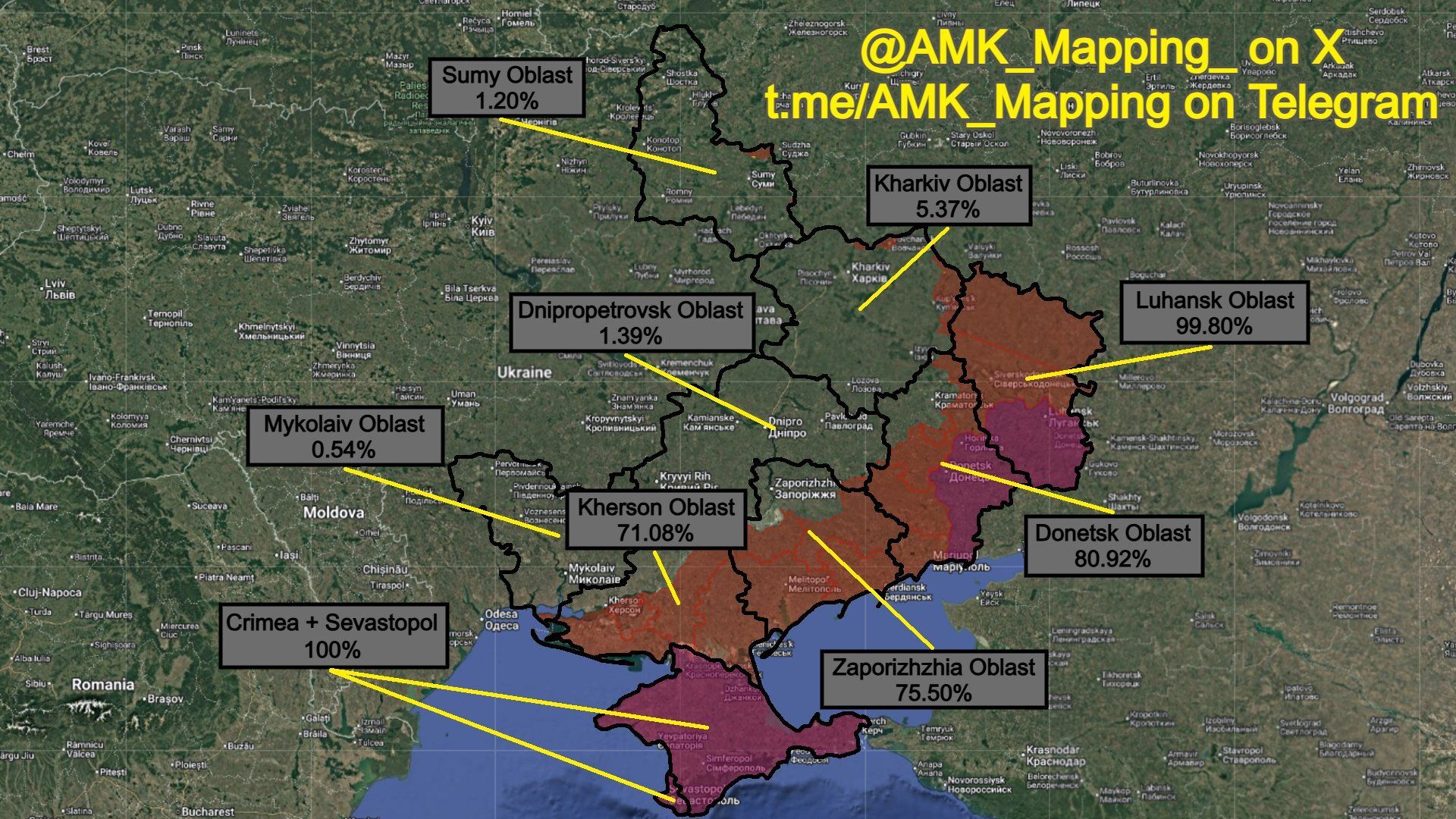
Percentage of the different regions of Ukraine controlled by Russia, as of January 1, 2026:
Crimea + Sevastopol: 100%
Luhansk Oblast: 99.80%
Donetsk Oblast: 80.92%
(Donbas total: 90.38%)
Zaporizhzhia Oblast: 75.50%
Kherson Oblast: 71.08%
(4 Oblasts total: 81.59%)
Kharkiv Oblast: 5.37%
Dnipropetrovsk Oblast: 1.39%
Sumy Oblast: 1.20%
Copied From AMK_Mapping on Telegram.
Our Commentary
As 2025 comes to an end, we take a look back at the fourth year since the launch of the large-scale invasion. Much has happened, and achieving peace somehow appears both maddeningly complex and deceptively simple. President Putin has made his aims clear: for any peace to be achieved, the four major oblasts in Russia’s sights must come under its control. As the war rages on, tactics, strategies, and trends continue to evolve, replace one another, and re-emerge — much the same can be said for the mistakes we continue to see from both sides.
Drone Warfare
Both sides enacted the largest drone air campaign ever conducted in modern warfare, applying a wide range of new lethal drone technologies and strategies. Ukraine prioritised a privatised, government-funded, decentralised production model, fielding drones such as the FP-1 and FP-2 developed by Fire Point. Russia, on the other hand, doubled down on a centralised production model, introducing the Geran-3 — a jet-powered evolution of its predecessor. Ukraine’s objective has been to degrade Russia’s ability to fund its war machine by striking oil and gas infrastructure and key logistical hubs. Russia continued targeting military and industrial sites but, in the second half of the year, shifted heavily toward energy infrastructure such as power grids and dams. Ukraine also continued its asymmetrical warfare against a much larger enemy, notably with Operation Web, but also targeting ships such as the recent attacks on the docked submarine.
On the ground, drone strategies continued to evolve. Both sides implemented fibre-optic drones, rendering many previously effective EW countermeasures obsolete. This has enabled deep drone strikes up to 50 kilometres behind the front lines, placing artillery, air defence systems, and logistics routes in unprecedented danger. Hundreds of kilometres of key roads are now covered in anti-drone netting. Russia’s Rubicon drone unit has emerged as a lethal counter to Ukraine’s traditionally dominant drone warfare role, fielding specialised teams that hunt drone operators, bases, and supply routes. What was once considered science fiction is now reality: hundreds of UGVs — wheeled and tracked — operate along the front, delivering supplies, evacuating wounded, and supporting combat operations.
Evolving Infantry Tactics
Drones have also fundamentally altered the role of infantry and mechanised assaults. Much of the war in 2025 resembled something out of Mad Max, with improvised methods used to bypass an increasingly gridlocked front. Mechanised assaults became almost nonexistent for much of the year, as vehicles — particularly grouped formations — were easily destroyed by FPV drone swarms. This forced Russia to rely more heavily on infantry, contributing to a sharp rise in casualties (among other factors we will cover separately). As losses mounted on both sides, battles paradoxically became smaller. Drone saturation meant assaults often involved one or two soldiers probing gaps, followed by slightly larger squads repeating the process.
By the second half of 2025, vehicles began to make a gradual comeback. Analysts suggest Russia sought to exploit breakthroughs around Dobropillya and Pokrovsk, but weather played a significant role. Infantry throughout 2025 relied heavily on treelines for concealment; as autumn and winter reduced foliage density, mechanised assaults re-emerged — particularly around Pokrovsk — with heavy losses on both sides.
The Russian Offensive?
Russia’s offensive has been criticised as underwhelming when viewed purely through the lens of square kilometres captured, but this framing is misleading. This is an attritional war, where collapse can occur suddenly. Russia has applied relentless pressure and achieved notable success, demonstrating its ability to sustain multi-front offensives, absorb high losses, and replenish forces with new volunteers. Ukraine, meanwhile, has struggled to hold urban terrain once Russian forces begin consolidating, with cities falling more rapidly than in earlier phases of the war such as Bakhmut or Mariupol. That said, Ukraine has shown it can still slow Russian advances — as seen in Toretsk, Chasiv Yar, and Pokrovsk — and mount effective local counterattacks, notably around Kupiansk and the Dobropillya salient. The question, however, remains at what cost. Both sides continue to make mistakes based off corruption with the remnants of soviet-style top-down leadership costing thousands of lives.
The Economy
Russia’s war economy is showing gradual strain, as expected, and for the first time since the invasion, the Russian army has not grown in size. Ukraine faces its own crises: energy shortages, corruption scandals, and severe manpower issues, with AWOL figures reportedly reaching tens of thousands per month — but fresh European financial and military backing offers hope. In this sense, history offers a warning — as in World War I, nothing decisive happens until sudden collapse. The question is who ultimately becomes the Central Powers, and who the Triple Alliance.
The Trump Effect
The diplomatic space has meanwhile become an unpredictable wild west, shaped by Trump’s presidential style and his administration. Internal distrust and divergent views on Ukraine have complicated peace efforts and weakened the administration’s perceived legitimacy. After a rocky start, Zelensky has managed to win points with Trump, but Trump remains drawn to leaders he views as strong equals — including Putin. This bipolar diplomatic approach has, at times, undermined negotiations, but it has also forced both sides — particularly Russia — to bring proposals to the table. For the first time, we are seeing something resembling a genuine peace framework emerge.
What To Expect In 2026
Looking ahead, we expect a gradual wind-down in the first quarter of 2026, marked by incremental movement rather than decisive shifts as Russia will begin to regroup for the new spring/summer offensive. This will likely be followed by a battle for Orikhiv, which would be critical if Russia intends to move toward Zaporizhzhia — its siege or loss would represent a major political and industrial blow to Ukraine. Russia is also expected to initiate operations around Lyman and Kostiantynivka, setting conditions for longer-term objectives toward Sloviansk and Kramatorsk possibly in 2027. We also anticipate new border incursions, potentially even in Chernihiv Oblast, aimed at drawing Ukrainian forces away from critical fronts and creating bargaining chips for future negotiations. Continued strikes on logistics, bases, and drone units will persist — all designed to crack morale and erode belief in victory.
Closing Statement
Ultimately, neither side appears to believe it can deliver a clean, decisive blow in the near term. Instead, the war has shifted toward breaking the belief in victory itself — eroding morale, exhausting manpower, degrading economies, and convincing the other side that continuing is futile. Victory is no longer defined by breakthroughs or flags raised, but by whose political will, social cohesion, and endurance collapse first. In that sense, the battlefield now extends far beyond the front lines.
HAPPY NEW YEAR - Thank you for the support!
Sources
News/Journal sources available upon request, not shown to maintain visual integrity of page.
TWEET OF THE DAY
TODAY IN HISTORY
(January 1, 1999): When Europe Changed Its Money Overnight
Eleven European Union countries changed their money to the euro on this day in 1999. All electronic transactions switched to the new monetary unit, although coins and banknotes stayed unchanged in these countries until January 1, 2002.