- Basedment
- Posts
- Russian Resistance Increases on Yanchur River Front
Russian Resistance Increases on Yanchur River Front
Ukraine continues pushing on the Pokrovske–Huliaipole front, but Russian resistance is intensifying. As advances deepen toward the Yanchur River, casualties are rising — and consolidation remains uncertain.

Editor-in-Chief
February 20, 2026
THE BRIEFING
Here’s what’s happening in geopolitics today.
It’s another whirlwind day in global politics: from the arrest of Prince Andrew in the UK, to Donald Trump convening his first Board of Peace meeting on Gaza, diplomacy and controversy are unfolding in parallel.
In Africa and Europe, Bola Tinubu and Friedrich Merz pledged closer security and energy cooperation, while Sweden rolled out a fresh $1.42 billion military package for Ukraine. And in Latin America, José María Balcázar steps in as Peru’s interim leader.
In today’s deep dive, Ukraine continues pushing on the Pokrovske–Huliaipole front, but Russian resistance is intensifying. As advances deepen toward the Yanchur River, casualties are rising, and consolidation remains uncertain.
WORD FROM TODAY’S SPONSOR
Ready to Plan Your Retirement?

Knowing when to retire starts with understanding your goals. When to Retire: A Quick and Easy Planning Guide can help you define your objectives, how long you’ll need your money to last and your financial needs. If you have $1 million or more, download it now.
THE LAST 24 HOURS IN GEOPOLITICS
1. UK Police arrest former Prince Andrew over Epstein ties
Prince Andrew, officially Andrew Mountbatten-Windsor, was arrested by UK police on suspicion of misconduct in public office, amid an investigation linked to newly released documents tying him to convicted sex offender Jeffrey Epstein. Thames Valley Police said a man in his 60s was taken into custody and that searches are underway at properties in Norfolk and Berkshire, though under UK law they did not initially name him. The arrest follows allegations he may have shared sensitive government information with Epstein during his decade-long tenure as the UK’s trade envoy, and comes more than a year after he was stripped of his royal titles amid ongoing scrutiny of his Epstein ties.
read more
2. Trump to preside over first meeting of Board of Peace on Thursday
Trump will preside over the inaugural meeting of his newly formed Board of Peace in Washington on Thursday, convening representatives from over 45 countries to discuss reconstruction and stabilization efforts in war-torn Gaza. Participating states have pledged about $5 billion toward the Gaza reconstruction fund, and deliberations will focus on humanitarian aid, rebuilding infrastructure, and plans for an International Stabilization Force, though key issues like Hamas disarmament remain unresolved. The board has drawn controversy for excluding Palestinian representation and raising concerns among some traditional U.S. allies about its mandate and potential to overlap with established U.N. roles.
read more
3. Tinubu, German Chancellor Merz pledge collaboration on security, power
Nigerian President Bola Tinubu and German Chancellor Friedrich Merz held a brief phone call on Wednesday in which they agreed to deepen bilateral cooperation on security and power infrastructure, including efforts to revive Nigeria’s stalled Siemens-led electricity transmission project and secure technical and financing support from German partners. The leaders also discussed enhancing regional security cooperation, with Tinubu requesting used helicopters to aid intelligence and reconnaissance operations in the volatile Sahel corridor, and agreed to broaden ties in rail development, creative industries and skills training.
read more
4. Sweden unveils $1.42B military aid package for Ukraine
Sweden has unveiled a new 12.9 billion Swedish crown (about $1.42 billion) military aid package for Ukraine, part of a broader 40 billion crown support framework for 2026 aimed at bolstering Kyiv’s defense capabilities. The package, announced by Defence Minister Pål Jonson, includes air-defense systems, drones and long-range missiles to strengthen Ukraine’s ability to counter Russian attacks.
read more
5. Joe Balcazar, left-wing lawmaker, steps in as Peru’s interim leader
Peru’s Congress has elected 83-year-old left-wing lawmaker José María Balcázar as the country’s new interim president following the removal of interim leader José Jerí amid corruption allegations, making him the nation’s eighth leader in about a decade. Balcázar, a lawyer and former judge from the Perú Libre party, will serve as interim head of state and head of Congress until the winner of the general elections scheduled for April 12 takes office in late July. His appointment underscores ongoing political instability as Peru prepares for national elections amid public mistrust of political institutions.
read more
DAILY DEEP DIVE
Russia Begins To Put Up Firm Resistance
Wider Context
Like we discussed a couple days ago, the main goal of this counter-offensive seems to be off-balance Russian regrouping efforts before their main offensive begins and attempt to reassert control of Russian forward positions that are on strategic grounding. The main focus points have been on the Pokrovske-Huliaipole front, with a majority of the fighting taking place on the Yanchur and Haichur river tributaries. These are important natural defensive barriers which Russian forces had crossed, but had failed to consolidate and had acted more as forward positions rather than established Russian frontline.
The Battle For the Rivers
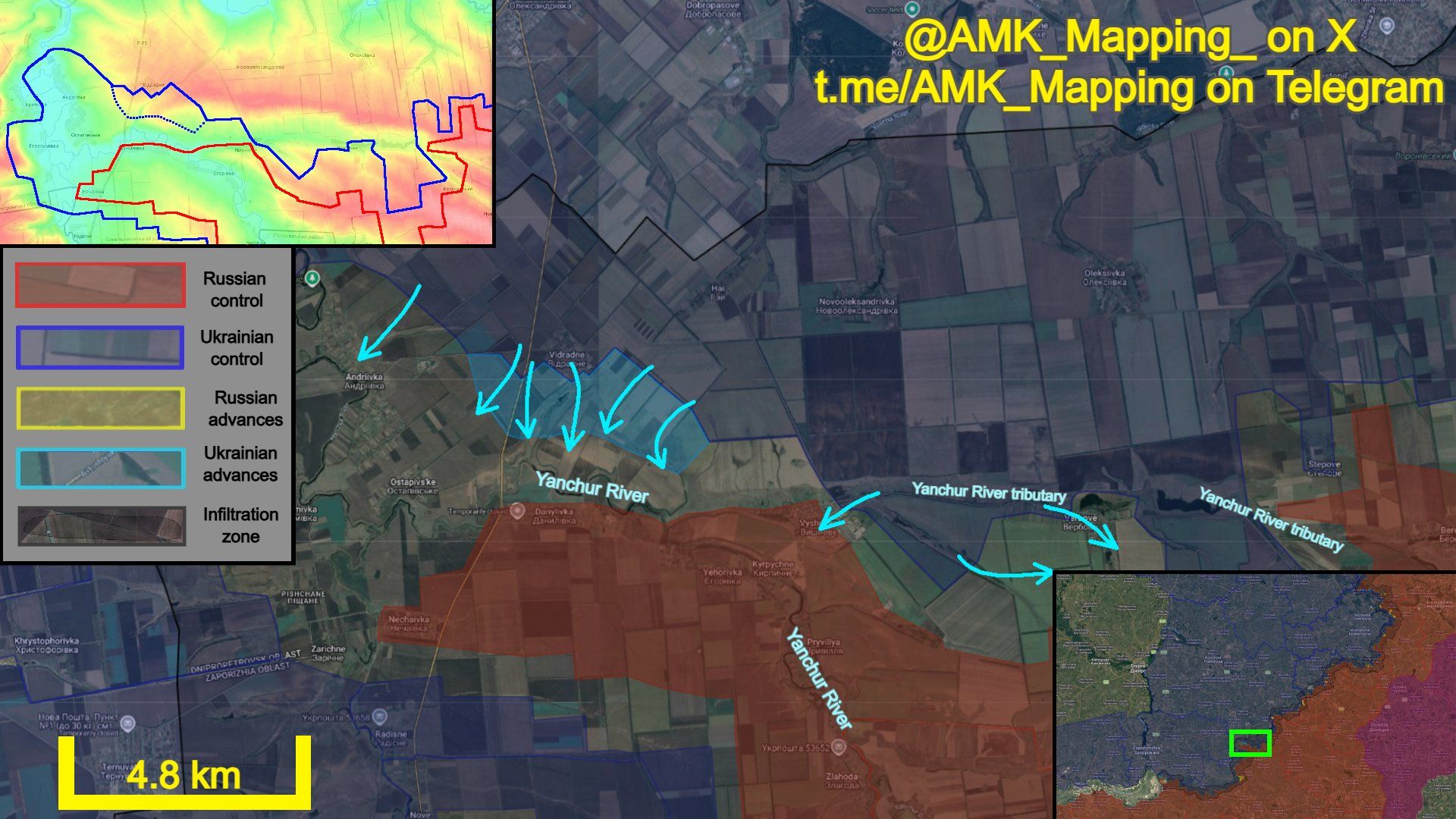
In the Pokrovs’ke direction, Ukrainian forces have continued their local counteroffensive, securing additional gains despite increasingly coordinated Russian resistance. After recapturing Vidradne, Ukrainian units advanced south toward the Yanchur River, capturing several treeline positions west of the highway and trench systems south of the village, while continuing pressure on Andriivka and improving positions in the treelines southeast of it. Fighting remains ongoing in central Vyshneve and Verbove, as well as in treelines southwest of Verbove. Ukrainian forces have also continued attacks south of the Yanchur tributary, though without confirmed additional breakthroughs. According to AMK Mapping, the net territorial shift stands at approximately +6.45 km² in Ukraine’s favour.
Casualties Increase
Naturally, with Ukrainian units coming closer to much more established Russian frontline positions, the difficulty and cost has begun to increase. Another issue is that the Russian units here are battlehardened and well equipped. Artillery, armour and drones - the latter which we are increasingly seeing strike videos of.
As Suriyak notes, many of the recently recaptured settlements — including Vidradne, Hai, Novooleksandrivka and Oleksiivka — had minimal Russian garrisons and were effectively grey zones. While the advance southward and the occupation of trench systems near the Yanchur River represent tactical progress, Russian forces north of Danylivka have held their line and continue to block deeper Ukrainian penetration. Suriyak argues that this counteroffensive has come at significant cost, with intensified Russian artillery, drone, and glide-bomb strikes reportedly inflicting heavy Ukrainian casualties over the past week. He suggests that while retaking lightly defended territory delivers a morale and media boost, it has not dislodged Russian forces from the Haichur River line nor meaningfully disrupted logistics toward Huliaipole. If losses continue at the current rate, the operation risks straining Ukrainian manpower and resources across other sectors of the front.
I would, for the most part, agree with Suriyak’s assessment — it’s a dynamic I’ve discussed multiple times before. Ukraine is operating between a rock and a hard place. Any counteroffensive carries significant long-term risk, particularly against an opponent that retains artillery dominance and greater manpower reserves. The clearest precedents are Kursk and the 2023 southern counteroffensive: initially tactically successful, generating momentum and media impact, but over time increasingly constrained by ammunition disparities, drone saturation, and Russian defensive depth, ultimately leading to reversals of gains or vulnerabilities opening elsewhere along the line.
That said, Ukrainian military command clearly believes the potential benefits outweigh the risks. Controlling ground near the Yanchur River offers positional leverage and could complicate Russian defensive geometry in the sector. The question is not whether the terrain has value — it does — but how much Kyiv is willing to expend in manpower and equipment to secure and hold it. At present, Ukraine is making incremental tactical progress along both river lines, but this remains contested maneuvering rather than firm consolidation. Without deeper breakthrough or sustained logistical disruption, a localized counter-reversal remains entirely possible.
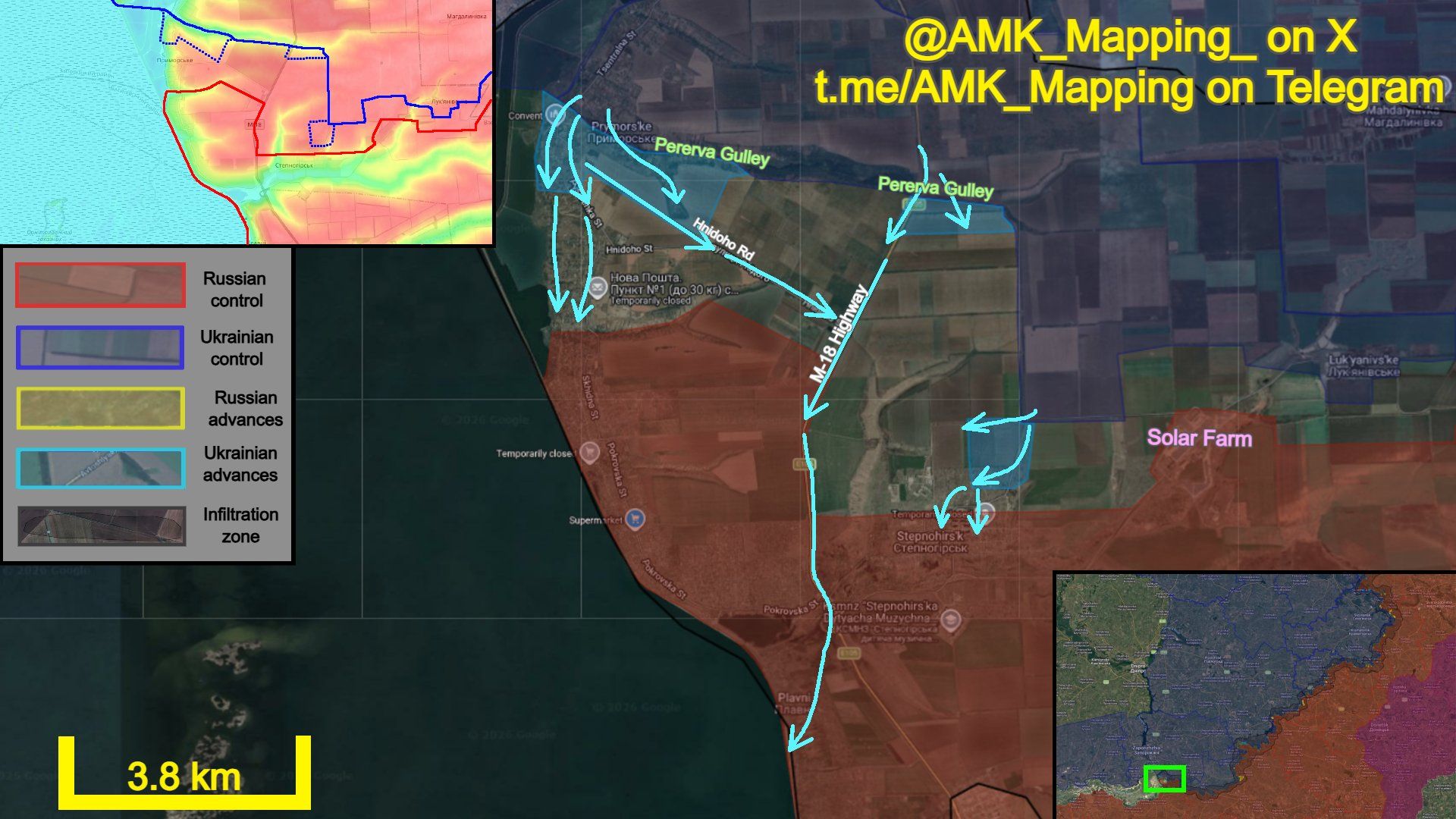
In saying all of this, the more strategically relevant development may be unfolding further west along the southern Zaporizhzhia front. While Russia spent the better part of a year grinding forward only a few tens of kilometres through layered defences and heavy attritional fighting, recent Ukrainian counterattacks have begun pushing Russian units back in certain sectors. These are not sweeping breakthroughs, but they complicate Moscow’s operational design.
If Russia cannot stabilise the line here, the broader geometry of the front begins to shift. The long-term objective of outflanking the fortress-town of Orikhiv becomes significantly more complex if the left flank is forced onto the defensive. A subdued or pressured flank limits the ability to mass forces for envelopments and stretches artillery and drone coverage thinner across the sector.
Sources
News/Journal sources available upon request, not shown to maintain visual integrity of page.
TWEET OF THE DAY
TODAY IN HISTORY
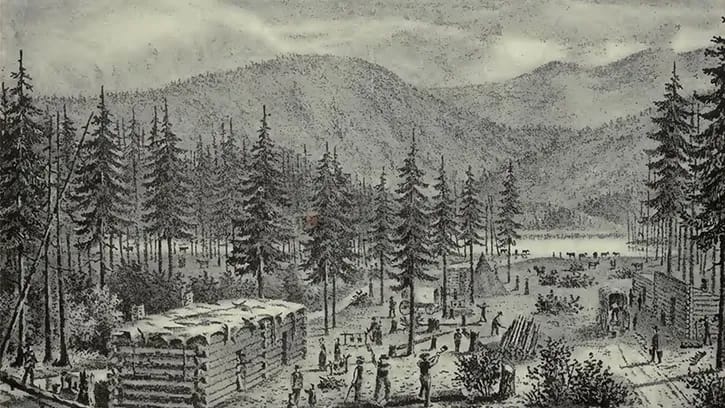
(February 19, 1847): First rescue team arrives to save members of the Donner party
On this day in 1847, the first of four rescue parties arrived to save members of the Donner-Reed party from where they were stranded in the Sierra Nevada mountains. The westward-bound party, which had started with almost 90 pioneers (more than half of whom were children), had taken a supposed shortcut through Utah that had put them far behind schedule. Facing heavy snowfall and supply shortages, the group became stranded in the mountains in October 1846. When the situation became more dire, members of the party allegedly resorted to cannibalism. In all, 42 people died. Today, the Donner Pass stands as a reminder of the family's unlucky fate.