- Basedment
- Posts
- Russians Increase Pressure On Kramatorsk-Sloviansk Front
Russians Increase Pressure On Kramatorsk-Sloviansk Front
Today we focus on the three major fronts that Russia will likely prioritise as Putin's sets his eyes on controlling the Donbas within the next two years.

Editor-in-Chief
March 02, 2026
THE BRIEFING
Here’s what’s happening in geopolitics today.
It’s another day of rapid escalation across multiple theatres: a drone strike shutters Saudi Arabia’s Ras Tanura refinery, Israel and Hezbollah trade deadly blows over Beirut and northern Israel, and several US aircraft go down in Kuwait as the Iran conflict ripples across the Gulf.
London has now entered the equation too, with Prime Minister Keir Starmer permitting the US to use British bases for what he describes as limited defensive strikes against Iranian missile assets, while violence in South Sudan’s Ruweng area leaves 122 dead in one of the country’s deadliest recent attacks.
Today we focus on the three major fronts that Russia will likely prioritise as Putin's sets his eyes on controlling the Donbas within the next two years.
THE LAST 24 HOURS IN GEOPOLITICS
1. Saudi Arabia’s Ras Tanura Refinery shuts down after drone attack
Saudi Arabia’s state oil giant Saudi Aramco has shut down operations at its Ras Tanura refinery following an apparent drone strike in the area, with company and industry sources saying the precautionary closure was implemented to ensure safety. The strike caused a small fire that was reportedly brought under control, and authorities indicated the situation at the site is now secure and being monitored.
read more
2. Israel bombs Beirut after Hezbollah launches rocket attack
Israeli forces launched air strikes on Beirut and other parts of Lebanon after Hezbollah fired rockets and drones at northern Israel, marking a significant escalation in the ongoing regional conflict. The Lebanese health ministry reported at least 31 people killed and around 149 wounded from the strikes, which Israeli authorities said targeted Hezbollah infrastructure and senior operatives in response to the militant group’s offensive. Hezbollah’s attack (its first since a 2024 ceasefire) was framed by the group as retaliation for the killing of Iran’s Supreme Leader Ayatollah Ali Khamenei in a US–Israeli strike.
read more
3. Several US planes crash in Kuwait as Iran war continues in Middle East
Kuwait’s Ministry of Defence reported multiple US military aircraft crashed in Kuwaiti territory amid the ongoing Iran-related conflict, with all crew members reportedly rescued and in stable condition. The incidents occurred near US facilities including Al Jahra and close to Ali Al Salem Air Base, where footage showed at least one fighter jet descending and personnel parachuting to safety; US Central Command has not yet publicly commented on the causes. The crashes come as Iran continues retaliatory missile and drone strikes on Gulf states hosting US forces.
read more
4. UK to allow US to use British bases for defensive strikes against Iran
British PM Keir Starmer announced that the United Kingdom has granted a US request to use certain British military bases for limited defensive strikes targeting Iranian missile storage depots and launchers, a move framed as protecting regional allies and British citizens from Iranian missile attacks. Starmer stressed that the UK was not involved in recent US-Israeli offensive strikes on Iran and will not join further offensive action, but accepted the request under the doctrine of collective self-defence to prevent Iran firing missiles across the region.
read more
5. Attack in South Sudan’s Ruweng area kills 122
On Sunday in South Sudan’s Ruweng Administrative Area, unidentified armed assailants killed 122 people, including 82 civilians (many of them children, women, and the elderly) officials said, with local leaders among the dead. The region’s information minister confirmed the casualties on Monday, while the motive and identity of the attackers remain unclear. The deadly assault underscores rising insecurity in Ruweng, a volatile area long affected by intercommunal clashes and political tensions that threaten South Sudan’s fragile peace.
read more
DAILY DEEP DIVE
THE BATTLE FOR SIVERSK, LYMAN AND KOSTIANTYNIVKA
As the ice begins to thaw, we are only months away from the beginning of a new Russian offensive. Putin remains determined to capture the remainder of Donetsk Oblast — already holding around 70-80% — a major red line and the golden ticket to any future peace deal. While the past few months have been relatively quiet across the remaining Donbas front, there is growing unease among pro-Ukrainian analysts.
The three main approaches — Siversk, Kostiantynivka and Lyman — are considered the final major fortress towns before any battles for Sloviansk and Kramatorsk can begin. Siversk has already fallen, a town with a legendary and bloody reputation for withstanding Russian assaults for years. It finally fell late last year. Kostiantynivka still holds, but Russia is tightening the noose through expanded infiltration attempts, aerial bombardment and drone strikes. To the north, a similar situation is unfolding on the Lyman front, as local Ukrainian counter-attacks attempt to hold Russian units at bay.
The Fall Of Siversk
The fall of Siversk can be described as a failure of its own success. Units defending the town, including the 54th Mechanised Brigade, performed so effectively that Ukrainian high command did not treat the sector as a priority for reinforcements. By 2025, cracks had begun to appear, and by 23 December Ukraine announced a full evacuation. There was hope that elevated defensive lines west of the town could be held, but this proved incorrect.
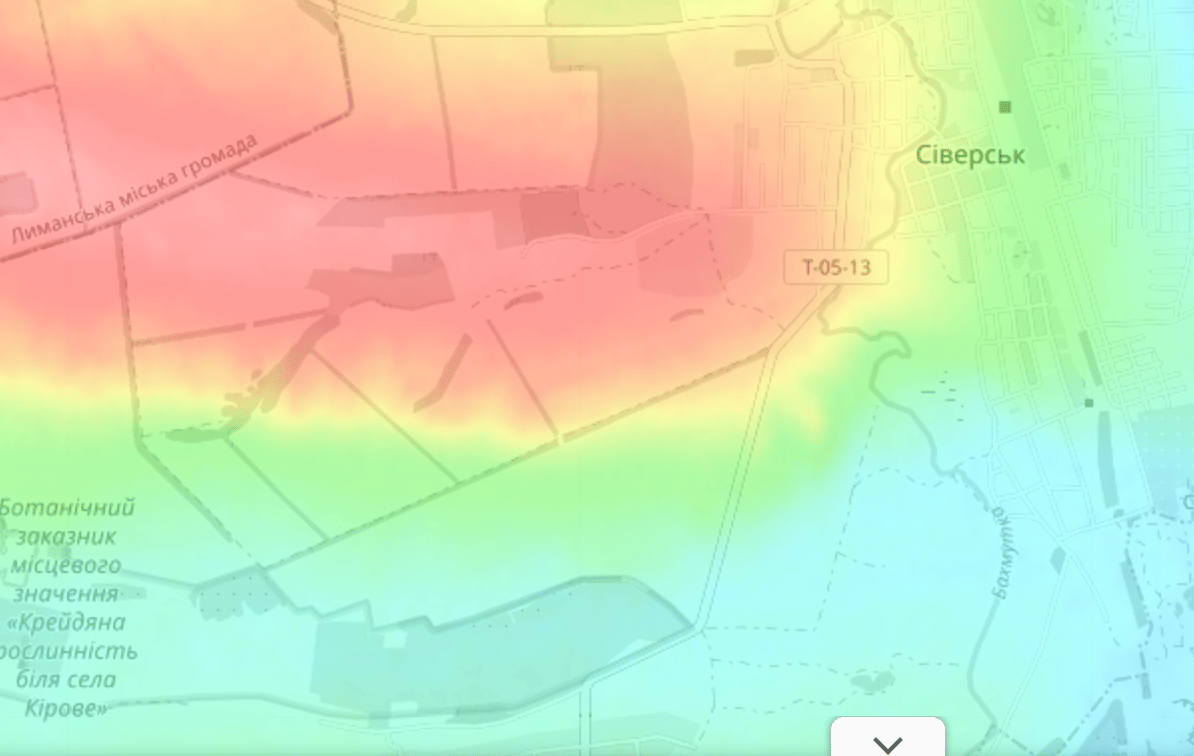
By mid-January, the Siversk axis began shifting decisively. Using treeline assaults and gulley infiltration tactics, Russian forces pushed west from positions near Siversk and Zakitne, steadily collapsing Ukrainian defensive pockets. According to AMK mapping, advances focused on tactical high ground north of Riznykivka and forest belts acting as natural defensive barriers. Clearing gulleys from both north and south reduced Ukrainian lateral movement and supply flexibility. Riznykivka became the operational hinge. Once its eastern sector fell, Russian forces advanced south-west along treelines, crossing multiple gulley points and expanding into adjacent forests. Simultaneously, pressure south of the Vasyukivka River enabled the capture of Bondarne and infiltration into Nykyforivka. By mid-February, Riznykivka, Nykyforivka and Minkivka had fallen. The front widened rather than spiked — incremental forest-to-forest grinding, roughly 13 km² gained in January alone.
Siversk’s importance cannot be understated — the golden jewel of the fortress belt that once held back Russian forces. The past two months, however, have shown that Russian units can now advance beyond it with less resistance than previously expected. The next objectives are Kalenky and Rai-Oleksandrivka. Kalenky would enable Russian forces to move further along both banks of the Donets, easing any future endeavour across the river should Lyman fall. Rai-Oleksandrivka holds logistical importance; two major roads pass through the town, facilitating movement towards Sloviansk if captured.

The Battle For Lyman
Lyman, briefly occupied in the early stages of the full-scale war before being recaptured on 1 October 2022, remains a key target. Its importance lies in its positioning north of Sloviansk, with its back to the Donets River. It functions as a defensive node designed to slow any Russian movement north of Sloviansk. Even if captured, crossing the Donets would remain extremely difficult, as history has shown. Ukrainian units have launched localised counter-attacks around Stavky and Drobysheve. While Drobysheve has held, creeping advances along Lyman’s outer suburbs raise difficult questions about a potential withdrawal.
What made Russia’s 2022 Donets crossings so perilous — dense forests and restricted manoeuvre — is now assisting Russian reconnaissance units around Lyman. By mid-2025, Russian DRG units had exploited treelines and forest cover south of the town, establishing positions between Lyman and the river. If they continue pushing north through the forest, Ukrainian logistics to the town could become severely strained.
With manpower constraints on both sides, Lyman has become a centrepiece of drone warfare. Ukraine has committed significant drone units to the sector, while both sides increasingly deploy fibre-optic systems. The town is effectively covered in a web of glass cable.

The Battle For Ukraine’s “Underbelly” In The Donbas
Finally, Kostiantynivka will be a central and difficult battle. It remains the underbelly of the Kramatorsk–Sloviansk defence. Chasiv Yar’s importance lay in granting Russian forces elevation parity with the defensive belt, with the first target being Kostiantynivka. Although captured at the end of July 2025, Russian units have struggled to expand westwards due to fierce Ukrainian resistance, slowing operations against Kostiantynivka.
As a result, Russian forces have prioritised frontal pressure, similar to Pokrovsk. DRG units identify gaps, which are then reinforced in attempts to overwhelm Ukrainian positions. The southern suburbs have largely fallen, according to independent mapping sources such as AMK_Mapping. South-western approaches have seen sustained infiltration. Russian air power and drone units have been prioritised here, with FPV drones disrupting supply routes and FAB strikes targeting high-rise defensive structures.
Dobropillia will also become increasingly relevant to the Kostiantynivka axis — but that is for another report.
Subscribe to our Youtube here!

Dobropillya-Kostyantinvka Front

Kostyantinvka Close-Up
Sources
News/Journal sources available upon request, not shown to maintain visual integrity of page.
TODAY IN HISTORY
(March 2, 1917): The Jones-Shafroth Act designated Puerto Rico a territory of the United States, “organised but unincorporated.” It also gave Puerto Ricans U.S. citizenship.
